


There is a scene, early in Jean-Luc Godard’s 1963 masterpiece Le Mépris, that surely contains the ultimate cinematic statement on Homer’s Odyssey. An American producer has asked the film’s screenwriter protagonist to help rewrite an adaptation of The Odyssey helmed by the great German director Fritz Lang (playing himself, beautifully). The writer comes to meet Lang in the studio and watches a few rushes for the proposed film. All we really see is a series of close-ups of actual Hellenic statues, painted over in sharp colors, while Georges Delerue’s famous score swells and the camera tracks around the figures. It’s an extraordinarily moving sequence; I could cry anytime I see it. Just before the producer interrupts, we get to see what Lang (or rather Godard’s Lang) has done with the story: something slightly alienating and abstract, but not enough to let us pretend we can somehow cinematically leap over the gulf between our own era and that ancient Bronze one. In other words, to make an honest film of something as old as The Odyssey would probably entail filming the grandeur of static, ancient figures, worn by time. The myth may be alive and well among us, but the world it came from is a ruin we can’t quite understand.
To be sure, Fritz Lang is one of the few directors who actually could have adapted Homer’s epic for the cinema. The man who gave the world Metropolis and Die Nibelungen — more or less inventing the modern cinematic language of science fiction and fantasy — in his UFA Studio days created images so severe and perfect they sustain a mythic register no other filmmaker has truly matched. The Tarkovsky of Andrei Rublev; the Kurosawa of Ran and Seven Samurai; Visconti’s The Leopard; Bondarchuk’s War and Peace — these films and filmmakers perhaps come closest to the scale, thematically, not just physically, necessary to do it. Among classic Hollywood filmmakers, perhaps only Anthony Mann could have made The Odyssey. His 1961 El Cid, now almost forgotten, may be the best directorial work ever done at that scale: enormous, melodramatic, never tipping into camp, exquisitely composed even while juggling literal thousands of extras. And most importantly: given over to a total belief in the romance and fantasy of its subject. Among contemporary filmmakers, only Robert Eggers can do this, though in a way that’s more or less new to cinema, and so paradoxically very contemporary. Still, it’s hard to imagine Eggers making a sweeping adventure on the scale of Odysseus’ voyage.
It’s usually a critical sin to review a film for what it isn’t. And yet while I sat watching Christopher Nolan’s The Odyssey, all I could think about was how many other Odysseys I was missing out on — how many more interesting decisions, even revisions, might have turned it into cinema (even in a cultural landscape as revolted by undiluted myth as ours). Those two or three minutes of Godard’s Le Mépris — a couple of statues and some gorgeous music — are more emotional and intellectual than two or three hours spent with Nolan.
For all its fascinating moments, its grand special effects, good performances, and the occasional, inarguable thrill of seeing an immortal archetype realized on the silver screen, Christopher Nolan’s The Odyssey is an extremely stupid film. If I really wanted to be perverse, I’d say it’s not even quite a film. This may be an unintelligible statement to some readers. But I’ve never been more convinced that Nolan is both the ultimate and the most depressingly influential of modern filmmakers. He practices a cinema almost entirely without images, without mise-en-scène, without spatial sense whatsoever. Only relentless forward motion, relentless montage: one long, exhausting movie trailer for the movie we thought we were seeing, for the movie beneath the movie (which used to be called a film), all of it structured around Nolan’s myopic addiction to the “revelatory moment” of each schematic, puzzle-based plot.
I’ll admit, I’ve generally been something of a humbug when it comes to Nolan. Critics and fans alike often speak of his apparent intellectuality — they see him as a kind of master watchmaker. But I sometimes wonder whether this is what Nolan actually thinks drama is: those supreme aha moments, when he can finally spring the mechanism he’s been winding, when all his previously “disconnected” montage material is finally organized into a “meaning” that retroactively changes the trajectory of everything you’ve just seen. It amounts (as I’ve written elsewhere) to a misunderstanding of Terrence Malick, easily the greatest palpable influence on his work. And it is a misunderstanding, because it takes Malick’s unrepeatable style of associative, scriptless memory-montage and applies it to those very Hollywood conceits — schematic plots, superheroes, action scenes — Malick evolved to avoid in the first place. Rather than unfolding as a true series of related images meant to be experienced in sequence, Nolan’s movies are like fissile material awaiting the endpoint explosion that finally makes them legible; then they end, and that’s it. The man endlessly — perhaps accidentally — metaphorizes himself.
Once Nolan started making superhero movies, he never really stopped making superhero movies. Every film he’s made since 2005’s Batman Begins has felt and moved exactly the same: deadly serious, dour, lumbering, melodramatic. Incredibly heavy, with little warmth, bright color, fun, sex, or sensuality anywhere in sight — it only works (and it generally does work, including in The Odyssey) because each film is based entirely on that constant forward propulsion, most of it a trick of editing and sound. Nolan and his editor Jennifer Lame tend to cut his scenes to shreds. Study an action scene in one of Nolan’s films — even some simple dialogue scenes — and anytime a series of cuts is meant to communicate action in space, the result is usually no more legible than a Michael Bay film.
Nolan’s cinema runs on pure momentum, and this is often genuinely thrilling, particularly in a loud theater. He’s an entertainer, after all, and the box-office receipts suggest he’s a great one. Still, the films themselves rarely have much to offer beyond that surface-level entertainment — and a somber, exhausting, one-note entertainment, at that. If I had to pick just one, I suppose I’d go with Oppenheimer: strip away the Lewis Strauss sections and the black-and-white testimonial time-jumps, concentrate on Oppenheimer’s arc from genius to apocalypse prophet, and you’d have something very nearly great — the greatest thing Nolan’s ever done. Though it, too, is constantly dragged down by Nolan’s usual fixations: guilty men and the wives and girlfriends who judge them; anonymous, interchangeable characters; nonlinearity, ticking noises, pounding scores. Even Oppenheimer’s pipe and hat get a dramatic close-up, as if they were just another superhero’s iconic costume, ready for the suit-up.
In truth, I don’t quite know what to make of Nolan’s The Odyssey. The meaning, the aesthetic residue, the contour of the film itself — it’s all vapor. The film slips out of my hands. It certainly wasn’t important that Nolan be “historically accurate” (call the troglodyte pre-backlash what it was: the internet’s triumph as a laboratory for new genres of human stupidity). And yet nearly every attempt to make it contemporary is baffling, clunky, and more clichéd than a Homeric epithet (“Our age of Bronze is dying . . .” “The face that launched a thousand ships…” “You’re a lost boy pining for a daddy you’ll never know…”). The demotion of Odysseus from a trickster beloved of the gods to a traumatized war veteran with a guilty conscience doesn’t even feel like a truly piquant “revision” because it’s telegraphed so rotely and literally. The moment we finally learn where his conscience-like visions of “Athena” come from is exactly the Nolan bathos I described above — it’s head-shakingly trite. It would even be silly, if it weren’t immediately followed by Penelope declaring, “You’re the people from the sea!” with astonishment, in a scene that would almost be camp if this were a smarter movie, one that understood how to use Anne Hathaway’s trickier screen talents to better effect.
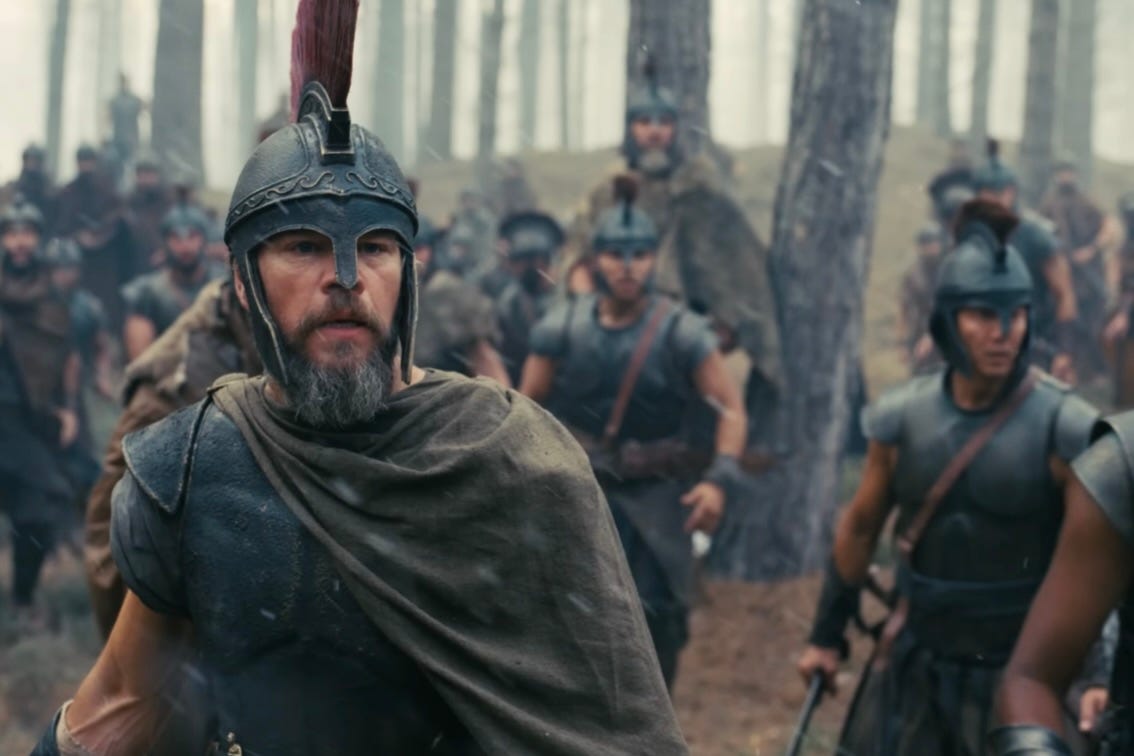
Certain performances are admirable. Robert Pattinson (the suitor Antinous), Hathaway, and Matt Damon have the elegance and gravitas necessary to make their characters feel like characters — though best of all when they begin to leave Nolan’s numbly “realist” territory behind and start clawing toward a more interesting artifice: Damon wandering with his silly gray beard around Calypso’s beach, genuinely pathetic; Hathaway and Pattinson playing at dueling divas in a two-shot through Penelope’s loom that might be the longest and most memorable shot in the film. The rest of the cast ranges from the very good (John Leguizamo as blind Eumaeus; Samantha Morton as Circe) to the perfectly decent (Elliot Page as Sinon, Lupita Nyong’o as Helen) to the remarkably bad (Tom Holland’s Telemachus). The rest are largely forgettable casualties of the film’s inability to pause long enough for them to matter — though Benny Safdie’s mostly silent few moments as Agamemnon are as iconic and memorable as everyone says, particularly in the film’s best sequence: Odysseus’ descent into a bleary, black volcanic Hades. Yet even there — as they do elsewhere, constantly — Nolan and Lame refuse to linger long enough on any image to let you fully register what you’re seeing.
In a sense, Nolan has simply remade Oppenheimer. The parallels are clear: the Trojan Horse is like the Atom Bomb, both of them metonyms for historical moments when some new human tool or discovery unleashed terrible forces on the world. Both films are heavy-handed parables about the guilt of uniquely Promethean men coming to terms with the old world order they destroyed. In The Odyssey, it’s the apocryphal breaking of Xenia, Zeus’ law, the civilizational importance of which Nolan’s script never stops hammering home. The Bronze Age Collapse mirrors the arrival of the Atomic Age — and, extrapolated forward, perhaps the dawning Age of AI. They’re Nolan’s sentimental warning to the rest of us: be kind to each other, and try not to invent thermonuclear weapons.
Some have read the film as commentary on Nolan’s own guilt, given his leading role in the superhero-ification and IP strip-mining that helped hollow out the film industry over the past two decades. I find this believable. Even more interesting, I recently had a conversation with a friend who considered the film a possibly unconscious allegory of the advent of the Christian idea of sin. For a film so obsessed with one man’s guilt, it’s striking that Nolan’s Odysseus isn’t guilty in any way Homer would have recognized. In Homer, guilt is a public failure to observe a stringent cultural code of honor; guilt comes with the external cultural role and is hierarchical (though no less a luminary than Simone Weil found more than a little proto-Christian pity in The Iliad). Nolan’s Odysseus is plagued by his own conscience — he did wrong, he knows it, and it’s eating him up inside. Of all the anachronisms in this stupendously anachronistic movie, an Odysseus who develops the concept of historical (not to say spiritual) sin surely takes the cake.
Still, speaking as a lover of cinema — which is all I am, not a “proper” critic — I can only say these suggestions sound far more interesting than the film I saw. Because it’s a work of consummate costuming, effects, and art direction — because it moves and moves and sometimes dazzles — Nolan’s Odyssey does largely work on its own terms. I left the theater feeling wrung out and entertained (to call it that). But I can’t shake the feeling that those terms are wrong-headed, unhelpful, and profoundly inartistic. Nolan is our representative contemporary filmmaker; in some sense he is modern filmmaking itself. His Odyssey is exactly what such a man would create in such a time, which may indeed make it one of the characteristic movies of our era. To that sad fact I can only say: thank the gods he didn’t do The Iliad.

Sam Jennings, The Metropolitan Review’s film critic, is an American writer living in London. He is an Associate Editor at The Hinternet, and he runs his own Substack, Vita Contemplativa. For those interested, his Letterboxd account can be found here.
 | A guest post by
|
I’m not enough of a film buff to have seen all of the classics, but the reference to Godard’s Le Mépris and Fritz Lang playing himself sounds interesting.
All of this talk about the Odyssey has made me want to finally read it, so it may have done some good.
This review confirms my impression that the movie would be a disappointment, so I will forgo seeing it.
I am delighted to find that I am not the only one who thinks Christopher Nolan is an overblown chocolate bunny of a director. I think Denis Villneuve could probably have taken this on, but other than that I don't think anybody else would give it a try. Odysseus has long been in American fascination because he's such a liar and schemer, but in Nolan's hands he's... well, Matt Damon. The only Nolan film that I even halfway like is Dunkirk.
The thing that I used to judge directors is how many times I can watch the movie and still find fresh things that I like. Nolan doesn't even bear one rewatch for most of his films. Inception is moronic. Tenet is essentially David Foster Wallace footnotes. The Prestige is a hammy vaudeville send up of what Ricky Jay did so elegantly.
And the Odyssey is pretty much his version of David Lynch's version of Dune.