


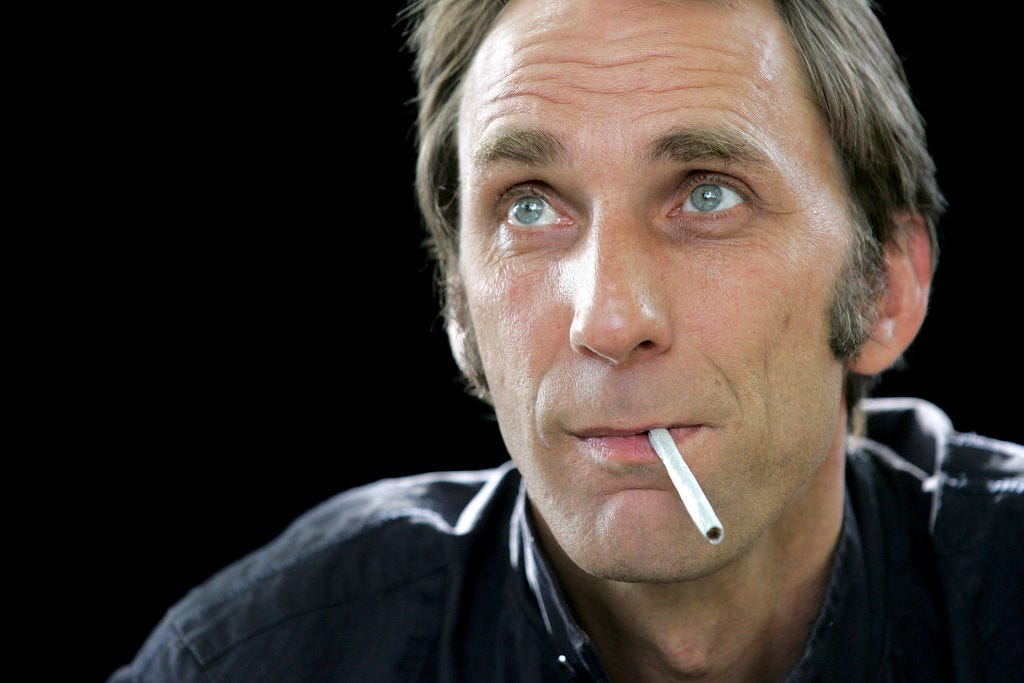
A series of minor events — a dinner party, a holiday in La Spezia, a poorly attended funeral — make up two years in the middling lives of a middle-aged, middle-class set of London friends, retold through different perspectives over the six chapters of Will Self’s The Quantity Theory of Morality. Burned out from one too many theatre premieres, gouty on fine wine, sick with salmon béarnaise, the only remedy Self’s characters manage against their anhedonia are gossip and contrived little melodramas, fit to divert them for the space of a three-course meal. Though tellers of variations of the same story, it’s hard to keep track of who’s who, given the venom, the cynicism, the conceit that rattle in the voices of each, as well as that, in a dig at the great eponymous novels of old, from Robinson Crusoe to The Brothers Karamazov, chapters are titled, in lieu of proper names, all after character types. Self’s humorous inversion takes aim at a major literary convention, but also at the complacent conformism of the middle classes, their proclivity to don tokens of status much as if they were personality traits:
They were just like all the middle-class, middle-aged professionals I knew in London...Paris…Frankfurt…New York….wherever: their identity was pretty much comprised by their clothing, jobs, assets (fungible and otherwise); their tastes and where – and with whom – they took their Mediterranean villa holidays. In other words, identity, for us, was a sort of social admission card, rather than anything which meant anything at all intrinsically, let alone determined how anyone behaved.
What brings Self’s milieu together isn’t mutual affection as much as the education, recreations, homes and beliefs afforded to them by matching economic means. Comfort being prized above all else, meaningful bonds are undesirable because ever at risk of becoming inconvenient. The character Bettina Haussman, say, is glad that her mother, whose Alzheimer’s is advancing, is adequately insured, as to care for her herself would have been a “torment” second only to having to fund it. Yet, no one in her circle thinks of Bettina as less than nice. Niceness, Self presses home, is not the same thing as goodness but what, within these milieus, the latter is a substitute of. Beneath the surface, flows a poison-stream of malice, hypocrisy and meanness of spirit, and a small faux pas is enough to precipitate one’s social death.
Self’s banishment of the category of Main Character from his novel takes aim at the feeble-minded, self-serving Anglo-European professional classes, which yield “no heroes and heroines anymore” but only “dull, boorish types, whose only real acumen is the sharp eye they keep on their finances.” The subtext of Self’s play on the various meanings of the word “character” throughout the book is this: people today suffer from a scarcity of moral character and a superfluity of character-like affectation. Self, who only knows the world of the middle-class, essentially protests that all the world’s a stage and implies that the only literary genre available to a “state of the nation” novel is the comedy of manners.
It is Self’s belief that only difficult literature can prevent the human mind from shrinking under the assault of forms of facile entertainment such as the internet and “‘page-turners’ with characters that are ‘relatable’.” Neither of the two things in between scare notes are, of course, in the least ruinous to the mind of a sensible thinker. Page-turners turn people from screen to page and relatable characters are simply characters suggestive enough of humanity to make a reader care. One of Self’s characters, Phil Szabo, at one point describes “forcing someone to identify with a character in a novel that’s completely unlike them” as “painful.” There is much truth to Phil’s words: a soul’s leap into someone other than oneself can entail the pain of changing one’s mind, of experiencing sadness where we would otherwise feel joy. Recognizing that villains aren’t straightforwardly so, and that we too, under the wrong conditions, might be capable of evil demands putting ourselves on trial. True moral expansion is hard because suspending one’s immediate best interest goes against our natural instinct for survival.
By offering the illusion of being uniquely able to obviate humans’ apartness — the chief hindrance to a perfect mutual understanding — the traditional novel is an exercise in feeling with, as well as for, others. But where, in novels like Forster’s or Franzen’s, characters are so life-like that we can relate with them as if they were real people, The Quantity Theory of Morality pushes hard to achieve the opposite effect. Again and again, Self’s narrators break the fourth wall to remind readers of their own fictiveness. They insist that they are no freestanding persons with psychologies and existences and desires transcending the span of the text, but linguistic constructs, the sole creations of the author (much like sexual, religious and ethnic identities are, in Self’s world, arbitrary or imposed from outside, something he illustrates most explicitly when recasting every character as male in the chapter “The Female Characters”, and as female in “The Women Characters”). Self poses these characters’ sheer self-interest as the catalyst for the nation’s spiritual impoverishment, but nowhere does he provide a glimpse of better ways of being.
James Wood is right to say that to deny character is equivalent to denying the form of the novel. People don’t pick up a novel for love of linguistic exploits or ideas divorced from experience, but on the promise of being plunged into the reality of being human with full force, of being enabled to see more keenly and of feeling seen. Novelists are incomplete if, other than linguists, philosophers and good analysts of society, they aren’t first and foremost humanists. But there’s not a hint of tenderness or charity, only disparagement and cynicism, to how Self draws human nature in his latest novel.
Self doesn’t seem to like people much these days. In a recent interview, he has revealed that he hardly sees anyone anymore: “I don’t socialize with anyone anymore and haven’t for some time, but it’s fine, because the communication through the text is so pure, so brilliant. Who would want to do anything else but that?” he told Publisher’s Weekly. A religious hermit, perhaps, or a literal-minded disciple of Platonism. Though being neither, Self has written a novel in love with its own ideas and disdainful of the flesh, only ever on the page to be vile or mortified: flashed penises — flaccid, erect, cut and deposited on the blacked tongue of a dead man —-, brutal orgies, “dumpy” bodies, smudged-over faces, flesh flogged bloody. Self laments the death of the novel, and at the same time is bent on delivering the blow himself.
Psychiatrist Zack Busner, a recurrent character in Self’s short and long fiction, makes a reappearance in The Quantity Theory of Morality to voice the theory that titles the book, according to which it is possible to calculate how much morality there is to a social collective at any given time. Busner worries that neither the group of friends nor the wider British society currently have enough to go round. He’s vindicated at both the micro and the macro level. The friend group gang up against Phil in a cruel game, shortly after which he commits suicide. And, when the Nationalist Trust takes over Britain, PJ (Perish the Jews) is mandated as the new government slogan and Jews are to identify themselves with badges pinned to their chests, not quite Jude stars but abbreviations that declare their Jewish ethnic division (ASHK for Ashkenazi, SEPH for Sephardic, and you get the gist). Following these events, Busner is the one committing suicide, out of despair at not having been able to prevent the country’s moral collapse.
We are to take it all as satire. But, while satire operates as a form of denunciation open to several shades of vitriol, its primary end is to persuade. Striking the right tone is of course challenging, for it requires being able to channel anger and indignation into something that sounds like wisdom. In other words, satire ought to read more detached and equanimous than it personally feels to the satirist. This is something that Self largely fails at. Voiced by his despicable characters, Self’s political grievances are disgorged on the page, for a satire, in an amazingly earnest way. And my, do they go on. And on. And on. After one especially splenetic outburst, one narrator addresses his readers directly:
“Ooh! Am I shocking you, darling? I know: it’s the highbrow shit you hate even more than the steady stream of nasty, ichorous venom in which I’ve dipped my pen – roll on AI, I say, ‘cause the sooner I’m replaced by a large language model, the better…”
Self might be unprepared for a shock of his own at finding that the reader is, by this point, nothing other than fed up. And, likely, tempted to find respite in a “page-turner” with characters that are “relatable” rather than intent on patronizing her with gusto while yet to examine their own conscience. The “shocking” and “highbrow” factors cannot apply to ideas which it is now the status quo for a complacent popular culture, corporate PR and herds of directionless, somewhat neurasthenic undergraduates and pensioners alike to peddle relentlessly, to people who would want nothing but get on with their day. Self’s unhinged berating has the same effect on readers as the sight of orange paint poured on a Monet: pity and alienation.
Drawing all characters in agreement with one another, the monolithic view on the Israel-Gaza conflict touted in the novel is quite the volte-face on Self’s assertion that “the role of satire that I produce is to make the audience think for themselves.” Supporters of Israel’s right to defend itself are dubbed “bloodthirsty” and converts to Judaism “wannabe chosen Jews” or “FOMO Jews”; IDF soldiers and Jihadi terrorists are spoken of as moral equivalents; and global warming is, grotesquely, compared to the Holocaust. The half-Jewish characters, none of whom think of themselves as particularly Jewish, shudder at the inevitable associations people are bound to draw between their identity and Israel. When Zack Busner inquires about the origins of her surname, Bettina fears he might be on a mission to have her “coming to terms” with her Jewish heritage: “I sat there fed up with this morally high-handed old man who wanted me to saturate myself in the toxic schmaltz that inevitably gets spread everywhere once the talk turns to Jews, Jewishness and eventually… bloody Israel and its bloody deeds.” Another character’s father “stopped going to shul after the Intifada broke out”.
Self, who has expressed frustration at being labelled a Jew despite not having been raised in the faith (his mother regarded Judaism as “altogether a cosmic embarrassment”), nonetheless decided in 2006 that he was enough of one as to publicly “resign” his Jewishness in protest against left-wing English Jews’ undeterred support of Israel’s military policies. It’s almost as if he sincerely shared his character Rob Brookman’s conviction that, “with the Jews, in true showbusiness fashion, life is a one-off command performance.” But there comes a point in the book, in which a new hostile regime comes into power in Britain and all Jewish citizens (including nonobservant ones) are forced to identify and segregate under a decree reminiscent of the Nuremberg Laws, stripping Self’s characters of the illusion that they could switch their Jewishness on and off. Whatever they claim to be or not be has no power against what the people in power say they are. But a society which would commit state-sponsored persecution is not what’s under fire, here. A society which, in committing state-sponsored persecution, would not discriminate between “bad” (Israel-supporting) Jews and the “good”, anti-Zionist Jews of Self’s and his characters’ ilk is rather the object of his critique. It does make one wonder about the quantity of morality available, these days, to Will Self.
Most of all, it mocks his resignation as a Jew in 2006. A new iteration of the 1930s (Jews once again becoming conspicuous and unwelcome in their diaspora countries) is precisely the historical logic that produced the single Jewish state Self goes into hysterics to distance himself from. Self wants identity to be as relative and artificial as literary character is in his conception, an organization of signs with no reality reference outside of language, and resents that identity is liable to incur in existential danger that rhetorics can provide no saving from.
To add to the book’s several ironies (only few of which, I’m sure, are lost on him), Self is the product of the very establishment he holds up to ridicule. His pretty well-to-do parents, British academic Peter Self and Jewish-American housewife Elaine Rosenbloom, brought Will up in placid East Finchley, North London. Both were as liberal in their politics as they were in their approach to raising children. Self has said somewhere that he started doing drugs at the age of 14 to be more like the Beat generation writers he admired then. His brother Jonathan claims that Will’s addiction agreed with their mother’s Bohemian tastes, so, at least for a while, she looked upon it with indulgence (though she did regret this when the addiction became more serious). Once he made it out of private school, Will went on to study a degree in PPE at Oxford University and graduated with a Third. I discern interesting parallels between Self’s coming-of-age and that of some secondary school peers of mine, who, having had nothing to rebel against while growing up, have now become the loudest denouncers of inequities in my generation.
Self’s characters don’t just occasionally share, with Self’s and with each other, biographical traits — a North London upbringing; a Jewish parent; a drug or alcohol addiction, or both; a career as a prolific freelance writer and author with a record of winning “no major literary prizes”; the first name Will, but also the same sharp, adolescent note of contempt, the same lip-curled sarcasm of Will Self. Sentences are sometimes repeated word-by-word by different narrators. Their opinions about each other and civilization at large tend to echo Self’s own expressions of resentment against his former friends in interviews (their fault being not having stood by him when Self’s ex wife publicly accused him of mental cruelty just before she died of cancer) — a resentment which he misses no opportunity to vent. Even by themselves, statements like “Your friends are only too happy to offer you a helping hand, but once you’re in genuine need, you won’t see them for carpet fluff” or “it’s only when people become adequately socialized that they can reach their full, cruel potential” hardly ring as universally resonant.
Self’s interviews invite the assumption that the person who wrote them underwent unfortunate disappointments which bred in him something like a mistrust of any man or woman who isn’t some romantic sort of noble savage. But readers know better than to accept any grudging piece of cynicism as a general truth (as they otherwise would statements like Lear’s “Allow not nature more than nature needs,/Man’s life is cheap as beast’s”, or Zeno’s “The sun didn’t illuminate me! When you are old, you remain in shadow, even when you have wit.”)
So much points to Self’s lack of faith in his readers’ intelligence, in connection as a force for good, or even in mankind at large. But good faith is inextricable from speaking truth and misanthropes famously are bad judges of character. There’s no such thing as a truthful observer of human nature whose view is distorted by loathing and pessimism. In order to understand something well enough to plainly make out both the beautiful and the ugly, one has to fall in love with it first. Everyone can recognize Katherine Mansfield’s satirical take on types of human behavior in her short story “At the Bay” as exact chiefly because she smiles upon them with a warmth. In one passage, it’s the early morning and businessman Stanley Burnell wades out to sea, thinking he’s the first one in. But his wife’s brother-in-law, Jonathan Trout, has beaten him to it and is in the mood to chat. In a hurry to get to work, Stanley rudely cuts him off and rushes out of the water:
“Pass, friend!” said the bass voice gently, and he slid away through the water with scarcely a ripple ... But curse the fellow! He’d ruined Stanley’s bathe. What an unpractical idiot the man was! Stanley struck out to sea again, and then as quickly swam in again, and away he rushed up the beach. He felt cheated.
Jonathan stayed a little longer in the water. He floated, gently moving his hands like fins, and letting the sea rock his long, skinny body. It was curious, but in spite of everything he was fond of Stanley Burnell. True, he had a fiendish desire to tease him sometimes, to poke fun at him, but at bottom he was sorry for the fellow. There was something pathetic in his determination to make a job of everything. You couldn’t help feeling he’d be caught out one day, and then what an almighty cropper he’d come! At that moment an immense wave lifted Jonathan, rode past him, and broke along the beach with a joyful sound. What a beauty! And now there came another. That was the way to live - carelessly, recklessly, spending oneself. He got on to his feet and began to wade towards the shore, pressing his toes into the firm, wrinkled sand. To take things easy, not to fight against the ebb and flow of life, but to give way to it - that was what was needed. It was this tension that was all wrong. To live - to live! And the perfect morning, so fresh and fair, basking in the light, as though laughing at its own beauty, seemed to whisper, “Why not?”
But now he was out of the water Jonathan turned blue with cold. He ached all over; it was as though some one was wringing the blood out of him. And stalking up the beach, shivering, all his muscles tight, he too felt his bathe was spoilt. He’d stayed in too long.
Exchanging a few words with his neighbor would have hurt Stanley less than if he hadn’t fretted so at the disruption of his tightly planned schedule. His mania for efficiency, not Jonathan, ruins his bathe. But, when overindulged, relaxation makes a body grow torpid and excessive freedom from care easily tips into irresponsibility. So, in the end, Jonathan’s bathe is ruined, too. This is a fine bit of satire, that behaves as its earliest practitioners conceived it should: as a humorous caricature of excess encouraging readers to recognize themselves in it. What Mansfield’s satire does not do is demonize humanity as either irredeemably hedonistic or irredeemably repressed. The balance of benevolence and lucidity that underlie it are what make Mansfield’s dig so felicitous.
On the cover of the uncorrected proof of How the Dead Live, Will Self’s third novel, is the quote from the author, “I don’t write fiction for people to identify with.” Seen the number of times Self told interviewers that he doesn’t care for entertaining his readers, the quote might as well have stopped at “people.” He has explained that he isn’t willing to contain the lava force of his imagination, and if readers find what comes of it too challenging, that must be because they’re lazy. He thinks the reason his work is not as popular as it deserves is that 50 percent less people read books than they used to 15 years ago, a decline in literacy he is persuaded will doom society to descend into fascism. He doesn’t suspect a connection between the low sales and his own determination to make his writing as antagonizing as he can. And this, he can plenty.
I have nothing to add to the wealth of criticism on Self’s stylistic tics (the strange ubiquity of his ellipses, em-dashes and end-word elisions – the adverbial incontinence…). But Self’s prose is too outrageous to ward off fresh commentary. Using words like “debouch” to mean leave, “apodictic” to mean undeniable and “avian element” to mean birds has no point to it other than creating a nuisance. When Self writes “they disported themselves into this ludicrous office” to say that someone has stepped into someone’s house, the adjective rebounds. Nowhere, however, is Self’s mix of a “high” register with a crass one as indefensible as in his description of a funeral as a “rambunctious riverrun of rapturous rodomontade, in which the grief of every and all is sucked up and spewed out in an ouroboric orgasm of loss… and love…” Writers go to archaic, technical and anomalous language to search for the word closest to what they mean. The use of it in the service of obscurity instead of clarity perverts the job of writing, which is to speak and be heard.
Though “engendering”, “temporalising”, “a dialectics of the uncanny” and their likes should have no place in fiction that’s not a parody of the academic world, they are rife in The Quantity Theory of Morality. Self’s decade as an arts and humanities professor at Birkbeck University, London, obtrudes when, instead of outlining, alluding, teasing and quizzing, he distills, lectures and asserts. Take Bettina’s complaint about an instance in which Will treats her to,
...one of his interminable, stoned monologues: riffs about the metaphysics of the mundane that might have been amusing twenty-five or thirty years ago, but which now, in all their meandering circumlocution, are no funnier than any other form of repetition; because after all, once you’ve reached a certain age, you know with crushing certainty that nothing is ever really that funny… even twice.
Instead, Bettina could have complained about Will treating her to, say,
...existential spins on everyday affairs. I mean tosh like the “unbearable futility” of throwing and catching a frisbee only to do so again. Sure, Will’s stoned monologues might have amused freshman me, but being long past the stage of brain development I could only laugh out of courtesy.
Away with the academic genitive of X structure, in with rhythm and the absurd particular — and just like that, caustic becomes fun.
Ever since having been diagnosed with myelofibrosis, Self has been in and out of hospitals. He wrote The Quantity Theory of Morality in one draft over a period of six months after nearly dying last September. That his literary output, some of which is already out of print, won’t guarantee him immortality in the form of posthumous fame is an assumption he shares with his character Phil: “All that will happen is that someone idly browsing in a charity bookshop, a few years hence, will leaf through these pages… read a few lines… then discard me.” Refusing his readers the joy of connection that, when life gets lonely, they turn to the novel to find might indeed spell oblivion for Self.
Now Self has accepted the fact of his own death, he asks everyone to do the same. He demands that we accept our existential status as minor characters adrift in a vaster than vast world that won’t stop revolving when we’re no longer in it. As if we didn’t know already and the reason we tell each other and ourselves stories wasn’t to forestall the nihilism which acknowledging our deeds as pointless in the greater scheme of things would sink us into. Sure, to think that we might ever be able to “tail meaning from behind and eventually master it by creating characters” is naive. But just as nothing is worth writing without someone to read it, no fiction is worth reading that has no people in it. What’s even more self-defeating in The Quantity Theory of Morality than its expunction of characters, though, is its expunction of relations, the very thing that makes the fact of one’s mortality tolerable. Because in an age that has faith in nothing beyond what’s material and marketable, what source of comfort can there be other than dependable, solid human bonds?

Maria Albano a freelance writer of fiction, essays and literary criticism born and bred in Italy but based in the UK since 2016, currently studying a PhD in English at the University of Cambridge.