


America’s power to wage war hangs more on the sex life of the greater sage-grouse than you might guess. You wouldn’t want to overstate the case. If you were to rank determinants of wartime readiness, the greater sage-grouse’s amorous entanglements would probably place behind things like defense outlays and the upkeep of stealth bombers. But those entanglements do play a small role, and that’s still more than most imagine. It is certainly more than I did until only a few years ago. Then I took command of a cavalry troop in the U.S. Army and lost my innocence forever.
The greater sage-grouse are picky eaters. Nature did not bless them with the strong gizzard a bird needs to eat seeds and so they have few options. They prefer sagebrush, black when possible. They nest below sagebrush, too, and among it they establish their leks, here a noun and elsewhere a verb, derived from the Swedish word for play, that refers both to the greater sage-grouse’s mating rituals and the sagebrushed sites where they occur. It is on the strength of these facts that English-speaking man gave the greater sage-grouse its name.
The trouble is that the land in America where the sagebrush grows also often lends itself to cattle grazing and natural gas drilling. Less valued than beef and power, the greater sage-grouse has retreated to certain swaths of federal land where legal protections mean cattle cannot graze and energy goes unexploited. One such swath lies in the rain shadow cast by the Cascade Mountains over Central Washington. It is a wind-swept steppe, about as big as Nashville, belonging to the U.S. Army. It is called Yakima Training Center.
To Yakima Training Center I would trundle as a cavalry commander with my trucks and troops to train. The trip to Yakima was already a nuisance. My unit was garrisoned at Joint Base Lewis-McChord in Tacoma, some 165 miles away from Yakima, on the far side of the mountains. Though it was peacetime, we were under standing orders to train hard and so serve as a “credible deterrent” to unrest in the Indo-Pacific. But owing to the density of human settlement on the Puget Sound, and to the sensitivities of another of God’s creations called the Mazama pocket gopher, we could not blow up the large munitions in Tacoma needed to stay sharp and so credibly deter anything.
For these reasons, we would climb into our Strykers, haul over the Snoqualmie Pass past ogling skiers, then descend to Yakima. But upon arrival at the Training Center we found ourselves at the mercy of the greater sage-grouse. Vast stretches of crosshatched yellow marked on the map where we could not drive our trucks or shoot our guns or even sleep on the ground, lest we upset the grouse leks. Having just explained to our soldiers that the planned training was so important they had to leave their families behind for weeks on end to hazard night maneuvers with live rounds, we then had to explain to them, with our yellow-splotched maps as aids, that the training was not more important than the carnal appetite of a local game bird.
Soldiers are alert to the absurdity of their position. Like an infinite staircase drawn by Escher, their work can at times seem to climb to the highest plane — the self-sacrificial preservation of society — only to terminate back at the start, in the low ground, squabbling with a grouse for a place to lay one’s head. For what reason, they start to wonder, do they endlessly trudge up and down these mountains? It’s enough to make you question whether you’ve gone mad, or if things aren’t ordered completely backwards. And then one day you pick up a novel like Michael Jerome Plunkett’s Zone Rouge, and you feel the order set right again.
Plunkett’s novel is set amidst the centennial of World War One. It opens not with a grouse but with a cow, and for its purposes a cow will do. “The cows, they suffer in silence,” the first sentence declares, scoring with the reader rare World War One surprise. And with that surprise’s momentum at its back, the book goes on in its first pages to depict the manual extraction of shrapnel, gathered while grazing, from the stomach of a suffering heifer. The squeamish and the empathetic might object if the writing weren’t so good. Others might object too, if it weren’t also for the overwhelming sense one gets immediately that the scene has a purpose, that the account of war to come is different than those we’re used to, and that either way, the story will be worth the wait. It is.
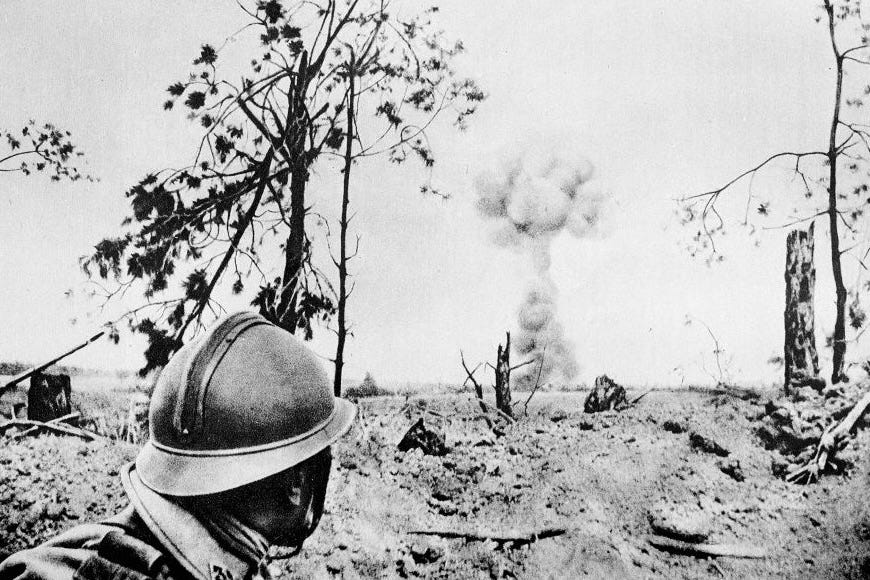
The story Zone Rouge tells is that of Verdun. Not the battle, per se, but the battlefield — or what is found there, one hundred years on. And what one finds at Verdun is ordnance. Artillery shells, mortar shells, grenade bodies, numbering in the millions. Most of them, poured into the land by German and French artillerists, remain buried there even after a century of cleaning. Underfoot the shells leach arsenic and mercury and lead into the soil, until a farmer plows them up or else the long-suffering earth, after so many cycles of freeze and thaw, finally heaves them to the surface.
Then what? One calls the démineurs. These men, trained in the handling and removal of unexploded ordnance, rumble in trucks out to the site of a shell’s discovery. There they get to work on the shell’s safe removal. By a job’s end they have taken another infinitesimally small step towards Verdun’s rehabilitation, a process that will consume several more of their lifetimes, estimated to end when Verdun is as distant a memory to the living as today Frederick the Great is to us.
These démineurs make up much of Zone Rouge’s cast. Throughout the book they speak in a choral voice that evokes for the reader the generational, faceless nature of the task to which they’ve dedicated their lives. It is a credit to Plunkett’s craftsmanship that despite the tactile subject, it all sounds almost musical. So the démineurs tell of the shells:
We carry them out of the ground to our trucks by the armfuls. In canvas sacks on our backs. Stack them in lockers lined with sand. Cinch them together with slick cable wire and pack them by the pallet. Put them on trucks and fill them to the ceiling. Store them in steel-lined cellars with thick iron doors that shut with a dull clunk. And when there is no room left, we shove them in the corners of the lot in our depot. Find odd gaps where they can be stacked a dozen high. Every nook and cranny. Loads and loads.
From this chorus of démineurs eventually emerges a leading man named Ferrand Martin. But as is the case in war as well, the foil in Zone Rogue steps forward first. His name is Hugo Lafleur. He is a real estate developer. To advance his business interests, he has sought and won election as the mayor of a dead town called Fleury. Dead, because Fleury exists materially only as rubble on the battlefield but is preserved in law alongside eight other ruined towns as an administrative monument to the places the war wiped out. Their mayors steward their memory.
A rib brings Ferrand and Hugo together. It juts out from Fleury’s poisoned soil beneath a 75-millimeter shell Ferrand and his crew are called to remove. Human remains are not unheard of at one of humanity’s foulest killing fields, but their discovery is not as common as it used to be and so is cause for commotion. As mayor, Hugo has a natural interest in the bones, heightened by the looming centennial of the battle. As a démineur, Martin’s interest in the dead is passing — he deals instead with what killed them — but the archaeologists who arrive at the scene need a hand, and Martin lends one.
What follows is an austere but often beautiful story of the bones of Verdun. In Hugo the mayor and Ferrand the démineur the reader gets a finely wrought, ironic contrast. Though Ferrand spends his days pulling things from the earth, Hugo is the extractive one — commercially, politically, sexually. And though Hugo is elected to an office of stewardship, Ferrand is the custodial spirit. Despite advancing illness and an acute awareness of his work’s Sisyphean aspect, he grows obsessed with the identity of the man to whom the discovered bones belonged.
It is just a small spoiler to say that no one learns that identity. A tag found close to the bones bears the name Augustin Caladec. Yet archival searches return several Augustin Caladecs, some French, one German. This frustrates both Hugo and Ferrand for different reasons. Hugo’s reasons are political; a particular French soldier would better serve the marketing of the battle’s centennial than an anonymous, nationless one. Ferrand’s reasons are existential; he hopes to give the ghosts that haunt his work any face at all.
But as it turns out, in the end all sides of war are faceless. A use of Zone Rouge’s hundred-year view is that it allows us to discern such things. The bones left behind are difficult to name and buried artillery shells do not discriminate between faces of any kind. This irresolution is just one way Zone Rouge hews to hard truths rather than the sort of false but pleasing narrative arc so many people, including the reader and Hugo Lafleur, wish the war would give them.
The second great use of Zone Rouge’s long view is that it affords the reader a good, hard look at the dirt war leaves behind. That dirt is everywhere, and it is forever. In the Red Zone demarking the battlefields from which the novel gets its name, one must be wary of the drinking water’s perchlorate levels. Mushroom pickers in the surrounding forests must be alert to anomalous toxicity in their harvest. Locals cannot spend a day in the fields of Verdun without finding shrapnel in the crevice of their clothes, “Titian red, oxidized rust, glittering in our palms.”
This dirt one cannot outrun. Eventually Ferrand is brought low by cancer. As with so much, he cannot be certain of the cause. Perhaps the poison amidst which he lives did him in. Perhaps it was bad luck. Either way he must cease his work as a démineur. He then passes his hobbled days with a mechanical claw, picking up trash. He will not live to see the job finished. A second choral voice, that of the dead of Verdun, joins that of the démineurs, to observe: “There is so much to clean up.” Such epochal contamination, of the spiritual and the ecological sort, transcends any one life, defies the measure of any one man.
The novel does not suffer much for foregoing tidy resolution or dealing in such bleakness. This is again a credit to Plunkett. A lesser writer might probe existential questions only at the cost of deadened prose. Zone Rouge is instead given to moments of deep, enlivening beauty. These moments come regularly enough both to sustain the reader’s attention and to stave off the claustrophobia that otherwise encloses a reader wandering through the dark of such trenches.
One such moment occurs at a local bar after a day’s work, between Lafleur and the young archaeologists come to Verdun to see about the bones. The beauty of the moment is not in Lafleur’s philandering, though Lafleur is rendered so humanely that the reader is tempted to forgive his many sins. Rather, Plunkett bottles the heady mood that forms between hardworking people out on the town after a day’s purposeful work. It’s an alchemical thing, more than the sum of its parts, the sort of moment that abides in one’s mind long after the toil that made it sweet is forgotten.
Another such moment is a memory from the edge of Ferrand’s youth. The reader is transported from Verdun’s cratered and poisoned hills to a French lake in late summer. After a long day’s work, a young Ferrand and some friends take a boat out. “We were all exactly who we wanted to be in that moment,” he remembers. They meet a boat of girls. A short flirtation follows. Just as the two boats part, Ferrand finds courage. He dives into the water, surfaces alongside the girls, and carves his number in the gunwale for the one who caught his eye. She would become his wife, then his ex-wife.
This memory Ferrand carries with him, “the moment an unfamiliar face becomes familiar.” Such moments are otherwise so elusive, as Augustin Caladec’s bones remind us. And once had, such moments can sustain an entire life: “We held it and then it was gone. It happened.” Faced with the horror of Verdun, so vast and deep, the reader and the démineur and soldier and Sisyphus himself all might be forgiven for asking: is life worth it? Carved in a gunwale of a boat on a lake in summer, in the air between some bar patrons, Zone Rouge seems to gives an answer. It is yes.
This brings us back, of course, to the lekking greater sage-grouse and the sidelined soldiers watching them. Set aside the obvious point that the soldier and the grouse and the demineurs and the Department of Natural Resources all agree that mating makes life worthwhile. Set aside also the ecological point, that it is not backwards in the least to preserve the sage-grouse at the cost of some military training, for if the winners of a war inherit a poisoned earth, theirs is a pyrrhic victory. There is something even deeper going on here than the conservation of randy birds, if you grant that such depth can be reached. There need not be anything else going on — Zone Rouge is a beautiful story in its own right — but there is.
In life it is easy to get confused about the order of things. So much of life runs in circles, and with little apparent forward movement, that one struggles to discern starts and ends. Does our work interrupt our rest, or the other way round? Does war interrupt peace, or is peace what we call a pause in the fighting? Does a shell’s detonation punctuate the end of a long arc or just launch that of another story? And given that all these things circle back on themselves, does any of it matter, or is all progress a cruel illusion? In Zone Rouge might be read the moving suggestion that we cannot know, and it does not matter. We can only find what is good and decide our work is in service to that good thing. So if one must cease his work to let the sage-grouse lek, it is perhaps best to let it lek.

Theo Lipsky is an active-duty captain in the U.S. Army. One can find his writing in War on the Rocks, The Point Magazine, Military Review, Modern War Institute, and his newsletter, Garrison Notes. The views expressed here are those of the author and do not reflect the official position of the United States Military Academy, Department of the Army, or Department of War.
 | A guest post by
|
We’ve been all over the Zone Rouge, including the ossuary and all those lost villages. When you leave the forts and wander into the forests (on the duckboards, of course), you feel yourself lost inside this massive, hollow, maybe godless space that surely no human could have created—until they (or we) did. You capture it very well here, and your frame fits it perfectly, because if you travel just a few miles in any direction from this human black hole, 21st century life is as frenetic and prosperous and stuck in its details as anywhere else. They might someday bring up the last shell (not in our lifetimes), but they will never squeeze out, much less sanitize, the blood and loss and sheer horror that still ooze from the earth here.
Very well done, Theo.