


{Cough, clears throat}. Chapter one. It’s 1991 in Manhattan. Cue a Gershwin piano trill, followed by sirens; open on an old lady getting her purse snatched. An ambulance whizzes by. Gray skies and rain; a little group of shivering hookers. Oh yeah, the roaring ’90s. But this isn’t Midtown. No, no, we’re in the crosshairs of 88th Street and Second Avenue. One building has a line outside. We zoom in on the awning — it’s Elaine’s, the glamorous literary canteen. The camera takes us inside, tracking. Tucked into a little table — not in the back, never in the back; only loser tourists and hack writers sit in the Siberia of that crowded restaurant — but along the right row, visible from the entrance, below the sconces and crooked picture frames, is Woody Allen’s table. Table six. Imagine it! A wintry night, and the tourists outside gripping their Frommers, and the candlelit table that sits empty until Woody Allen arrives. Mia Farrow is there, too, picking at cold tortellini, but she doesn’t stay long. Not because she’s angry — no, none of that stuff has happened yet; Farrow just doesn’t like to stay out late, and leaves hours before her famous boyfriend, who lives alone on the opposite side of the park. Woody spends the rest of the night chewing burnt steak, drilling red wine, and shuffling cards for Gay Talese and George Plimpton at a late-night poker game that wraps at dawn.
Allen was a fixture at Elaine’s every night for 10 years, and would trade barbs with Kaufman, the thick-wristed owner who talked like a yenta but punched rather more like a Belfast prizefighter. Kaufman and Woody were like relatives, which made Allen a prince in the kingdom of New York’s top haunt for mayors and movie stars, where Jackie Kennedy made her first public appearance at 2 a.m., several months after the assassination of her husband, and where Woody Allen was introduced to Mia Farrow.
Cast your mind back to the time before The Allegations, and you realize that, right up until that point, Allen was in the midst of an unstoppable 15-year run: Annie Hall, Manhattan, Interiors, Stardust Memories, Radio Days, Broadway Danny Rose, Crimes and Misdemeanors, Zelig, Hannah and Her Sisters, and Husbands and Wives — not a flop among them and several considered masterpieces of cinema. Woody Allen was drowning in Oscars and cultural acclaim that hummed alongside a tumultuous personal life of divorces, high-profile romances with co-stars and slobbering nubiles, jazz residencies, Knicks game sightings and regular late-night TV appearances. Allen was an arthouse darling and a box office supernova who laughed his way to mainstream success. Then came August of 1992.
Everything changed. These days, Woody Allen might be the closest thing the internet has to a stock-image diddler. He’s the Colonel Sanders of “coming to a playground near you . . . .” Searching for someone in New York who is confident Woody Allen molested his daughter is like looking for a beard at the Western Wall. They hear a few grisly details, watch the HBO doc, take one look at Allen’s big nose and squinty eyes, and decide he’s 100% a pedo. His man-about-town persona all but vanished, excepting, for a time, a quiet clarinet residency at the Carlyle. The bard of 20th-century personal freedom was replaced by a monkish 21st-century ghost. Suddenly, the same filmmaker who wrote and directed Crimes and Demeanors is a husk of his former self. Gaffe after gaffe, blunder after blunder. Manhattan and Radio Days are exchanged for clunkers like Bullets Over Broadway and The Curse of the Jade Scorpion, with Deconstructing Harry — Allen’s angriest, funniest movie — sandwiched in between. Going to see a new Woody Allen movie becomes less of a cultural event and more a question of: Is this one actually good? Because the last one was a pile of shit! Every film after 1992 is measured against the virtuosity of that miraculous run, before the director’s private life rattled his artistic one. Woody’s name now summons an old man with a hat pulled low, withdrawn into cultural exile — irrelevant to most, yet fiercely defended by a devout cult of truthers ready to wage war to preserve the reputation of the artist formerly known as Allan Stewart Konigsberg.
Yet even these fans of Woody Allen might pick up his newest work and first novel, What’s With Baum?, feeling some trepidation about the prowess of this one-time master storyteller at 90 years old. When I showed off my copy of What’s With Baum? (it wasn’t easy to find a copy in Park Slope), my brother said: “Lemme guess, the main character’s neurotic and loves jazz.” Point taken. After all, is Woody Allen even still a great filmmaker? An inspired writer? Or just a short Francophile with a disease obsession and a half-century hard-on for boilerplate philosophy, urban elitism, and eager nymphs? Do the stories matter, or is the ticket price just an excuse to litigate his bizarre life choices? Can you play in your mind the long pull of a trombone, a tuba farting out a few bass notes, and from that point onward predict exactly what Allen is going to say, again?
Perhaps Woody is going to say that old men find young women attractive? Fascinating. Or that wealthy married people are tempted to cheat in order to feel something? And when they do philander, they do so with lots of massage oil and martinis, necking in the shadows of cheeky uptown jazz bars. They will often regret it, too, and end up killing their sexual accomplice only to get away with it in the end. Woody likes love triangles; he is a strong believer in the power of luck over other cosmic forces. You can find all these themes in his old and new material. The only difference is that it feels old in his new material, and new in the old material. Sydney Pollack’s performance in Husbands and Wives will never not feel fresh in its wry brutality. Are we supposed to laugh or be appalled by Pollack’s character violently dragging his yoga instructor girlfriend into a car while attacking her New Age love of tofu and crystals and spiritual consumerism — a profound dig at early-’90s bullshit enlightenment? Owen Wilson’s floundering Allen-character in Midnight in Paris is charming enough with his floppy hair and general paralysis, but there is nothing transcendent about the performance or the film. What seems to change and improve in Woody Allen’s later movies is mainly the apartments, which get bigger and more unattainable as the years wear on. Allen famously shot inside Mia Farrow’s spacious but hamish Upper West Side apartment for the Thanksgiving scene in Hannah and Her Sisters. In 2019’s A Rainy Day in New York, Timothée Chalamet’s character, Gatsby Welles, is an intellectually tortured twentysomething who wears loose ties and tweed suits and plays piano in his family’s residence at the Pierre Hotel, where an apartment can go for as much as $65 million. He spends time writing poetry and longing for the past in the aisles of Dean and Deluca or in the lamplight of Bemelmans Bar. Elle Fanning’s character describes him as “quaint . . . searching for his romantic dream from a vanished age.”
Woody’s early masterpieces ask us to indulge and roll our eyes at the liberal arts-educated characters we’ve surely encountered in the city and found insufferable. But the new movies, with a few exceptions, contain none of the lives and affectations recognizable enough to be satirical. Similarly, What’s With Baum? fails to make much of a statement, probably because Allen chose an earlier, but essentially unchanged version of himself to mock-examine his present-day affliction.
In What’s With Baum?, Asher Baum, a Jewish writer with bad allergies, imprisoned in a loveless marriage, seeks creative validation wherever he can find it. And when he does, he pounces on it, literally. One of the more revealing through lines in the novel is the way Baum, a hapless Allen stand-in, tries to squirm and joke his way around the fact that he groped a journalist after she complimented his writing. First he denies, then he massages the truth, and finally Baum admits what happened: he felt-up a journalist! All the while, he paints himself as a victim with an odd relationship to sexual dynamics. After all, fawning over someone’s work is a sexual invitation, isn’t it? Allen suggests that Baum was tricked, preyed on by the female journalist’s licentious praise. A conversation between Baum and his agent goes like this: “‘Rape? She says I raped her?’ ‘I definitely don’t [think you did], Asher, but what the hell does it matter what I think? In today’s culture an accusal is as good as a conviction.’” Initially Baum is stunned by the accusations. Who, me? And thinks of suing her for defamation. What a wild and irresponsible tall tale, he says! A hit job! But then we learn that Baum’s memory is a little foggy and he was in a weird place that day and maybe, just maybe, he needed some affection. Doesn’t everyone? Baum demands. It was an innocent kiss! So what if she wasn’t as reciprocal to the advance as he might have liked. He needed to smooch somebody!
In other words, isn’t everybody vulnerable to predatory impulses once in a while? Can’t we cut Baum some slack? So what if his hand grazed (or did it cup) both her breasts?
It is one of the more chilling moments in the book, especially because, at first, I was charmed by Asher Baum, just as I have been by Alvy Singer, Isaac Davis, and Harry Block — magnetic Allen proxies with questionable judgment. Allen’s characters have a good track record of joking their way out of unsettling behavior, like when Isaac Davis, Woody’s Manhattan surrogate, jokes to his fortysomething-year-old friends that he’s dating someone “who still does homework.” Davis’ quips about Tracy, his astonishingly young girlfriend, don’t feel like Allen building a case. Allen embraces the edginess of the relationship, proud of his libertine spirit; the pure ecstasy of toying with a teenager. If Manhattan is a celebration of this period of Allen’s carefree debauchery, What’s With Baum? is a whitewash of it. Baum might be the closest thing Allen has to an updated Deconstructing Harry, Allen’s most self-effacing film. Deconstructing Harry is the exception that proves the rule that Allen made pretty bad movies after the accusations. Deconstructing Harry, the 1997 Ingmar Bergman tribute, is an underrated Allen masterpiece, a fiery, urgent reaction to Allen’s own humiliation, and a gemstone crammed inside a shit sandwich of post-1992 films. What’s With Baum? is an attempt to replicate the same manic doggedness, but this time someone forgot to put a ball in the cannon. The novel is cynical and amusing and full of Woody’s trademark wit, but fails to create a universe or arouse much interest other than as a flimsy device to express Allen’s personal grievances. Asher Baum is a pill-popping writer ruled by a wandering eye, with several bad marriages behind him and another divorce on the way. Baum’s first marriage went sour when he couldn’t not bang his wife’s identical twin sister. Now Baum is in his 50s and imprisoned in an unhappy third marriage to Connie. They live in the Berkshires because that’s where Connie feels most at ease. She spends her time obsessing and bragging about her gorgeous, writerly son, Thane, a bestselling overnight sensation. If this rings a bell, it might be because it’s similar to Allen and Farrow’s relationship in the ’80s. Here is what Allen told the New York Times Magazine in 1991 about their relationship:
I could go on about our differences forever. . . . She doesn’t like the city and I adore it. She loves the country and I don’t like it. She likes simple, unpretentious restaurants; I like fancy places. She likes the West Side of New York; I like the East Side of New York.
The real-life country home that belonged to the Farrow family, known as Frog Hollow, haunts Woody’s fiction even 34 years later. “Baum had always hated the country,” Allen writes. “Everything about it: the ticks and spiders; the raccoons, cute but with rabies; the poison ivy; the sound of crickets and cicadas. He hated the isolation.” Baum is a prisoner in the great outdoors, bored to the point of carrying on long paranoid conversations with himself; a weak, but telling device in the book that reminds us we’re in the hands of a reclusive, first-time novelist with a bone to pick.
Woody’s family man routine that he’s been trying to peddle since the ’90s is finally true now that he’s a nonagenarian, but Friar-Woody is a recent development. For six decades Allen was a social animal mining a tangled personal life for material — bleeding relationships dry, taking morally and legally questionable risks, crafting composite characters from a libertine sex life. Rolling Stone reported that in the late ’70s and ’80s, Allen brought Mia Farrow into threesomes with various teenage women and even carried on a long turgid affair with a 16-year-old he met at Elaine’s, later used as a pastiche for Mariel Hemingway in Manhattan. At the height of his unimaginable fame, Allen was a cunt-hound, an untameable rake trading on fame and charm who pushed his dalliances to the limit. And according to Christina Engelhardt, the subject of Rolling Stone’s 2018 piece, Engelhardt was a willing participant in Allen’s threesomes that included Mia Farrow. And Farrow took part in these orgies not for her own sexual gratification, but to please Woody. But Mia had limits. For a decade she shared her creative life and body with Allen, but Farrow’s adopted daughter, Soon-Yi, was a redline.
Ironically enough, Woody’s womanizing ends when he marries Soon-Yi in 1997, which is in stark contrast to his relationship with Jeffrey Epstein. According to the Sunday Times, Allen and Epstein became acquainted in 2010. A trove of 10,000-ish emails between Allen and Epstein suggests that two of the world’s leading Ashkenazi sex pests took a lot of walks together in Central Park and mainly chatted over Chinese food at dinner parties. Their friendship had little to do with underage girls, but Bard College, family rendezvous in Venice, and private screenings of Woody’s new films. As these revelations are revealed across Twitter feeds, Allen has not backed away from or downplayed their bizarrely innocent alliance, perhaps to prove that he hung up the rake 30 years ago.
For Woody, the highest order of existence has not been art, but rather personal freedom. Allen’s uncompromising pursuit of Soon-Yi was the logical final transgressive act in a life of heedlessness. It is poetically fitting that Allen’s own scandal consumed him, and ultimately gave him an obsessive sense of unfairness that compromised so much of his later work. In Allen’s 2020 memoir, Apropos of Nothing, he says that he would marry Soon-Yi all over again. This is perhaps the most courageous (I did not say honorable!) thing about Woody Allen. Feel free to call the marriage to Soon-Yi repellent or immoral or predatory or just very, very European.
Woody Allen had a lot to lose by pursuing his current wife. He would have gained much more, in terms of public adoration and creative opportunity, had he actually been the shut-in he claims to be. But Woody Allen lives to be absolutely true to himself, and ultimately one part of him defeated the other. A real worker bee would have sat at home and stayed with the same woman, like a Robert Caro or Stephen King. The risk of changing partners at a late age, no matter how stale the relationship, endangers productivity. Being true to yourself isn’t so easy — if you’re too true to yourself you run the risk of being completely selfish, and it’s hard to say whether or not courting Soon-Yi and alienating himself from the world was the ultimate act of selfishness or romance. They have, after all, been married for three decades.
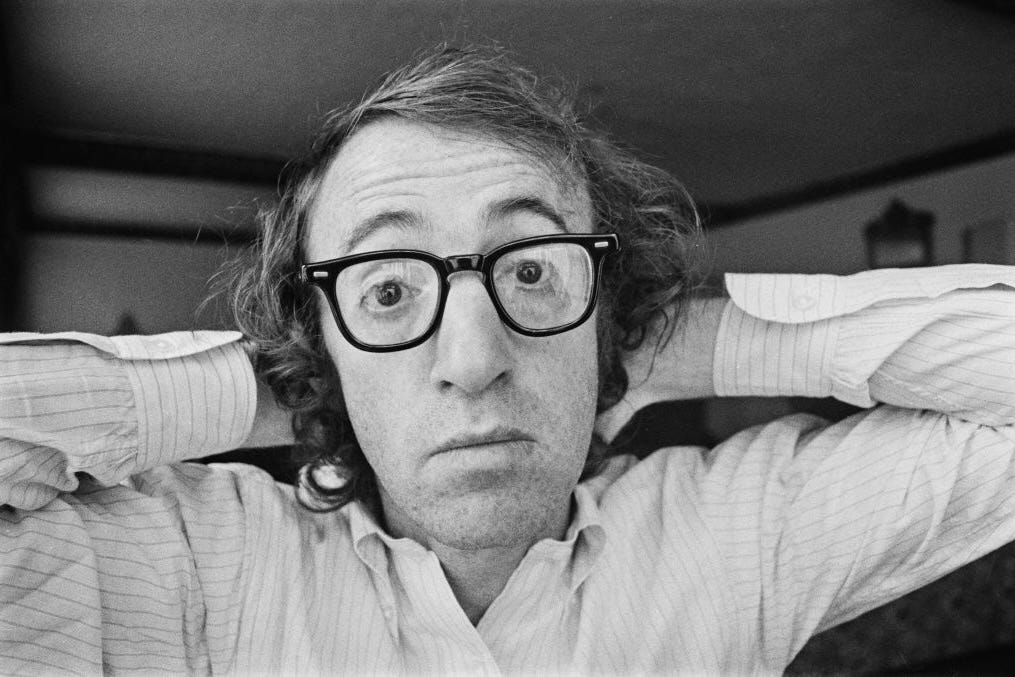
Today, not much is known of Allen’s domestic life; a discrete third act wedged between two roaring avenues on a quiet Upper East Side street. When Allen did happen to appear at a Halloween party with Soon-Yi in 2013, Page Six reported that he left the moment he “became the center of attention.” We know that he attended many dinners at Jeffrey Epstein’s apartment and hated the food, and also that he heroically saved a man’s life with the Heimlich maneuver in 2023, as reported by Page Six. It’s comforting to think that Allen is still up there working everyday, honoring the same routine — the treadmill, the typewriter, the careful diet. The thick glasses and high corduroys and reliable hairline that hasn’t budged since the ’70s.
What’s With Baum? is Woody Allen still wrestling with the same questions from a past life. The prose will not change your life, but you will chuckle. Even chortle. He isn’t in competition with the gods of literature at this point; he writes for himself. Woody Allen is still on an inner journey, still lusting after someone’s sister or a drooling fan with great legs and a taste for the arts, even at 90. Woody Allen has developed his craft at a level that has earned him the right to repeat himself, and it’s a delight that he’s still around. The same Woody Allen who directed Crimes and Misdemeanors and Annie Hall is coming out with new work and it’s still the same! The inner compulsiveness, the commitment to his own preoccupations — is it a dedication to legacy? Nope. It’s just that Woody hasn’t learned a goddamn thing.

Noah Rinsky is the creator of @oldjewishmen and the author of the bestselling humor book, The Old Jewish Men’s Guide to Eating, Sleeping, and Futzing Around. His personal Substack is Father’s Milk.

you have convinced me to watch deconstructing harry
"Searching for someone in New York who is confident Woody Allen molested his daughter is like looking for a beard at the Western Wall. They hear a few grisly details, watch the HBO doc, take one look at Allen’s big nose and squinty eyes, and decide he’s 100% a pedo." oooooomph