


In June 2020, a friend and I were walking to a Black Lives Matter protest in Columbus, Ohio. Pristine downtown storefronts with boarded-up windows made things feel fake-apocalyptic. Then we heard the sound of glass smashing and people screaming. My friend wanted to leave, but I insisted we turn the corner to see what was happening. We stuck our heads past the faux-brick wall and saw no one. The screaming and window-smashing cut to dialogue. It was coming from a television in someone’s apartment. The protest, when we found it, was also an overproduced phantasm. Mainly, my memory is of people with signs marching around a blond and smooth-faced boy who lounged atop a shiny Mustang, phone in hand, chains glittering in the ringlight. As an outlet for collective outrage, the protest was very successful. It endures as a feeling captured in iPhone videos that no doubt garnered millions of views on that blond boy’s TikTok. But other than setting a moral agenda, the protests of the 2010s and 2020s achieved no tangible political outcome. The George Floyd Justice in Policing Act never made it through the Senate, and the post-2020 police department budget cuts have been restored, even augmented. Police violence has increased; in 2019, cops killed 1,098 people. In 2024, that number was 1,271. But Jeff Bezos, defender of “personal liberties” in the Washington Post, did (let’s not forget!) redraw the Amazon logo to say “Black Lives Matter” in June 2020.
Anton Jäger, a Belgian political theorist who teaches at Oxford and contributes regularly to the New York Times opinion section, argues in Hyperpolitics: Extreme Politicization Without Political Consequences — published in February by Verso — that the spectral nature of protest is a consequence of the spectral nature of political parties, institutions, and social cohesion. From the mid-2010s to now, Jäger identifies:
[A] new mode of interaction between public and private. It is dynamic, intense, and polarizing, yet also ideologically diffuse, visibly modeled on the fluidity of the online world . . . low-commitment, low-cost, and often, low-value . . . a Carrollian grin without a cat.
This era is hyperpolitics.
Like Baudrillard before him (and de Tocqueville before him), Jäger belongs to an intellectual tradition of Europeans who look to America as a case study in the political present, and as an augury of the global future. The result is a sleek little book that compiles and reworks essays that appeared in The Point, New Left Review, New Statesman, and Jacobin, providing a compelling and ambitiously broad overview of our current political era, gathered from a variety of sources: Michel Houellebecq’s novels, Wolfgang Tillmans’ photos, Weber, Habermas, Putnam, Graeber, Hobswam and Sloterdijk, Fisher and Žižek. All are placed in conversation by Jäger who deftly orchestrates with a dispassionate and perceptive ear.
Baudrillard gets the first word, in Jäger’s preface. In 1986, the French theorist diagnosed the U.S. with a case of hysteresis. America, Baudrillard said, is like a character in the Alfred Jarry story Supermale. It has died mid-bicycle race, but its corpse continues to pedal even faster than before, because sometimes dead systems function better than live ones. Since 1986 ⏤ when Baudrillard published America, six years before Fukuyama declared the “end of history” ⏤ a necromancer has been busy. The 2020s have seen an increase in political activity and a decrease in political outcomes. Voter turnout in 2020 was the highest it’s been since 1900, at 66%. Sixteen assassination plots against Trump plus 13 against Obama is a dramatic uptick from the two against Bush and five against Clinton. Indignation expressed through protests and capitol-stormings is the norm. But this political frenzy comes from an inactive, mushy civic body, whose workplace and community associations have dissolved in the “acid of deindustrialization and triumphant market logic.” No connective tissues ⏤ no political parties ⏤ remain, yet the ghost of politics flailingly animates the dead body politic in a semblance of frenetic activity.
Four eras make up Jäger’s reckoning of the past century: mass politics, postpolitics, antipolitics, and hyperpolitics. The period from 1914 to 1989 marked the era of mass politics. In 1918, Weber offered its definition: “a slow, strong drilling through hard boards.” Politics required a “passion and a sense of judgment” and, for Weber, a populace whose total political involvement, supported institutionally, was a given. Unions, clubs, and party membership formed the basis for political action, especially in the case of workers’ rights in Europe, because these institutions were able to pull the levers of governmental power. Unions were heavily involved in Martin Luther King Jr.’s March on Washington, and the outcomes of the Civil Rights movement ⏤ changes to voting law and educational reform ⏤ were protest’s tangible results.
Postpolitics, from 1989 to 2008, followed. The cover of Hyperpolitics is an emblematic photo of the era: a caution-yellow border frames a 1989 photo of a blissed-out woman in a nightclub dimly lit by a moon-like disco ball. Her eyes are closed, lips parted. A man reaches from out of frame, fingers laced through her hair. This moment of lazy ecstasy is called “Love (Hands in Hair)” by photographer Wolfgang Tillmans. For Annie Ernaux, another chronicler of the postpolitical era, “in the humdrum routine of personal existence, history did not matter.” In 1989, in this warehouse devoid of the industry whose crashes and clangs inspired the techno that the woman in the photo is dancing to, Tillmans captured revelers in Berlin and London in the wake of the collapse of the Berlin Wall, a rite of deliberate “collective amnesia,” an “after-the-orgy” in Baudrillard’s terms, when the bloodlust of both World Wars was forgotten, hippie love-ins morphed into board meetings, and the pleasurable tentacles of capitalism began to stroke consumers’ egos on a global scale. The personal pursuit of freedom (to consume) and enjoyment (of products) was everything. An era in which William S. Burroughs starred in an ad for Nike. An era in the U.S. not of Watergate wiretaps or large-scale Presidential child rape-murders, just simple extramarital White House blowjobs. An era of NGOs, consultants, slashes to union power, and shrinking church congregations.
The erosion of public political life under postpolitics uprooted political institutions, resulting in the mudslide into antipolitics (2010s), landing finally in the hyperpolitical gulch of the 2010s to now. George Putnam, in his 2000 suburban sociological treatise Bowling Alone: The Collapse and Revival of American Community, suggests that the end of civic life in the ’80s and ’90s was a result of longer working hours, car culture, shopping malls, and that “tombstone of postwar loneliness,” television. Though Americans were bowling, they weren’t joining leagues anymore ⏤ they were bowling alone. And this dissolution was felt most strongly by the left, an intervention of Jäger’s I’ll return to later. Jäger says that all this bowling alone produced the antipolitical era; Mark Fisher’s “depressive hedonism” and Sam Kriss’ “boozy nihilist perspective” were typical modes of politics in this era. Antipolitics, unlike postpolitics, was also characterized by populism and indignation. The anti- prefixed the status quo, and it manifested mainly on the left: as Sanders and Occupy Wall Street, as the Podemos movement in Spain, as the Movimiento 5 Stelle in Italy, and as support for Corbyn in the U.K. But it also had some right-wing manifestations that have, it seems, surpassed their left-wing equivalents: the Tea Party, Boris Johnson, eventually Donald Trump, and Matteo Salvini. Parties were further hollowed out, supported by external funders rather than membership dues. Now we have politics without parties, hyperpolitics:
[A] permanently volatile, diffuse phenomenon. Whereas populist parties at least made the first steps towards reinstitutionalization, “hyperpolitical” refers to a general atmosphere rather than to specific actors . . . a redoubling of antipolitics, a mode of viral panic typical of the internet age with its short cycles of hype and outrage.
Hyperpolitics is all vibes ⏤ and bad vibes, at that.
“Hyperpolitics” was originally coined in 1993 by Peter Sloterdijk. As social cohesion dissolves, said the Dutch political theorist, the once steady ship of state has become a high-speed super-ferry “so vast as to be almost unsteerable, plowing through a sea of drowning people with waves battering the hull and anxious conferences unfolding onboard.” Sounds like the annual luxury cruise of The Nation! For Jäger, a failure on the left was responsible for the shift to panicked hyperpolitics. In the U.S., Democrats did not rebuild political parties, but instead made a muddled, consultant-driven attempt at uniting opposing constituencies (becoming, to quote Christian Lorentzen, “the party of anti-monopolists and Silicon Valley; the party for immigrants and for border security; the party of family and of freedom; the party of ceasefires and the war machine; the party that opposes fascism but abets a genocide.”) The second issue is that Putnam’s thesis ⏤ that the dissolution of associative life leads to political atomism in Bowling Alone ⏤ is true more for the left than for the right. A study called “Golfing with Trump” showed Trump trouncing Romney in 2016 in Rust Belt and Midwest counties where golfing and other communitarian associations remained comparatively intact. On the right, there may be a civic renaissance afoot. Could hyperpolitics be history?
Jäger’s book, unsurprisingly, doesn’t end on a high note: “Our patient has awoken from a coma to a state of frenzied activity, without ever coming to terms with the symptoms.” Bouts of mania and melancholy (Jäger is paraphrasing Freud here) are a common response to losing something precious. And we have lost memberships in groups that once made it possible for us to exert some control over our political destinies. Groups ⏤ physical associations ⏤ sustained not only stable political entities but also our senses of self and agency. So, what’s a hyperpolitical leftist bowling enthusiast to do? “The prospects for any renewal will have to be sought in everyday life ⏤ in those circumstances in which people still regularly enter into contact with others.” Where are those places? Daycares and retirement homes, says Jäger. Jesus Christ. That’s fucking depressing. And neighborhoods, adds Jäger, unhelpfully.
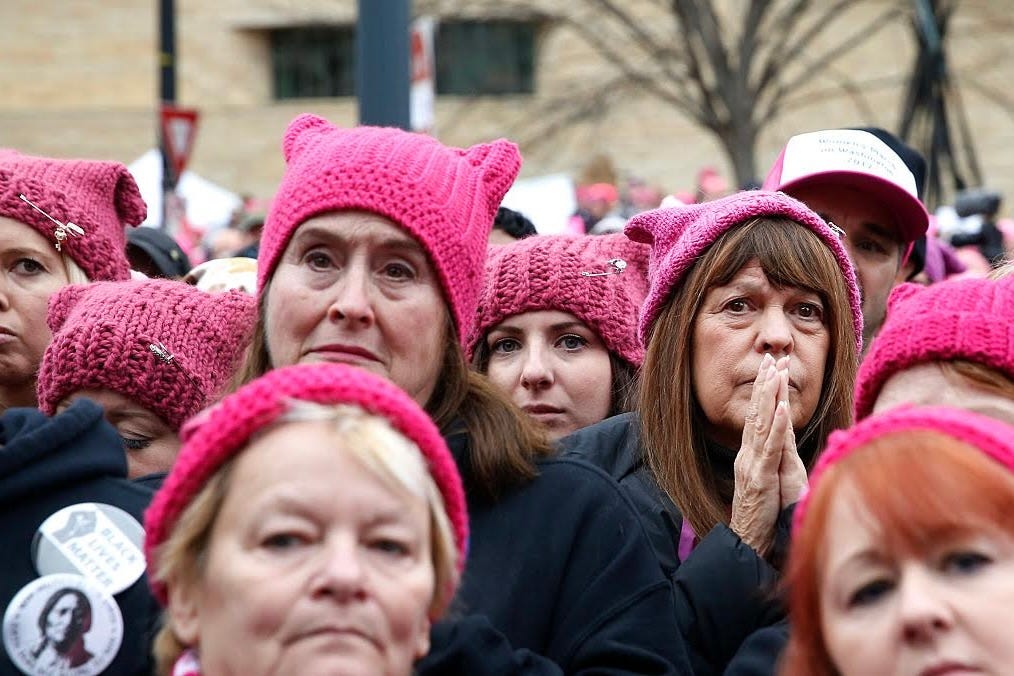
Perhaps the biggest problem with Jäger’s book is its gloomy nostalgia; for all his wide scope, packed into fewer than 100 pages, Jäger lacks the mischievous ironizing of a Baudrillard, or the innocent excitement of a de Tocqueville. If social media has made the ultraconservative slope slipperier than ever, it’s because the image the alt-right has cultivated and disseminated online is that it has fun. January 6th, with its carnival and pageantry, its Wagner horns and facepaint and parkour stunts around the Senate floor, looked like a good time. Pussy Grabs Back rallies? With those floppy pink vagina cat hats? Not so much. QAnon hint-drops were exciting, like the next installment of The West Wing wasn’t. The right has re-enchanted politics in a way that frumpy leftist consensus-pessimism simply can’t. No, my idea of fun in 2020 wasn’t watching an e-boy draped like a showroom dummy over his muscle car, but my idea of fun isn’t sitting in a drab two-hour DSA meeting, either. My idea of a party is, well, a party. Let’s go knock on Zohran Mamdani’s door and see what he’s up to.

Madeleine Adams is a writer living in Brooklyn, whose fiction and nonfiction reviews have appeared in The Baffler, Dirt, and Public Seminar. She is a contributing editor to the journal of literary philosophy, Book XI.
 |
|
This is great. I agree that one of the hidden reasons for Zohran’s success is the fact that he just seems like a fun guy. I sometimes feel like the left got eaten by the old Tumblr blog “your fav is problematic”.
“'The prospects for any renewal will have to be sought in everyday life ⏤ in those circumstances in which people still regularly enter into contact with others.” Where are those places? Daycares and retirement homes, says Jäger. Jesus Christ. That’s fucking depressing. And neighborhoods, adds Jäger, unhelpfully."
Jager is correct. Taking care of the elderly is essential to a full life; it gives purpose and perspective for which there is no substitute. And daycares anchor neighborhoods and connect families to a more visceral degree than even local schools do.
Depressing is a life surrounded by transient, childless adults who have never changed a diaper and don’t know how to talk to someone with dementia.