


Everybody knows Donte Carmello’s a criminal. But the crime’s not interesting. The reason he makes papers is he’s mysterious. Gray fedora with a black or white velvet band. Big scar up his cheek and over the brow. Driven day and night on these long slow laps around the city. Sitting in the back with a skinny brown cigar, misted by smoke, and his car’s got this dull bloated glide to it on account of there’s armor plating in the doors. Two thousand pounds. And so folks’ll pause on sidewalks or kick back on a tenement’s porch or set their chins on a third-story windowsill to catch sight of that jungle-green Cadillac purring past.
Fedora’d silhouette inside. Paintjob fresh and grabbing sun like a candycane casket.
People see it and think, Must be some kinda guy.
But then the car’s gone and they see a buncha kids craning their necks as it goes.
“Hey!” Some geezer shouting from a barbershop stoop, “Don’t look up to a guy like that.” Sweeping a sidewalk as he says it. Kids walk away like, Yeah. Sure thing.
Cuz the other thing they like about Carmello apart from the mystery and the glamor is he’s generous. Like there’s a story that he’s getting driven around through the rain one day and sees a buncha paperboys huddling under a storefront, curled over the bundles of newspaper, and he sees they need shelter. Can’t say no to it. See, those’re Krohly Diary papers they’re selling. The only penny-daily in the city. Printers advise reading it with your face averted so’s your breath won’t soak it. These newsboys, in a downpour like this one, even just the moisture in the air is enough to set the pages’ edges dissolving into wormy gray flecks.
Which means they have to protect those papers long enough to get them sold. Not because it’s their “job” to sell papers, or they’ll get in “trouble” with anybody; only consequence is they’ll lose the investment.
The thing nobody mentions about paperboys is they gotta buy those papers.
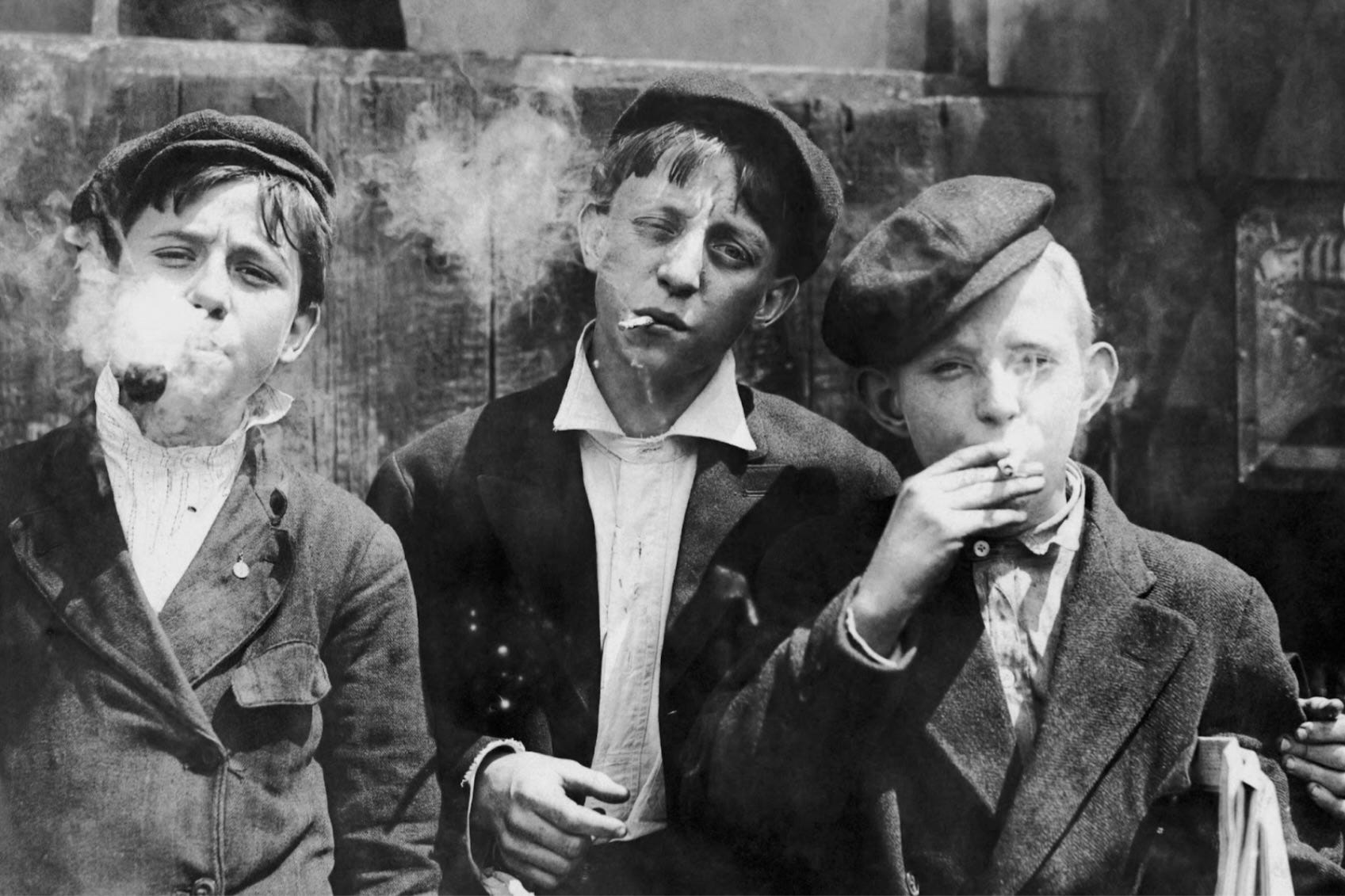
Go look at the Krohly Diary offices every morning at daybreak. The couple dozen kids lined up in the cold, hands in their coat pockets, paddy caps pulled snug on their heads. Chewing licorice with small steaming bites. Passing around a thermos with coffee and maybe a splash of some golden thing they pilfered from the fire extinguisher over the pantry back home, the one their dad keeps adjusting like Yes, well, gotta make sure it’s working, or else they’re rolling cigarettes with pages torn from those little onion-skin Bibles the temperance people hand out, mostly women, doing God-knows-what on the sidewalks at all hours, “Here Have A Bible Here Have A Bible,” some snarly Christian victory lap, nationwide, 1921 and here they’re all marching in circles with their picket signs against alcohol (Lips That Touch Liquor Shall Not Touch Ours!) and occasionally one of the ballsier kids — or maybe he’s angry cuz he spent a whole goddamn dollar on a Krohly Diary bundle today, thinking the front-page story of a pharmacist’s murder would sell like hotcakes when in fact it sold dick — he’ll pause his angry homeward trot and gesture with two ink-stained claws, “It’s banned already! Fuck’s the pointa this?”
Kids.
4 a.m. and they’re out here, chewing their sweets at the back door of the Diary or the Herald sipping their coffees, sugared and Irished, smoking their cigarettes, cloves, bouncing little red balls that go pok! in the alleyway’s cobblestone acoustics, pok!
The sound travels.
It draws shadows, tall and sharp-headed in the gas lamps at every streetcorner.
Kids catch sight and freeze: “Hey,” hissing at each other, “hey cut it out — look.”
Cops. Strolling past the mouth of the alleyway. Alone or in pairs. Thumbs in their belts and preening. Talking shit. “Why it’s keds then.” Looming into the alleyway. Skinny legs and fitted pants with bellies jutting. “Lookitum.” Tsk tsk. Adjusting their cophats by the many-pointed brim. Truncheons heavy on their hips. Dense flops of wood. Glossy black shoes hide their hooves and say tak! against the cobblestones.
One of the kids stands up short and dense and flanneled against the chill. Rolls his shoulders. Juts a chin at the cops. “Spend a lotta time polishin your piece?”
Standing here with his chest out, preening right back at the officers, miming with his fist a pole-polishing gesture. Fourteen years old but short for his age, fat-looking but really it’s density. Cops try to roust him and hurt their hands. Like shoving a fire hydrant.
Paperboys laugh. The dozen who heard. They don’t all get the joke but they’re laughing anyway.
Officers just smile and nod. Confer with a glance. Mutter their cop code. They pocket their hands and rock on their heels so that the little chains on their belts go chika-clik and -clak. The kids take note of the cuffs and some of the chuckles go like wet clothes over a line.
Carney Company handcuffs. “Swing throughs” is what the cops call them. Used to be those horseshoe-looking things with a bar that runs through, like a letter D, easy to slip off, especially if you’re little. Not these. The Carneys are proper bracelets. Grab your perp, slap those loops on his wrist, hear the clasp go clik-lik-lik until they fit nice and snug. No more of this business about kids being too small to shackle.
The Carneys ignite a new tension with cops and newsboys. Rare is the Nashport family that lives in a larger-than-one-room apartment. Kid wakes up in the morning, sprawled on a Murphy bed with his two sisters, he squints at the shape looming over him, it’s his mom, up with the sun and telling him, “OUT,” handing out breadrolls like court summons, smacking flanneled bottoms off the collective bed, “Up and out, come on, hurry,” meaning schooltime, crimetime, fine, just go, don’t come back til supper. Dad’ll be out and mom’s here with work of her own. Piles of uniforms from the Kelly family’s bakehouse, two blocks over, she’s washing and mending for a quarter. Needs the space and the quiet like most every other mom in this building and the one beside it. Maybe after school they’ll run back and shout up to the window and if she’s feeling generous she’ll tear off some newsheet and wrap a nickel inside and drop it down so you don’t miss. Get some penny candy to hold you over. Gamble with it.
And so there’s two groups of people on the street from dawn to dark and that’s kids and cops. The kids outnumber the cops by a factor of, Jesus, who knows; same time, though, the kids have to answer the cops, which doesn’t seem to make sense, instinctively, especially given their behavior (the cops’) and what almost everyone feels, but nobody says it out loud, which is this:
If in this modern world of 1921 they’ve gotta decide whether to raise their families in a world of cops or Carmellos, the choice isn’t looking so obvious as maybe six months prior.

Nobody’s crazy about the bootlegger violence or the bathtub brewers who make the whole hallway smell like shit — what they’re mad about is the cops, of whom it’d be one thing if they were just inept, which god knows they can be, but what’s galling now is how flagrantly on-the-take they are.
Not all of them, but a lot. Maybe most.
And yet it’s hard to be mad if you really sit and talk it through!
Think about it: a cop with Nashport PD, your average blue, he’s making, what, $1,800 a year? $2,100? It’s not big money. Especially for such dangerous work.
His job is to enforce the law and win the trust of John Q. Public.
Thing is: John Q. Public keeps breaking the law. Postwar economy, jobs’re sparse, the one thing everybody wants but can’t get is booze, though, and it’s easy enough to make it at home, or smuggle it from somewhere, and so that’s what they do. Small-timers. Rum from Key West. Cubafruit from San Mara. Pints and bottles with ease, sometimes whole cases. Mr. Public brings home a fire extinguisher fulla grain liquor and dumps it in a bathtub, fluffs it with water and caramel, if he’s wise he’ll use a thick sweet odorless thing called glycerol to smooth it out and then hey: scoop it with a mason jar and screw the cap on. Y’know who’ll buy it?
Anyone.
If your plan, as a ’20s cop of the Nashport or New York or any other PD in a metro area, is to arrest every person you see buying alcohol, it’ll be the only thing you do, ever, and you still won’t make a dent. May as well grab a net and chase rain. Because contrary to what the buttoned-up pols would have you believe, here’s the truth: while all these godless drinkers are sitting at home, sipping tasteless hooch over a jigsaw, people are still getting murdered.
All the other crime in town didn’t vanish.
So here’s the rub: if a police department’s budget is overseen by politicians, the politicians have to pander to the voters, and the way they’re pandering at the moment is by telling them all the world’s problems are found in a bottle and pretty soon our streets’ll be clear of it. So the pols lean on the cops. They say, You want a bigger budget? Press more liquor charges.
But it’s their “efficiency” at apprehending and prosecuting these petty liquor offenses that ends up clogging the courts. Some hundred hearings a day for this shit. Literally. Every judge is sick of it. Not to mention neutered, basically, since there’s not enough jail space in the world to even hold all these people getting dragged in here.
If you’re a cop, and you want to get a sense of how your hard work is helping the community, go sit at one of those hearings on a Tuesday. Check out the judge’s face when some single mother stands trembling at the bench, wringing her handkerchief, pleading for mercy on account of some guy in the building, who’s since run off somewhere, offered ten bucks if he could ferment some wine in her kitchen cabinets. Two kids at home and guess what her mechanic husband’s in jail for right now.
These are the people getting scooped up now that Prohibition’s on. Not “gangsters.” Not lurid sex maniacs in speakeasies, either, which nobody even goes to. Craving a beer? Hey come on down to the speakeasy! Fuckin flat foamless pint’s only seven times what you paid for it ten months ago! What the dimebooks and the pols and the papers never mention about speakeasies, is the price. Nor should they! What they’re marketing is fear and there’s nothing scary about knowing you’ve got a speakeasy on your block. Your average schoolteacher, plumber, fireman, busting their ass for twenty dollars a week — you think they’re popping into speakeasies for a ninety-cent martini? Poured from a bottle with no label? Odds are someone fixed it at home? Plus it’s being served by a, a . . . by a what’s this guy, Italian?
No. They don’t. Y’know why?
Cuz everybody hates this shit.

What happens is the small-timers get picked up in droves, which leaves the big-timers, the Donte Carmellos of the world, operating with something worse than just impunity: market share. They start chafing, fighting over territory, and so now, big fish in a small barrel, there’s no way they can regulate their differences in court and so they’ve gotta do it on the street.
Violence means pressure on cops to crack down on organized crime.
OK but you’re still prosecuting the small-timers, cuz those’re easy numbers, so now you need more cops.
Except then it creates this paradox because organized crime tends to flourish under a police state; in other words, you take something like booze — which everybody wants, everybody’s accustomed to having it, for the Jews and Catholics especially it’s part of a sacrament — and you start slapping Carneys on everyone from Donte Carmello to John Q. Public in his underwear, in full view of the neighbors, you’re gonna end up with two things: (1) angry voters, and (2) it means the supply of alcohol, confiscated and (“hey where’d it go!”) chronically misplaced by officers of the law, falls below the demand for alcohol. This means the price of booze goes way high, which in turn means there’s all these households on hard times where, guess what, the teenage boys are getting propositioned by some local fat cat with a silk suit and a gold wristwatch, pair of hundred-dollar Eckelburgs on his nose, counting out greenbacks from a stack in his pocket, “Wanna earn some jack, Jack?”
The cops get so outnumbered they start hiring in a hurry, and the only feasible way to do that is to forego some of the vetting process, which means people start getting hired to the police force who, any other time in history, are supposed to be running from the police force.
And guess who they’re keenest to terrorize after a while?
Who’s the most vulnerable person in a community?
Who’s the smallest?
The youngest?

“Lookitum.” Cops lifting their voices now so the newsies can hear. “Sounds like they’re scared. Sounds like they feel mistreated.”
Syd’s underdressed for the cold of these pre-sun hours in the alleys of Nashport but hey fortunately he’s angry enough at these guys to put his chest out and think, Yeah. Mistreated. Like Martin Hapcomb was mistreated.
That was four months back now. October 1920. Some cop tried grabbing one of Marty’s papers without paying and Marty snatched it back, told him to kick rocks, get fucked — the works. Other paperboys overheard it and said, “OoOooOoo . . . ” fists at their mouth, scandal and delight, whereupon the copper in question got all red in the face. Fuming. He looked this way and that, catching their eyes, smirking finally, and Marty Hapcomb meanwhile stands there tense, waiting for the cop’s hand to shoot back out, grab again for his paper.
And then it happens! Cop’s hand flashes up — Marty snatches his bag outta reach — but the cop’s hand isn’t going that way, outward.
It’s flashing upward. From his belt. In a swift liquid move like a dancer he cross-drew the truncheon off his belt and arched it up, high up, then whipped it back down, straight, bending at the waist and hurling the weight of his back and legs and shoulder into a swing that brought this truncheon down on Marty Hapcomb’s crown like to cleave it. One kid who was standing five paces away says to this day he can’t go near a baseball game, as the crack of a homer makes the same noise that bludgeon made when it broke a trench in Marty Hapcomb’s head and webbed his skull with cracks.
Hapcomb dropped fidgeting with his eyes rolled back and his jaw watching and the cop stood there just looking around for a moment, breathing, chest going up-down-up-down, holding his composure like it’d only just hit him, what he’d done, and that there were five or six kids who saw it — but then he found his composure and just, real casual, he just bent down. At the waist again. Plucked that same stolen newspaper off the chest of the convulsing child. Tucked it under his arm. Walked off. Sheathing his stick with elan.
Marty was in a coma for a while. Everyone was happy when he came out of it but he couldn’t talk or sit up. Doctor said it was temporary but it wasn’t. These days he sleeps in a crib because he has seizures in his sleep and might fall off the bed and he’s got no muscle or fat to cushion the landing. (Wanna know the saddest part about thirteen-year-old Martin Hapcomb sleeping in a crib? He fits.) Drooling all the time. Shitting gruel. His dad’s a builder and fixed some wheels to a dinner chair, with a canopy jutting over the top of it like a parasol, so that he can bring Marty on a stroll through the neighborhood, swaddled in blankets up to the neck like a mummy. Googley-eyed and salivating and huffing teary smiles whenever Syd comes around, thumbing his suspenders, “Who’s this guy?” playing a big shot and wrenching the chair’s handles away from Marty’s dad, “How fast can he go?” then pushing him at a near-sprint through the seedier streets of Nashport where the shadiest characters, the guys you don’t look at if you know what’s good, they take their hats off and call, “Ford’s latest!” Smiling. Callused Catholic hearts wrenching for Marty, sclerotic in his chair, braying with delight and jostling over the bumps and the cracks, his chin as wet as his eyes.
Fuckin Marty Hapcomb. Bright, beautiful, ballsy kid. Made a cop feel small and the cop fucked his brain up.
Paperboys don’t forget it.
This is the milieu and those’re the tensions when a linen-clad criminal in an armored Cadillac finds four paperboys huddled and stranded under a canopy outside a tax office and tells his driver to slow down, roll back, stop. Pops his car door open and calls to them. The backseat is dark. The leather’s black. Nothing but dim gray storm light to trace his outline — except his diamond stickpin winking. His pinstripe kneecaps and his hat brim and smile. Beckoning with a ring-studded hand. “Boys need a ride?” His face in the shadows and the bluish haze of his left eye’s cataract stirs like creamy fog, and the silver eyetooth winks a thrifty menace from a grin. Little gray details in the halflight, glimpsed through a curtain of rain. Normally they might’ve said it wasn’t worth the risk, trusting this guy enough to hop in his car, but hey, if they wanna know what he looks like, they only have to look down at their papers, fresh-bought for ten cents this morning from the Diary’s back door:
There he is. Page One, above the fold.
“Carmello Questioned in Cop Slaying.”
In which case it’s not so much the mystery that makes him interesting, but the crime.

Alexander Sorondo writes a Substack newsletter, Big Reader Bad Grades, and his debut novel, Cubafruit, was recently nominated for the Samuel Richardson Prize. He lives on Miami Beach.
 | A guest post by
|
I like the atmosphere in this and the narrative voice.
A dyspotic tale apropos to our current dyspotic times...