

Cerfin' U.S.A.
On Gayle Feldman’s ‘Nothing Random: Bennett Cerf and the Publishing House He Built’


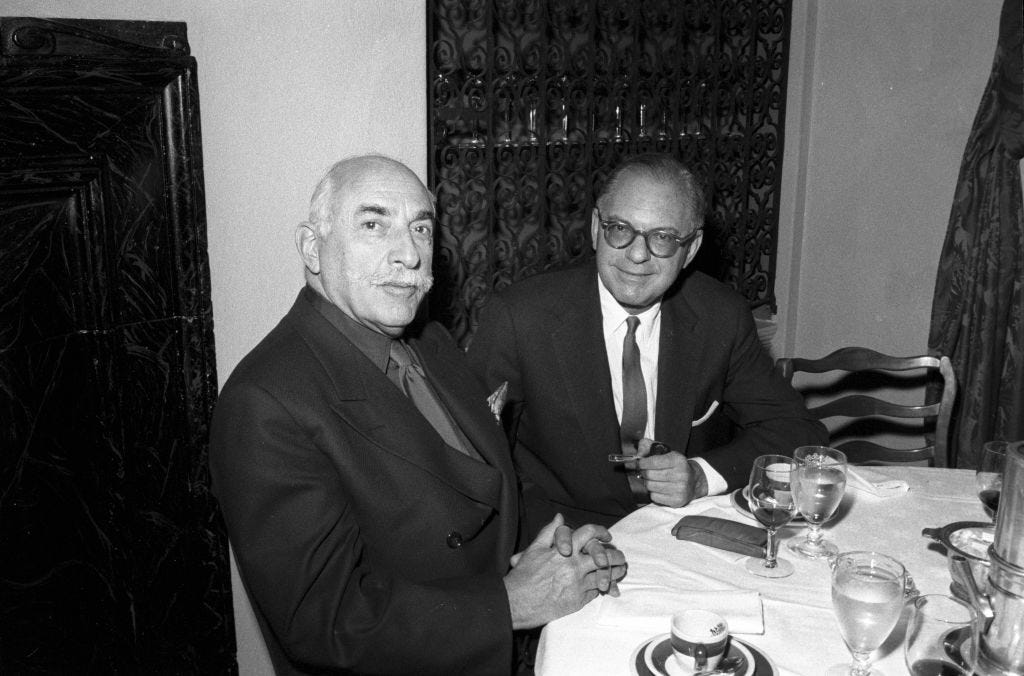
Emoji-faced Bennett Cerf, founder of Random House and star of the YouTube-friendly game show What’s My Line?, is no longer remembered. In his lifetime, he was close to Frank Sinatra (a pallbearer at Cerf’s funeral), Truman Capote (declined to be a pallbearer — too waifish?), William Faulkner, Eugene O’Neill, Ayn Rand, Gertrude Stein, Dr. Seuss, etc. etc. etc. Each one easily worth a monumental biography; yet in Nothing Random Gayle Feldman gives Cerf and his publishing kingdom (only after his death an empire) the 1,000-page treatment. Until his death, Cerf was as famous as any of these — even Ol’ Blue Eyes.
The first 10 percent of any biography is skippable. Generally the childhoods of the famous are tedious; Bennett Cerf’s is no exception. He was not Arthur Rimbaud. I confess I fail to care about where precisely he lived or New Yorkers’ prestige-based sub-subdivisions by street address (as Groucho Marx once said to Dick Cavett, he himself was born on 78th Street, “between Lexington and Third”). The least class-conscious people in the world are always the most. Cerf would later change his office’s official address to avoid having the unfashionable Third Avenue on the headed paper. It is good enough for me to know that Cerf was born in Harlem and died in Westchester County. I am not particularly interested in his grandfather’s tobacco business, nor that his father was good at baseball. Feldman has to do this work, and a reviewer has to read it, and it is fascinating to no one. It seems to have been along the lines of the typically slow Jewish tri-generational trajectory: peasant — fur trader — Nobel Prize winner. Or, rather, Cerf’s authors would win the Nobels for him.
Here we go. He had a middle-class and not particularly Jewish childhood and was brought up reading boys’ adventure books. Like everyone born in the 19th century he put together a childhood newspaper to sell to neighbors. He goes to Columbia; edits the college newspaper. Cleverly, he fails an eye test in order to survive WWI — then the decision is reversed, and he’s shipped out to Virginia to become an officer and artilleryman. The Armistice; Phi Beta Kappa; middlebrow tastes (“Wells, Kipling, Arnold Bennett”); inheritance; Wall Street; month at the New-York Tribune (fired); Vice-President and Director of Boni & Liveright; buys Modern Library from Liveright; travels Europe; names firm Random House. By this point, Cerf is still in his 20s.
Cerf had been mentored by the incredible Horace Liveright, a tragicomic Falstaffian character often found in flagrante delicto at work. His bleak decline is in poignant contrast to Cerf’s whistle-stop ascent. In 1925, Liveright sold Bennett and his colleague Donald Klopfer the Modern Library, a deal which bankrolled the rest of all three of their lives. It produced cheap reprints of books from Europe, and would in the 1990s be responsible for the infamously ubiquitous list, “Modern Library’s 100 Best Novels.” Random House was a start-up imprint of Modern Library, founded 1927, and intended to publish a few contemporary books “at random.” Soon, Random House was an even greater success than its parent.
More than business, less than friendship, the publisher-writer relationship has a peculiar intimacy. I would likely not attend the funeral of a business contact, yet Cerf flies to Mississippi for Faulkner’s. (We learn that nobody in Oxford or Faulkner’s family has read any of his books, yet they insist all businesses close at 2 p.m. for a quarter hour to honor their great son.) Feldman’s real gift is — ironically for a writer of a great, long biography — microbiography. The capsule life of Eugene O’Neill is thrillingly told, as is the longer story of United States v. One Book Called “Ulysses.” Book-chat folk will delight in stories of Alexander Woollcott and Gertrude Stein, of Roth, Mailer (almost assaults Cerf), Rand, Cormac McCarthy. Coups for progressive Random House were Ralph Ellison, Toni Morrison, and Maya Angelou; likewise Isherwood, Auden, Spender, Coward, Capote. There is a ceaseless honor-roll of Hollywood, from Cerf’s first wife, Sylvia Sidney, to Anna May Wong, Ginger Rogers, Shirley Temple, Claudette Colbert, Marlon Brando — etc. There are the Broadwayites: the Gershwins, Kaufman & Hart, Rodgers & Hammerstein. There are McCarthy & Cohn, and Hoover, and Kissinger. Cerf hated McCarthy, and stood up against HUAC. He was related to Hoover by marriage, and though the FBI kept a file on him, Hoover had it sidelined. In later years he met Kissinger at Frank Sinatra’s house and invited him to his country place, hoping to publish him. My advance copy does not have an index, but it must be incredible.
Half literary and half gossipy, these parts are diverting. The extravaganza of showbiz goings-on, in 2026, reads like the lament of The Wanderer in the anonymous Anglo-Saxon poem: Hwær cwom maþþumgyfa? Hwær cwom symbla gesetu? Hwær sindon seledreamas? Where has the treasuregiver gone? Where are the seats at the feast? Where are the revels of the hall? Everyone Cerf meets assumes he cannot really be reading the books he publishes, yet a century before our brainrot age we see him sit up late to read Proust, Faulkner, Joyce. Gertrude Stein playfully calls him “dumb” — but they all respect him. Are our middlebrows now reading Absalom, Absalom! and À la recherche? We who for gods would look to JoJo Siwa and MrBeast?
Yet, as a literary study, there can be no depth. It is about a facilitator, not a real writer. I’m writing this the same day the New York Times has said Cerf is as worthy of Feldman’s 1,000-page biography as New York City Parks Commissioner Robert Moses is of Robert Caro’s. Yet Caro uses Moses as a bonesaw with which to vivisect corruption. His subject is politics: the amassment of power. Feldman, her Random House biography published by Random House, lacks the wagon she might hitch to Cerf’s star. There is no “motive,” or “idea” — this is a stately, scholarly, expansive, exhaustive and exhausting study of 20th-century publishing and of the somewhat tiresome Bennett Cerf.
Obsessed with publicity, Noël Coward’s dictum, “Television is for appearing on, not for looking at” might well have been Cerf’s motto. Except that, as Feldman reveals, he used to obsessively watch himself on television, once leaving a party to do so when he discovered the hosts did not have a set (incidentally, ctrl+f “party” reveals 155 matches). News begets news. Cerf was one of the few people who seemed to realize that book sales could be fed by publicity around the publishing house itself. He made himself a celebrity, and it made Random House. He wrote weekly columns that reached tens of millions. What’s My Line? was for a period the fourth-most-watched show on television. And Cerf was himself a million-copy bestseller, writing humor books and anthologies of gags, 24 of them, which were inexplicably adored. There will always be people who vote the wrong way and there will always be people who find New Yorker cartoons funny.
But Cerf, beneath thick strata of frivolity, was complex. He did champion Ulysses, fighting a ban to have Joyce published in a non-piratical edition in the U.S. This is beautifully told in Nothing Random, as it is in Richard Ellmann’s James Joyce. It is the reviewer’s privilege to repackage these and other anecdotes as if he has discovered them. Here’s one: Cerf and his lawyer Morris Ernst had to force the customs inspector to search their suitcase and then force him to seize Ulysses. They’d admitted to smuggling contraband and the inspector was too hot and tired to care. Seeing the copy, he said, “Oh for God’s sake, everyone brings in that.” Here’s another: after Finnegans Wake, Cerf wrote to Joyce proposing he do another book in a “more popular vein.”
There’s a book to be written on Jewish American history and how Modernism was sold, and championed, by publishers like Cerf. A brief version of it would be: pre-First World War “WASP family firms” such as Dutton, Harper, and Scribner were naturally more conservative, publishing grand trad types like F. Scott Fitzgerald, Edith Wharton, and Thornton Wilder. As Modernism exploded in Europe as a cultural force, it was always slightly too esoteric for mass appeal, or indeed was censored outright (on a scale, say, from the British censorship of Lawrence at one end to Nazi book burning at the other). Modernist writers began to make real money when passionate new Jewish publishing houses based in New York gambled on them: Random House (Faulkner, Joyce, Stein, Auden), Knopf (Lawrence, Stevens, Eliot, Pound). Modernism was the chic way of being a social pariah. Consider that Joyce, Stein, Lawrence, Eliot, Pound, and Auden were all expats. Things are really fucking bad if you have to move to Paris. I once did.
And, of those, Cerf met and was friendly with Joyce, Stein, Lawrence, and Auden. He refused to publish Pound, considering him a “traitor,” but reversed his decision after a massive backlash against censorship led by Auden. Later he was prepared to publish Lolita, only relenting when an editor with a daughter the same age as Dolores Haze complained — Cerf allowed himself to be overruled. The same editor would veto Mailer’s The Deer Park (JFK’s favorite Mailer according to Arthur M. Schlesinger Jr.), which Cerf called “very dirty” but which he would otherwise have published. Cerf was able to contradict himself. He would publish the young Philip Roth, yet he also considered Lady Chatterley’s Lover to be a “deliberately pornographic . . . . dirty book.” He was not a crusader for writers’ freedoms, so much as someone with ad hoc prejudices and a hatred of being dull.
Feldman took a quarter of a century writing this biography. It’s a piece of colossal infrastructure: it’s like a very important freeway interchange, from which many other interesting locations can be accessed. Should a biography have novel-like editing, narrative vim, gusto, pep, dash? Cerf’s own memoir, At Random, has. He’s vaguely humorous and fits his high-profile life into 200 pages. Feldman’s biography of him has 200 pages of endnotes. It has achieved comprehensiveness. I now know that Cerf had “always driven Cadillacs” but his wife “lobbied for a Buick convertible.” I’m also not really interested in the exact specification of house Cerf bought in Westchester County (guess what: it’s white, Colonial Revival, with columns). This is not Feldman’s fault — a biographer has to biographize. But am I surprised that a rich New Yorker had a nice car and a nice house near New York City and another in New York City? Compare for example biographies of Saul Bellow, where his house does matter, because it is a central element of Herzog, or where his car matters, because it is a central element of Humboldt’s Gift. In biographies of those who aren’t sublimating their possessions into their art, it’s just forgettable décor. This really is the issue: Bennett Cerf’s personality is not worthy of biography. He is the vehicle — a dignified, high-spec Cadillac, no doubt — to tell the story of Random House.
The best part of this biography is when its subject, Bennett Cerf, dies. The epilogue details in another zippy microbiographical history the last 50 years of book publishing. Dozens of mergers, acquisitions, firings, and hirings lead to Penguin Random House (2013) and eventually the Justice Department quashing PRH’s purchase of Simon & Schuster (2020–22). Such business entanglements are foreshadowed by what Cerf does to Random House, tying up film and Broadway and books, indeed trying to buy Penguin several times, and in this he and his firm are like a genteel, 20th-century version of the 21st’s present superficial ghastliness, the Cadillac to our Tesla.
Now that every film is made by Disney or Netflix, and every significant cultural product is controlled at arm’s length by various private equity firms, I long for all-smiling, happy-go-lucky publishers like Bennett Cerf, who really did read the books he was putting out, and really would have you to the Random House “palazzo” to chitchat about novels. When AI focus groups begin to decide, literally soullessly, on the exact formula of profitmaking efficiency for every work of art we are to ever experience, either we lock in, blissed out in the slop, or we decline to, and return to a new primitivism of anti-elegance.
It is simply amazing how the haute-haute bourgeoisie, those who own the magnates, have willingly alienated themselves from their own labor, and will continue to do so, accelerando, as they outsource their opinions to artificial intelligence; which is like feeding your blood into a predetermined Saw trap whose purpose, when full of your blood, is to guillotine you. Three cheers, then, for Bennett Cerf: tedious, inane, kindly, and human. Read this biography, abundant with erring lives, to see how much we have to lose.

Ben Sims is a novelist from London, UK. He publishes Short stories once a month. His debut novel will be released in November.
 | A guest post by
|
That's Henry Morgan in the photo.
Funny that, for I find most biographies last two-thirds to three-quarters worth of pages generally dull and uninspired. I like the beginnings, the acorn before the mighty oak, not the great deeds of famous people once they are famous, for we know this list, or should. In any case, most all panelists on What's My LIne were scintillating, charming, and smart. Each possessed that wonderful mix of high-middle-low brow intellects, interests, and enthusiasms. Find me a show or group of supposed celebs today who can match them. I'd tune in. Just one old guy's take.