


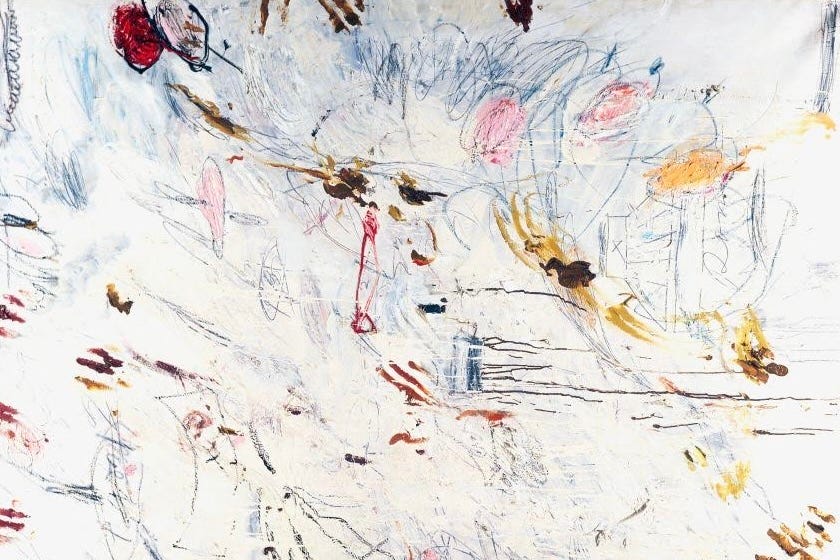
Please enjoy these poems from J.R. Solonche and Katharine Diehl that examine intensity through art and thought.

—The Editors
Coltrane on Soprano


                                                                               His
                                                                            eyes are
                                                                           so closed
                                                                          they're op
                                                                        en. From the
                                                                        top of his he
                                                                      ad, he sees the
                                                                      music coming
                                                                      at him eleven
                                                                    notes at a time.
                                                                    He must squee
                                                                   ze them all thro
                                                                   ugh this narrow
                                                                  tongue flick of a
                                                                  horn, this squeal
                                                                  er, whiner, sopra
                                                                 no, diva of a high
                                                                pitched saxophone.
                                                                 Flurries of fingere
                                                                 d-key-fingers indis
                                                              tinguishable from eac
                                                            h other, strike the honey
                                                      from the stone. O, blurry pain
                                                    and slurry sorrow suck the merci
                                                ful marrow from this brass-gold bone.

Nominated for the Eric Hoffer Book Award, twice for the National Book Award and three times for the Pulitzer Prize, J.R. Solonche is the author of more than 50 books of poetry and coauthor of another. He lives in the Hudson Valley.
Driving in the Highlands

What catches the tongue in the throat like a loss of meaning?
What I speak of came into being
By means of brutal necessity.
What is not bartered or consigned.
Whose arc does not bend.
My subject is not the unsayable but the unsaid.
Now curse, now clearing.

Katharine Cortese lives in New Jersey and has published chapbooks with Dancing Girl Press and Typewriter City.

 | A guest post by
|
 | A guest post by
|
The Latin phrase was Carl Jung's personal motto, which to him "represented the idea that archetypal forces or the "divine" (the autonomous power of the unconscious) are always at work in the human psyche, whether an individual acknowledges them or not. He used it to remind himself and his patients of the objective reality of spiritual forces in everyday life."
I'm sorry but as a jazz fan, I have to throw the red challenge flag here. Coltrane did not have specific notes in his head and then play them extremely rapidly- that was Charlie Parker, and he played alto, and if you slow the recording down, the precision is more easily discernible. Coltrane's "tower of sound" solos were deliberately chaotic- he sounded all over the place and frenetic because he was. He was a great arranger and gave McCoy Tyner a chance to shine, and when Wayne Shorter heard that, he knew he had to have Tyner on Night Dreamer / Armageddon. So, very influenttial and popular player, great arranger, but there was no precision in the solos - nor did he intend there to be.