


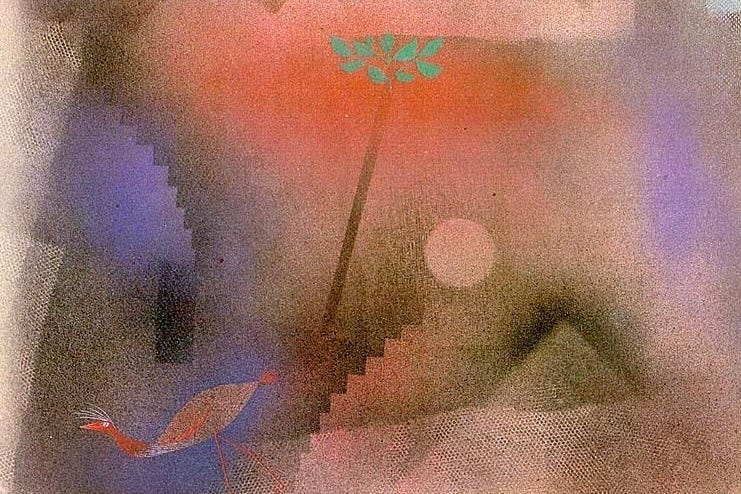
To live with plants, even if one lives alone, is to not truly live alone. Plants are living beings, with both a genesis and a death; for a while, like us, they are infused with life and then that life recedes. I have wondered whether plants go to heaven when they die. Or whether their life essence, once it leaves their material substance, joins the greater consciousness, and whether we can feel their spirit surrounding us the way we do when a person dies.
“Everything alive is sentient,” Michael Pollan says in his new book, A World Appears: A Journey into Consciousness. Describing a walk home through a grove of trees, he tells us he is humbled by the sudden feeling that “the kinship of all these sentient others” could finally be “an antidote to our loneliness.” He echoes Wordsworth, who in describing nature spoke of something “deeply interfused.” Nature is infused with consciousness. One imagines, when reading this passage, the trees sensing Pollan’s realization and swaying in gratitude as he walks by.
A World Appears is Pollan’s 10th nonfiction book, and it is billed simply as “a journey into consciousness.” He has also written bestselling books on food, botany, gardening, and psychedelics. An impression of him, even before reading this book, glimmered in my mind as a kind of mysticism-whisperer to the respectable masses — someone capable of introducing potentially inflammatory ideas, such as the connection between mental health and psychoactive plants, to people who listen to NPR and wear slippers from L.L. Bean.
The visionary Book of Revelation in the New Testament speaks of a tree of life, growing on either side of a sparkling river “that produces fruit twelve times a year, once each month; the leaves of the trees serve as medicine.” Plants as sources of healing is a very old idea. Contemplation of a person’s interiority, and what it means to be aware, awake, and alive, is not a new practice either. Pollan is a science writer who looks into these spaces through a biological lens, but A World Appears is steeped from first word to last in spiritual longing.
It is not going too far to suggest that this book reaches toward religion in every way. It is a “re-enchantment” book, even if it does not fit into the contemporary canon of re-enchantment discourse (titles like Rod Dreher’s Living in Wonder come to mind). Throughout Pollan’s questioning of what consciousness is, what sentience, feeling, and emotion are, and who or what has consciousness, he speaks with various scientists and brain specialists. Yet his sojourn ends with a stay in a remote cave on a Buddhist retreat property. He expresses resistance to the mind-body dualism that originated with Descartes, and examines the “bifurcation of nature we inherited from Galileo” which places quantifiable abstractions over “immediate experience.” Pollan also considers the meaning of terms like intelligence and cognition, and how we share these qualities with non-human beings like computers.
What, then, is consciousness? There is no scientific consensus. Is it merely sentience? Is it something like awareness of being alive? Is it the ability to think? To perceive? The philosopher Thomas Nagel believes that an organism is conscious if it is “like something” to be that organism (in other words, if it has subjectivity). For years, scientists have tried to crack what is known as the “hard problem” of consciousness. Why does it feel like something to be alive? Why don’t we simply carry out activities with a lack of sensation? Do animals feel what we do? Do plants?
Early in the book, Pollan describes himself as a humanist and a romantic of sorts. He is skeptical of reductive, chemicals-only explanations for existence. He finds in literature a better encapsulation of emotional experience, yet at the same time he is wary of his own attraction to what he calls “magic.” One gets the sense that the author is laying the groundwork so as not to alienate his typical reader — likely a secular, liberal, well-educated, and well-to-do dweller in a largely irreligious community. But there is something very deep in Pollan that yearns for mystic awareness. He is a seeker despite himself. He is masterful in his ability to seduce even the most rational reader into a consideration of what might be beyond — and that there could be a beyond at all. His writing is effective because he does not come across as a frizzy-haired hippie or proselytizing religious fanatic, but as a sensible everyman. He is not mushroom-hunting in purple Crocs, nor is he Bible-thumping. Yet, surreptitiously, he draws the most “trust the science” reader into cosmic territory. He is a contemplative with a willingness to enter into silence, and more than a little mischievous. I found myself glancing at his author picture repeatedly, seeing in his eyes on the back flap of the book a gaze that twinkled with stealthy delight.
The most interesting scientists Pollan talks to are humanists like Antonio Damasio, author of the famed book Descartes’ Error as well as The Feeling of What Happens: Body and Emotion in the Making of Consciousness. The descriptions of brainiacs in A World Appears are often amusing and provide extra insight into eccentric characters. Pollan tells us Damasio is “a vibrant and charming eightysomething, a compact figure with silvery hair swept back from his broad forehead. He was dressed head to loafer in designer leisurewear, all in black, and wore stylish round glasses with tortoiseshell frames.” He speaks of the neurologist’s “old-world air” and “passion for art, music, and literature.” Damasio is an example of a scientist who grounds his conception of consciousness in the body. Because human beings want to maintain homeostasis, we are aware of delicate changes in physical sensation and interpret them for the purpose of survival. This is a fascinating theory of emotion: we don’t generate tears because we are upset. First, the body generates tears, and our consciousness interprets that we are sad. Our bodies don’t shake because we are afraid; first, the body shakes, and we interpret that we have something to be nervous about. These ideas were first explored in the 19th century by psychologist William James, author of The Varieties of Religious Experience.
Consciousness being rooted in the incarnated body makes sense to me, a believing Catholic. I think consciousness would be served by being more deeply identified with the body, not less. Pollan makes a fine point when he notices that “curiously, we speak of ‘our bodies’ as something we own, which is why ‘I am my body,’ strikes the ear as off-key.” But I am my body. I experience a thousand physical sensations every day, some of which I misinterpret. My body is often right when I am wrong. I notice statements from artists throughout time which help me liberate my physical awareness from our analytical culture with its Puritan roots. Martha Graham said “the body never lies.” Lord Byron claimed that “the great object of life is Sensation.” Ariana Grande, in a pop song about sexual desire, references both Elvis and Mariah Carey in pleading for “a little less conversation and a little more touch my body.”
In fact, many of the impressions and objections Pollan shares, whether he’s conscious of it or not (and I don’t suspect he is), could be seen as leading to a Catholic worldview. The only Christian he mentions in his book is the unorthodox gnostic Blake Lemoine, who was formerly an engineer at Google, and the only spiritual figure we see him consulting is a Buddhist abbot. But his indignation at the view of consciousness often espoused by the AI community — “bloodless, bodiless, and utterly oblivious to biology” — could be soothed by immersion in the ritual of the Mass, in which we hear the words body and blood before our sacrament. He mentions that Damasio, the elegant neurologist, stands by “the premise that human feelings owe their existence to our vulnerability,” which echoes the Catholic idea that meaning is found in suffering.
A strong feeling for the sacredness of life can be evoked by varying quotations Pollan provides. He speaks with a psychologist named Arthur Reber who says that a single cell can sense its environment. “When some event is sensed, it is felt. It is experienced. It is encoded as a subjective phenomenal state — even when the organism doing the sensing is unicellular,” Reber explains. A philosopher named Evan Thompson tells Pollan that “my hunch is that sentience is woven into life from the beginning.”
By far the topic I’d most love to discuss with Pollan, if I got the chance, would be animism. Animism — the idea that everything in the universe is alive and has a spirit (anima in Latin means soul) — is close to the traditional Catholic belief in the sacramentality of nature, or the view that nature is infused with God. Both ideas are related to something Pollan calls panpsychism — “the ancient idea that everything . . . is conscious to some infinitesimal degree.” Pollan laments that Western science has given us the idea that other than human beings, “the rest of the world is more or less dead,” and that “the dead-world idea has helped the West prevail over traditional cultures that believe the world is alive with consciousness.” He sees psychedelic medicine as one way to overcome this learned anti-animism. But an animistic view is to be found within our Western tradition too.
In a 2019 episode of the podcast Strange Familiars called “A Monastic View of The Other,” host Timothy Renner speaks with a Franciscan friar named Brother Richard Hendrick who lives in Ireland. Brother Richard, a monastic who works closely in his community with neighbors needing prayer and healing, talks about the idea of the anima mundi, or world soul, and how in early Christian thought there was an “infinitude of steps on the ladder of consciousness.” Believers thought of the world as a “vast ecosystem of spirits,” and that originally, “all of this consciousness was able to communicate in various ways.” Although “our ability to communicate with creation” has been “broken,” he says, it is possible to reach this state of dialogue again through contemplative practices.
Saint Augustine introduced the idea of the world as a book offering messages to those willing to read or listen. If the Bible was the book of Scripture, the world and nature made up the “book” of creation. It is perfectly apt, Brother Richard explains, to combine strong Catholic faith with an older “understanding of the land as something alive, and living, and active.” As human beings, we are ourselves a “mix of consciousness and physicality.” He talks about other theologians like Aquinas and Bonaventure, suggesting that “every species, every individual plant or animal has its guardian spirit,” and brings up the idea of panentheism, or the notion that “the divine is present in everything that exists, in every aspect of nature . . . everything is a communicative word of the divine, so reality itself is sacramental.” This is different from pantheism, which sees nature as God. In panentheism, nature is a point of contact with God, while God transcends and is beyond nature.
In one of the most fascinating moments of the conversation, Brother Richard speaks about messages from God taking shape in animals or other beings when a person would otherwise be frightened and shocked by a more direct divine encounter. Is this what happened to Pollan when he decided to eat “a handful of magic mushrooms,” an experience he has described in detail? The author sits in his garden and, under the influence of psilocybin, is suddenly “certain of the sentience of the flowering plants.” They “returned my gaze,” he remembers writing in his journal, and beyond this, even “wished [him] well.” Is it possible that God gave Michael Pollan this taste of the sacramentality of nature, this inherent aliveness of all things, because he was open to another being — in this case the mushrooms? It does say in the Book of Revelation that healing will be provided through plant medicine. Some people are not open to the idea of God. In fact, the word “God” itself brings up massive blocks in many. But my sense is that God uses any opening possible in order to draw people toward belief. Since Michael Pollan was open to mushrooms, they were used as a portal to communicate, however briefly, this divine knowledge.
In a chapter called “Feeling,” Pollan writes about his meeting with a young scientist named Kingson Man, once a student of Damasio’s. Kingson tells him about his own experience inhaling a psychedelic derived from a toad that lives in the deserts of the Southwest. It was “the most profound experience of my life,” he shares with Pollan. “I disappeared, fell out of time, and then came back with the realization that everything in the world is love. . . . As a scientist, there’s no reasoning about it. But I understood for the first time that everything is connected by the same substance, and that substance is love. Afterward, I was overflowing with love. For every person on the street! . . . I came out of it convinced there’s a spark of the divine in us.”
This testimony, given to Kingson through an animal messenger, sounds remarkably similar to the American monk Thomas Merton’s account of a mystical experience on the streets of Louisville, Kentucky, about an hour from his monastery in 1958:
In Louisville, at the corner of Fourth and Walnut, in the center of the shopping district, I was suddenly overwhelmed with the realization that I loved all those people, that they were mine and I theirs. . . . There is no way of telling people that they are all walking around shining like the sun.
Merton, of course, was open to this experience because of his monastic practice. But God reaches people in various ways. The host of Strange Familiars, Timothy, at one point tells Brother Richard that he has always thought of himself as a “Marian animist”: a person for whom the Blessed Mother of Christ, Mary, has been deeply important, and who also believes in the living nature of all created things. Would it be too daring or expansive to suggest that Michael Pollan is, or has the capacity to be, a Marian animist as well? In the most boundless vision of the Blessed Mother lies the notion of Blessed Mother Earth — something Pollan obviously has feeling for, given his many books about gardening, food, plant medicine, and building himself a writing hut far in the Connecticut woods. His intuition that “everything alive is sentient” is not too far removed from William Blake’s “everything that lives is holy.”
It can be frustrating to watch Pollan search for answers to the question of consciousness in everything but the religious wisdom of our own Western tradition — like watching someone try to put a nail in the wall using a hairdryer instead of a hammer. Seeking deeper knowledge about the Christian understanding of consciousness, I contacted Luke Dysinger, a Benedictine monk and expert on Catholic bioethics living in California. He forwarded me a paper called “The Spirituality of Human Consciousness” by a theologian at Providence College named Terence McGoldrick. Of course, from a religious perspective, the idea of consciousness is inseparable from the idea of the soul. McGoldrick illustrates how the Catholic understanding of the soul grew out of Judaism and Greek philosophy, as well as the New Testament. While scientific inquiry is useful and worthy of respect, he insinuates, it can never fully account for nor penetrate the profound mystery of human consciousness. “Vital signs are measured daily in hospitals around the world, but life is more than the functions that always accompany it,” he explains. “The believer is not satisfied with the materialist’s reduction of intelligent and conscious life to biochemistry, because it does not account for this spiritual human experience of life.”
In many ways, McGoldrick sounds like a romantic himself:
Reducing human consciousness to an aggregation of cellular “desire to live” and a concert of neurons does not explain the wonder of human freedom, genius, love, virtue and intelligence. . . . Theories in biology of emergence and dynamic systems are compatible with belief in the human soul as the principle of conscious life only insofar as they recognize that consciousness is not reducible to the metabolic parts. The wonder of two people falling in love cannot be explained by gravity and the Big Bang theory and, similarly, human conscious freedom, from which the act of love in its noblest form arises, cannot be reduced to neurons. Without the self-conscious human soul, humans lose their individuality and become nothing more than accidental and temporary collections of atoms.
Perhaps a New Science is needed, one capable of taking into account the spiritual dimension of human life without reducing it to a solely materialist view. McGoldrick intriguingly calls this interdisciplinary approach neurotheology. What else could it be called? Mystic biology? Enchanted somatology? Pollan speaks excitedly of such an idea, suggesting that we will “have to broaden our conception of science.” He mentions that Evan Thompson, the philosopher who studies sentience, has collaborated with Buddhist thinkers. “A new science of consciousness will likely be a hybrid enterprise,” he contends.
In April of this year, President Donald Trump signed an executive order meant to accelerate access to psychedelic drugs and develop “innovative research models” for the benefit of people with “serious mental illness.” The president explained that these drugs are a hopeful solution for the many veterans struggling with suicidal ideation, but another fact is worthy of note: psychedelics have been known to cause religious conversions. In his 2024 book Living in Wonder: Finding Mystery and Meaning in a Secular Age, Rod Dreher confesses to having tried LSD during a period of despair in his college years. Although he is embarrassed to admit to this experience, it directly led to him becoming interested in Christianity. “Though I regret it, I must admit that it pulled me out of depression and opened my eyes to the fact that God was real,” he writes. Dreher maintains, and I agree, that it is possible and far more preferable to reach a similar state through “prescribed prayer and religious practice.” But perhaps some of us moderns require a substantial intervention to be able to accept a truth Dreher describes in The Benedict Option as obvious to the medieval Christian mind: “the world is charged with spiritual force.”
Pollan is an effective nonfiction writer because of his own sentience. Like a plant, he is able to sense his way toward the light, and to climb along the edge of what is life-giving to the collective unconscious. Like many great writers, he has a premonitory quality. His books How to Change Your Mind (2018) and This Is Your Mind on Plants (2021) preceded Trump’s executive order by eight and five years, respectively. If these titles presaged a collective turn toward psychoactive plants as healers, A World Appears may signal a coming shift toward a spiritual understanding of consciousness.
It may also add to people’s acknowledgment and acceptance of the sentience of plants and animals as far more similar to our own than we have assumed. This is something that many people intuitively know, but a great writer can crystallize in words what lies beneath the surface of shared awareness, ready to emerge. I remember a time in my own life when plants healed me. I was a younger woman then, suffering from panic disorder and awakened several nights a week by severe nausea that enveloped my whole physical being. I had tried therapy and many kinds of medication, but the attacks did not subside until I went to live on the farm of a man I loved. There, on long walks through his fields, my nervous system came down to earth, and I lay for hours in a grove of trees just beyond a stream at the edge of his property. Would it be too much to say that the plants were ministering to me in that moment? Hour by hour, my consciousness blended with theirs, until I saw everything as it is — infused with transcendental power. The anxiety subsided.
Some of the most beautiful sentences in A World Appears come in the last section, when Pollan describes his stay in a remote Buddhist retreat in the mountains of the Southwest. His lodging is a kind of monastic cell carved into a hillside that faces a meadow and has a sliding glass door. He has come here because, on some deep level, he senses the need to think of consciousness “less as a scientific or philosophical puzzle to be solved and more as a practice.” One night, after several days spent meditating and doing simple chores around the lodging, he looks up at the sky and sees it differently.
Instead of dotting the same black scrim, like pinholes in a two-dimensional theater backdrop, the stars were scattered through space at dramatically varying distances, a vast swarm of them filling every last corner of an even vaster, more numinous, and emphatically three-dimensional darkness. Even stranger, the negative space between the stars had flipped to positive, forming a soft, almost palpable blackness that embraced the stars and reached all the way to earth, enveloping it and me in the same intergalactic blanket. For the first time I could see — no, could feel — that the stars and I shared the same infinite space.
Pollan spends the majority of the book speaking to scientists before finally turning toward what he was looking for all along: the spiritual. The word “religion” means, at its root, to “re-tie”: ligare means to bind. The purpose of spiritual practice is to re-tie us to our source. It is possible to question consciousness, or even practice it; our deepest aim may be to enjoy it.

Emma Collins, a contributing writer to The Metropolitan Review, is the author of A New Heaven on Substack. She has written for the Washington Examiner, RealClear Books & Culture, and The Wall Street Journal’s Free Expression. Originally from upstate New York, she now lives in Washington, D.C.
 | A guest post by
|
Beautiful piece. I especially appreciated your reflection on the necessary embodiment of the sacred. I have felt something similar unfolding in my own life. The more ecological my sense of self becomes, the more I find myself rooted in the body, in the animate world, and in the countless relationships that make a life possible. Rather than pulling me away from matter, consciousness seems to draw me deeper into it.
“I think consciousness would be served by being more deeply identified with the body, not less.” 👏
I was listening to Michael Pollan talk to Kara Swisher on her podcast just yesterday, so this is great timing.
He mentioned an experiment he took part in where an alarm would sound at random and he had to write down exactly what he was thinking at that moment. I’m fascinated by that because I often try to catch myself thinking and to write it down before the thought gets away from me. (Writers have to, I suppose.) It was interesting to hear him talk about how many of us think in words, in language, rather than in images or something less verbal.
Also, doesn’t Michael have a great surname given what he loves to write about? 💐😄