


To the world we dream about. And the one we live in now.
—Orpheus, Hadestown
I spent the entire day at the Met and it wasn’t enough. Unsurprisingly, because of the sheer volume of pieces, and beyond that — endlessly more frustrating — because no later than lunch smoke was coming out of my ears. I was exhausted. I had tried to prioritize, to start easy on the second floor, strolling through the European paintings and focusing on the wings I wouldn’t have access to back home. But I got stuck in the drawings before the Europeans even started. I was in front of Matisse’s Jazz series and I couldn’t stop staring at them. Something stopped me dead in my tracks. In my case, the largest part of studying art history happened during Covid and meant memorizing measurements of all the objects we never actually went to see. Standing there I thought I felt what must have been the muse behind all of the books I’d read then, what must have kept every one of my professors sitting through staff meetings, to talk about lines on paper to half-empty lecture halls.
The dinner party in the New York Bowery loft that Zoe Dubno’s debut novel Happiness and Love is set in is significantly empty in a separate way: rather than attendees, it’s the muse whose invitation must have gotten lost. The protagonist, an unnamed writer, having once already escaped her circle of creative friends, entrepreneurs, multimedia artists, writers straining to be seen as miserable, intellectuals, children of “great, genuinely great artists,” has just returned from her self-imposed exile to find herself on the same seat she’d always inhabited: the corner seat of the white linen sofa. From her seat in the “conversational area,” we are let into the entangled histories of the attendees she hates to varying degrees, from nagging irritation to inveterate loathing. They present a type “made up of New York’s most successful artists, [who] fancied themselves to be great intellectuals for the sole reason that New York embraced them . . . .” Whatever she sees, hears, tastes, feels, and remembers triggers different associations. Refusing to engage, dissociating, she takes us back. Coming out of college, sick of theory on paper, she was looking for the measurements that she’d learned by heart in their alive state, for that enigmatic thing that lives on the line between shapes on paper and art, “so overrich in what is beautiful, strange, questionable, terrible and divine,” as Nietzsche says, and for the people making it come alive. Young and moonstruck, an aspiring sybarite, she was swallowed up by Nicole and Eugene, a collector-curator and multidisciplinary-artist-photographer couple, who promised a world of ideas, spaces to show and produce art that could flourish with ease and nurturing companionship: “[A] wonderful place where people exchanged ideas and created things together, for a public, for each other, with a purpose.” Slowly realizing the lie that this was, she escaped for five years to Europe and the UK. With every Visa over-extended she has had to return to New York.
On a particular New York evening, she waits, as does everybody, for the arrival of a guest of honor: an actress from L.A. The dinner tonight isn’t supposed to be a party, however. One of their own, Rebecca, just died. The funeral happened earlier that day. Rebecca’s story was one similar to what Elizabeth Hardwick once wrote about Zelda Fitzgerald: that she had all the talent and none of the luck or the means to realize it, leaving her “soul . . . slowly attenuated, diminished largely because of her failure to actually land any of the parts she tried to embody for weeks only to lead to an unsuccessful audition . . . .” Like many she was convinced that when Eugene and Nicole “were cruel to others it was for the greater benefit of the higher ideal that was art.” And so the bodies are happily offered to the void. Instead of the artistic heaven promised, their patroness, Nicole, “was more interested in demonstrating her knowledge of culture, in dipping into her own cultural memory . . . rather than offering [her] any real comfort she was, as always, locked in cultural exchange with herself.” Meanwhile Eugene “cannibalized the artistic innovations of his poorer, more creative friends for profit, sapping their ideas of all their revolutionary potential . . . .” Not moving from her seat, we are, like a whirling waterfall, retrospectively hurled, according to her observations, through spaces where art can live and spaces echoing with its absence.
In an interview for His Three Daughters, when asked about the limitations of the movie, Elizabeth Olsen started explaining, already laughing, that in college she’d read an essay outlining the idea that any kind of creative force without constraints or a structure disappears, loses specificity, and the power of its impact, while in the box, within certain parameters, can be concentrated and intense. Fierce, anarchic freedom in a box.
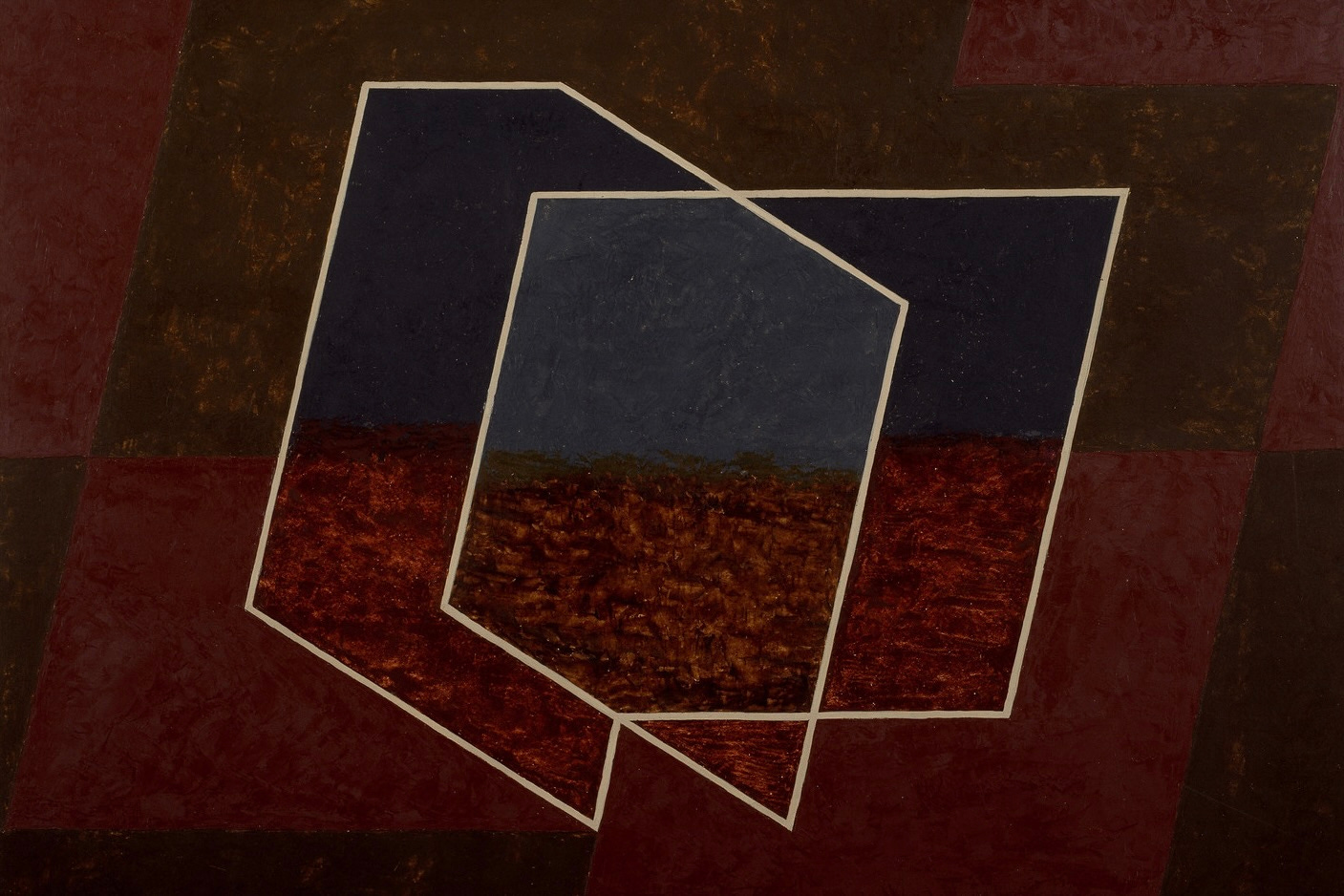
Imagine a box then. It has six sides. In your mind’s eye it is rotating and clear. In it imagine a red-hot, terrifying, magnificent, pulsating mass of something. Pick your poison. There are people standing around it. An assemblage huddling closer, trying to catch a glimpse. Let’s say the mass is any kind of art and the box an idea of a community surrounding it: its artists, its audience, its collectors and its critics. The novel hinges on the idea of the existence of such artistic exchange and flourishing, fueled by intimate, electrifying experiences with ideas and works of art and consequently the people who care about the same thing. However, and for so many reasons, the top of the box opens. Everything that’s inside is slowly diluted. The red of the mass turns lighter and lighter until it might as well not even be there. The box serves no more purpose and sits vacant. With no more locus, eyes stop looking after a while. The bodies start moving in convoluted directions. In place of conversations about art that are informed by each viewer’s experiences with it — experiences that are “private, voluntary and a little scary” — the dinner and the inferred world its guests come from is filled with the absence of these experiences. Instead, they convene in this New York apartment for “evenings where people who called themselves artists and directors but in fact worked as content creators and creative directors made a mockery of themselves.” People who gather around an empty box talking about the mass as if it were there. An emperor without his clothes performing polemics in fear of his nakedness being noticed. Happiness and Love is a perfectly realist drawing of Dave Hickey’s “aridity and suspicion” that one always finds in spaces “we had set aside to nurture culture and study its workings . . . .” By this she is — the same way Rebecca was — slowly broken down. Naked, Nicole and Eugene can impart nothing on their miserable prodigies but cruelty and passivity as supposed wit and profundity. Ceaselessly perpetuating the myth that to be great and worthwhile art must be born in pain, and the importance of “intentional carelessness . . . with . . . expensive and luxurious things, which made one feel absolutely foolish for cherishing one’s possessions as if they were precious when they were so worthless in comparison.” First ideas becoming holy grails, turning into the performances entertaining our lonely writer on the sofa.
And yet, in the long, winding string of thoughts, nothing happens. The writer laughs to herself, dozes off occasionally, and continues to watch “these performances from the comfort of [her] seat . . . .”
She knows what it feels like to have prints on paper transfix you in the middle of the Met, and yet she sits. Still, specks of what the unnamed writer went to look for in the first place peek through. There are echoes of the “unspeakable tenderness that pervaded life on earth, [where] even in moments of great tragedy, human beings made carnivals, visited shrines, held hands on buses” in artworks, performances, poetry readings, that one class in college, any experience that leaves you with this almost unbearably amplified conviction of, “This is it! This is what it’s all about!” Like an allegory, Emily, Rebecca’s oldest friend, is positioned as someone with enough agency to build a new box or animate an old one, only to be tossed aside again as a failed artist and a pushover. Emily is introduced as “the terribly kind, overweight, lesbian photographer’s assistant.” She’s capable of long friendships and relationships, she was there for Rebecca in the throes of her drug abuse, she drove to Massachusetts to attend to her body and organized the memorial earlier that day. She is quiet, never went anywhere with Rebecca and so evaded Nicole and Eugene’s grip. On this day our writer clings “to Emily and her girlfriend as if they could protect [her] from the other people.” We don’t get to know too much about Emily, but, failed or not, she has a rigorous agency, a quiet purpose that seems to do without performances of “great artistic temperament.” After all, in the end she’s the one creating a carnival in a moment of great tragedy, piercing the proclamations of misery marketed as a fabulous dinner party.
Paragraph after paragraph after paragraph, I want the protagonist to leave. To slam the door on this world and find her people. Toward the end, well into the night, Eugene is too drunk, Nicole keeps fleeing into the kitchen, and like most Alexander has left, ego bruised by the actress in a brutally long monologue voicing what our writer couldn’t. Beholding the party, our watchful loner realizes “these people were total nonentities, people I was completely free to leave.” Yet, when she does, I slump at the supposed catharsis of our writer running away towards her own apartment on the Bowery. How complicit are we? Do we see ourselves as overwhelmed by these “non-entities?” Is the only way out to run away from the party when it’s already over? The energy inside the box must fluctuate, change, move, and so the box has to move with it. Mundanity is bound to set in like it does, like it probably has to, but so it goes back and forth. Nietzsche, in The Gay Science, has to drag himself back to his gaiety again and again, because even after we “life-thirsty people” are intoxicated, we fall silent and become “sick” with a philosophical misunderstanding of our experiences. Only after that we convalesce again, having reinvigorated, in Nietzsche’s case, a cold academy with the wisdom that remembered the dignity of the fool. In our writer’s case, a world of art and ideas where, as Hickey phrases it, “this rush to converse . . . is the one undeniable consequence of art that speaks to our desire.”
At least that is what I hoped. The absurdities of the empty box are laid bare by Dubno, as clearly as Matisse’s lines are in his Jazz series: jagged and multiple. Simultaneously, the liberating agency our writer clings to in Emily, that could truly confront “artistic scenes” like this and build temples on their ashes, lacks from the end. Particles, a mass, creative kinetic energy — whatever we end up calling it — even if diluted by parties like these and the people that host them, are never really gone. As much as experience is a rude awakening to the emptiness found where ravenous, effervescent abundance is sought, it is also experience that nurtures it, makes it bright again before our eyes — experiences with art, with the people who love it, who work tirelessly to provide a place for wandering drifters. The people are the English professors, the rogue art critics, the true friends. They are glimpses of the world we dream about in the one we live in now.
Sophia Fiedler is a writer and graduate student in Anglophone Literatures and Cultures based in Vienna, Austria.
 | A guest post by
|
Interesting. From the description, this looks like a rewrite of Thomas Bernhard's "Woodcutters," swapping Vienna for New York and music for visual art. The narrator even sits in the same chair the whole time, just like in Bernhard's novel.
Thanks, Sophia. There's a lot here and I enjoyed a reread as soon as I finished the first time around. The discussion of the party reminded me of the song The Party's Over: "It's time to wind up / The masquerade / Just make your mind up / The piper must be paid."