


Where to begin? At the end.
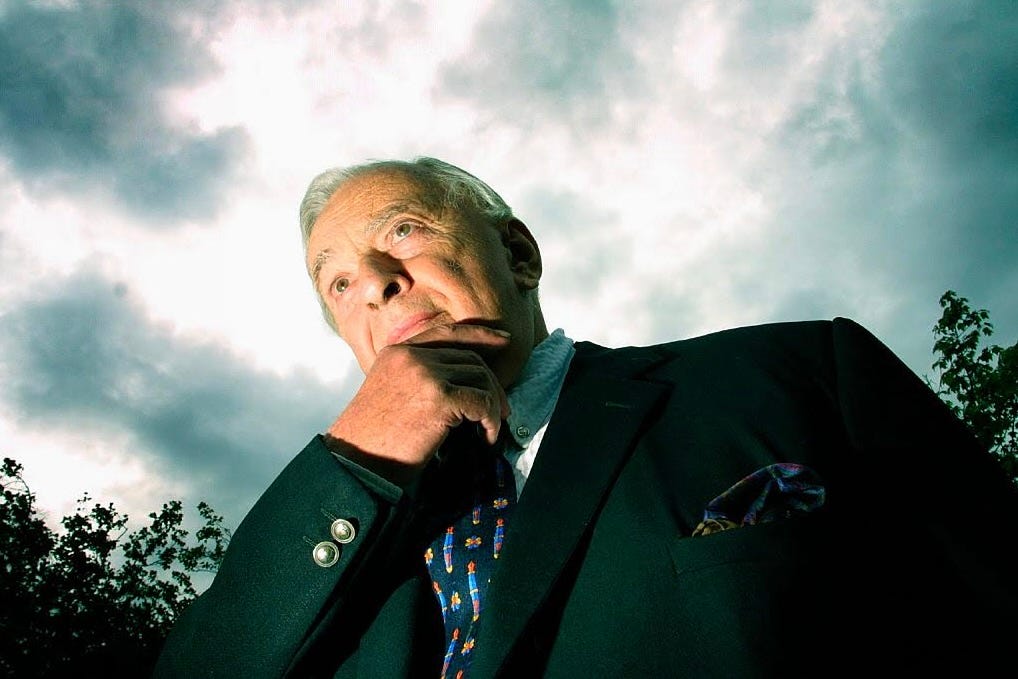
At the close of The Golden Age, the last novel in his long series of American history, Gore Vidal performs a theatrical trick. The year is 2000. A television crew has come from Rome to Ravello in order to interview Vidal (the writer) alongside Peter Sanford (one of the writer’s central characters) for a program they’re making (about Roosevelt, Truman, and the arming of America in the 20th century). Yes, the man who never misses a chance to have sex or appear on television cannot resist inserting himself into his own final chapter, where he converses freely with his own creations on and off the air. After the filming, the crew goes back to Rome, and Peter and Vidal — character and creator — are left alone together above the Gulf of Salerno. “Our revels now are ended,” says Peter. “Why do you keep letting Shakespeare leak in upon us?” Vidal’s reply is simple: Why not? William, after all, gives names to things, real and unreal.
It’s a fitting moment with which to close his American Chronicles — or, as Vidal more metaphorically calls them, his Narratives of Empire. At the end, Vidal stands as a playwright who is his own Prospero. He sets aside his script, looks back at the long drama he’s just staged: seven historical novels (novelized histories?) measuring the steps of the United States along the path from revolution to world war. Shakespeare pervades the novels. From Salmon P. Chase feeling like Brutus listening to William Seward’s Cassius in Lincoln, to Peter likening the political style of his father Blaise Sanford to that of Coriolanus in Washington, D.C., Shakespeare is a real presence in the Narratives. He has the power to speak directly to what’s happening, which is the power to affect how events are perceived, how stories are made sense of.
In As You Like It, Shakespeare imagines the progress of human life over seven ages. It’s in one of those monologues everyone knows, beginning, “All the world’s a stage, / And all the men and women merely players.” Each age brings its own version of events, ambitions, and (in)decisions: the infant mewling and puking, the schoolboy creeping like snail, the lover with a woeful ballad, the soldier quick in quarrel, the justice who plays his part, the old man heading toward childish treble, and the “second child” facing death and mere oblivion. This is not a map of human life. It’s a way of seeing patterns of character as people change with time.
In the Narratives, Vidal gives an account of the life of the United States, now 250 years old. Vidal, who died in 2012, once quipped that during his long life he met many people but knew no one. True or not, the curious American master certainly knew a great deal about his country. And countries are, after all, like people. The national character shifts when a country moves through significant moments of crisis or carelessness or confusion. Vidal’s seven novels capture those moments for the American empire, connecting readers in the present to parts of the past and, simultaneously, offering examples that might be useful in the future. What follows is not a comprehensive description. It is an introductory reading of Burr through to The Golden Age, from the mewling and puking of revolutionary infancy to the mere oblivion of a global empire in decline: seven ways into the seven acts that make up the strange, eventful history of the United States.
Act I: Mewling and puking
America’s history begins, in Vidal’s telling, with its most infamous founder. In Burr, the first of the Narratives of Empire, Vidal does something simple yet subversive: he casts Aaron Burr as the hero of the infant republic. Not George Washington. Not John Adams. Certainly not Thomas Jefferson. Burr, the stock villain of American history, is the real hero, the point of view from which many of the stories are told. The novel is narrated by Charlie Schuyler, Burr’s law clerk, an aspiring journalist, and Burr’s illegitimate (fictional) son. Burr is Charlie’s guide through the “true story” of the Revolution, Burr’s vice presidency, and Burr’s fall from grace in the eyes of the American public. Burr is anxious to tell his story in his own words, “before it is too late,” he says, “which is probably now since the legend of those days seems to be cast in lead if the schoolbooks are any guide. It is quite uncanny how wrong they are about all of us.” The extensive passages, in which Burr shares his recollections and Charlie assembles them for a memoir, are intimate and conversational. Vidal’s blurring of the lines between Burr’s perspective and Charlie’s narration draws us in as close confidants. We are listening to a father talk to his son. We hear the birth and early years of the republic retold as a private inheritance.
Early on, Burr gives Charlie his notes on George Washington: “It is a continuation of what you have already read. With some new marginal notes. It is a nice portrait, I think, but I am sure you will find it unrecognisable.” Unrecognizable is precisely the point. The portraits Burr (Vidal) paints are not the ones history has agreed to display. In Burr, we see the founders not as monuments, but as men: all male, all very human. They are complex, a little of this and a little of that — ambitious, proud, and all competing with one another in the climb to the summit. For Vidal, the Revolution is improvised rather than planned: “Washington was not — and would never be — sufficiently competent to defeat the British.” And the republic is uncertain from the beginning, as Burr observes: “I have told you I did not think the Constitution in its original form would last fifty years. Nor has it.” The republic, not born fully formed, is in its infancy — mewling and puking, as Shakespeare puts it — and like any infant cannot know what shape it will take, or what fictions will later be told about its beginnings.
Because Vidal begins the Narratives by unsettling the founders of the United States, the infant republic looks rather different from the one cast in lead and preserved in schoolbooks. Reputation is replaced by recollection. The gap between what is said to have happened and what Burr remembers is the real subject of the novel. The best example of this is Burr’s friendship with Hamilton. “I had always thought of him as a friendly rival,” says Burr. “I ought to have hated him, but did not.” A 1994 edition of Burr carries a subtitle Vidal never gave it: The Man Who Shot Hamilton. Aaron Burr does shoot Alexander Hamilton (Vidal suggests the “despicable” remark that triggered the duel was Hamilton’s charge that Burr committed incest with his daughter), but killing Hamilton is not all that Burr does. Vidal’s novel doesn’t seek to prolong the life of Burr the American antagonist, the man history prefers to remember as a villain, or else not to remember at all. Rather, it recasts the old scoundrel as a marvelous character: brilliant, charming, dignified. Burr does a great deal, is not especially repentant, and finds himself badly misunderstood by history. Burr the novel does not correct the historical record. Rather, it complicates it, introducing doubt where certainty is preferred, thus collapsing the founding myths of the United States.
Act II: Creeping like snail
If the republic begins in Burr as an infant, it survives its boyhood in Lincoln because power is exercised with patience. The story of the 16th president is second in the sequence of the Narratives, but Lincoln stands apart from the others. It’s the only novel that does not directly join the branches of the fictional family tree Vidal plants in Burr and extends to The Golden Age (Charlie Schuyler, his daughter Emma, and her future husband William Sanford play cameo roles before their leading performances in 1876). It’s the only novel that isn’t directly concerned with the expanding empire (though Secretary of State Seward is eager to enlarge the Union, despite the secession of the slave states in the South). And it’s the only novel named after one of the presidents. So, like the man himself, Lincoln is somewhat rare and isolated.
Vidal’s Abraham Lincoln is certain of purpose, and his purpose is different from that which is commonly proposed (or imposed) by history. Lincoln does not fight the Civil War to abolish the institution of slavery, he fights the Civil War to preserve the United States. “I believe in this Union. That is my fate, I suppose. And my necessity,” he says. And the war is not so much fought as it is managed. Lincoln does not rush toward it — “You can have no conflict without being yourselves the aggressors,” he says to the Confederacy — preferring peace to war. Nor does he retreat from it when it arrives. Lincoln prefers deliberation to action. Instead of decisive resolution on the battlefield, there is the weighing of legal odds, the sifting of political probabilities, then the execution of office. From the suspension of habeas corpus and the First Amendment, to the Emancipation Proclamation, Lincoln’s steps are slow and calculated (and often exclude Congress), while the Union’s military defeats are quick and devastating, from Bull Run to Fredericksburg (“We seem always to lose”). Like Washington before him, Lincoln is a president whose mastery of politics goes hand in hand with his shortcomings as commander in chief.
As the novel moves slowly along, with Lincoln creeping like snail toward the Union’s rebirth and his own death, he balances divisions from within as well as from without. To many of those around him, Lincoln is out of his depth, incapable of resisting the current drawing them all toward disaster. His cabinet is composed of men who have opposed him before and would gladly occupy his office. Seward and Chase and the others are Lincoln’s “team of rivals,” as Doris Kearns Goodwin memorably calls them. His generals are replaced, tolerated, and eventually replaced again. Before General Grant’s appointment toward the end of the Civil War, Lincoln has Scott (a fossil from earlier wars), McClellan (who prefers drilling the army to using it), and Halleck (an administrator with epaulets). Even Lincoln’s loyal secretaries, Hay and Nicolay, call him “the Ancient,” as though he is out of place in the present, an inadequate response to what the time demands. Lincoln’s appearance as a provincial outsider, a figure of homespun stories and modest education, fools almost everyone. Few notice Lincoln slowly gaining complete control over the stage on which everyone acts. Finally, the clever and cunning Seward recognizes the nature of his control:
Seward felt an involuntary shudder in his limbs. He was also ravished by the irony of the moment. For nearly three years, a thousand voices, including his own, had called for a Cromwell, a dictator, a despot; and in all that time, no one had suspected that there had been, from the beginning, a single-minded dictator in the White House, a Lord Protector of the Union by whose will alone the war had been prosecuted. For the first time, Seward understood the nature of Lincoln’s political genius. He had been able to make himself absolute dictator without ever letting anyone suspect that he was anything more than a joking, timid backwoods lawyer, given to fits of humility in the presence of all the strutting military and political peacocks that flocked about him.
Lincoln governs by allowing others to believe that they, not he, determine the course of the Civil War. The Union ultimately survives because he exercises presidential power with a patience and a slowness that’s almost impossible to see.
Act III: A woeful ballad
The events that make up the early adulthood of the United States are deeply undemocratic and dishonorable. The third novel in the Narratives of Empire series concerns the republic’s centenary, a moment meant for celebration: 100 years of independence, 100 years of the Constitution, 100 years of government for the people. After telling Lincoln’s story in the slightly impersonal third person (Lincoln is destined to remain somewhat remote from the reader), Vidal hands the narration back to Charlie Schuyler in 1876. Charlie returns to New York from France to live by his pen, find his daughter a husband, and restore his family’s fortune, lost in the panic of ’73. As Philadelphia welcomes citizens to its Centennial Exhibition, and politicians deliver their speeches about good government, Charlie sees a nation congratulating itself on its survival. And yet, what Vidal writes is something closer to a lament than a celebration: 1876 is a woeful ballad because the song it sings is not of achievement and endurance, but of betrayal and corruption.
What does the son of Colonel Burr make of General Grant, whose second term as president is due to end after the 1876 election? “I suspect that he is as corrupt as those about him; otherwise, he would not have such men as intimates.” Running throughout the novel is a theme, Charlie’s notion that his fellow Democrats ought to be wary of the motives of this administration: “If Grant is not himself a criminal he is a fool. Yet the Republican party protects him, cherishes him, is loath even to let him go now after two terms.” Charlie sees that, having previously put off kings and a wealthy aristocracy, the United States is now developing a greater and greater appetite for plutocracy. The president no longer belongs to the people of the republic, but to the Republican Party. For the most part, the government carries out actions that benefit the party’s financial interests. But any hope that General (and Mrs.) Grant have of remaining at the White House is finally lost. The crisis that the novel builds toward is the contested election between Samuel Tilden and Rutherford B. Hayes. History records that Governor Tilden wins the popular vote, but there is no President Tilden, is there? The outcome is disputed by the Republicans, and the presidency is handed to their man:
The United States is now on the verge of civil war. During the week since the Governor was elected president, the Republican press and the Republican party and Federal troops commanded by the Republican President have been openly at work trying to reverse the popular vote. It is a truly marvellous scandal, and deeply alarming.
Marvelous and alarming capture the peculiar tone of the moment. The republic, having survived destruction in Lincoln, now discovers a different kind of danger in 1876: that power can be determined not by the will of the people but by the manipulation of process. Deciding that the election is close enough “to fix up,” members of the Republican National Committee direct leaders in Louisiana and Florida (always Florida!) to “hold your state.” In other words: falsify the vote in favor of Hayes. The party that fought the Civil War to assert the supremacy of the federal government now turns individual states against the people for political gain. There are chants of “Tilden or Blood,” but in the end there is neither, and Hayes is elected president by a single vote in the Electoral College. After 1876, the machinery of democracy continues to function, but the centennial shows how easily the inner workings of the republic can be manipulated. The United States does not collapse, but its character has changed. In the afterword to 1876, Vidal writes that the year was the low point in the history of the United States: the outward show of democracy is preserved while its inner substance is compromised.
Act IV: Quick in quarrel
As the republic begins to fall in 1876, so the American empire begins to rise in Empire. At the halfway stage of the Narratives, the fourth novel is symbolic of the historical crossroads facing the United States. It’s 1898. Charlie’s generation, who witnessed the early life of the republic, is gone. The United States, now prosperous and increasingly aware of its own power, is no longer concerned with survival alone. The question that Empire asks is not whether the Union will endure. There’s confidence that it will. It is what the Union will do with its growing strength. As it looks forward to the 20th century, will the United States reach outward beyond its borders to the world?
Vidal answers that question by placing the emergence of empire not in the hands of soldiers or statesmen alone, but in the offices of newspapers. Caroline Sanford, Charlie’s granddaughter, becomes the first newspaperwoman in America. Not only is she the heroine of the Narratives, she is one of the great (and greatly overlooked) female characters of 20th-century literature. Caroline is beautiful, intense, resolute. Like her Shakespearean counterparts — Beatrice, Rosalind, Cleopatra — Caroline stirs both admiration and insecurity in those around her, particularly the male characters (and readers) who are no match for her. Caroline enters, and at times even shapes, a world in which politics and journalism are increasingly inseparable, one in which the line between creating and reporting the news is no longer clear: “[T]he spring and summer were devoted to the expansion of the Journal’s circulation and, incidentally, the American empire.” In this sense, the Spanish-American War of 1898 is not just a conflict between countries. It is the moment the United States decisively stands on the world stage, part of a story carefully constructed for public consumption.
Caroline and Blaise Sanford, half-siblings, compete as publishers because each realizes that newspapers do not merely reflect public opinion, they shape it. It’s a lesson in power born of their encounters (in print and in person) with William Randolph Hearst, who sits at the center of this transformation. Hearst is the original media mogul. And his relationship with Theodore Roosevelt is key to Empire. Hearst, with more money than he knows what to do with, fancies himself the true author of events. Roosevelt, who has inherited the presidency from an unfortunate McKinley, believes he is the rightful master of a new empire. Needless to say, the two men — quick in quarrel — fall out in moments of temper and vanity. At the end of the novel, Hearst is asked to the White House, where he schools the portly president on how the world works:
“When I made — invented, I should say — the war with Spain, all of it fiction to begin with, I saw to it that the war would be a real one at the end, and it was. For better or worse, we took over a real empire from the Caribbean to the shores of China. Now, in the process, a lot of small fry like you and Dewey benefitted. I’m afraid I couldn’t control the thing once I set it in motion. No one could. I was also struck with the fact that once you start a war you have to have heroes. So you — of all people — came bustling along, and I told the editors, ‘All right. Build him up.’ So that’s how a second-rate New York politician, wandering around Kettle Hill, blind as a bat and just about as effective, got turned into a war hero. But you sure knew how to cash in. I’ll hand you that. Of all my inventions you certainly leapt off the page of the Journal, and into the White House.”
All of it fiction to begin with. In Vidal’s telling, an empire is not the inevitable outcome of a properly articulated plan. The early American empire emerges as if by accident, the byproduct of competition and chance. There’s the desire for influence among journalists and politicians, then one thing suggests another. War is not only fought, it is written — the conquest of nations advancing with the circulation of newspapers.
Act V: Plays his part
The art of improvisation in Empire hardens into a polished performance in Hollywood. As the Narratives reach the early decades of the 20th century, the United States begins to reimagine how it wields power. The fifth novel shows the shift away from accidental acquisition of empire toward its deliberate representation, and Vidal reveals how Hollywood is used for much more than mere entertainment. Movies tell a particular story — of war and peace, of freedom and slavery, of light and dark — that differs from the one most people actually encounter. In this, movies resemble newspapers, and men of power prize them for it. If the journalist gets to print the story, the filmmaker gets to screen it. When people stare at screens, they become suggestible; it’s easy, then, to direct their thinking or to demonize an enemy. What matters is not what happens, but how what happens is seen.
As owner and editor of the Washington Tribune, Caroline Sanford already knows what it means to live in a world where politics and performance are indivisible. But now she finds herself in a culture increasingly defined by cinema, and she sees the potential in movies: “Now why not use them to alter the viewer’s perception of himself and the world? Thus, she would be able to outdo Hearst at last. Self-pity was now replaced by megalomania of the most agreeable sort.” Movies reframe real life. Politics is shot, edited, and screened. Where some still see a gap between pretense and reality, Caroline knows that gap has closed. She becomes a Hollywood star, producing and acting in films like Huns From Hell and Mary, Queen of Scots, with what Shakespeare would call a natural perspective. The experience teaches Caroline something valuable. Power, she tells Blaise, lies in representation on screen:
“After all, that’s the only world there is now, what we invent.”
“Invent or reflect?”
“What we invent others reflect, if we’re ingenious enough, of course. Hearst showed us how to invent news, which we do, some of the time, for the best of reasons. But nothing we do ever goes very deep. We don’t get into people’s dreams, the way the movies do — or can do.”
This exchange captures the transformation Vidal traces in Hollywood. Newspapers shape public opinion; movies shape public imagination. If the press influences what people think, Hollywood influences what they feel, and what they take to be real. Because politics is performance, politicians are judged not only for what they do, but for how they appear. Woodrow Wilson recognizes this and uses Hollywood for his own agenda. He even plays his part, appearing in early propaganda films that demonize the Hun and encourage American intervention in the First World War, literalizing the performance of the presidency upon the world stage. The empire that emerges from this process is more than real: it’s a romantic idea that exists in the minds of moviegoers.
Act VI: Toward childish treble
Having passed through youth and middle age, the United States is now on the threshold of old age. Washington, D.C. is Vidal’s sixth and most indirect study of empire. The picture he captures is not so much of a period of time — like the Revolution in Burr, say, or the centennial in 1876 — but of a particular place in time: the capital city itself during and after the Second World War. At this point in the Narratives, a change takes place. The performance of power in Hollywood settles into something subtler and more troubling in Washington, D.C. Washington is now a place where public life is conducted in private arrangements, where a man may affect political decision-making because he lives in close proximity to power. Influence is inherited by a small political establishment that preserves and protects its own wealth. The distance between politics and everyday life widens as a ruling class settles into it.
At the heart of Washington, D.C. is the Sanford family once again, now firmly planted within the ruling class of the day. Blaise, who watches William Randolph Hearst in Empire and Hollywood while competing with his half-sister Caroline, is proof that true power lies in the press. As a leading newspaper publisher in Washington, he exercises political influence without political office. His son Peter, observing his family around him, comprehends the cost of that influence through the course of the novel. The generational dynamics that recur throughout the Narratives are especially pronounced in Washington, D.C. Peter, a version of Vidal himself, looks at the world his father and his aunt have mastered with both fascination and unease. He notices that “news was fiction and fiction, often, history.” Where Charlie Schuyler once contemplated the story of the United States, the Sanfords now create American fiction, sustaining the society they inhabit through the printing of news.
Blaise tells Peter, “There is always a price to be paid for survival.” The line lands harder at the end of the novel than it does here. The price, as Vidal presents it in Washington, D.C., is different from the blood spilled in Lincoln to save the Union: it is a gradual compromise of character. To remain within the ruling class requires a willingness to accept the terms by which influence is maintained. Principles are not abandoned all at once; they are bent by degrees to endure — the journalist who prints a story regardless of its truth, the senator who sells his vote for a bribe, the presidential candidate who passes himself off as a war hero. In the end, none of them are “different from the used-car dealer who makes a profit on a car he knows will not run properly.” A ruling class permanently playing with power begins, without noticing, to exhaust the system it sustains. Then comes the diminishment. The movement toward childish treble is not a return to a child’s innocence; it is the surrender of character to circumstance. Distinctions of individual and national character, once considered concrete, no longer carry the same weight.
Act VII: And mere oblivion
If the United States seems at its zenith by 1945, Vidal insists in The Golden Age that its decline has already started. The seventh of the Narratives covers much of the same time span as Washington, D.C., not only looking inward at the Sanford family, but outward at the turning points of American supremacy. Familiar characters remain — Caroline’s intelligence is undiminished, her instincts as sharp as ever — while other figures are reintroduced from history, like Franklin D. Roosevelt, “who towered even when seated in his wheelchair.” In the final novel, FDR draws the United States closer and closer to dangerous entanglements with Europe and Japan. As America emerges from the Second World War in the ascendant, Harry Truman establishes a militarized economy and society with gusto. Vidal approaches the moment of triumph with restraint. What interests him is not celebrating the achievement but examining the conditions it produces.
What Vidal reveals is that, however cavalier leaders may be about their actions, consolidating a global empire opens a new field of uncertainty. Peter, like Vidal, is reflective and increasingly skeptical of what he sees:
Peter wondered if Joe was serious; if Truman was serious; if the current ‘crisis’ was serious. But if what had already been billed in advance as the Truman Doctrine were to take effect, would a total world empire ever be in anyone’s interest? The war industries, now languishing, would profit. But would the general economy improve? Would . . . ?
In The Golden Age, the United States is no longer preoccupied with its own survival and expansion, at least not as it was in Lincoln and in Empire. It embraces a global role without fully understanding what it’s doing, and Peter’s generation inherits a country shaped by decisions they didn’t make. The republic that Peter’s ancestors observed and helped create has become an empire extending far beyond its original conception of itself. As the novel unfolds, Peter begins to grasp the contradiction at the heart of the new empire: “Peter had just done a piece celebrating Washington as the great necropolis of a nation so furiously dedicated to peace that it was almost never not at war to ensure ultimate peace for all time.” The logic of empire — that the United States must wage perpetual war for perpetual peace — eludes Peter and Vidal, and it ought to frighten any reader.
This last act is not a moment of disappearance. And mere oblivion is a recognition of limits no empire can slip. However secure it may seem, the United States is subject to the same forces that transform all empires. Golden ages are finite. Change and time are real.
*
In the Narratives, history and family are twin threads, like tragedy and comedy, that bind together all seven novels. Beginning with Burr, the most inconvenient of the founders, Vidal spawns a fictional family that opens the history of the United States to his readers. Charlie Schuyler, Burr’s illegitimate and imaginary son, looks on as the founding myths of the republic are dispelled in Burr. With his daughter Emma, Charlie watches from the wings as a powerful president tries to preserve a union at war with itself in Lincoln, and they return to center stage in 1876 as the reconstruction of the republic gives way to the betrayal of democracy. Caroline is Charlie’s granddaughter and Burr’s great-granddaughter. In Empire, she sees the republic become imperial, and in Hollywood she helps shape politics into spectacle. By the time we get to Washington, D.C., Caroline’s family belongs to a ruling class permanently playing with power. In The Golden Age, a new generation — including Caroline’s nephew Peter and her daughter, Burr’s great-great-granddaughter — inherits an empire at its peak but already disintegrating. Gore Vidal’s United States, then, is a family affair. Together with them we witness a strange, eventful history.
Just as the family members have their exits and their entrances, the very structure of the Narratives reflects a sense of recurrence. Washington, D.C. comes sixth in the sequence but was in fact the first Vidal wrote in the series. The Golden Age comes seventh in the sequence and was also his last novel. Vidal ends both books with the same profound meditation:
As for the human case, the generations of men come and go and are in eternity no more than bacteria upon a luminous slide, and the fall of a republic or the rise of an empire — so significant to those involved — is not detectable upon the slide even were there an interested eye to behold that steadily proliferating species which would either end in time or, with luck, become something else, since change is the nature of life, and its hope.
To read Vidal’s Narratives of Empire is to see the United States perpetually becoming something else. Its transformations are not always visible to those living through them. They become clear when we read the stories through which these changes are told. That is why these novels are worth reading now, as the country observes the 250th anniversary of its founding. Surely it is time to reread the Narratives, to look again at the bones of the republic and listen to the ghosts of its history. If the future of the United States lies anywhere, it lies in its past.
Where to finish? At the start.

Michael Preedy is the author of Making Sentences, a newsletter for making sense of the written world. Through his essays, Michael gives readers a clear way into great books, with references from Shakespeare to The Simpsons. He lives by his pen in Norwich, the U.K.’s “City of Stories.”
 | A guest post by
|
Enjoyed this. I collected Vidal's most salacious Kennedy quotes here: https://substack.com/@henrydstaley/note/p-195591573?utm_source=notes-share-action&r=7qoxxf