


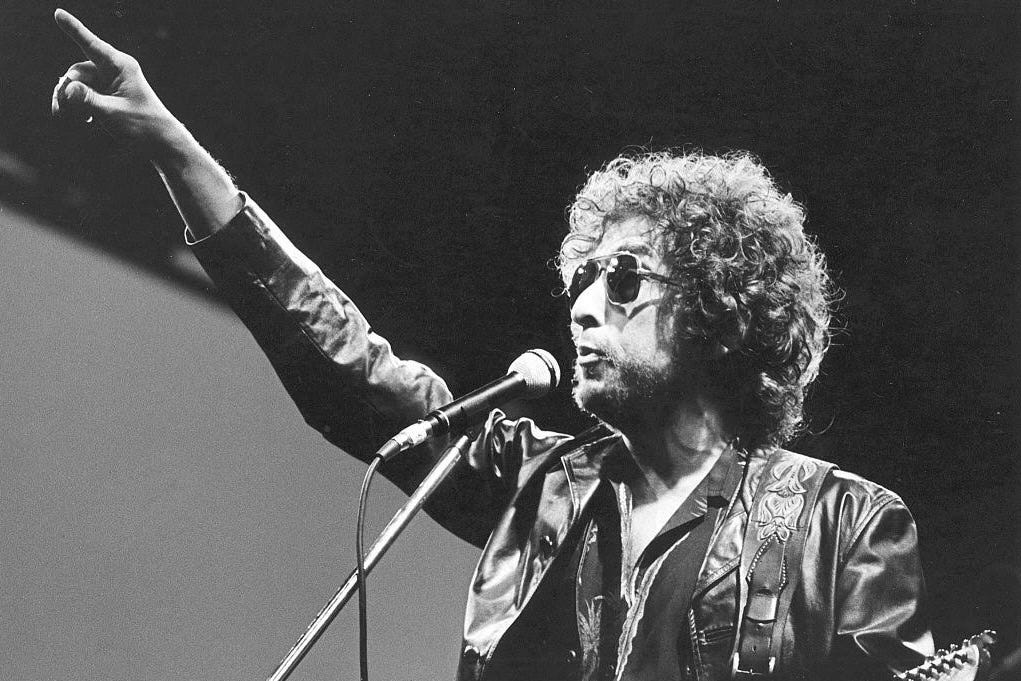
A musician dies and goes to heaven. He’s introduced to Elvis, John Lennon, and Jimi Hendrix, and they’re all talking happily when Bono walks by. “Hey, I didn’t know Bono was dead,” the musician says. “He’s not,” Elvis replies. “That’s God. He just likes to pretend he’s Bono.” —1980s joke, Author unknown
A woman stands on a stage under harsh, punishing red light, wearing a black skirt over tight black pants. Her hair is a thick black mane, swept back from her face, and her eyes are wide and dark and her gaze pierces you like a bullet. She is topless, but her body is covered in blood and her wrathful eyes dare you to sexualize her.
In the voice of a demon she roars,
When any man hath an issue out of his flesh
Because of his issue, he is unclean
Every bed whereon he lieth is unclean
And everything whereon he sitteth, unclean
And whosoever toucheth his bed shall be unclean
And he that sitteth whereon he sat shall be unclean
And he that toucheth the flesh of the unclean becomes unclean
And he that be spat on by him, unclean
Becomes unclean
Her voice is an instrument of astonishing power. She rises from a guttural growl to a piercing shriek and holds that glass-shattering, tooth-rattling note so long you begin to think she must have the lungs of a deep-sea free diver. With just a single microphone, she seems like she can tear down the walls of the cathedral in which she is performing — St. John the Divine, in New York City.
She is Diamanda Galás, and she is performing the Plague Mass, a song cycle that functions as a rite in memory of those (including her brother, the playwright Philip-Dimitri Galás) who died of AIDS in the 1980s, and a furious excoriation of the religious and governmental authorities who chose to condemn the sick rather than help them, never mind fighting the disease. The song, “This is the Law of the Plague,” comes from her 1986 album The Divine Punishment, the first volume in a trilogy continued on in Saint of the Pit and You Must Be Certain of the Devil.
There is no mention of Diamanda Galás in Paul Elie’s The Last Supper: Art, Faith, Sex, and Controversy in the 1980s.
Four men and a woman are onstage. They are all shirtless except for her; they are doing hard, physical work. The music (guitar, keyboard, bass, drums) is extraordinarily loud, and slow, and heavy, but it refuses to grant the listener catharsis. The guitar and bass play a single, simple, Black Sabbath-esque riff, over and over and over, and the drummer slams his snare like an orchestral tympanist. The singer has long blond hair like a Hollywood Jesus, and he howls his lyrics with the passion of a preacher, or a penitent. “I will pray / I will pray / I will go down low, and I will pray to you. . . . I will beg you Lord, and I will pray for you to forgive me now / I will go down to the center of the earth, and I will curl up in flames, and I will beg you Lord: Take me in your cruel arms, take me down home. . . . Praise God! Praise the Lord!” Behind him, the band crashes along like a giant tearing through a forest, uprooting trees and digging holes in the earth with every step. The only grace note amid all this punishment is the female vocalist, who moans wordlessly like she’s singing at a funeral mass. The song is more than 10 minutes long, and by the time it ends it feels like it’s been happening forever. You come out of it like being awakened from a trance, and for a brief moment you wonder who you are, where you are, how you got here, and how you’re going to get home.
They are Swans, and they are performing “Sex, God, Sex,” from their album Children of God. Earlier Swans releases bore titles like Filth, Cop, Greed, and Raping A Slave, and the songs were about abjection, punishment, and self-loathing. This album includes a liner-note thank you to “Jesus Christ, Our Lord,” and the songs are full of images of love, trust, sacrifice, repentance, and rebirth. Onstage, these songs become rites of purgation, singer Michael Gira bellowing his mantralike lyrics at the audience as his partner, Jarboe, offers a blissful, angelic counter-presence.
There is no mention of Swans in Paul Elie’s The Last Supper: Art, Faith, Sex, and Controversy in the 1980s.
(I interviewed Michael Gira once. I mentioned that his lyrics often seemed moralistic, and he laughed very hard.)
Other songs and artists not mentioned in Elie’s book: Metallica’s “Leper Messiah,” from their 1986 album Master Of Puppets; Motörhead’s “Orgasmatron,” from their album of the same name, also released in 1986; Slayer’s “Jesus Saves,” from Reign In Blood (1986 again); Ozzy Osbourne’s “Miracle Man,” from 1988’s No Rest For The Wicked; Trouble’s Psalm 9, from 1984. Even when criticizing its hypocrisies and venality, metal has always taken religion and faith seriously — far from being Satanists, Black Sabbath were practically a Christian rock band, an impression impossible to overlook when one actually reads the lyrics to songs like “Black Sabbath” and “After Forever.” And Trouble were Christians. But Elie either doesn’t know this, or believes it to lie outside the scope of his book.
One could also suggest that classical works like Steve Reich’s Tehillim, composed in 1981, and Arvo Pärt’s Tabula Rasa, from 1984, might be worth analyzing, particularly the latter, which became a favorite (if that’s the word) among terminal AIDS patients. But they are not to be found in this book either.
So what does Paul Elie think was the notable religious pop culture of the 1980s? Well, the book begins with the release of Bob Dylan’s 1979 album Slow Train Coming, on which he announced his conversion to evangelical “born again” Christianity. He then leaps forward 13 years, to Sinéad O’Connor’s 1992 appearance on Saturday Night Live, during which she infamously tore up a photo of then-Pope John Paul II, exhorting the audience to “fight the real enemy.” He describes these two events as bracketing an era in which:
figures in what we call popular culture engaged questions of faith and art and the ways they fit together with an intensity seldom seen before or since. They tested boundaries between sex and the sacred; they explored the controverted character of religion — its power to divide us inwardly against ourselves and to set us apart from one another in society. The work they made brought on public controversy: protests, boycotts, congressional hearings, pulpit denunciations, and claims that this song or film or photograph spelled the end of Western civilization.
Even in these three sentences, there are premises one can easily argue with. His “seldom seen before or since” is hyperbole almost as empty as when Donald Trump says something is “like nobody’s ever seen before.” The idea of art “test[ing] boundaries between sex and the sacred” frames the discussion entirely and only on the terms of religions that don’t view sex itself as sacred, which is to say this is a book about the Abrahamic monotheistic faiths, and if we’re being honest, mostly the Roman Catholic Church.
Born in 1965, Paul Elie has written extensively for the New Yorker, the New York Times, The Atlantic, Vanity Fair, and Commonweal. He has deep ties to the New York publishing world, having worked for decades as a senior editor at Farrar, Straus and Giroux (this book’s publisher). His Catholicism is at the heart of his work to such a degree that one could almost call him a missionary. His first book, 2003’s The Life You Save May Be Your Own: An American Pilgrimage, chronicled and analyzed the lives, work, and friendship of four midcentury Catholic writers — Dorothy Day, Thomas Merton, Flannery O’Connor, and Walker Percy. He is currently a senior fellow at Georgetown University’s Berkley Center for Religion, Peace, and World Affairs, and is also a longtime supporter of the Community of Sant’Egidio, a Catholic social organization founded in 1968.
So here’s where I declare myself: despite my mother’s best efforts, I do not consider myself to be a Catholic. I was raised Catholic; I was baptized, I took first communion, served as an altar boy, was confirmed. But I haven’t been in a church in over 30 years, and if I believe in anything these days it’s more of a personal philosophy than a religion, one that draws haphazardly and in roughly equal measure from Norse paganism, Zen Buddhism, the Stoics, and the poetry of Jim Harrison. Monotheistic religion baffles me.
This often puts me at some distance from pop culture, because pop culture in America is drenched in religion, even when it’s not explicit. So much American music of the 20th century — Ray Charles, Aretha Franklin, Prince, James Brown, George Clinton, and many others — is either drawn from the music of the Black church or is in dialogue with it that someone of a non-religious nature can wind up more than a little alienated. Am I appreciating this music wrong? Am I being disrespectful to it by enjoying it purely as sounds arranged in patterns, rather than as some sort of devotional act?
Of course, it’s not just Western pop that raises these issues. The voice of the late Pakistani singer Nusrat Fateh Ali Khan was astonishingly beautiful, and his marathon performances could send any listener into a joyful trance, whether or not they were Sufi Muslims like him. South African jazz pianist Nduduzo Makhathini’s music often carries deeply spiritual messages, but he’s singing in the Zulu language, so what does it matter? Many such cases.
Elie describes most of the art discussed in The Last Supper as “crypto-religious,” a term he defines as “work that incorporates religious words and images and motifs but expresses something other than conventional belief . . . work that raises the question of what the person who made it believes, so that the question of what it means to believe is crucial to the work’s effect: as you see it, hear it, read it, listen to it, you wind up reflecting on your own beliefs.”
The works he selects for analysis cover a broad range: art by Andy Warhol, Jean-Michel Basquiat, Keith Haring, Robert Mapplethorpe, Andres Serrano, and David Wojnarowicz; music by U2, Leonard Cohen, Bob Dylan, Bruce Springsteen, Patti Smith, the Smiths, the Neville Brothers, Prince, and Madonna; novels by Don DeLillo, William Kennedy, Toni Morrison, and Salman Rushdie; Martin Scorsese’s The Last Temptation of Christ and Wim Wenders’ Wings of Desire. Some of these were attacked in their time as blasphemous, and Elie does a good job of describing the political whirlwinds surrounding the release of Last Temptation and Rushdie’s The Satanic Verses. (Jean-Luc Godard’s 1985 film Hail Mary, widely protested and criticized by the pope himself, is another surprising omission.) Others were only mildly controversial, if at all. Who’s ever had a problem with Bono’s preachiness, except as a manifestation of his overall pomposity?
The Last Supper is about more than art, though. Elie is also telling us a story of religion’s place in 1980s society, with a particular focus on the Catholic Church, the presidential administration of Ronald Reagan, and how both those entities responded to the AIDS crisis. He also delves into the sexual abuse scandals within the Church, which would not truly burst forth until decades later. He follows the lives and careers of brothers Philip and Daniel Berrigan, priests and peace activists who took up a variety of causes throughout their lives, including Philip’s work with AIDS patients in the late ’80s. (Which brings me to another surprising omission: Larry Kramer, whose name appears only twice in this book and whose play The Normal Heart goes entirely unmentioned.) He also talks about the Polish poet Czesław Miłosz, forced to keep his Catholicism hidden while living under Soviet domination but who let it blossom late in life, in California. The contrast between Miłosz and his fellow Pole, Pope John Paul II, is a fascinating mini-narrative running through the book.
The degree to which Elie focuses on Catholicism and Catholic (or at least Christian) artists makes the few exceptions stand out, often starkly. Obviously the story of Salman Rushdie and his novel The Satanic Verses, which earned him a death warrant from Iran’s religious authorities, among other condemnations, is important as an example of the collision of religion, art, and politics, but it doesn’t really tie in with most of the “action” of the rest of the book. This is partly because its subject was Islam, but also because Rushdie was based in London, and Elie’s book is mostly centered around New York City. The New York art world, the New York literary scene, and New York-based filmmakers like Scorsese make up the bulk of it, and Elie’s story of gay protests against AIDS focuses on New York-based actions like the infamous “die-in” held at St. Patrick’s Cathedral. Thus, Rushdie is discussed on his own, but he’s only truly assimilated into the big story when fellow authors stage a reading on his behalf in Manhattan.
Despite its omissions, elisions, and awkward juxtapositions, The Last Supper is a fascinating and valuable book. I learned a lot reading it — about Andy Warhol, who was a much more devout Catholic than I ever knew; about the Neville Brothers, whose work was unfamiliar to me (though I love the Meters, a band led by Art Neville that sometimes included younger brother Cyril); about The Last Temptation of Christ, which I really should watch one of these days; and more. And any book that can make a reader say “Yeah, but what about?” and “Yeah, I don’t know,” as many times as this one is well worth reading. Paul Elie’s taste in art may stay mostly in normie territory, but he clearly sees art as one of the highest human endeavors, whether inspired by faith or not. I bet I could get him to listen to Swans or Diamanda Galás, and we could have a very interesting conversation afterward.

Philip Freeman is the author of Burning Ambulance on Substack. His latest book is In The Brewing Luminous: The Life and Music of Cecil Taylor. He lives in Montana.
 | A guest post by
|
Well, this ended better than it began, nice twist.
book sounds interesting, though ordinarily, as i saw diamanda galas twice & had that first swans album when it came out, i would dismiss anyone who claimed to cover this period & this subject without mentioning them. oh well. history is written by the winners & there were an awful lot then who were not.