

He Said They Said
On Jim Windolf’s ‘Where the Music Had to Go: How Bob Dylan and the Beatles Changed Each Other — and the World’


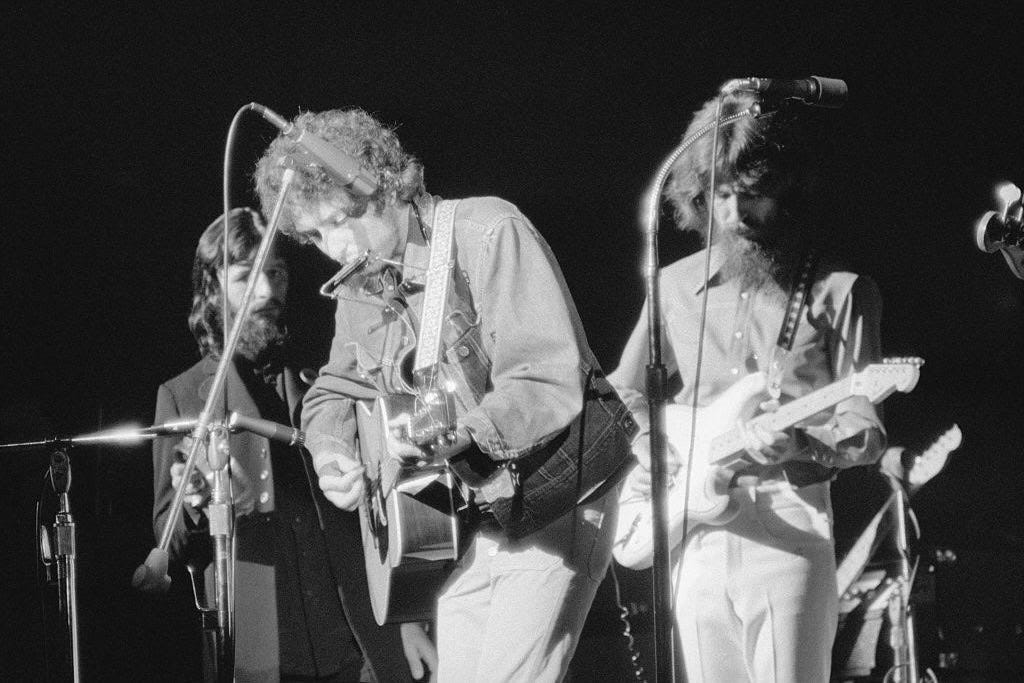
There was a boy in postwar Liverpool, and his name was Mike. Mike had a girlfriend named Celia, who once let him borrow a record by an American folk singer who pretended to be a lonesome hobo, though he was really just a middle-class kid from Minnesota, but with an exceptional musical talent. Mike went home to 20 Forthlin Road and played the record. Mike had a brother named Paul, who didn’t think much of the music.
“What’s that crap?” Paul asked.
To which Mike answered, “A bloke called Bob Dylan.”
You’ll never guess who Paul was. Okay, maybe you already did. In which case you probably also know that Paul McCartney’s band, the Beatles, would dominate the sound of the 1960s alongside Dylan, making them the two most foundational acts in postwar pop music. But there is much to the relationship between band and bard that has lingered in the background, which is why Jim Windolf’s surprising and delightful Where the Music Had to Go: How Bob Dylan and the Beatles Changed Each Other — and the World manages to say something new about some of the most written-about people in the history of culture.
Dylan’s eponymous first album hit the shelves on March 19, 1962. Exactly one year and three days later, the Beatles came out with their debut album, Please Please Me. In the years to come, they grew so close that Dylan was sometimes called the “fifth Beatle.” I would have gladly swapped George Harrison for him, but since Mr. Tambourine Man was not exactly a team player, maybe it was for the best.
They were comrades and competitors. “They got drunk and high together and shared meals at one another’s homes,” Windolf writes. “They played advance pressings of their albums for one another, and on those occasions the sense of rivalry bubbling beneath the surface was apparent.” The writing here is crisp and cliché-free. Windolf does not make the mistake, frequently committed by music writers, of attempting to be as lyrical as his subjects.
About the only thing the brooding young man from North Country and the four mop tops from Liverpool shared was a profound reverence for Little Richard, whose piano playing galvanized rock music in the 1950s, and postwar Black music in general. But as Windolf argues, they constantly pushed each other and, in doing so, forged a new path for rock-and-roll. A lifelong music fan, he assembles this story from “scattered piecemeal across biographies, out-of-print memoirs, and long-buried articles,” turning it into a brisk and enjoyable read for anyone interested in the creative explosion of the 1960s.
Their musical intersections were frequently edged with competition. As “I Want to Hold Your Hand” began to dominate American airwaves after a broadcast by a Washington, D.C. deejay, Dylan dismissed the Beatles’ music as “bubblegum” for “teenyboppers.” But as the journalist Al Aronowitz, an important source for Dylanologists, observed, “I somehow wanted his lyrics to enlighten the same teenyboppers then trying to claw the clothes off the Beatles.”
Especially after their landmark appearance on the Ed Sullivan Show in February 1964, Dylan recognized that “folk music wasn’t what it used to be,” according to his then-girlfriend Suze Rotolo (famously captured by photographer Don Hunstein walking with Dylan down Jones Street for the cover of The Freewheelin’ Bob Dylan). Dylan went electric at the Newport Folk Festival the following year, in what proved to be a key career move. (Windolf points out that Dylan was as much a teen icon as the Beatles in the 1960s, if for a slightly different demographic.)
Having gotten over his long-ago dismissal of Dylan, McCartney introduced his bandmates to Bob Dylan, Dylan’s first album, and Freewheelin’ while the band was on a three-week Paris engagement in 1964, right before the famous Sullivan appearance. “Right from that moment, we recognized some vital energy, a voice crying out somewhere, toiling in the darkness,” George said.
Which is to say that this is really a book about art and artists, about competition and collaboration. Forget all the groupies and drugs (or, if you can’t, or won’t, the 1983 book The Love You Make by Peter Brown and Steven Gaines is your best bet): what is truly irrecoverable from that era is the freedom and foment. It’s a milieu impossible to imagine today, with our collective creativity flattened and molded by algorithmic conformity. Movies and books are “IP.” Influencers are the new intellectuals. Silly dancing goes viral and is forgotten, and then comes another dance. Have you heard of the Bushwick bolero?
Windolf limns a legendary scene captured by the documentarian D. A. Pennebaker, a 1966 limo ride shared by Dylan and John Lennon. They are both edgy, literary frontmen with titanic ambitions and egos to match. They regard each other’s work with admiration, but not flattery. “They adored each other,” Pennebaker would later say. (The New York Times recently excerpted the limo ride passage, topped with a short clip of Pennebaker’s footage, which isn’t readily available.)
The apotheosis of their cross-pollination arguably comes in 1967, when the Beatles released Sgt. Pepper’s Lonely Hearts Club Band, a radical break from radio-friendly rock that they had already teased, but not yet fully realized, with Revolver and Rubber Soul. Time magazine praised the band for “absorbing and extending Bob Dylan’s folk-rock hybrid and sowing innovations of their own.”
Dylan answered at the end of the year with John Wesley Harding, a folk throwback that nevertheless showed how far he’d come since his days singing in the coffeehouses of Bleecker and MacDougal Streets. “This is not a better record than Sgt. Pepper, but it should have better effect,” the influential critic Robert Christgau wrote at the time. (Sgt. Pepper ended up being the more influential record, by far, though some of us insist that John Wesley Harding is the superior effort.)
With music criticism having descended into moralized cheerleading, there is diminishing incentive for an artist to take risks, to push themselves or their peers in a new direction. Do something original, as when white country crooner Luke Combs brilliantly covered “Fast Car,” by the Black folk singer Tracy Chapman, and you might find yourself engulfed in a firestorm. (As if to show how far music criticism had deviated from music itself, Combs and Chapman performed together, with transparent and mutual joy, and to our collective benefit, at the 2024 Grammys.) Safer just to stick to the algorithm. It knows all the catchiest tunes.
Windolf accomplishes an especially rare feat in resisting the lure of fangirling over two of the greatest acts in pop music history. He clearly admires both, but his style is cool and restrained, as befits a longtime New York Times editor and writer. (Disclosure: I’ve written for him.) He never descends into geeky arcana, another trap of the pop culture writer. Nashville Skyline, the great Dylan album heavily influenced by Johnny Cash, “was the kind of thing you might have heard coming from a room behind a general store in some frontier outpost of the previous century.” You don’t need to know what a slash chord is to know what Windolf means here.
He lays out his case calmly and persuasively, so that by the time you’ve finished the book, you wonder why it had not been written much earlier. In fact, Where the Music Had to Go concludes with a transcript of an interview Windolf conducted with McCartney, who recently released a new record of his own, The Boys of Dungeon Lane.
McCartney told Windolf that he’d tried to initiate conversations about a collaboration with Dylan, but those conversations never got anywhere. But it’s not too late, Paul. Tomorrow never knows.

Alexander Nazaryan writes about culture, politics, and science.
 | A guest post by
|
Thanks to Alexander Nazaryan for the insights and inspiration to read Windolf's book and take a listening tour of the Beatles and Dylan albums!
Swapped for George Harrison? The only Beatle Dylan ever did collaborate with and the one who was the closest to him before that? Leaving aside that George was the best Beatle, this is some Bangladesh and If Not For You erasure. I will leave aside the Traveling Wilburies