


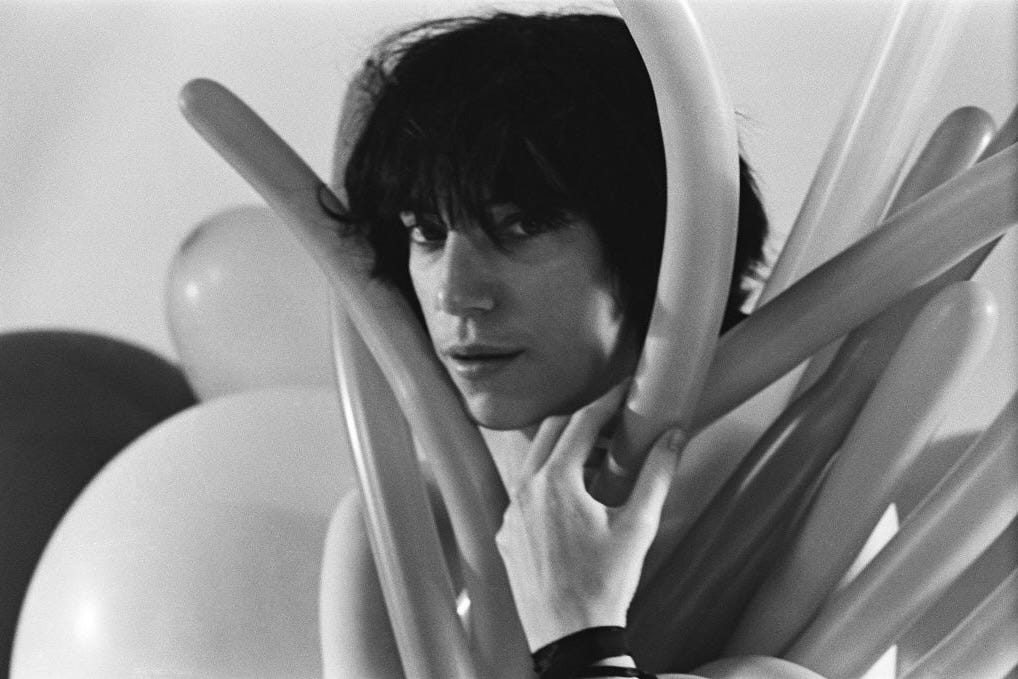
An interviewer once asked Patti Smith whether she’d always planned on becoming a rock musician, and she responded with a characteristically impassioned rant against labels. “Why do people want to know exactly who I am? Am I a poet? Am I this or that?” she said. “I’ve always made people wary. First they called me a rock poet. Then they called me a poet that dabbled in rock. Then I was a rock person who dabbled in art.” This was in 2008, by which point Smith had produced 10 records, almost as many poetry collections, a play, and a few books of photography and visual art. Two years later, she released the National Book Award-winning memoir Just Kids, and for a while it was tempting to think of her as a rock poet who dabbled in autobiography. But more books have since followed — there are about five prose memoirs in total now, depending on whether you include the 90-odd page Devotion — signaling something less like a side project than a complete creative rebirth.
Patti Smith has always been an oddly protean artist, so enigmatic and passionate and willing to follow her own creative whims. As a young poet in the early ’70s, she came to see rock music as a more potent vehicle for her writing and recast herself as a singer-songwriter, emerging from the early New York City punk scene as both an avatar of the movement and a singular force that stood outside of it. Beginning with the earth-shattering debut Horses, her first records stripped rock ’n’ roll down to its constituent parts and blended them with impressionistic spoken word delivered with operatic intensity — a sound that she once called “three chords combined with the power of the word.” In the mid-’90s, after nearly 15 years in semi-retirement, she stepped back into the public eye with a string of poetry collections and plaintive albums that traded in the street-punk vigor of her early work for a gossamer sincerity befitting Smith’s status as a recently widowed mother of two. The decades since have seen her become a peculiar kind of renaissance woman, shedding records, books, and artwork at an astonishing rate, all while continuing to tour and blogging/vlogging prolifically on her Substack.
The foregoing arc might have fit snuggly into a single ghostwritten volume, the kind that we’ve seen far too many of in recent years, but Smith has instead spun her story into an eclectic batch of books written in her own inimitable style. Unlike the autobiographies of, say, Maya Angelou, which chart a life sequentially, Smith’s overlap and intertwine in a patchwork of narrative and rumination. One has to read them together for a complete portrait of her life. Just Kids, for instance, focuses on her relationship with the photographer Robert Mapplethorpe and their time together in New York City. The more lyrical and elliptical M Train presents a series of vignettes that oscillate between the recent present and Smith’s life with her husband, former MC5 guitarist Fred “Sonic” Smith. The Year of the Monkey gives us a play-by-play of her 2016. Smith’s latest book, Bread of Angels, ties all of the disparate threads of her previous works together in a linear narrative, painted in broad strokes, that takes us from her birth to the present day. As a unit, the books add up to a volatile but thorough portrait of the artist, candid and guarded by turns, occasionally listless and girlish, but always shot through with Smith’s peculiar charm.
Her childhood was an unsheltered one in every way. Smith’s family relocated 11 times before she turned five, shuttling from one rooming house to another in Pennsylvania and South Jersey. Her father was a machinist in a factory, her mother a waitress who occasionally took on ironing work. Patti, the eldest of four, was always sick. She was born with bronchial pneumonia in the middle of the winter, and when she returned from the hospital, her father had to hold her over a steaming washtub to keep her alive. “Mine was a Proustian childhood, one of intermittent quarantine and convalescence,” she writes in Bread of Angels. “During the first six years, I weathered one communicable disease after another, bronchial pneumonia, tuberculosis, German measles, mumps, and chicken pox.”
An artistic and anarchistic streak revealed itself at an early age. When she wasn’t bedridden, she read poetry and fairy tales and played make-believe in the trash-strewn lots around her house. On her first visit to an art museum, she was entranced by Picasso’s paintings and defended them against her father, who was partial to Dalí. She later stole a copy of Rimbaud’s Illuminations, setting in motion a lifelong infatuation with the poet rivaled only by her parallel obsession with Bob Dylan. As a card-carrying Jehovah’s Witness, she attended bible studies and knocked on doors with her mother (“buckets of urine and excrement were thrown on us when hostile people opened their doors”), but she left the church as an early teen when an elder told her she had to choose between God and art. By then, she was already dreaming of escaping and becoming a jazz singer, a poet, a famous painter. “Only my devotion to my siblings kept me from running away,” she writes. Trapped in South Jersey, she got a job in a factory inspecting tricycle handlebars and then attended a teacher’s college for a few years before dropping out. At 19, she became pregnant and gave the child up for adoption.
Such was the life that Smith fled in 1967 for a transient existence in New York City. Almost immediately, she met Mapplethorpe, and the two set about making a life for themselves as bohemian artists, first as a couple and later, after the photographer threw himself headlong into the city’s gay BDSM scene, as close friends. Supporting herself by working in a bookstore, Smith drew furiously and wrote poems that she would later cannibalize for lyrics. In 1971, she was invited to read alongside the poet Gerard Malanga at St. Mark’s Church, and on a whim, she asked her friend Lenny Kaye to accompany her on the electric guitar. “It was the first time an electric guitar had been played in St. Mark’s Church, provoking cheers and jeers,” she writes in Just Kids.
Things moved quickly from there. There were invitations to publish poems in small magazines and give readings in London and Philadelphia. Cowboy Mouth, a play that Smith had co-written with her then-paramour Sam Shepard, hit the stage a few months after the St. Mark’s gig. Blue Sky Records offered her a record deal, which she turned down, wary of losing creative control. She published chapbooks of poetry and wrote lyrics for Blue Öyster Cult. Smith and Kaye meanwhile continued giving hybrid performances that fused music and spoken word, billing themselves at one point as “Rock ’n’ Rimbaud.” By 1975, they had added a keyboardist, a drummer, and another guitarist to their troop. Smith now found herself at the helm of a rock band, which was invited to play a two-month residency at CBGB, where they were spotted by Clive Davis and promptly given a seven-album deal with Arista Records.
Smith had released four of those albums and was playing to stadiums packed with tens of thousands of fans when she abruptly stepped out of the public eye in 1979 to settle down with Fred “Sonic” Smith. Given their previous lives as boho punks, their time together, in Patti’s telling, seems almost confoundingly quaint. After a private wedding ceremony attended only by their parents, the couple bought an ivy-covered cottage near Lake Saint Clair in Michigan and spent the next 15 years raising a family out of the public eye. Together, they refurbished an old boat and listened to jazz records and traveled to far-flung corners of the world together on artistic fact-finding missions. Fred listened to baseball games and got into classical music. Patti wrote and communed with the natural world. “With the arrival of dawn,” she writes in a typically lyrical passage:
I would step outside as the flowers opened, the doves cooed, and the long-haired willows swayed slightly over the dark canal. I was enthralled by small things, the wonder that our tree grew pears that fell by my feet, that wild roses climbed up the trellis, entwining our balcony, that the same doves returned every spring to nest upon it, and that the morning glory seeds I planted covered the cyclone fence at the edge of our property, boomed an impossible blue.
William S. Burroughs once described Smith as “a shaman . . . someone in touch with other levels of reality,” and there are intimations throughout the memoirs of this higher order of perception. The most ordinary objects can begin to shimmer when they come into her orbit. As a child, she covets a friend’s Communion dress, believing that “it had special properties, like an invisible cloak, and that it would keep one safe from harm.” She pockets a stone while hiking in Mexico because it seems to call out to her “as if waiting for another commandment to be etched on its polished surface” — although airport security later confiscates it, occasioning a mini spiritual crisis (“I took the stone from the mountain and it was taken from me”). We’re likewise alerted at every turn to the totemic significance of a particular café chair, a bathrobe, a billboard outside of a hotel.
It’s the same with books, which Smith writes about with an almost religious sense of devotion. Her favorite works of fiction and poetry — Rimbaud’s Illuminations, Bolaño’s 2666, Genet’s The Thief’s Journal — become holy books, sacred texts to return to and explicate again and again. As soon as she finished Murakami’s The Wind-Up Bird Chronicle, she immediately started over with the first of many re-readings because, she writes in M Train, “the ghost of a phrase was eating me.” Then, too, she’s unapologetically mawkish in her reverence towards the authors. Over the course of her memoirs, we accompany her on trips to the gravesites of at least a dozen writers and are treated to many a grainy polaroid of their possessions (Herman Hesse’s typewriter, Virginia Woolf’s walking stick).
But Smith’s literary hero worship tracks with her own hard pivot toward the written word over the last few decades. For all of her resistance to labels, her memoirs are littered with starkly candid statements of artistic purpose: “I knew then with all my being that to be a writer was what I wanted more than anything”; “I’m going to remember everything, and then I’m going to write it all down”; “I grew lighter, healthier, and sure of the vocation I had chosen above all others. That of a writer.” Fred’s early death from heart failure in 1994 led Smith to return to the stage and begin making music again. By that point, however, she’d begun to think of herself primarily as a prose writer, although it took her 15 years to release her first full-length book. In the intervening years, there have been new records, constant tours, and exhibitions of her artwork — all of which appears, now, like mere dabbling for Smith. “I could imagine life not performing, not singing, not drawing, not doing many, many things,” she said in an interview recently. “But I could not imagine not writing.” We can only hope she stays the course.

Habib Sabet is a writer based in Vermont. His writing has appeared in County Highway, Pitchfork, and Aquarium Drunkard, among other publications.
 | A guest post by
|
I’m sorry to report that I found this physically almost impossible to read, owing to the layout of the text (‘justified’). I believe it would be easier to read if it were left-aligned.
"Smith had released four of those albums and was playing to stadiums packed with tens of thousands of fans when she abruptly stepped out of the public eye in 1979"
In Italy, yes. In New York she was still playing the Palladium. Another interesting quirk of her career