

Life on a Tube Filled With Seamen
On Yannick Murphy’s ‘Things That Are Funny on a Submarine But Not Really’


Military life has long served as reliable fodder for American literature, which should come as no surprise: something about stories of men from all corners of the country facing danger as a team is inherently dramatic. From Stephen Crane’s The Red Badge of Courage to Norman Mailer’s The Naked and the Dead, authors have mined the ups and downs of military life not just to shine a light on what makes those institutions — and the people who work them — tick, but also the American experience as a whole. Sometimes this even takes a comic turn, as seen in Joseph Heller’s satirical masterpiece, Catch-22, or Neil Simon’s autobiographical play Biloxi Blues, which documents his stint in the U.S. Army (with plenty of gags thrown in for good measure).
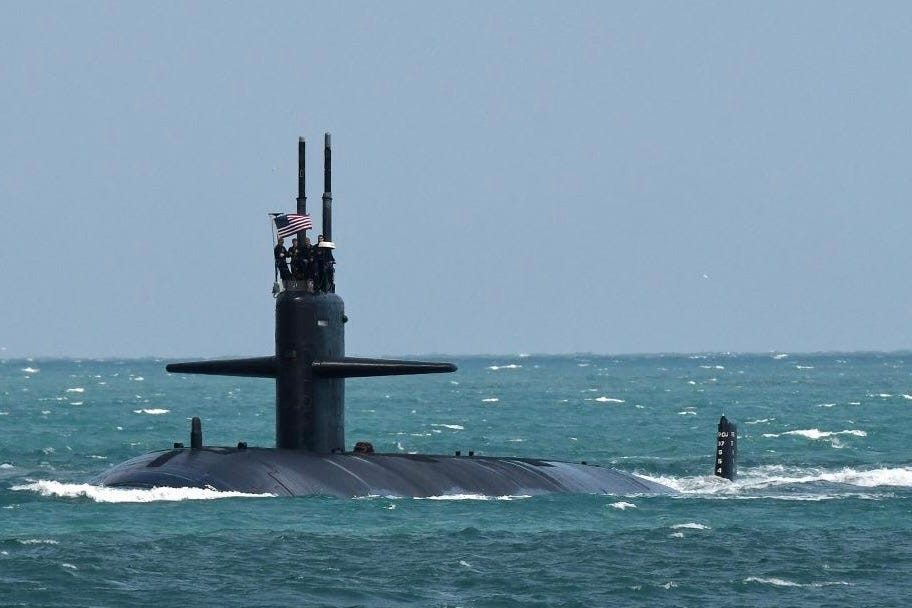
It is from this very established tradition that Yannick Murphy’s new novel, Things That Are Funny on a Submarine But Not Really emerges. As the title suggests, the story focuses on a group of submariners — aka bubbleheads — in the U.S. Navy, and if you skip the mini-foreword, you just may think the book is a memoir. It certainly reads that way, as Murphy yanks you deep beneath the ocean’s surface and straight into the “big steel tube of dumb” that the sailors call home. You’re then immediately delivered into the head of David Sterling, a radioman in his early 20s as he nears the end of his five-year stint underwater. His racing thoughts make up the book’s story and play out as if he himself had committed them to the page.
This book, however, is very much a novel, and it’s a credit to Murphy’s considerable powers as a writer that she may trick you — at least at first — into thinking you’re reading a true first-person account. As is briefly explained before the story starts, all three of Murphy’s children are submariners in the U.S. Navy: one is retired, while two are active duty. Things That Are Funny on a Submarine But Not Really is said to be “a work of fiction blended with her children’s stories from overseas phone calls and underway emails,” and in lesser hands it could read as an inauthentic pastiche. Murphy, however, is an accomplished, award-winning novelist, and the claustrophobic, often crude, mostly male world she builds never rings false. The writing is also full of enough Navy slang, acronyms, and abbreviations that you may find yourself — like me — consulting Google every three or four pages.
Our protagonist, David Sterling, is obviously bright, but he was a shiftless, poor student in high school. Facing few options after graduation, he joined the Navy because he “liked submarines” (a passion instilled by his father, a full-blown sub geek), but now that his time is almost up, the prospect of college looms. His parents are constantly pushing him to enroll in a university when he gets out, but Sterling wonders “if there is a shit ass college for me out there. Is there one that admits students with high school grades more like their shoe sizes?” His ticket to college is the G.I. Bill, but he fears he’ll self-sabotage before claiming his reward by mouthing off to an officer and ending up with the “Big Chicken Dinner, aka dishonorable discharge.”
Sterling has never had a girlfriend, a secret he confessed to his comrades during sub school. One reason for this is his weight. This doesn’t go unnoticed in the confines of the submarine, where every physical flaw is the target of ruthless ribbing. “The gay guy Manning . . . tells me I’m fat,” Sterling says, “and he’d never do me, and I’m actually relieved for once to be fat.” On several occasions he refers to his “ba-donk-a-donk ass,” and this, plus the “Bigfoot is Real” bucket hat he often sports, paints the picture of an overgrown nerd in a poopy suit — the jumpsuits that serve as the uniform for enlisted men onboard.
Like any good military book, it’s the supporting cast — all referred to by surnames or nicknames — that really breathes life into the story. Baitz is from South Carolina and “thinks that North Carolina is in the North.” Tintin is an Iowa farm boy named after the comic book character on account of his greasy ginger cowlick. Grenadier hails from the mean streets of South Chicago and admits to gangbanging before enlisting. Bortlein is called “Borderline” because of his tendency to violently flip out, while Cordova “has one of those hook noses that makes him look like he just came running down the steps at Chichen Itza in a loincloth.” Their captain sounds like Matthew McConaughey in Dazed and Confused, and every time he signs off on the sub’s P.A., Sterling and his buddies respond in Texas drawls with “Alright, alright, alright.” Doc — the boat’s medic — is an intense loner from NYC and a known woman-beater, and Sterling — due to failing his role in a fire drill — comes to be known as simply “Dead Man.”
These men represent the regional and racial patchwork that is the modern U.S. military — which Sterling describes this way:
Sometimes I think of our submarine as the Noah’s ark of all different types of humans. If we were to sink to the bottom of the ocean and be found hundreds of years later, there would be no shortage of a diverse gene pool with which to start colonizing the planet.
The submarine is based in the island territory of Guam in the Western Pacific, and while their supposed nemesis in those waters is the Chinese navy, the biggest enemy they face aboard the boat is boredom. Sterling and his buddies in the radio room — known as “the Goon Squad” — do anything they can to pass the time. They argue about whose mother makes better pancakes. They speak in mafia accents. They scuffle, wrestle, and put each other in headlocks at the slightest provocation. They watch old movies ranging from Cool Hand Luke to Pretty in Pink, and Sterling entertains them all with stories from home:
The guys on the boat want to hear the story about the time the heavy snow on the powerline cut the electricity, so my father went out with the shotgun and tried to shoot the snow off. They want to hear about the calls I went on with my father, the veterinarian, to treat horses and cattle. The time we pulled out a newborn calf, but it was dead, and all we pulled out were the legs that had broken off from the body that was still inside the mother.
As the book progresses, it’s clear that Sterling comes from a different social class than his boatmates. After all, his father is a veterinarian — hardly a proletarian occupation — and the family home in New England comes complete with a private pond. This — plus the fact that he has a college education in his future — makes him stand out from the rest of the enlisted guys on the crew. Grenadier is aware of this, and encourages Sterling to grab the opportunity in front of him. “Go to college,” he says. “I’ve never been, but I bet it’s dank. Chicks and shit. You don’t have to stand watch. You don’t have to live in a metal fucking tube. Besides, you’d be good at college. You’re smart and shit.”
Sterling’s buddies clearly grew up rougher and poorer, and their current life choices put them on a vastly different trajectory. Grenadier is married to a stripper back in Chicago. They have two kids, but when it becomes clear she wants to leave him, it sends him into a tailspin. Tintin is in love with another stripper named “Kitten” from one of the clubs they frequent back in Guam, and — despite Sterling’s repeated warnings — is determined to tie the knot with her.
Murphy’s prose shines best when she’s describing the day-to-day passing of time on the sub, with illuminative passages such as this:
I start whistling riffs from Aaron Copland’s Rodeo. Baitz reaches his hand up to his face and starts squeezing a zit on his cheek between two fingers. Wonton cracks his neck, and we all agree that it sounds like fucking popcorn being cooked.
She also keenly describes the unwritten rules that govern sub life, especially when it comes to the crews’ bunks known as “Rackistan”: “Pulling back another guy’s rack curtain when it’s closed is grounds for all-out-war, and even if you think your rack mate is on his deathbed, you do not open the curtain to his inner spanktum.”
While the mundanity of sub life may be enough for a slice-of-life story, Murphy manages to inject enough drama into the proceedings to prevent any narrative navel-gazing. There is a suicide attempt. Doc becomes convinced that one of the crew is spying for the Chinese, and attempts to enlist Sterling as his eyes and ears. A group of Navy SEALs launches a mission from the boat to recover a submersible device captured by the Chinese, who respond by shadowing the sub with one of their own. Finally, during a crew swim session on the surface, known as a “steel beach party,” one of their numbers never makes it back onto the boat.
All of these crisis-laced sub stories certainly elevate the stakes in Things That Are Funny on a Submarine But Not Really, though they do feel shoehorned at times, as if Murphy didn’t trust that a day-to-day examination of submarine life where nothing extraordinary ever happens would be sufficient fodder for a novel. Maybe she’s right, but the book works best when it’s not trying too hard to drum up some Hollywood action.
The actual submarine scenes occupy just the first half of the novel. Due to a conflict with a superior who seemingly has it out for him, Sterling is grounded to the base in Guam while the sub returns to sea without him, pondering his soon-to-be civilian future while taking a resume-writing class, which includes penning college-entrance essays, igniting a new passion. He soon is discharged and makes his way back stateside, where, after a stint with his parents in New England, he finds himself enrolled at a nameless midwestern university. Supported by the G.I. Bill, he immediately feels out of place, surrounded by bright and shiny, much younger students with stridently woke sensibilities and very little life experience. “I’m wearing my boat T-shirt with the name of our sub on it,” he remarks on the day of his arrival at the college. “The T-shirt’s dark shitty brown with black lettering, and the shorts I’m wearing are also brown. I look like a muddy river trout in a sea full of neon tetras and paradise fish.”
This sense of alienation is made worse in his creative writing class, where his first story — an account of visiting a legendary brothel known as “Four Floors of Whores” on shore leave — is savaged by fellow students for running afoul of current sensibilities. “Nobody talks about the story, instead they talk about how I shouldn’t call women whores and that I’m being derogatory toward women,” he laments. “On the first day of class, the teacher said we should write about what we know. That was my mistake.”
Despite the fact that Sterling is thousands of miles away from the sub, sub life can’t seem to quit him. He thinks about the Navy constantly, longing to be back underwater with his old crew of misfits. Some send him occasional emails filling him in on sub gossip and encouraging him to re-enlist, which tempts him as his college life feels empty. The one quasi-friend he’s made (his video-game-playing partner) seems hopelessly naive and unable to understand his previous life, and it’s also the same with Taloe, a girl introduced as a possible love interest.
Most notably, Sterling suffers from hearing voices in his head in the form of his comrade who went missing during the swimming break, who at times berates him for going civilian and turning his back on his bubblehead buddies. Whether this is a specter of his guilt or an actual mental break is never made clear, but once Sterling settles more and more into the rhythms of regular life, the voice fades away.
His final encounter with sub life happens when his old buddy Tintin, in the midst of a drugged-up psychosis, appears at his doorstep on a bug-eyed quest to track down his ex-fiancée, the stripper-turned-student at the university (it all seems a bit too convenient plot-wise, but hey, sometimes writers need to keep things simple). Just when Sterling is finding his groove as a respectable civilian, Tintin acts as a tornado from his past, almost blowing him completely off the tracks. Tintin also acts as a potent reminder that sub life wasn’t everything it was cracked up to be, and that we tend to romanticize our pasts.
This seems to be a big idea in Things That Are Funny on a SubmarineBut Not Really: that our memories define us, at least for a while — especially when formed in our teens and early 20s. This is why the once-great high school quarterback will still tearfully wax poetic about his glorious game-winning touchdown 30 years down the road, and why so many military guys can never really shed the armor they once donned. The bond created between humans who wear the uniform is stronger than lifelong civilians such as myself can ever really fathom, which is why it’s remarkable that Yannick Murphy — never having served herself — captures these feelings so clearly. I suppose it’s because, as a mom, she knows a thing or two about mutual love and obligation, and that greatly aids the telling of this story.

Chris Tharp is the author of The Cuttlefish and two other books. He has been a regular contributor to National Geographic, The Telegraph, Asia Times, and plenty of fancy travel mags. He lives in Busan, South Korea with his wife and a pack of animals, and his Substack is called The World According to Tharp.
 | A guest post by
|
We are deeply offended by this title … ! Please recall that submarines are big BLACK and full of seamen