


There exists such a thing as a “poet’s novel” — that is, a novel written by a writer who is primarily a poet. Notable examples include The Notebooks of Malte Laurids Brigge by Rainer Maria Rilke, Pictures from an Institution by Randall Jarrell, and The Issa Valley by Czesław Miłosz. These aren’t just novels that happen to have been written by poets. They are novels that express a certain poetic sensibility. They dwell lovingly on description, whether of landscapes or clothing or furniture. Style seems to exist more as an end in itself than as an instrument of storytelling. There’s a good reason for that: often there isn’t much of a story. Instead of a traditional plot, we get moods, atmospheres, character sketches, and essayistic digressions. A poet’s novel is usually not a page-turner; it’s a book that invites you to linger on the page.
Emmalea Russo is a poet, and her new book, The Moon Papers, is a novel. In some respects, it fits the above description of a poet’s novel. In others, it doesn’t. Basically, it tries to be three things at once: a science fiction story, a satire of the art world, and a character study.
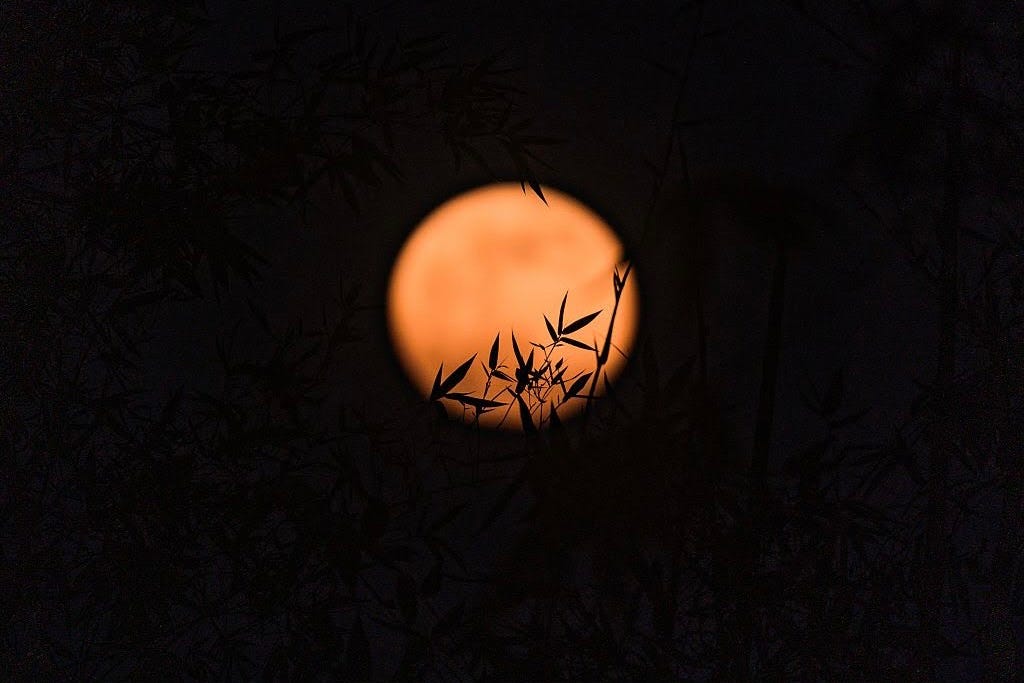
The first element — the science fiction — is the weakest of the three. Russo admittedly sets up an intriguing premise. In the California desert, a mysterious art collective known as the Center for Constant Creation (CCC) is engaged in its most ambitious project yet: the launching of a new, artificial moon. This object, which is supposedly made of thousands of recycled plastic bags, will be towed by a “space tug” into place, launched from a giant silver can on a summer night, and will be one-eighth the size of the already existing moon.
This is a science-fictional scenario, but we can already see the art-world satire poking through. Its edge, however, remains blunted, largely because of the unsolved mysteries that surround the collective and its projects. There is a definite air of creepiness about the CCC. It has an unusual “Artist in Residence Program”: pregnant female artists are kept there in a coma until they give birth. Members of the collective who maintain contact with the outside world are regarded with suspicion. It is almost impossible to find images of its buildings on the internet. Rumors circulate about its backing: the government might be behind it, or a sinister corporation, or both.
The main problem is that we are not given much to go on. The question of motivation remains obscure, starting with why anyone would want to launch a fake moon in the first place. We learn almost nothing about Voortelle, the shadowy corporation that may or may not be sponsoring the CCC, and that may — or may not! — be in cahoots with the government. Moon2, the free-floating referent at the center of this novel, is such a cipher that it can mean all things to all people. This leads to endless speculation and worry: Moon2 will have a positive effect; it will have a negative effect; it will affect menstrual cycles; it makes horses lethargic; it causes psychological problems in people; it’s about mind control; it’s nothing to worry about; it’s something we should all be worried about.
We live in a world where viruses rage across continents and force lockdowns of entire countries; where floods drown villages and fires ravage even upscale real estate; where billionaires who resemble Bond villains develop technologies that threaten to make homo sapiens obsolete; and where the threat of nuclear war has never really gone away. To put it mildly, this list is not exhaustive. Yet the characters in this novel are concerned, almost obsessively, about the effect that a fake lunar replica — a Christo-like art project — could have on the world. It’s hard to take these worries seriously when real-world horrors clamor for our attention.
The satire, while not as pointed as it could be, does provide some bubbly if rather predictable entertainment along the way. It would be hard to go wrong here: the art world is so full of pretension, self-importance, and high-flying but meaningless rhetoric that the jokes practically write themselves. Transcripts of the CCC’s meetings are full of statements like this:
What we’re launching is a change of energy and vibe, a vibrational shift. Obviously. A different era entirely. There will be the times pre-Moon2 and the times post-Moon2. The before times and the after times. This means that Moon2’s launch is an event. . . . Simultaneously, we continued working on avoiding the terms “real” and “fake.” We don’t want the original moon to be considered the “real” one and Moon2 the “fake” or the “imitation.” Rather, we want them to be viewed as different, but equal.
The first half of the book alternates between “West” and “East” — those are, in fact, repeated chapter titles. East is rural Pennsylvania, which is populated by a cast of strange, quirky characters. Many of them are holdovers from Russo’s previous novel, Vivienne. Velour, the late Vivienne’s daughter, and Vesta, her granddaughter, both live in this picturesque country setting, in a richly imagined landscape full of animal life and animal death, nosy neighbors, traditional towns, and gentrified new developments with names like the “Residenz.” The discovery of a bat colony in Velour’s furniture-cluttered house, where she lives as a virtual shut-in, serves as a way of introducing other characters, most notably a young bat conservancy worker named Radko Toth.
While a rather surprising degree of sexual energy gradually builds between Radko and the 68-year-old Velour, Vesta — now an artist herself — conducts a long-distance quasi-affair by phone with Dean Konig, a dissident member of the CCC. This affair connects the two locations of the story; we see much of their lives through their screens, a manifestation of this book’s interest in surveillance and control. To complicate things, Vesta is married to Lars Arden, a gallery owner about 30 years her senior. She spends much of her time painting in her “secret studio,” located in a house owned by a 90-year-old man called Ziggy, whose senile outbursts provide some edgy humor.
Structurally, the story is marked by doubling, symmetry, and contrast. We get two moons. We get the harsh Western desert and the green bucolic East. There’s the artist-in-residence program that is actually a birthing program, and there’s a colony of female bats and their offspring. There is full-sized furniture and there is miniature furniture (Velour is excited by the idea of creating a diorama out of the latter). There are multiple relationships involving large age gaps.
Stylistically, The Moon Papers is a potpourri, with vast amounts of “found” material — a hallmark of much modern art — interrupting the flow of its narrative. In addition to CCC transcripts, we read discussions from an “anti-Moon2” forum, full of paranoia and conspiratorial thinking. The book reproduces two complete articles, one each on Vesta and Lars, from New York-based art periodicals. We are treated to recorded sessions with Chloe, the rural psychotherapist. Naturally, there are text message exchanges, with their trademark truncated language. The second half, in which the camera is turned more strongly on Vesta and Lars, features numerous monologues labeled simply “Voice.” Some of these Voices are easily identifiable within the context of the story, while others are not. They are meant to give us further perspectives on the main characters and other elements of the story. I found some of them illuminating, others superfluous.
The found material contains extensive quotations from a journal kept by Lars; he calls these notes — you guessed it — “The Moon Papers.” I found Lars to be the most interesting character by far. Luckily, in the book’s crazily fragmented second half, he gets a couple of solid chapters to be himself. Lars is a guy with a lot on his mind, and it weighs him down. He’s the curator of his wife’s work and that of her family, and the art business, with its demands for commercial viability, can be aggravating. He haunts the anti-Moon2 forum, frets about what the CCC is up to, and worries about Moon2, which he considers to be “the work of the devil.” Lars has a mystical streak: he finds inspiration in Christian saints, having a particular affinity for the desert hermit St. Anthony of Egypt, whom he regards wistfully as a sort of role model:
Like Lars, Saint Anthony was born into upper-class Catholics. Unlike Lars, Saint Anthony had renounced everything. . . . Somehow, he had lived to be 105 years old. This fact impressed and surprised Lars, who planned to live as long as possible. Perhaps the saint lasted so long because he only ate bread and whatever stuff his fans and followers would throw over the fence. Lars wondered if he, himself, could figure a way to alter his dietary habits to match the saint. He had skipped breakfast. That was a start.
I read the book twice, and both times I had the same overall reaction. Russo excels as a creator of character and an inventive prose stylist, but the book tries to be too many things at once. I thought there was too much about rumors, speculation, and conspiratorial thinking, and not enough about skipping breakfast. I appreciate the author’s willingness to take risks throughout the work; it’s something I wish lit-fic authors would do more often. Some of the risks pay off, while others fall flat. At its heart, The Moon Papers is largely a comic elaboration of insider lore. The extent to which you enjoy it will probably be a function of how interested you are in the contemporary art world and the outlandish personalities who populate it.

Scott Spires is the author of the novels Abandon All Hope and Social Distancing. He writes about literature, culture, and geography at Lakefront Review of Books.

I appreciate your thoughtful engagement and honest here! Plus you read the book twice
Would you place Borges in the category of writer who’s primarily a poet? Appreciate he wrote short stories over novels. But he certainly had that poetic sensibility you mention.
Curious: how long is The Moon Papers? With your observation that it’s trying to be too many things at once, just wondering whether it spends a lot of time doing that?