


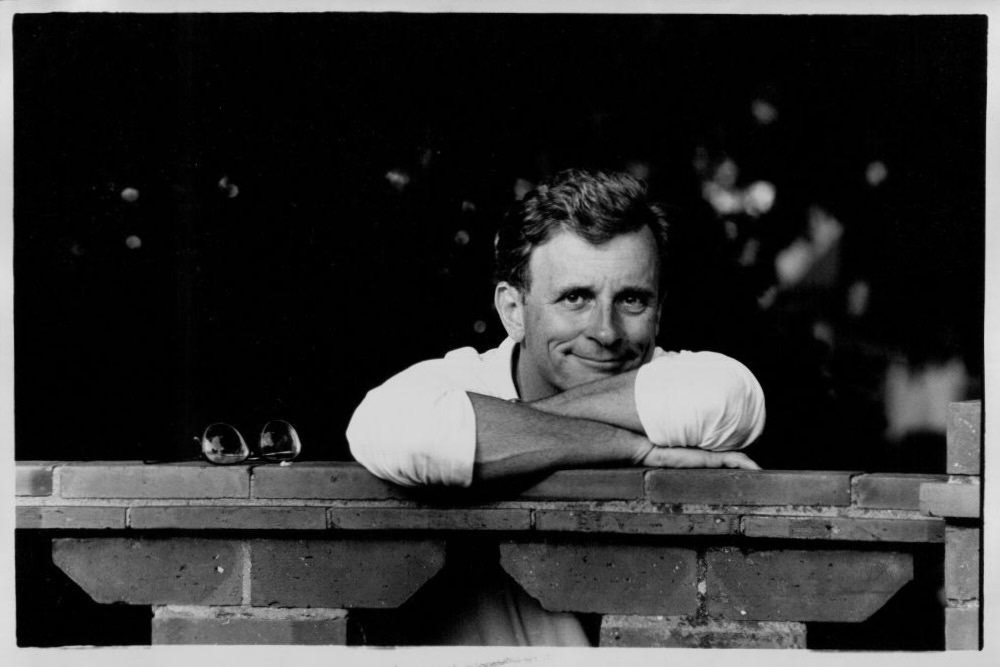
I always imagined I would write something about Edmund White after his death. What I never imagined was the death itself. It came on the evening of June 3, 2025. I found out the morning after, lying in bed. I had slept in; I was startled and squinted into the indirect sunlight just past my bedroom doors as I heard my wife say, “He died.” I didn’t know whom she meant, nor why he should be important enough to wake me; I assumed she was talking about some actor, musician, or statesman whose obituary she’d read in the paper. “Who?” I asked.
“Edmund,” she replied. His friends called him Ed, but I never took to it. At first, it felt too familiar, and once I got to know him well, it was too awkward to change. I first met him in 2003, at the Free Library of Philadelphia, where he’d given a reading from Fanny: A Fiction, his novel about Frances Trollope, mother of Anthony Trollope and author of Domestic Manners of the Americans. We had exchanged a few emails the year before, but he didn’t remember me when I approached the table to buy his book. My life would have been different had the person I was with not blurted out, “Nate wants to know if you can meet for coffee.”
Edmund invited me to lunch the next day at the Fountain, the now-closed restaurant at the now-closed Four Seasons on the Ben Franklin Parkway in Philadelphia, one of a few proper fine dining places in the city. That was the last gasp, or the second-to-last gasp, of the luxury book tours authors used to count on as a matter of course (he told me a year later, an ominous chill in his voice, of how the bottom had fallen out of the literary fiction market, and all the writers I thought were a big deal were now scraping by on $10,000 advances). He ordered monkfish, which I remarked I’d never tried, apart from a pâté of its liver served in the fancy Japanese restaurant where I worked. He smiled and said hm, as he often did when at a loss for words. We then walked to the art museum to see an exhibition that I always remember as being of Fortuny gowns, but in fact its subject was the dress designer Elsa Schiaparelli. I thought fashion was stupid — I suppose I still do — but Edmund’s effusive admiration of all he saw, and the sense he conveyed of some essential congruence between luxury and high culture, made me painfully conscious of my own provincialism. I confessed to him, after the eighth or ninth anecdote about Schiaparelli’s relations with Isadora Duncan or Francis Picabia or Giacometti, that I was afraid I was too stupid to be a writer. “Oh, no,” he said. “Most writers are very stupid.”
I haven’t met most writers and I’ll not dare concur with his observation, but I will say that when, a month later, in an effort to do something for my literary career, Edmund took me to a dinner with a group of authors, I found them tremendously boring. John Berendt was there, and he complained at length in a reedy voice about some klutz who’d dropped a glass of wine at his house, and how it had splashed up the wall and ruined his cream paint. There was lots of rehashing of articles in the New York Times and a good bit of who was sleeping with whom. When we were in a taxi headed home, I mentioned to Edmund I’d been surprised there was no talk of books. “Yes, it’s so strange. That’s why I like you, because we really do talk about books,” he said. “All writers ever want to talk about is real estate.”
I first heard of Edmund White through his biography of Jean Genet, which my girlfriend gave me as a birthday present my senior year of high school. It didn’t cross my mind then to read his fiction. I saw Genet’s homosexuality, like Sade’s or Burroughs’, as a minor piece of a broader embrace of transgression that appealed to me the way such things do to disgruntled adolescents; but a contemporary gay novelist, that sounded like a fruitier version of Updike or Cheever, to take two writers who fill me with admiration now but whom I dismissed then as of dullness incarnate. A few years later, Vintage International reprinted Edmund’s major books in stylish paperbacks with beautiful cover photographs by Herbert List. I found one of them, The Beautiful Room is Empty, for a dollar at a used bookstore in Tennessee. I read it in one sitting, from nine in the evening until one in the morning, finding a language and a depth of insight that took my breath away, hearkening back to Henry James and Góngora and the fine discriminating psychology of Madame de Staël.
The realism I was then acquainted with fell short of, or to the side of, my own ambitions as a writer, and because it was well-regarded among my teachers in high school and college, I’d rebelled against it by reading weird, decadent Europeans whose tricks I couldn’t copy effectively (this is a roundabout way of saying I was too pretentious and hadn’t lived enough or read enough). And so I was dumbstruck to find an American who could write of Midwestern drabness in phrases of such supple sophistication. For years, there lingered within me his description of a day “so surgically clean and sharp that even the clouds looked like cotton soaked in alcohol,” his “hemorrhage of sunlight,” his sociologist’s attentiveness to the codes shaping sexual desire, his sultry evocations of perversion amid drear.
It’s not that he wasn’t a realist in his way; in The Farewell Symphony, he even declares that realism is the great challenge. He sensed that many writers known and praised for their rawness had actually ducked the hard stuff, striking all the vast realms of experience that refuse to yield to laconicity. Realism for me was synonymous with Raymond Carver (whom Edmund was friendly with, though he was appalled when Carver told him, “You know, my children ruined my life”); I still like Raymond Carver, but I cannot help seeing him now as an artist of the most extreme abstraction, his tales a stark play of animated statues, impoverished and intriguing, but quite alien from the miscellany and disproportion of life. Whereas, at their best, Edmund’s ramifying circumlocutions, cast out like nets and drawn back in rue of the fallibility of words, were an earnest attempt at catching the fullness of life in flight.
Nabokov observes, in part to marshal evidence to his contrarian conviction that Flaubert was no realist, that it is impossible, hewing close to the description given in Madame Bovary, to coherently envision Charles Bovary’s hat; Edmund’s details are often like this, little engines of adjectives and similes that pass from vagueness to specificity and back, leaving readers with the feeling of having witnessed something ungraspable. And yet they are not idle poetry, or not always; in their instability, they remind us that perception is motile, not so much a relation to the outer world as, to cite Bergson, the mode of evolution of the mind in freedom.
Not all of his extravagancies are justified — I see this now, as I reread him coolly — but Edmund taught me that beauty was worth striving for, was worth taking a risk. He revealed the vein of cowardice, at the same time of amour-propre, that runs through any purported realism that mistakes whittling away for “craft.” To be mealy-mouthed, he knew, is cheating, forcing the reader to do the author’s work. Simplicity is a virtue; inarticulateness is not, and too much bluntness, particularly in the treatment of the sordid and shoved-aside, degrades easily into a gloomy minstrelsy that gay literature, in common with southern literature, hasn’t always managed to escape. Edmund aimed consistently for something larger.
His body of work is perhaps unique in following the metamorphoses of sexual desire from prepubescence to senescence. As a young man, he dreamed of being seduced by an English lord; he had shown himself as lover and beloved, cheater and traitor, husband and hussy, master and slave. He wrote that only first loves were true; I think that was a paraphrase of Proust. It was far from true for me and I doubt it was for him, not just because I heard him say so many times, I’ve fallen in love, but also because he was too sophisticated, too much of a follower of Foucault, to go in for so naïve a notion as that feelings can be distinguished as true or false.
Edmund asked me once with a sly grin, “Why do you read all these fag writers?” He meant his contemporaries, and John Rechy, who was older, and Alan Hollinghurst and maybe Julien Green. I didn’t have a good answer, and I can’t remember the one I made up. I’m sure it didn’t satisfy him. He had what I’ll dare call a queeny inclination to overintuit sexual motives; that was common among gay people well into the late ’90s, and maybe I’m just old now, but it seems mostly to have disappeared. I couldn’t express then what I see more urgently now as the repositories of meaning in my own life begin to pass — I include here not only the noble ones like Edmund, but things lowly, stupid, inexplicably private, things I may have overlooked or abhorred but that matter simply because they were there — that I want so badly, before the end of my own days, to try and get some sense of what the world actually is, and this inevitably draws me toward all that I am not. It was a coincidence that it was gay letters; it would later be Spanish viticulture, the Austrian Antiheimatroman, Brazilian jiu-jitsu, gang culture in Philadelphia. There is so much to know, and I am still learning, as Goya writes in his Bordeaux notebook beneath a pencil sketch of a hoary man leaning on two canes; what pains me terribly is that now, I will have to learn without him.
We talked often about similes and metaphors, when they worked and when they fell flat. I was unduly influenced by Martin Amis’ view of the moral dubiousness of clichés (and was unwary of the danger of virtuosity, which Édouard Levé says confuses art with prowess), and when I was still learning Spanish — in other words, when I had no leg to stand on — I complained to him about what I saw as the triteness of Jorge Manrique’s “Verses on the Death of His Father,” one of the greatest poems of that language. Edmund had met Borges, who told him the only true metaphors were the commonplace ones: time as a river, life as the dawning and setting of the sun. He censured a piece of my own writing by quoting someone — I want to say Harold Brodkey, though Richard Howard is more likely — to the effect that a metaphor was only justifiable when it broadened or particularized a description. He adduced, as an example of idle figurative language, the comparison of a window to an eye. This very comparison appears several times in his books, and I wonder now if he was passing along a rebuke he himself had received long before.
He also told me once that for “ordinary people,” clichés had the ring of truth, whereas elaborate language was confusing, alienating, and suspect. He didn’t mean this to sound as snobbish as it does. He was warning me to be cautious in copying those who express themselves in ciphers, to doubt willful sophistication, and not to confuse artlessness with shallowness of feeling. This was an aesthetic lesson, but one I have also applied in life, and it came back to me poignantly when dementia struck my mother and her voicing of her fears, longings, and affections shrank to a glossary of platitudes repeated over and again, southernisms like “madder than a wet hen,” and a slightly misquoted line from Tobacco Road, the significance of which continues to elude me: “It didn’t hurt the runnin’ of it none.”
Edmund took me once to the IFC, I think, to see Visconti’s The Leopard, based on the novel by Lampedusa. I hadn’t read the book, I didn’t know what the Risorgimento was, I had only left the United States to get drunk in Ciudad Juárez and, for a year of drudgery, to teach English in a tiny school next to a train station in Japan; and because I liked writers with a knack for witticism and thought I might grow into a maker of quips myself (I was already an adult then, but felt then, as I still feel now, that my life is just beginning), I told him, when he asked whether I was enjoying myself, that I felt like a man who had been hanged but couldn’t die. This must have hurt his feelings, because he mentioned it to someone else later, imprecisely, and I was proud enough of my cleverness to correct his wording. The truth is there is something skeevy to me about the sight of Burt Lancaster’s supernumerary teeth, and so-called period films bore me to desperation; I cannot escape the sense that they have nothing at all to do with how things were. These peculiarities were wedded to cultural vulnerabilities that I preferred to defend through a show of allegiance to my origins (southern, uncosmopolitan, class indefinable but more lower than upper) rather than accept that when seen in the proper light, everything is significant and warrants interest. Edmund tittered at a hand-kissing scene, explaining that it was boorish for the lips to touch the hand, and I thought to myself, Who cares? I feel now that this question must almost always be the mark of an idiot. Frédéric Rouvillois writes, in Histoire de la politesse de 1789 à nos jours, that hand-kissing was hardly known, at least in France, before the 20th century, making it probable that its appearance in the film is an anachronism. I wish now I had sent Edmund this book, with a note recalling the occasion; it would have delighted him, who could never put too fine a point on anything. My consolation is that he must have found it on his own. I’m chattering now, but what I want to say is he helped me see that if something bores me (in his honor I’ll make one of those linguistic asides he was so fond of to observe that in Romance languages, the word for to bore is reflexive, and instead of saying that we’re bored, we say literally that we bore ourselves), this tends to be because I’m missing something and not because the world is beneath me.
I often had the sense in our conversations that Edmund was indulging me — not condescendingly, but complaisantly. He liked to talk of famous people I knew little about, authors or artists I had only heard of, French royalty, which I couldn’t have made matter to me if I’d tried. I do know hundreds of dirty jokes, so in a pinch, I could always make him laugh. The one time he seemed to ruminate over something that I’d said — at any rate, the one time that sticks in my mind — was when I told him about a visit to an old friend who had gone drastically downhill. He offered his sympathies, and I replied that I didn’t think people really liked their friends anyway, that they just needed them to have something to talk about. It was a specious comment, and not particularly witty, but he liked it enough to repeat it on another occasion, possibly because its duplicity was akin to the climactic betrayals in a few of his novels, or maybe just because he saw value in admitting horrible things about oneself.
I told him about a conversation I’d had through email with the neuroscientist, Semir Zeki, about whether hostility toward the old and frail had an evolutionary basis. We had just finished watching, of all things, a sketch from Mr. Show. Edmund admitted, “You know, when my friends all started to die, there was a part of me that thought they were sort of losers.” I nearly wrote that I’m unsure he was being sincere, but that’s not the right way to put it; what I mean is that Edmund viewed sincerity not as an accord between public statements and privately held beliefs, but as a subsidiary property of affection — supra-sincèrité, as Vladimir Jankélévitch put it, whose primary concern is attending to the reasons the two of us are together. Or maybe I’m bullshitting. Regardless, I, who normally take pains to be polite but harbor the greatest pessimism in my heart, will long be grateful for the company of someone with whom I could air my worst thoughts without worry.
Edmund had, as most honest Americans do, an ambivalent relationship with intellectuality. I remember him encouraging me to strike the phrase “polymorphously perverse” from an early story. Perhaps because his primary pleasures were vices — lust and gluttony above all — he took a dim view of cerebration. But in the first years I knew him, he wore a watch with Nietzsche’s image in profile on the face, and I recall him rhapsodizing over a fancy edition of the works of Walter Benjamin he’d acquired in French. I preferred Adorno to Benjamin, with his misplaced theological forays; “The Stars Down to Earth” had been for me, and remains, one of the pithiest testaments to modern permutations of stupidity. But when I mentioned it, Edmund responded, “I’ve never read Adorno. I mean, things Adorno wrote have passed before my eyes, but I retained nothing from them, I wouldn’t call that reading.”
He admired or disdained American frankness, depending on the day; he shared whatever he had and was considerate to a fault, he was happy to have a coffee with you in his boxers and a T-shirt, but he loved to tell stories about haughty French aristocrats (such as the old woman he had interviewed for his biography of Genet who commented, on the subject of television, “I can’t bear the thought of watching the same things as my servants”). He’s the only person I’ve ever known to rank Thomas Eakins alongside the great European portraitists of the 19th century; when I saw on his table The Brown Decades, by Lewis Mumford, which I happened to be reading just then as well, he mentioned approvingly its citation of Rodin, who said, “America has had a Renaissance, but America doesn’t know it.” Yet when I asked if he’d become reconciled to America after moving back to New York from Paris in the late ’90s — admittedly, I don’t really know what the question was supposed to mean — he responded, “Oh, no,” in that mildly strained warble of his, as though he were holding back a bit of breath should need for a further comment arise. By his expression, I could see he found this insinuation repugnant.
Edmund possessed a romantic magnanimity that sprang less from observation than imagination, and seduced him into positing, as a corollary to his lovers’ beauty or voluptuousness, complex and fraught inner lives that I am not sure were always there. I doubt this trait was lost on him; little about himself was. But he might have responded, or might have believed, that to be enamored, even beguiled, was an experience more exalted than cynicism, and not a failing to be expunged. This comes across in his writing, where every trick has something special, and many of them are divine. His yen for religious imagery might be an inheritance from Genet, though Edmund told me he didn’t consider Genet a great influence on his style. Genet’s fiction, with its ornate solemnization of the mundane, must look risible to thieves and hustlers familiar with the immobile unsublimity of jail cells and piss-soaked street corners; Genet takes us not into these places, but into himself as he enters them, giving a view of the alchemy whereby the repulsive becomes captivating. In a similar way, Edmund worked in service of Eros, and his primary audience was himself; he had slept with thousands of men and had sampled every kink, but embellishment was the one he liked best.
His creativity was such that it couldn’t help improving even on events that had hurt him. He moaned to me once that Benjamin Ivry, “a nerd” per his explanation, had referred to him in a nasty review as “the second-fattest man in American literature after Harold Bloom.” It’s a good burn; it’s also not what Ivry said. He often over-egged the pudding with his accounts of his beloved, as when he boasted of an Italian paramour who sounded to me like a self-regarding prick. He had been photographed meeting the pope, which dazzled Edmund but meant nothing to me, “and in the picture, it looks like the pope is bowing to him,” Edmund gushed. I thought it likelier than Benedict XVI was hard of hearing, or that he struggled to hold his head upright under his ponderous gold miter.
We didn’t talk much about love per se, though we used the word as a send-off in our emails, he, I think, more naturally than I. If I’m optimistic, I say we understood we were different people with different notions of arete or eudaimonia or whatever — I use these fancy words for his sake — but who knows if he didn’t see me as a bumpkin from Chattanooga, unable to escape the mores of my upbringing. He writes that the word forever excited him sexually, and love for him was an aphrodisiac, adding the thrill of consequence to sex acts that otherwise must have become rote; I have always needed love much more than I’ve needed sex. That the craving for it, that any appetite, should overtake my will, I would find unacceptable. I remember telling Edmund this once at a barbecue place in New York; it’s not something I boast of, it’s just a fact, one that maybe makes me a little too rigid. He said, because his initial instinct was always to agree, that he was the same way. “I don’t really have any vices,” he declared, before adding, as I looked at him quizzically but gently, “Except for sex. And food. But you have to eat.” He left off that he’d smoked four packs a day of Kools until his doctor told him they’d kill him and had drunk heavily and taken a good deal of drugs throughout the ’60s and ’70s.
It is boring to observe that some revered figure from the past would be canceled if he did now what he did then, but evidently, there is much in Edmund’s writing to offend what we call, having decided the whiniest voices in our culture are the most vital, “contemporary sensitivities.” Our era is dangerously prone to the positivist illusion; it is an irony that only a few decades ago, defenders of tradition would rail against deconstructionism, post-structuralism, and other attacks on objectivity when the greater threat was the dime-a-dozen certainties of the scientifically semiliterate who cannot conceive, let alone admit, that the insight of the month might be historically conditioned; and so, as much of what Edmund chronicled, not just of gay life, but of American life in general, takes on the sepia glow of summer suits, Sunday drives, elevator men, and sock hops, one would like to tell the intolerant young and those micro-traumatized by eroticized stereotypes and adolescent sex that things really were different then, and they will be different again in the future.
This explains, to a degree, Edmund’s distaste for gay marriage. He felt, he wanted very much to believe, that gay men had discovered what Deleuzians would call a novel regime of desires; he recognized, with Denis de Rougemont and the historians of the Annales school, how love and lovemaking had varied across time and place, and saw no need for the late-19th-century ideal of the love marriage to be a terminus rather than a transit point; and knowledge of the malleable nature of amorous and sensual arrangements represented for him, if not an obligation, then at least a suggestion that one should seek out forms of them that were more convenient, more pleasurable, or more equitable. I held similar ideas as a teenager, but had cast them aside by my mid-20s. I came to believe that the problems our fate presents us with must be resolved within the historical conditions that shape us, and that breaking free of them was an illusion; besides, I was close with many people who bucked against the strictures of traditional relationships, and they so often got their hearts broken or were fucked over in some other way that I concluded polyamory was a cop-out. I preferred the timeworn hypocrisy of infidelity, with its admission of the weakness of the flesh, to the oppressive positivity of those who demand their partners ratify their selfishness.
Edmund understood this as well as I did and was always falling in love himself, and he showed nothing but kindness and respect for my wife Beatriz, whom he first met 15 years ago and whom he gave a cameo in his novel A Previous Life. His objection to so-called traditional relationships was partly aesthetic: it saddened him to see the world of bathhouses, cruising grounds, and leather bars eclipsed by one of trim gay 30-somethings comparison-shopping for strollers. I understand, because it saddens me, too, the same way it saddens me that the diners are all gone, and the movie palaces and bowling alleys and dive bars next to no-tell motels, all those ecosystems of seediness that have dissolved into thin air as everywhere’s been cleaned up and all diversion has collapsed into dicking around with our phones. We are right to miss the things that are gone, just as we are surely unjust with the present, which is always more complicated than it seems for those with one foot lodged in the past. This is nostalgia: it is beautiful, and it is the price we pay for not dying early.
Everyone has a theory about when a man gets old. For me, it’s when he starts missing the whiskers at the corners of his lips when he shaves. It’s a minor negligence but a symptom of involuntary decline, and I first noticed it in Edmund when he was in his late 70s. A reluctance to move very much followed, and inability to move very much in turn. He was the first person I remember ever inviting me to go for a walk as though that alone were a proper thing to do (where I grew up, people would circle a parking lot for half an hour to avoid taking a few extra steps); he devoted a charming book to his strolls around Paris. But with time, he became fonder of taxis, then he stuck to his block, then, if he went out, he’d meet you at the corner restaurant near his house. His knees stiffened, and he would stomp heavily around his apartment, and the last few times I saw him, he didn’t leave his chair.
When he was 64 or 65, he told me he thought he’d like to die at 83. Last year, in his poem “An Interview,” he wrote at 84 that death terrified him. My sense is that, in late middle age, he assumed he’d eventually have done all that was worth doing, and could resign himself to the finitude of those pleasures more easily than he could accept the deprivations of life’s winter. Did he cross-reference his bookkeeper’s approach to the memory of sex — remember, his generation of gay men referred to their hookups as numbers — to the other experiences that mattered to him, and presume that after two decades more of them, he’d be sated? It is hard to imagine a fuller life than his, but he ignored a point Thomas Nagel makes in his short essay on death, that while there are things that make life better and things that make it worse, what remains is not a mere neutral quality, but an intrinsic good in itself, one that refuses the idea of limitation and can only be realized in an open-ended future.
I didn’t know how to greet Edmund or how to say goodbye. When I was young, I hugged women and shook men’s hands; later, my closer male friends got a handshake with a hug, and urbane young women received a peck on the cheek. I moved to Spain for nine years, where men and women exchange two kisses with each other, but men don’t know what to do — I know because I’ve asked and have never gotten a good answer — and so they improvise awkwardly for a second or two, one clutches the other’s biceps, the other comes in for a generally spurned kiss, and they exchange a few words too closely for comfort. At times I kissed Edmund on the cheek, on the silly conjecture of a certain continuity between Europeanness and gayness; it felt unsatisfactory, and I later traded it for the noncommittal man-hug that expresses as much hesitancy as affection. Now that he’s gone, I feel I’d like to hug him as I hugged my older brother recently, chest to chest, with slaps on the back that reassure you of a person’s solidity, as though had I done so, the idea of Edmund I must now sustain myself on might have more bulk to it.
Flaubert says melancholy is a duty we ignore (or are unaware of, depending on the translation of s’ignorer). It was not until I reread Edmund’s books in preparation for this essay that it truly struck me that I will never talk to him again. That awareness bears with it the ache, the urge to remind him that I loved him, and to recall to him that there were years when his writing meant the world to me; to thank him for when my ex tried to kill herself, or pretended to, and he took the train down and ate Chinese with me and we read the Times Literary Supplement and watched Chappelle’s Show in his hotel. I didn’t hold my feelings back in life, and there were dozens of people who were closer to Edmund than I, and so if there is a way — I know there’s not, and Edmund knew, too — for the love of others to sheathe us in our cold career toward nothingness, then he must be swaddled well. Don’t make it about yourself is a catchphrase current among people who believe they are thinking, and I will use it now to chide myself, recalling that the pain I feel springs not from something that I ought to have done or said but couldn’t, but from the absence of the person who inspires these spurious regrets.

Adrian Nathan West is the author of the novel My Father’s Diet, a literary translator from German, Spanish, and Catalan, and an essayist and critic whose work has appeared in the Baffler, the New York Times, and the New York Review of Books.
 | A guest post by
|
He gave perhaps the greatest advice I ever received in a Creative Writing workshop: “No one gives a shit about all of your childhoods.”
A lovely tribute to vitality and curiosity. Beauty is worth striving for, despite the pain it leaves in its wake. Thank you.