


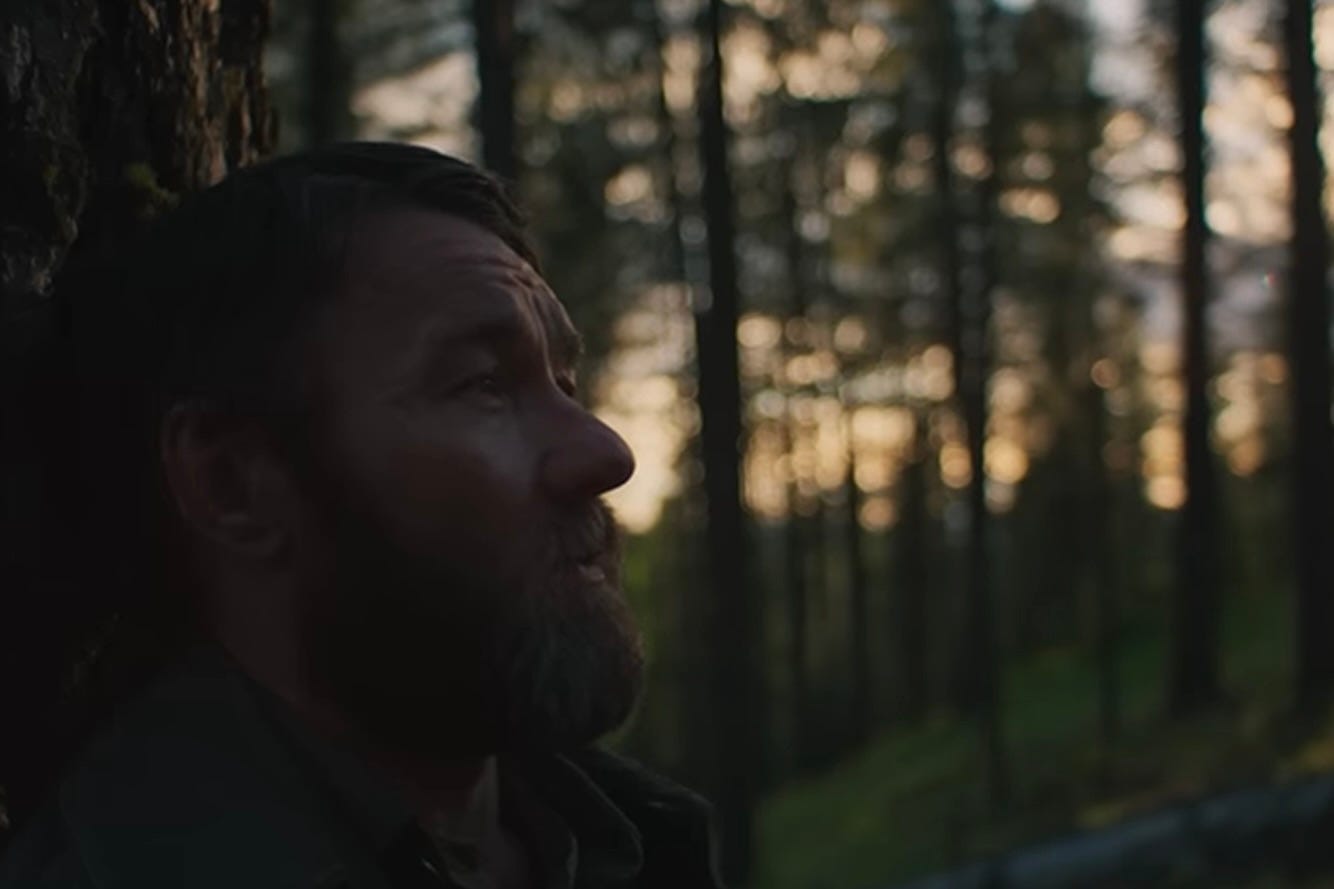
It gives me little pleasure to report that Train Dreams is an unfortunately empty film. A pretty film, in some ways. But an empty one. And as a moviegoer who believes that today’s critics are, on the whole, far too easy on this contemporary strain of middlebrow cinema, I must confess: I’m tired of films that look and feel like Train Dreams. I know nothing about the original Denis Johnson novel, which some people I know have called a great one — I only have the film. And in the film of Train Dreams, everything which could possibly be said about it is already so present at the surface, already so obvious and literal and exhaustively clear, it’s transparent. The movie is a long, muted, gentle lament on the old themes of American industrialism and on the fading of nature at the hands of those American industries. It’s about the loss and the hard work and the loneliness of a single stoic man, quietly watching history pass him by.
But even more than any of these, what Train Dreams is really “about” is its constant telegraphing to the audience that these are the themes which make up the movie Train Dreams. It is understood that the audience will be dutifully contemplating these themes, as the Max Richter-y strings of Bryce Dessner’s score thrum ponderously beneath big American images of trees and train tracks and the furrowed brows of the sawyers and Arcadian cabins by lovely low marsh ponds. They’re the great, meaty, existential American themes, after all — here rendered competently in a familiar digital over-crispness, better-looking than your average Netflix Original but still perched somewhere between a more artful episode of Planet Earth and Iñárritu’s The Revenant. Throughout my viewing of the film, I felt more and more that I would very much like to escape its overtight, picturesque vision (literally: the film is set at a 3:2 ratio, standard for 35mm still photography) into the far freer, far deeper worlds of its most obvious mediating influence: Terrence Malick.
What is left to positively report? Not much. The story centers around a logger named Robert Grainier (Joel Edgerton), working in Idaho and Washington in the early years of the 20th century. He goes off on long expeditions before coming home to his wife (Felicity Jones) and infant daughter, until one day he comes back to find that a wildfire has destroyed the cabin and consumed his family with it. He wanders the wilderness like a ghost, until deciding to rebuild the place as a hermitage, and then one day in the 1960s someone gives him a cheap ride in a biplane. We’re told by the narrator (Will Patton) that this was the moment he finally understood his life. And it’s as literal as that.
From the start we understand that Grainier is your classic puzzled everyman: a vaguely spiritual proletarian cipher, ideally “natural” and soft, always yearning to get back to domestic bliss, regarding the world mostly as a peculiar blur of ideals, people, and actions he’ll never understand. Early on, he watches a group of angry white men grab a Chinese railworker and throw him off a bridge to his death: the face of the unnamed dead man appears to him again throughout the film, and never speaks — a cringeworthy, impassive Oriental ghost, symbolizing Grainier’s essential acquiescence to the world. Plenty of other (essentially anonymous) figures come and go, as Grainier slowly plods his way through wet forests, mourns the loss of his wife, and stumbles unknowingly into the middle of the 20th century. And throughout all of it, that all-knowing narrator describes what Grainier feels and thinks with all the perfunctory folksiness of a Ken Burns documentary. I assume the narration has either been lifted from the novel or shaped to invoke it. Either way, it’s a complete miscalculation.
Joel Edgerton and Felicity Jones are good actors with nice faces. But neither of them register much as characters. Even as the center of the film, Edgerton is so interiorized and withdrawn that almost nothing comes across in the way of personality. The same is true for most of the undifferentiated faces scattered through the film’s vignettes. It’s perplexing. Are we supposed to take these vague people as essentially allegorical — standing in for humanity itself? Or are we meant to take them as individuals being anonymized by the flatness and confusion of their small place in history? It’s not that a film like this has any obligation to say either of these things. But as it is, the movie seemingly gestures towards each, without much thought as to what it would actually entail to suggest either idea more definitely — or any ideas at all, really. The big exceptions here are William H. Macy, who gives a wonderful, brief performance as an eccentric old dynamite man; and the great Irish actor Kerry Condon, who has perhaps two scenes as a National Park worker, the only person to whom Grainier ever confesses his grief. Both of these people have so much personality behind their eyes — are such clear characters — they throw the emotional drabness of the rest of the film into stark relief.
Clint Bentley, in his first time behind the camera, proves an unimaginative director—though he’s perfectly adept at locating and arranging some very pretty vistas, and occasionally manages to frame a memorable shot. Late in the film, when Grainier has gone back to logging, Bentley just about pulls off one genuinely motivated tracking shot of workers in a clearing. For a moment we get a glimpse of that fuller sense of space, which would have been necessary to make the rest of the film feel less plainly claustrophobic. As it is, that 3:2 ratio, which Bentley apparently selected for its verticality (to capture the height of the trees) and its consistency with old photographs, while not as squarish as the old 4:3 of silent film, is still tall and quite constrictive — especially since so much of the film consists of tight medium shots and close-ups of people, most of which are shaky and loose, often with a shallow focus. The film can’t help but descend constantly to these dull shorthands for suggesting “realism” and “poetry” in contemporary cinema. If Bentley does rest his camera long enough to get more than one figure in the frame, then he generally leans too heavily on that analogy with old pictures, arranging and posing the actors too neatly (the overly pristine period production design of the interiors doesn’t help this). Then what might have been arresting images of bodies in a landscape, usually become only more idols of static photographic “history.” Though it insists on trite poetic realism, the film’s “poetry” mostly consists of on-the-nose dream montages, while its idea of “realism” ends up more like a frontier postcard — think less Ansel Adams, more basic American nature-kitsch.
Besides giving further proof to my suspicions that Terence Malick may indeed be the single most influential American filmmaker of the century so far, Train Dreams at least provides an opportunity to reflect on what passes for arthouse these days, and an opportunity for me to take the state of “independent” cinema to task. The problem — generally — is that it’s too frequently middlebrow. The filmmakers have simply gotten better at hiding it. Train Dreams shares a lot with contemporary films that flaunt their groundedness and ground-level poetizing. It isn’t far off from films like Ramell Ross’ Nickel Boys, or even certain films by David Lowery and Chloé Zhao (though Lowery has made a few excellent movies, and Zhao has her moments) — it’s even somewhat adjacent to Sean Baker’s films; in a different way, it borders on the mode of Barry Jenkins (a very good filmmaker) or Trey Edward Shults. I’m reminded, too, of Sebastián Lelio’s The Wonder, and films by Jeff Nichols.
True, that’s a wide spread of films and filmmakers. But what they share, in my mind, is a kind of basic sense of time and montage, of tones and techniques that almost never stray from the same subdued strain of plaintive poetry; images that can be either airless, or lost in bleariness, or even just chasing a sentimental striation of light. It’s a sensibility I don’t yet have a name for, though it’s much closer to middlebrow than many would like to admit. The same is true for so many “elevated” horror films, and the lesser products of boutique studios like A24 or Neon. They get by on good scripts and great actors and the fact that it’s quite easy to make a perfectly nice image with an expensive film camera and an attractive interior, or a landscape. But even in the best of these small-to-mid-sized “indie” films (often “indie” in affect alone), things are often too contained; they’re too legible. These films are often “about” very important contemporary issues and feelings, except that their way of going about this never extends to formal considerations. They may ultimately work because they sustain a mood (and this is maybe even more important than form, in the end, for cinema) — but there’s a sameness which afflicts so many of them, little different from the sameness across our Blockbusters, or across our streaming shows.
I’m not hardly suggesting something like Anora is actually comparable to Marvel films or Stranger Things. But films like Anora are still only impressive to audiences because they’ve become so unused to seeing basic competency (and universal human concerns like death and sex) on the cinema screen. But put Baker’s Oscar-winning sex worker thriller next to something like Alan Pakula’s 1971 masterpiece Klute — you’ll see just how sexless contemporary “sexiness” is; how tepid its sense of real risk and social commentary. Ambiguity, empathy, arousal, danger, drugs, cities — any of the “serious contemporary things” that Baker is going on about in his film seem to me more than a bit adolescent, when placed against something like Klute’s street-level dive into 1970s New York, its tender love story, or Jane Fonda’s still-extraordinary performance. But go even further, and put it next to something like Andy Warhol’s party films, or Ken Russell’s ragged, psychedelic operas — the sheer tameness and prudery of the entire current cinema will be glaringly apparent. A lot of what gets deemed “mature” or “challenging” filmmaking these days is, unfortunately, only a kind of leeching off of the saddest, emptiest leftovers of a movie culture that seems close to being forgotten.
After The Brutalist, which I saw at the beginning of this year, I began to wonder if this is turning into one of the more crippling diseases of whatever passes for the arthouse in American cinema today: the clear sense that what drives these films is an obvious desire to be instantly read in the category of “classic,” by creating far less formally interesting and much more literal versions of older ones. The Brutalist succeeded despite its ambitions. But its reach and its pretension were clear from the start. It wanted to be “the kind of film they don’t make anymore” and if it ended up being better than this, that was only to the degree that Brady Corbet and Mona Fastvold created something idiosyncratic and genuinely gorgeous — this despite the film’s overt concerns with its own grandeur and place in the long history of epochal cinema.
Indeed, this is how “indie” movies (or more accurately, small-to-mid-sized cinema) can still sometimes rank among the better contemporary American films. The Safdie Brothers reach for this same “classic” strata, and do so nakedly. But they’ve succeeded because their own personal obsessions are peculiar and illuminating enough to carry them through the force of their own pretensions. They’ve also devised a frenetic style that feels both totally modern and formally appropriate to the characters and tones that interest them. Similarly, Ari Aster can be an exhaustingly virtuosic director: somehow overly-controlled in his set-ups yet completely self-indulgent in his scripts. Yet at least once — in Midsommar — he achieved something brilliant and original, where the formal constrictions worked with the “content,” not against it. And of course, of all contemporary filmmakers, Robert Eggers remains the purest exception to the era’s overweening sensibility: in The Lighthouse, in the best sequences of The Northman, and above all in his Nosferatu, none of the aforementioned contemporary fixations apply in the least. On close examination he is in fact the most genuinely “classical” young filmmaker we have. All these filmmakers (but not just them; there are others) share one thing: they are too singular and weird to be middlebrow. They’re far from avant-garde, far from experimental. But they’re still the work of resolute artists with a bit of freakishness and compulsion to them — things the middlebrow tends to sand away when it can.
Of course, by now I’ve veered far away from Train Dreams — mostly because there’s just not much else to say about it, other than its being yet another example of rather empty prestige filmmaking in 2025. Of course I would like to see younger filmmakers making more interesting movies, rather than falling for the easier cliches of contemporary cinematic storytelling. Of course I want a renaissance of inventive and experimental independent cinema — same as anyone else who cares. But I still don’t see this happening if critics can’t start being a little tougher, even on smaller adult dramas that win Oscars. As far as I can tell from the number of critics who have simply swallowed Wicked: For Good without complaining — treating it as if it were anything other than a disturbing sign of the immense hollowness of the age — we’ve lost nearly all our central, trustworthy critical voices. Meanwhile, the industry culture of interviewers, content-makers, and fandoms have gone off the deep end of complete commercial fealty, totally abandoning the idea of addressing movie art whatsoever. From now on, as far as I’m concerned, anyone who reviews a film like Wicked without calling it exactly what it is (a cultural nadir and an embarrassment to cinema) no longer deserves to call themselves a critic. But just because popular cinema has grown this desiccated doesn’t mean we should heap empty praise elsewhere — as the general, consistent plaudits for Train Dreams have demonstrated, plenty of critics are still too easily wowed by films that make them feel very sentimental and profound. When it comes to the middlebrow, even the critics themselves need rescuing. Who is going to do it?

Sam Jennings, The Metropolitan Review’s film critic, is an American writer living in London. He is the Poetry Editor at The Hinternet, and he runs his own Substack, Vita Contemplativa. For those interested, his Letterboxd account can be found here.

Great review, Sam. I haven’t seen the movie but don’t really watch much contemporary cinema for the reasons you mention. There’s just too much good stuff from the past, and especially international cinema, that I’d rather watch. I was recently dragged to go and see “House of Dynamite” and it was one of the worst movies I’ve ever seen, yet it has 75% on Rotten Tomatoes. The movie made me so angry in its stupidity. The last time I was that angry was when I saw “Vice,” another middlebrow movie considered art. Anyway, I’m glad you pissed some people off here. We need people willing to articulate their aesthetic vision and stand behind it.
'The Brutalist succeeded despite its ambitions' - 100%