


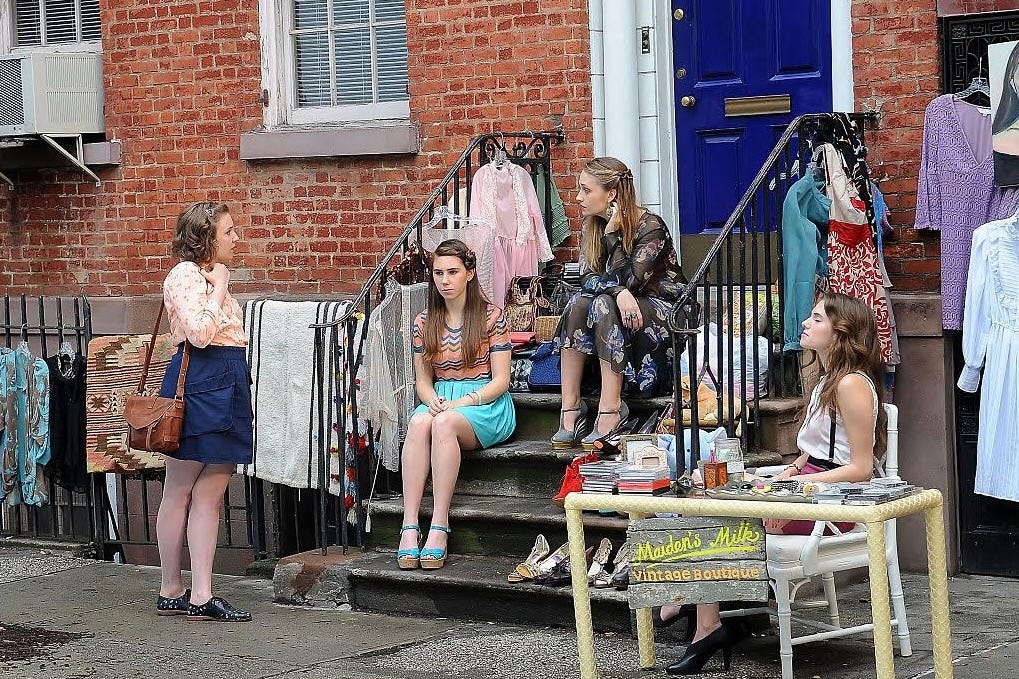
Last year, while at a literary magazine party at a big Greek restaurant in New York City’s Financial District, I saw Alex Karpovsky mingling in the crowd near the bar. I walked over and let him know that I’ve watched Girls, start to finish, about eight times. He said something like, “Wow, that must be a world record.” I couldn’t tell if he was flattered or alarmed.
Karpovsky is an actor who played Ray, one of the main supporting characters in Lena Dunham’s HBO show, Girls. But of course you knew that, or else why would you be reading this? Then again, Girls and Dunham have become such American cultural touchstones that people don’t need to have watched the show to have an interest in what a memoir like Famesick is all about.
The book is an incredible read, especially the first half, in which Dunham memorializes her dizzying ascent from making her first scrappy student film to helming and starring in the definitive prestige TV show of her generation. We get an early-twentysomething Dunham running around with various as-yet-unknown people in her filmmaking milieu, and then you realize how much time has passed when those people are now famous. It’s like reading John Glassco’s Memoirs of Montparnasse but featuring the Safdie Brothers, Greta Gerwig, and Ti West instead of the luminaries of the Lost Generation, if it’d been written by Gertrude Stein and not an outsider who might’ve made the whole thing up.
For dedicated fans of Girls, there are many intriguing behind-the-scenes bits. Those who cherish the final heartbreaking scene between Hannah and Adam in Kellogg’s Diner (when they realize they will never work as a couple) should skip the part where Dunham reveals her tears were mostly because of her broken elbow. There’s the laugh-out-loud part where you see just how wrong some initial hypothetical choices would’ve been, like a Taylor Kitsch type as Adam. “Hey Horvath. Brooklyn forever.” That would’ve ruined both Girls and Friday Night Lights. I was also surprised to learn that Dunham hadn’t always been meant to play Hannah from day one, and that her casting was more due to necessity than design. Knowing what the show would do to Dunham, it reads like a monkey’s paw moment.
There are beautiful passages that also bring a little heartache, not just because we know that things won’t be happily ever after for Dunham even with the show’s success, but also because they invoke a bygone era where all the artsy kids were still running around with their relatively bulky film cameras, without a care about the algorithm, or worse, AI. There’s a part where Dunham describes walking around with Adam Driver, still a nobody in Hollywood, early in the morning on the Brooklyn Heights Promenade after a long night’s shoot as they share their hopes and dreams:
To this day, I still get a pang every time I watch a documentary about an artist and they talk about this very moment, when they first become part of a creative community but nobody was doing it for the cash yet, when nobody had yet betrayed a trusted collaborator or called someone else a sellout.
Here, Dunham sounds like Bongrand, the successful older painter in Émile Zola’s The Masterpiece, who gives a poignant monologue to a rabble of young artists living in glamorous squalor in Montmartre about how they’ll never be happier than they are now, still anonymous upstarts with nothing but ambitions and dreams — success will only bring misery.
Dunham’s finely tuned, self-deprecating humor shines through, never fishing for reassurances. When her medical treatments cause her hair to thin, she references her “three Homer Simpson hairs.” She describes how she tucks her stomach into her pants “like an undershirt.” There’s a darkly funny moment where she witnesses the hatching of baby sea turtles and is so inspired that she drafts a conciliatory email to Jenni Konner (her producer and surrogate big sister), only to realize via a quick Google search that a mere 1% of those baby turtle hatchlings will make it to adulthood.
Most readers will likely designate Konner as the villain of the story (her saying “I’m really trying to like you again” to Dunham doesn’t help). She comes off as callous at best and as a user at worst, someone with few gifts of her own other than recognizing (and exploiting) Dunham as her cash cow. But while Dunham does air her grievances about Konner, she also acknowledges that Konner must have felt a lot of pressure overseeing and producing Girls while Dunham attended to her health issues. I was also expecting the book to be harsher on Jack Antonoff, since many have claimed that the heinous ex-boyfriend character in Dunham’s 2025 Netflix show Too Much was based on him. But Antonoff comes off more like a well-meaning guy who just couldn’t handle having a sick and depressive girlfriend, especially when his career was skyrocketing and he must’ve had all the dating options in the world. That doesn’t make him a leading man in a romantic comedy, but that doesn’t make him evil either.
The weakest part of the book is when Dunham underreports her actual role in initially defending Girls writer Murray Miller against Aurora Perrineau’s rape allegations, and overreports her explanation as to why she acted the way she did. All she has to say is that she was in a terrible mental and physical state, and that our desire to protect our friends can heavily influence us.
However, I’m not as interested in evaluating the merits of the book. Is anyone surprised that Dunham is an excellent memoirist? I’m much more intrigued by what spawned the hellish hatred she received for most of the 2010s, what’s led to the public turnaround regarding her image, and what that says about us.
Upon Famesick’s release, there’s been a slew of mea culpa pieces by Dunham’s generational peers admitting that their harsh criticism of her was based on little more than envy. This isn’t revelatory news — even back then, it was obvious that there was a deep, rotten layer of personal animosity in the attacks on Dunham. A telltale sign was that the most bitter criticism came from her own ideological and cultural peers.
Dunham writes about how much this friendly fire affected her — more than any proto-MAGA chuds ranting about how she represents everything wrong with modern women. Dunham could’ve worn — and did wear — such attacks from cultural foes as badges of honor and her cultural allies would’ve circled wagons around her (the all-women Ghostbusters was released in 2016, and thus began the era of “Watch the movie that the creeps don’t want you to see!” marketing). But what can you do when an ostensibly feminist publication like Jezebel puts a bounty on un-retouched Vogue photos of you under the flimsy pretense of social progress?
Still, there are moments in Famesick that do make you sympathize with those who must’ve felt that they could’ve been Dunham, had a few life circumstances turned out differently. When Dunham decides to make Tiny Furniture, the breakout movie that fast-tracked her to HBO, her family offers to vacate their Tribeca loft apartment for a whole month so that Dunham can shoot her film there. And to raise money, Dunham’s mother solicits her family friends as if she were helping her daughter move boxes of Thin Mints. How many artists, or those who once dreamed of being one, had to fight their parents every step of the way, warding off discouragement and even outright hopes of failure not just from the cruel, uncaring world but also from their own kin?
There’s a little anecdote that Dunham throws around casually that even I had to pause to sit with for a bit. She recalls a summer she and her family spent in Italy because her father (a reputable artist in his own right, just like Dunham’s mother) wanted to learn glassblowing: “I have mostly tender memories of this time—three of us to a bed in a little palazzo, playing in the fountain and eating thick slices of focaccia.” This sounds like something out of a Wes Anderson movie, back when Anderson was cooler than he is now.
There’s been a long-standing debate about how much Dunham benefitted from nepotism. On the one hand, she had industry connections that are unavailable to 99% of the public. Early in Dunham’s career, her mother offered to reach out to the lone Hollywood connection she had, which turned out to be the founder of United Talent Agency. On the other hand, it’s not as if her parents were superstars with legions of sycophants. How much weight did the names Carroll Dunham and Laurie Simmons carry in the cutthroat entertainment industry?
What is less discussed is how people were likely envious that Dunham enjoyed the perfect amount of nepotism. She had enough of it to take glassblowing-centered childhood trips to Italy and the phone numbers of Hollywood agents (or at least, a phone number of a Hollywood agent), but not so much that every stage of her life had been ruthlessly public. The Jaden Smiths, Lily-Rose Depps, and Brooklyn Beckhams of our world may grow up with fantastical amounts of privilege, once only available to children whose fathers conquered at least one civilization, but they are also burdened by the fact that they will never quite live up to their parents. Dunham didn’t have to deal with such overshadowing, and one of the most uncomfortable parts of Famesick is when she describes how her own parents, especially her mother, became envious of her rapid success.
While it’s nice that many people have come around to appreciating Dunham and her work, I’m not impressed with the timing of it all. Of course it’s easier to be kinder to Dunham when she’s no longer a threat to making the generation-defining show about twentysomething New Yorkers that you yourself wanted to make. When Dunham was an upstart force, her future must have seemed agonizingly limitless: she had the buzziest show, the buzziest boyfriend, the buzziest friends. Now that she’s gone through public heartbreaks, serious health issues, and a post-Girls creative period that still seems unsure of itself, she suddenly becomes more likable, doesn’t she? The apologizers are less like penitents and more like gloaters: we hobbled her good, didn’t we?
I’ve often wondered what a contemporary Lena Dunham would look like and whether she would get the same amount and type of hate. The answer to the second part is undoubtedly yes, the caveat being I don’t think a genuinely new Dunham could exist. There will be those who somewhat mimic her. However, “Hannah Horvath but in wide-legged jeans” is not a genuine reincarnation. Dunham was the last of her type, arriving at the perfect intersection of monoculture and online culture, where the latter had yet to cripple the former: a Goldilocks era of new and old media, where more people than ever before felt they had a shot at becoming famous — magazine-cover famous, not Twitter lolcow famous.
Dunham recalls how she and her family looked down on “the commonness of wanting to be seen.” However, it was fine to want one’s work to be renowned. If it just so happened that some of that renown spilled over to personal celebrity, then that could be acceptable. A nice little side effect that can’t be helped. In the introduction, Dunham states:
I didn’t start this looking for celebrity. Instead, I’m here because of an almost unrelenting drive toward self-expression, which manifests as workaholism AND single-minded obsession that actually runs counter to a skilled manipulation of fame.
Dunham isn’t some trend-hopping clout-chaser, and Girls endures because it’s a work of art with a singular vision. But claiming not to seek fame when your “unrelenting drive toward self-expression” revolved around putting your extremely personal thoughts and experiences into the spotlight is a distinction without a difference. For artists who want to be celebrities but won’t admit it, making art about themselves is an ideal roundabout way to achieve that gauche goal of being seen. In her essay for The Cut entitled “I Was Caroline Calloway,” Natalie Beach writes:
It was 2013, and the internet felt like the future of writing, at least for girls. The boys from our classes were churning out different versions of Fear and Loathing in Bushwick, but I believed Caroline and I were busting open the form of nonfiction. Instagram is memoir in real time. It’s memoir without the act of remembering. It’s collapsing the distance between writer and reader and critic, which is why it’s true feminist storytelling, I’d argue to Caroline, trying to convince her that a white girl learning to believe in herself could be the height of radicalism (convenient, as I too was a white girl learning to believe in herself).
What an intoxicating idea that was, that the pursuit of celebrity, the creation of art, and the advancement of social progress could all be blended together to form an ideology whose core tenet was that the more of ourselves we put out there, the better the world would be.
Had Girls been set in the past, or been a murder mystery, or been about alien invaders — or a combination of all three — the resentment against Dunham would’ve been much less. But because Girls narrowed the gulf between art and artist to almost nothing, the show’s very existence on America’s most prestigious cable channel was seen as the specific promotion of a specific person, a specific demographic, and a specific culture that many of us knew all too well.
At first, I too was reluctant to pay attention to all the things that Girls represented. A funny detail I’d discover about the show in one of my many rewatches is that Hannah and Marnie were born the same year I was. I’d known girls like them — and the guys in their cliques — in college. I did not like those people, so why would I want to watch a show that apparently glorified them? In Famesick, Dunham references a snarky Gawker piece where all the main actors were identified as daughters of their famous parents (e.g. Allison Williams would be called “Daughter of Brian Williams”). I remember reading that piece and having a good laugh.
But in early 2014, I was visiting NYC and, because I had some free time, I figured I should at least hatewatch the show about the city that everybody was talking about. It only took me a couple of episodes to realize I’d been wrong, that the show wasn’t some auto-romanticization by and for snooty twits. Instead, it was an incisively (even viciously) self-aware examination of a cultural cohort that seemed destined at the time to make Obama-style liberalism a permanent American reality.
In stark contrast stood something like Master of None, a show I began watching at around the same time and immediately called bullshit on for being so smugly clueless about its own blind spots. Consider the persistent criticism of Girls for its lack of racial diversity. Girls had far more insightful things to say about race, precisely by accurately reflecting the predominant whiteness of its world. That spoke volumes more about the reality of race relations, even in self-consciously progressive and gentrifying Brooklyn, than the wishful diversity in shows like Master of None. Dunham is also far too sharp a social observer for it to have been an accident that among the Asian American characters, the straight female and gay male characters were more enmeshed in the culture depicted in the show (Soo Jin is Marnie’s gallerina frenemy and Chester is Hannah’s classmate at the Iowa Workshop) than the straight male ones (Yoshi lives in Japan and Byron comes from a more yuppie crowd, and both are love interests to Shoshannah, the biggest misfit of the main characters).
But though Dunham refused to glorify her Girls characters, she also didn’t stoop to sneering at them. Hannah, because of her well-realized flaws, remains a deeply relatable character to many, including myself. When I first began watching the show — I would’ve been about Hannah’s age — I felt compelled to write this email to my closest high school friend after watching the season three scene where Hannah quits a relatively well-compensated job as an advertorial writer at GQ because she is insecure that it makes her a sellout, especially when Adam and Marnie are seemingly having their breakout moments in their creative careers:
I remember being at college and wanting so badly to be a writer but being so scared of starting because then, I could’ve ended up failing. That’s why I was so depressed on my 21st birthday, because it felt as though time was flying by and I was never going to accomplish anything. And every time my parents tried to talk me into being a lawyer, it felt as though they were telling me that I’d never be able to accomplish my dreams, so I might as well fall in line like everybody else. Of course that’s not what they meant, I now realize. But at the time, that’s what it felt like, which is why I had periods when I wanted to be a journalist, magazine intern, or a theatre intern, or even just a retail clerk for a bit. ANYTHING that would’ve loudly told the world that my dreams weren’t dead or stupid.
Furthermore, writing meant being alone. I wanted to be liked and loved. You can’t be liked or loved if you’re in a cafe or library for hours a day while writing something that may end up supremely sucking. I have to admit that one of the reasons that I loved the idea of becoming a writer is because of how much I loved writers. I imagined myself receiving that love from lots of people and it made me feel good about myself, which is something I often didn’t feel at that age.
I understand the desperation and insecurity that creates the need for such external validation. Because you lack such self-esteem (you’re not that attractive, you’re not that popular, you’re not that smart, you’re not that athletic), you think that the only thing that can redeem you is your writing. Perhaps if you could jujitsu your neurosis and turn it into literary gold, perhaps then people will like you. Maybe even love you. And because so much of yourself is riding on this lone ability, you’re petrified of finding out that you can’t actually do it that well. Your lack of confidence extends to your One Chosen Craft as well. Hence, the constant need to seek signs that you are indeed that good without the risk of putting your work out there.
At the end of “One Man’s Trash,” an episode in which Hannah spends a weekend with an affluent older doctor separated from his wife, Hannah breaks down in front of Josh — the doctor, played by Patrick Wilson — and laments how happy she is playing house with him in his beautiful townhouse with its tasteful furniture, backyard grill, and soft sheets. She says she’d always vowed she would take on every experience in the world, especially the bad ones, so she could write about them like some nobly suffering saint. Then she confesses that maybe she just wants to be comfortable and content like everybody else.
The little speech is meant to make Hannah look comically self-aggrandizing. But Hannah is just expressing a desire to be special. She’s deduced that she’s not part of the lucky few predestined to live exceptional lives by virtue of their great wealth, beauty, or prodigious talent. But she still wants such a life, and she’s accepted that the only way to have a shot at it is to subject herself to all life’s horrors and humiliations.
Had Girls been a bad show, Dunham would’ve had fewer, not more, haters. She would’ve been easily dismissible as yet another undeserving rich white girl, the latest exhibit proving that the system had to be disrupted. It’s interesting that for all of Dunham’s real-life and fictional insecurities, she was never seen as a relatable figure. I have to wonder if that’s because, for all her publicly declared body image issues, she never acted like a loser.
When I hear people say they want to be in creative circles, I suspect what many of them mean is that they want to be around beautiful, rich, and cool people (creativity being optional). Dunham, in real life, ran in such circles. That must’ve drawn the ire of those who also wished to belong to such cliques. Had Dunham been Hollywood Hot or even Hollywood Cool, then that could’ve been the explanatory factor. But she seemed to be there almost entirely on talent, the one currency almost all outsiders believe is their ticket into the exclusive club. Dunham even speaks the language of the one who’s never quite in the innermost circle. “It was only when fame entered the equation that the party came to me,” she writes. But instead of eliciting feelings of “She’s just like me!” this provoked “Why her and not me?”
In retrospect, people in the 2010s simultaneously acted as if they were living in a period of abundance and scarcity. My friends and I refer to this time as Zero Interest Loan Culture Heaven, or ZILCH. A thousand Gen Z YouTube video essayists wax wistfully about Millennial optimism during that era. Traditional media may have been dying, but the internet was going to save us somehow. And everybody, if they just worked hard enough, was going to get a TV show or a book deal. That created more opportunities, but also much more competition. And a generation only gets a few shots to define itself. Maybe only one.
Deep down, we all knew it was bullshit, about as authentic as an Amherst grad cosplaying as a lumberjack in the most expensive city in the country. Subconsciously, we knew it was unsustainable, but we dared not say it out loud, in case the utterance would accelerate the demolition of this gigantic playground we’d built for ourselves. But Dunham, from the inside, recognized this bullshit and called it out for all to see.
Millennials are vintage now. Our prime is over. Everyone who thought they could do a better Girls has either tried and failed, or had the opportunity window closed and accepted that. All we can do now is look back at what was made and evaluate it, free of personal agendas. The 2010s aren’t that long ago, but so far, Girls is standing the test of time, only getting better with age as the Obama Era becomes harder and harder to remember. Even younger generations are embracing the show as their own.
I was happy that Famesick is such a good book. “She’s still got it,” I thought, because I’d watched Too Much last year and found it disappointing. Sharp Stick has its charms, but it could’ve been made by any number of directors. If Dunham never comes close to replicating Girls, would that be such a terrible fate? Is one outstanding achievement better than five merely good ones? How about 10? Famesick is great, but it still relies heavily on Girls to be meaningful to its readers. Should that matter, though? If I were Dunham, while I wouldn’t coast on Girls for the rest of my life, I also wouldn’t feel like a failure if I never made anything of that quality and relevance again.
Even the title of the memoir is an olive branch, as though Dunham is telling her former haters that this fame they all coveted nearly ruined her life, so they can relax. “Never mistake maintenance for care, attention for love, or even love for empathy,” writes Dunham in the most neon-sign-worthy quote of the book.
I think of Jessa’s tearful apology to Hannah in the penultimate episode of the show, something that the otherwise stubborn Jessa would never do, except that she has realized their friendship is, if not over, then forever frayed. Hannah cries too and says she’s sorry, that they were both just trying their best, as terrible as their best turned out to be. Both are ready to move on.
Dunham’s admirers and haters alike are also ready to move on, and so both can say: “We had it pretty good, didn’t we? And nobody captured us like you did, Lena.”

Chris Jesu Lee lives and works in New York City and has previously been published in The Metropolitan Review, The Believer, The Cleveland Review of Books, and Current Affairs. He writes the Substack newsletter Salieri Redemption.

I feel like, as millennials survey the ruins of 2010s culture, we hunt for something of value to salvage and settle on Girls, a show from a time just before social media ate everything, when it seemed like the present, and future, might still be somewhat interesting.
Today, fictional characters are often dismissed as "unlikable" due to their misdeeds, but we root for the characters in Girls even though they do wrong. Maybe that's partly because their failures have consequences. The female empowerment stuff that came later lacks any kind of karmic balance. It's purely positive & Pollyannish.
This is finely observed. The most interesting part of the Lena Dunham backlash has always been how much of it came from people close enough to recognize the room, the language, and the ambitions.
Criticism is easy. Being accurately seen is the part that leaves a bruise.