


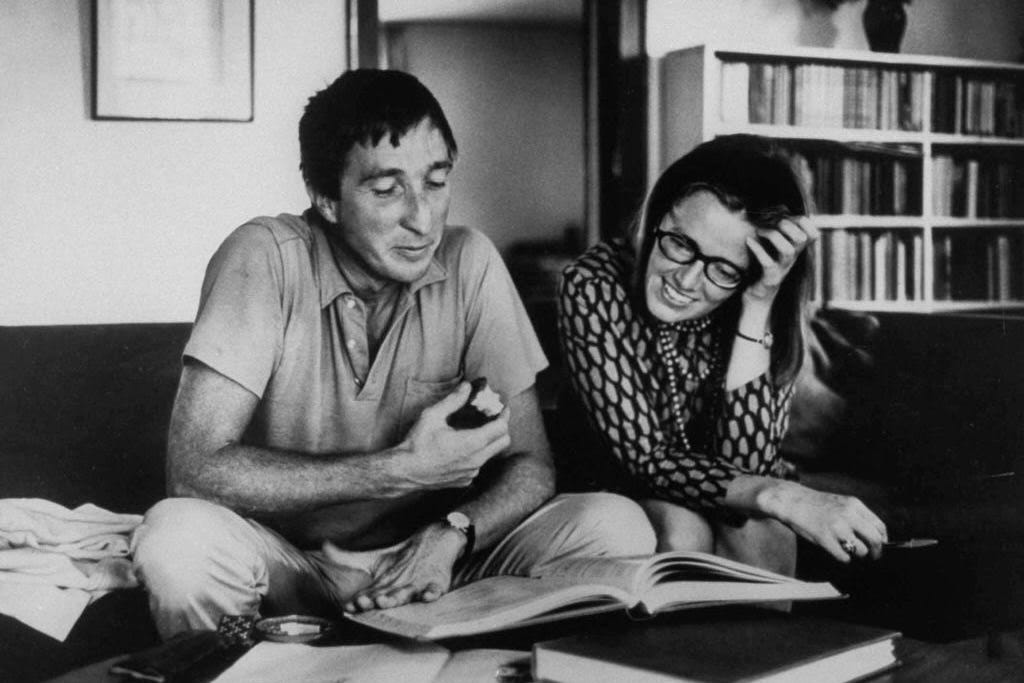
I do not really write a good letter. I am too impatient, too full of the sense of time wasted, too anxious to either retreat into solitude or grapple with souls face to face but in any case baffled by this peculiar mixture of loneliness and companionship.
We find this passage in a letter written by John Updike to his girlfriend Mary Entwistle Pennington on April 1st, 1952, sent from the farmhouse he was visiting in Plowville, Pennsylvania, where he had lived with his parents and maternal grandparents during high school before he went off to Harvard where he would meet Mary, a Radcliffe student, in a course on medieval sculpture. They would be engaged by the end of the year, with just over 20 years of marriage and four children ahead of them. In these tender letters to her, before the logistics of marrying obtrude, we can hear Updike’s music, as in this description of Jolson, the Plowville dog: “His hair, cultivated with a diet of raw eggs recommended by the sturdy veterinarian, is luxuriant, curving, gleaming, switching back upon itself in the triumph of brownness and blackness and whiteness.” Notice the clever slip from the intransitive “gleaming” to transitive “switching,” which reorients the slowing body of the sentence, readying it for another push, more life ahead. We also note, perhaps occasionally with disapproval, his easy, nearly promiscuous way with figuration: “Life is just too naked around here at times, and your letter fell like a rose petal dropped into a lion’s cage.” In the letters from this period which went from Harvard’s Lowell House back to Plowville, there are confidences regarding worries, and witty jokes, and nice thoughts about literature, but the language does not, as it does here, shrug off its manners and move rapidly and sinuously, following Updike’s eye, ear, and imagination in their explorations. Updike may demean a “peculiar mixture of loneliness and companionship,” but much is communicated in these letters to Mary besides the usual amorous stuff. It is not just that she was in a particular “face to face” relationship with Updike, but that she would read him carefully, before he had reached all his distant readers through the New Yorker and his many novels. There is some fine writing, with much humor and useful information, in the 750 pages of the Selected Letters, but there is not much in Updike’s best mode, in which he esteems and honors life while transfiguring it.
As we can learn from these letters or from passing comments in Updike’s criticism, he was more concerned than most writers with paper, typesetting, and cover design, so readers will be pleased to note that the Selected Letters is a handsome, sturdy production done on creamy paper, cleanly and efficiently laid out. Editor James Schiff includes reproductions of typed postcards and the occasional illustrations that Updike enclosed with his letters. One written to his not very coy mistress Joanna Brown is reprinted and also shown in its first form, filling out the ample negative space in a full-page ad for the Bell Telephone System taken from a 1963 issue of the New Yorker. Updike was an illustrator before he began writing, and here the photographed office workers have been given facial hair and dialogue in speech bubbles. The mass of correspondence is broken up with three series of photographs in high-quality reproductions, and if a theme or essence emerges in these it is the slightly awkward and diffident posture in any of the posed photos. (In profile birdlike, when smiling rather reptilian, Updike had an essentially comic visual existence. He had a notably consistent haircut, which registered to Martin Amis in 1987 as a “salt-and-pepper turban.” In its convoluted, self-conscious swoopings and swirlings, it gave him, along with the stiff lankiness of the pose, the look of a teenaged boy — early talent arrested, like Rabbit Angstrom, one wants to add.) As for the selecting, it was an unusually extensive task in Updike’s case, since by Schiff’s estimation he wrote more than 25,000 letters, postcards, and notes. Without knowing what was not selected one can only speculate, noticing in any case that in the ’70s, as Updike’s first marriage ends and his second begins, the professional and friendly letters go scarce in favor of all the separating, arranging, promising and sometimes quarreling involved in leaving Mary for Martha Bernhard, a fellow resident of Ipswich, Massachusetts. The footnotes are excellent, and contain their own quoted flourishes and nested treasures, though occasionally, mostly later in the book, public activities such as some kind of ceremony involving George Plimpton and, posthumously, Ernest Hemingway, seem to be missing an explanatory note. Updike’s professional life, as he would sometimes gently complain, did become terrifically complicated, as he served in the roles of lecturer, receiver of awards, grateful speech-giver, anthologist, and critic of not just many kinds of literature but also contemporary art, all while the novels and short stories arrived regularly.
The Updike corpus without the letters is already very large: over 60 books, if the collections with overlapping stories and poems are included. His terrific production has taken on the aspect of a clinical problem. Schiff’s introduction mentions a “compulsion to put his thoughts to paper,” and “graphophilia,” though here it should be noted that fortunately graphophilia is not graphomania. It is not difficult in reading Updike to imagine that he enjoyed writing very much, and from there to somewhat discount terms like “compulsion.” But if one is looking for deep causes, they are not hard to find. Born in 1932, Updike grew up and out of the Great Depression, during which his father Wesley lost his job and had to retrain himself as a high school mathematics teacher. Wesley was stably employed from then on, but according to his son “running scared financially for much of his life.” This could be seen as helping form Updike as the writer who would do so much work beyond subsistence, but then one discovers in these letters that he was once offered $30,000 to play golf with a celebrity and write a profile, but declined. All that squinting and hammering at the desk wasn’t just about the money. The important family figure is really his mother, Linda Grace Hoyer Updike, who wrote fiction, some of which would eventually be published in the New Yorker with her son’s assistance. Schiff reports that Updike remembered that Linda, otherwise distinctly latitudinarian, once startled him by telling him to be quiet when she was at her desk, teaching him to see writing as “a very momentous activity.” The letters home to Plowville and addressed to the “Plowvillians” in the Harvard years, concerned mostly with reading and writing, are really for her, and later much finely detailed correspondence about his and her works in progress passes between them. Between 1961 and her passing in 1989, she gets 10 stories into the New Yorker and publishes one novel, called Enchantment. He writes to her after reading her story “Unlike Girls” that “[t]he world cries for more,” and perhaps he was answering this call by writing enough for two.
The New Yorker began as a humor magazine, and early in Updike’s career, when he started writing “Talk of the Town” columns, short stories, and poems for them, humorous elegance was the expectation. The stories have a warm, glinting, Cheeverish humor. Was he at least in part a comic writer in all fictional situations? The Bech stories are certainly comic, in the obvious, bumbling way, but even also as they grow metafictional appendages in their collected book forms. Even an awfully serious topical novel like Terrorist has its occasional levity. The Rabbit novels have rich and varied tones, certainly including mirth. Updike eases his way into a looser, more comic mode in the third of them, Rabbit is Rich, in which Rabbit Angstrom, now in his mid-40s, has developed a truculent, bantering style. On the job at the Toyota dealership, even if only in his thoughts directed at imagined consumers, he has a kind of salesman’s catchphrase: “Read Consumer Reports, April issue.” The thematic burdens of the previous two novels (fidelity in Rabbit, Run, counterculture in Rabbit Redux) had lifted only intermittently to allow comedy into a few scenes, notably meetings in bars and restaurants, and the fatal incidents in those plots had a way of killing the mood, too, but in Rabbit is Rich, as critic William H. Pritchard writes, Updike finds a “comic-elegiac” mode, which treats the rusting and emptying of Brewer, Pennsylvania (to be read more or less as America), with a rueful, not gloomy attitude. This discovery in the course of the tetralogy deserves much interest.
One aspect of Updike’s humor is lit up in the Letters. At Harvard, Updike did much writing for the Lampoon. Writing to Plowville from amidst exams in drama since Ibsen and late Romantic poets, he predicts that he will not write “unread masterpieces” and thus consign Mary to poverty, but instead please an audience the way he knows he can with his drawings (which were roughly in the manner of James Thurber). This will be as a humorous writer of some kind, and “if I am going to be a humorist, I must get the idea of infinity out of my head — there has never been a humorist who lived in infinity; humor is manipulation of limitations, a series of contrasts of finite objects.” He would treat the writer’s page as an enclosed world, putting on hold the infinite questions, religious and existential, and working up the laughs from the combination of a few elements. And we see Updike, here and there in the Letters, slowing down his narration to play just that sort of game. A few pages later, again writing to Plowville, he reports being taken along with his new bride Mary by family friends to a nice dinner near Ipswich: “The meal was elegant, but it was chiefly notable for the dessert, which was pecan pie. I had never had pecan pie before. I hope to have it again.” And in the ’90s, he complains about Tina Brown, then editor of the New Yorker: “She conned me into writing about Gene Kelly, of all people, and every time I saw another video I had to go back and insert some sentences so the whole thing is as lumpy as a blueberry muffin. And about as crumby.” This is not the celebrated social comedy, the recreation of manners and speech that Updike’s fiction is known for; it is a precocious young man’s comedy of words (and their referents) as “finite objects,” to be comically repeated (“pecan pie”), launched from towards anything associated (“muffin” to “crumby”), engaging both definitions at once.
Updike was not, of course, to limit himself, either in his seeing, his imaginative journeying, or his learning. His fiction in particular, never satisfied with a “few elements,” takes in much sensory information, his metaphors are sometimes extravagant, and he shows his knowledge of literature, theology, physics, history, music, painting, printing, even cars and golf. And then of course there is his own life, the main subject of the letters, if his work is considered a part of (as opposed to apart from) that life. The wit that treats the Updike life in the Letters is worldly as much as wordy, and grows more weary with the years. A letter to Erica Jong, who was famous for a time, begins by addressing Updike’s embarrassment over a blurb bearing his name on her book: “All’s fair in love, war, and excerptation from reviews for purposes of quotation on paperback editions.” He then quibbles over the formatting (to be seen on the Signet Fear of Flying cover), which deviously conflates someone’s ad copy with his quoted review. A postscript in a letter to Kurt Vonnegut in 2005 elliptically comments on Truman Capote’s public persona: “We saw Capote. Seymour was good, but Capote was even better at it. We once spent an hour with him in Sagaponack.” Such urbane cleverness takes its opportunities in the archly erudite Bech books, for instance, or through the mouth of the devilish art collector Daryl Van Horne in The Witches of Eastwick, and of course it is to be found in Updike’s several non-fiction collections.
In the Rabbit novels, Updike’s avatar, or locus of consciousness, or whatever Rabbit Angstrom is, cannot be credited with all that much learning or sophistication. We know how much TV he watches. So Updike’s narration, having to render his perceptions in the precise language that would give this world its exquisite life, sometimes seems to be translating Rabbit, as critics have complained. But each time he revisits Brewer, Updike is more committed to the texture and sound of Rabbit’s mind, to be recreated as carefully as his world. In the first novel, Rabbit, Run, at a game of golf with the Episcopalian minister Eccles, Rabbit notices something acutely and Updike writes it cutely, cleverly, with onomatopoeic trickery: “Eccles sinks his. The ball wobbles up and with a glottal rattle bobbles in.” One relishes the Joycean sound effect while having to accept that it is the author’s, not Rabbit’s. Twenty years later in Rabbit is Rich, Rabbit and his wife Janice enjoy their new prosperity by playing golf with friends at the country club. In the midst of a complex sentence with high diction, we are treated in a parenthetical to Rabbit’s memory of his afternoon success, “the wooden gobbling sound the cup makes when a long putt falls.” This sounds like the Rabbit we have known from the beginning in his dialogue, in his living. For him, golf is more than just golf; in fact, it is grace. So this can be taken as an allusion to the earlier novel for thematic purposes, but one that records Rabbit’s idiosyncratic, relatively uneducated way of thinking.
The older Rabbit’s thinking includes clichés that can lead him on to dreamy maunderings. He falls asleep “at the drop of a hat. He never used to understand the phrase. But then he never used to wear a hat and now, at the first breath of cold weather, he does.” And in this gentle, sometimes puzzled way, Rabbit’s mental language plays games with itself, games of definition and repetition. Updike, as Rabbit, is in the curious mode of the humorist who wanted to get the heavens out of his head, but it is more about relaxation than effort. Thus the humor is sometimes broader. Rabbit is allowed to start from the belief that men are from Mars and women from Venus, and see what odd collisions follow. Hearing the hammering from a nearby house whose residents he thinks are probably lesbians, who in any case are avid carpenters, he meditates on homosexuality. He had “always meant to ask them what it was like, and why. He can see not liking men, he doesn’t like them much himself, but why would you like women any better, if you were one? Especially women who hammer all the time, just like men.” And sometimes Rabbit’s thoughts are as enigmatic as they are humorous. He loves being inside when it rains, hearing it on the windows. This for him is an example of “Things that touch and yet not.” The Rabbit novels are increasingly vivid because Rabbit’s life, like the reader’s, is full of such finite objects, and Updike is not in such a hurry to interpret and use them to get at something beyond. He has learned to imagine what Rabbit would make of them, or more simply he has learned to be Rabbit, which may be more a matter of remembering.
The fourth novel, Rabbit at Rest, closes the gaps and brings Updike and Rabbit into closer communion. Now corpulent and retired, Rabbit has lately been reading history in bed while Janice watches TV, exploring the curiosity one always noticed beneath his worrying. He applies a word new to him from his reading, “seigneurial,” to his bathrobe, and half-jokingly fancies that it helps dignify him as the pater familias. The oldish birds now spend half the year in Deleon, Florida, and when their son Nelson and his family visit, Rabbit feels crowded, like an African in his hut, he thinks. He asks himself what Western man has done with his prosperity and privacy, and answers with “nothing much except invent the gun and psychoanalysis.” This is rather droll for a car salesman: he is making a late effort at cleverness, as if winking at his creator. (In a review of the collection Odd Jobs: Essays and Criticism, Amis acknowledges Updike’s dogged autodidacticism, undertaken as if for a grade, and says “there’s no need to ask whose approval Updike is after, [God’s].”) Rabbit is not just learning information; he understands himself better, now. He has never had so many years of living and feeling behind him, and even if his memory is less keen, there are new clarities. Golf is his great joy, still, and he knows why, because it is an “opportunity for infinite improvement.” The game, like playful joking, is “manipulation of limitations,” but it points somehow outside itself. The young, restless Rabbit sensed this, and Updike had to suggest it for him, but the older Rabbit is ready to say it, addressing it to the reader:
When you stand up on the first tee it is there, it comes back from wherever it lives during the rest of your life, endless possibility, the possibility of a flawless round, a round without a speck of dirt in it, without a missed two-footer or a flying right elbow, without a pushed wood or pulled iron; the first fairway is in front of you, palm trees on the left and water on the right, flat as a picture. All you have to do is take a simple pure swing and puncture the picture in the middle with a ball that shrinks in a second to the size of a needle-prick, a tiny tunnel into the absolute.
In Updike’s words, Rabbit’s life has been “less defended and logocentric” than his author’s, and this is why he once had to speak for him, but as Rabbit has learned new words, Updike has made himself more comfortable within Rabbit’s limits, and finds from within them that actually, Rabbit is “more sensitive and spiritual” than he. Remembered as priggish, a questionable father and worse husband, Rabbit is incompletely remembered: he has often been nervous, though less sympathetic readers have not noticed, and his avid senses have always been seeking those “motions of grace” mentioned by Pascal in the epigraph to Rabbit, Run. Motions like the swing of a golf club, or gifts of grace like the swaddled granddaughter Judy placed in his arms as “a real presence hardly weighing anything but alive.” Rabbit is harried by himself, Harry, but sometimes calmed by another. In his 50s his heart, after too many Planters Peanut Bars, and, as readers of the Letters will be tickled to see, too much pecan pie, is none too healthy, but it is not totally hardened in the Christian sense. What might first look to a lot of readers like the author’s condescension, toward the tradesman who stayed in Pennsylvania, is affection and even admiration.
It feels odd, ambling along with Rabbit in the sun, so far from Brewer in what the author has called Deleon, Florida, but since Updike’s relationship with his mother, who died shortly after the first draft of Rabbit at Rest was completed, brought him regularly back to his and Rabbit’s Berks County, it is appropriate that the exotic Southern home is named after a man about whom she long wished to write a novel, Juan Ponce de León, the would-be settler of La Florida. The novel, many times rejected and revised, was to be titled Dear Juan. Her interest in the explorer seemed “incongruous” to Updike, as he writes in a letter a month after her death, but he found a place to fit it, like so much else, in his fiction. In her letters to him, she had sometimes likewise neatly linked distant lives, fictional and actual, by using as her salutation “Dear Juan.” While he was at Harvard, which she imagined as “the Salamanca of the twentieth century,” she sent him rather more letters than he her, and wondered if she might save more of her Plowville stories for another use. But she decided against it. “Wouldn’t it be better to spend them now, hoping that the smile they have brought will somehow be carried through the mails to another?” In any case, she would always encourage his writing. “Answer me, John.”

Kazuo Robinson is a writer based in New York. His work has been published by The New Criterion, Los Angeles Review of Books, The Spectator World, and The Oxonian Review. He is on Substack at kazuorobinson.substack.com.
 | A guest post by
|
I've read all of Updike's books, including the wonderful poetry he wrote at the end of his life. I have this surprise of an anecdote to add: When I finished my memoir _(Re)Making Love_ that is here for free now on Substack and if okay, I will add a link at the end here. In the memoir that began as a blog before a publisher picked it up, I quoted with full attribution poets and authors and then needed permission to quote them. Every writer who was alive gave me that. All that were dead—with on exception—had estates that required me to pay them—even though the excerpts were fully annotated: John Updike!!! I hold him in my heart forever for the work, for the criticism, and for the gift of the quote. Off to buy his letters that I haven't yet read. Here's the link to my memoir: https://marytabor.substack.com/p/table-of-content
Thank you for this wonderful essay, Kazuo!
Beautiful review that reminds me how much fun it is to read Updike. I know, I know, he's a discredited unprogressive old white guy, totally out of vogue, but the man could write a sentence!