


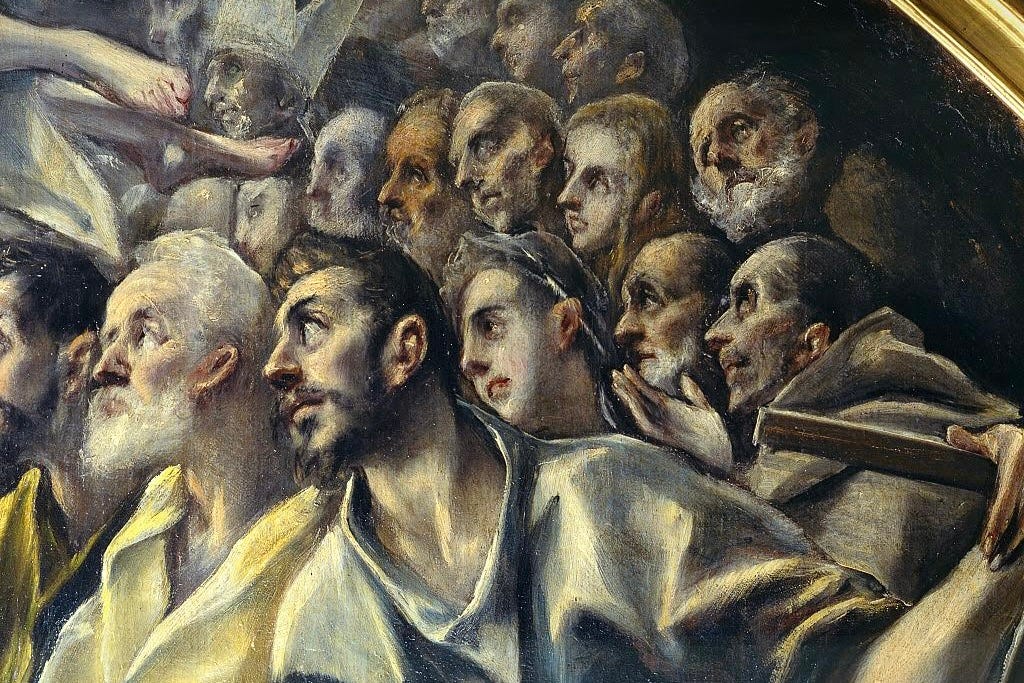
The 20th century variously imagined the end of history: rapture, communism, the triumph of neoliberalism. For the people of the Lamb of God, it was a gust of wind and words. Partly because far-away Jews had recently reclaimed the city of Jerusalem and partly because of our own faithfulness, we believed we were witnessing the outpouring of the Holy Spirit. Heaven was “inbreaking,” and before long, it would fully sweep the earth.
It was the late 1980s, and the Baltimore-based Lamb of God was one of dozens of “covenant communities” that had formed amidst the Catholic charismatic renewal. Adults pledged to tithe and obey leaders, then took their families to prayer meetings or festivals at the Farm, a sprawling estate with bonfires, pony rides, potato sack races, and a maypole. Thirty-plus years have not diminished the sensorial clarity of that place: the amber glow on the horizon, the dirt on my feet, the hum of a people who are sure that something big is about to happen.
We took our cues from the second chapter of Acts, where it’s written that, after Jesus’ ascension into heaven, his friends gathered in the upper room of a house, frightened and confused. Jesus had proclaimed the coming of the Kingdom of God, but then the Roman Empire got him. He’d returned only to vanish again. As the apostles fretted about what to do, there came a “mighty, rushing wind,” then “tongues of fire.” Possessed by Jesus’ ghost, and now speaking strange languages, they went forth to proclaim the Good News.
So much of our lives, even the way we kids moved at our community-run school — in pairs, as the apostles did — was an extension of this scripture. We called Jesus “Yeshua,” we shook, cried, and gibbered ourselves silly — often, in the middle of math class. All this, because we were purposed with opening the text, with making prophecy come true.
I’ve never known anyone outside the Lamb of God to live in such a double way, in two places and times. And so, it’s not lost on me why the literary scholar Michael Warner writes that the Pentecostals of his own childhood gave him a “passionate intellectual life of which universities are only a pale ivory shadow.” Nowhere, not even in graduate English departments, has either of us found such a “profoundly hermeneutic” culture.
But if there is a romance to Pentecostalism, it also has a shadow side. In the Lamb of God, we kids were disposed to associate the Holy Spirit with spectacular force. I can remember prayer meetings that turned into mob scenes. Children would lose sight of their parents as someone with a microphone prayed for fire to fall. When people began to shake, they were said to be “slain in the spirit.” Holiness, in our minds, was being massacred by a ghost.
We didn’t know it then, but some of our peers and mothers were being molested, either by the community’s sole priest leader or by another prominent figure. In sister communities, and at charismatic colleges, abuse was becoming even more rampant. Often, it was disguised as spiritual healing.
At Franciscan University in Steubenville, Ohio, a woman was reportedly raped by a campus chaplain who was conducting “deliverance sessions,” he said, to relieve her of lingering demons from a childhood assault. When the woman became pregnant, the priest blamed a demon, then compelled her to have an abortion. Though there’s no evidence they witnessed rape, members of the university-affiliated Community of God’s Love participated in some sessions, dousing the woman with holy water.
By the early aughts, Catholic charismatics were also using “spiritual warfare” against outsiders. In one town, our co-religionists stormed a public library to celebrate Mass, then made their way to city hall to cast out evil spirits there. In another, they helped a Pentecostal preacher drive out a specter named Unbelief, which they believed to be hovering over the area because of a local suicide.
This was my moral universe, one of sublime, penetrative spirits and clearly demarcated boundaries — “us” and “them.” Even though I never knew the worst of it, even though my parents were gentle and kind, I had little sense of the mystery, the playfulness, the extravagance of the Holy Spirit. Because of this, and notwithstanding the community’s weird hermeneutics, I thought of the Bible — of all texts — as closed things. They contained truth; they did not spill over or spin out.
Going back to Acts, I’m struck by the excess of Pentecost. Tongues unify the apostles as one corpus, but they simultaneously multiply them. Tongues mystify the apostles, but they also drive them to the ends of the earth. The apostles know not what they speak — only that this truth does not belong to them.
I often ask myself how then any Pentecostals could become so sure of themselves, landing on this: the Holy Spirit that some understand as possessing humans is, for others, something to be possessed by humans. People mistake a ghost for a thing they can domesticate. They think they can catch that dove and put it in a cage to hoard for themselves or sic upon their enemies. But sooner or later, the ghost makes its presence known. The bird gets out.
I was in graduate school when I first encountered Don DeLillo, the acclaimed postwar novelist known for critiquing consumerism, nuclear war, and paranoia. Sitting around a seminar table with White Noise, my peers and I may still have been figuring out what constituted the postmodern aesthetic, but we didn’t dare let on, dropping terms like “irony” and “late-stage capitalism.” By the end of that seminar, I’d discerned that literary critics associated postmodernism with cynicism, especially about grand narratives. And further that postmodernists viewed meaning as subjective. At long last, it made sense why so many Catholics used the word “postmodern” to mean atheist or Protestant. In their minds, both denied the Truth.
But the more I read of DeLillo, the more I came to understand that the mysterious, leather-jacketed man on the back cover was deeply serious, especially about the transcendent nature of language and ritual. White noise refers to the hum of information and technology that characterize modernity, but it also refers to the chanting, the babble, the “sacred small talk” that forms the daily liturgy of human life.
Literary scholar Amy Hungerford traces DeLillo’s mysticism to his days as an altar boy in the pre-Vatican II Church. The little Italian American from the Bronx spent many a morning listening to inaudible chants as they floated from a priest’s lips to the domed ceiling. He watched incense curl in the same direction.
According to Hungerford, DeLillo inherited from the Latin Mass a thoroughly sacramental understanding of the world, which he transposed to fiction, fashioning characters who spoke nonsense and marveled at objects, then transporting to some higher plane. On the page, and long after seeming to abandon his baptismal faith, DeLillo treated the unintelligible as a means to the divine.
But DeLillo was also inspired by Acts, and his 1982 novel The Names complicates an easy reading of language. It dramatizes a mock Pentecost, where cult members murder people whose first and last names share an initial. If the first-century apostles used language to unify, members of the titular cult use it to sow terror and chaos. Language, for DeLillo, is, then, neither intrinsically holy nor intrinsically unholy. It can free someone from reason, from what Names’ narrator calls the “machinery” of the self, but this is a morally ambiguous project.
By the time I encountered DeLillo, I’d given up prayer — given up God, the idea of a taskmaster in the sky too much a strain on the intellect, especially one yearning to be assimilated by academia. But I must have felt God’s absence, explaining the draw. I must have remembered the strange tongues of my childhood, talking to this artist who created something, not ex nihilo, but ex morte. Not from nothing but from death.
My old co-religionists were wrong about postmodernism — I know that now. It’s more Pentecostal than atheistic. DeLillo and other postwar thinkers lived through God’s demise, or the mass secularization of Western society, as widely proclaimed on magazine covers like TIME. When the old structures of knowledge collapsed and they were forced into an upper room to regroup, they emerged with a “crypto-religion,” in some cases, a post-theistic one. This is not the same as disavowal.
For many postmodern novelists, not just for DeLillo, the aftershock of institutional Christianity is linguistic. What-comes-after is word play. Toni Morrison was also formed by the Latin rite, her ear attuned to hums and chants; and in Beloved, she plays with spoken language as a form of ritual, collective memory, “ripping the veil” between the dead and the living. Then there’s James Baldwin, raised Pentecostal. In his semi-autobiographical novel, Go Tell It on the Mountain, the protagonist goes to the “thrashing room” of a church, where the character undergoes an intense spiritual crisis and sexual awakening. This section of the novel is partly written in the style of tongues — for Baldwin, a remembered language and a prophetic one, similar to “Black English.”
Words are surplus, and words are summons. But — and this is the part that still gets the girl from the covenant community — surplus and summons are necessarily impenetrable. This is because we cannot fully know things that don’t exist in space and time. To “do language,” as Morrison once put it, is to do who-knows-what.
I am petrified of this pneumatology, this ghost science. But I am even more enthralled by it. The Spirit is both a danger and a promise, never the one without the other. This is the antithesis of the Lamb of God, with its inflexible orthodoxy. At the same time, this was the community’s underlying grammar, wasn’t it? Not certainty but possibility. Not being but may-being. What philosopher John Caputo calls a “theology of the Event.”
Sometimes, when I close my eyes, I can see those crowds at the Farm. On the green, adults sway to song. On the hilltop, girls recreate the rituals seen below. We collapse into each other’s arms, “slain in the spirit.” We rearrange until we’ve exhausted all the combinations of falling and catching. Even though some of us lie to get a second turn, we’re joyful. It’s not forced joy, like when our teachers tell us to smile, but the joy of peasants who speak the imperial tongue while plotting an uprising.
I have to resist the temptation to flatten my old community into any single project, theological or political. I have to remember what was going on in the background and around the edges — never as the main event but also no phantom. This is how you combat the prophets of doom: you feel around for the nerves of things. Press an ear against the ground to find where it shakes. Listen for the echo of an event and then give it another chance.
There are many reasons why I ended up on that hilltop, cosplaying as people who were cosplaying as other people. Here’s a big one: in 1961, a man in long robes prayed for God to restore the wonders of the nascent Church in Jerusalem. When Pope John XXIII convened the Second Vatican Council, the world still reeling from the Shoah and the reality that centuries of theological antisemitism had culminated in that genocide, he explicitly asked for the heavenly father to renew the earth “as by a new Pentecost.”
Pope John died before the council could conclude, but that little white dove? Once more in flight. There came a flurry of magisterial documents affirming Judaism and other religions, modernizing the liturgy to incorporate congregants’ vernacular, and admitting that the Church was not a static thing, but a group of people on a journey. Both lay and clergy were electrified, taking to the streets to organize against war, poverty, and apartheid.
Feeling their own exuberance about the Spirit’s work in the world, two men at Duquesne University in Pittsburgh began to pray the Pentecost sequence. Veni Sancte Spiritus, chanted graduate student Ralph Keifer and history professor William Storey. “Come, Holy Spirit.” What happened next was beyond their wildest dreams.
The story goes that at a weekend retreat, Keifer, Storey, and some undergraduates were reading a book about tongue-speaking when the depicted events sprang to glorious life. One young woman described a burning sensation. Others began to laugh, cry, or tremble as unknown words hit the air. “What is the bishop going to say when he hears that all these kids have been baptized in the Holy Spirit?” Storey wondered aloud.
With this, the charismatic renewal was born. To be sure, things quickly went awry. Others took charge, conceiving of covenant communities and using geopolitical moments, such as Israel’s recapture of Jerusalem, to grow their ranks. But events leave ripples in their wake. This is the mystery of Pentecost, or one of them: when someone or something is gone, their absence can be felt so deeply as to become a kind of presence. And this presence — call it memory, call it a mystical body — can change the world.
A spirit did move through the Lamb of God, only it wasn’t the one that leaders claimed. This spirit gave rise to customs like “crashing,” where an entire family would show up unannounced at dinner. Without asking questions, the residents would add place settings. The idea was that it is good to practice spontaneity and make more room at the table. Certainly, there were homes everyone knew never to crash, and there were times when people rolled their eyes to see a car pulling up to the curb. But it was special to have so many families who had your back.
Even at school, we had rituals to practice charity. If someone forgot a lunch, he or she was allowed to pick one thing from others’ boxes. While this usually meant that person ended up with all the chips and Fruit Roll-ups, it was a lesson in Catholic social teaching: the poor tell the rich what they need, not the other way around.
Then there were the tears. If one of us was hurting, the others would gather and lay a hand to take some of the load off. Once, during class, a boy remembered his grandfather had just died and began to weep. Seeing this, we dropped our pencils, walked over, and let his sorrow enter into us.
Listening to the stories of the old community members, I sometimes get the feeling that the millenarism enabled this fraternity. The talk of an event, of something imminent, inspired people to live more spontaneously. The background noise of rupture inclined them to be interrupted, to hear voices they might otherwise not have heard. And far from hardening their hearts against outsiders, it gave them the courage to notice the widows and orphans. “It was in community that I really learned to serve,” one ex-member tells me.
Lamb of God dissolved in the late 1990s, not long after it was absorbed by the Archdiocese of Baltimore in an apparent effort to subject it to oversight. Dozens of other covenant communities met the same fate. Today, many onetime charismatics can be found at the Latin Mass. They’ve traded tongues for the other old language. I wince to see some of them proclaim contempt for “modernity,” migrants, even Pope Leo, for recentering the gospel around the poor. But I also know that when these cynics sign offline, they go staff soup kitchens or otherwise expose themselves to the needs of strangers. If many of my political allies would have me write them off for their words — and certainly, their votes — I can’t help but marvel at the power of the Holy Spirit, compelling people to incarnate the “good news” in ways that even they do not comprehend. Ghost language is body language. Action without full understanding. What DeLillo once called “automatic writing.”
A child of both Pentecost and postmodernism, I cannot believe that anyone is turned to stone, nor that any of us have arrived at any final understanding. The story — of the Spirit, of America, of democracy — is still unraveling. “There is nothing outside the text,” Jacques Derrida famously said, meaning both that human agency has limits and that the work of interpretation goes on and on and on. In this, perhaps, an echo of John’s gospel: “The wind blows where it wishes, and you hear its sound, but you do not know where it comes from or where it goes.”
At this hour, Americans seem disenchanted with secularism, sensing that it does not have the moral language to combat the crises of the 21st century: rising authoritarianism, technological change, and the near-total reduction of humans to data, then capital. We’re told that people are turning to religion because they yearn for answers and stability. I’m not sure it’s clarity that people seek — or that they’ll find — rather than a world that is haunted and strange.
This is now my prayer: for the arrival of something I cannot begin to predict. When I’m all alone, I ask for the courage to see what is moving across this fruited plain, especially in those spaces I’ve damned. I remind myself that the future does not belong to me but to the Event. And then I recite that old chant known as the Pentecost sequence: Veni Sancte Spiritus. Come, Holy Spirit.

Audrey Clare Farley holds a PhD in English literature and is the author of The Unfit Heiress and Girls and Their Monsters. The latter won the Michigan Notable Book Award and was named a New York Times Editors’ Pick.

You are right to discern the spirit of Catholicism in even the most "secular" of Don DeLillo's novels, such as WHITE NOISE. (Except for the ending with those German nuns.) I was his editor for LIBRA and I was also, to paraphrase you, a little Irish American altar boy serving the Latin mass in Brooklyn before Vatican II. I have long ago "fallen away," but the numinous is in no way alien to me. I have always been particularly attuned to the religious subtext and content of his work. Especially the truly excellent Jesuit jokes he gets off here and there.
I don't really buy that Don's work is, in any formal way, postmodern. His irony does no extend to what it is that he is doing. He is not pulling the epistemological rug out from under his readers. He is doing something else, something unique to himself and very very important to try to understand. His body of work, like that of Faulkner's (whom he read as a kid and admires) will provide grist for the critical mill for decades to come.
Remarkable piece.