


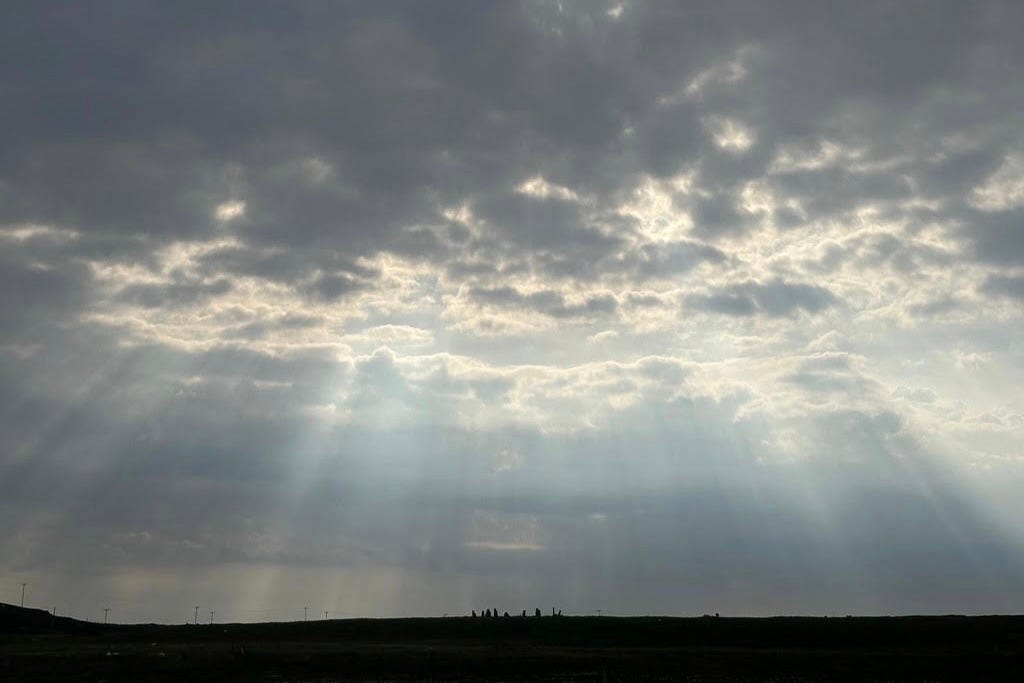
In the spring, Leif . . . set sail, but unfortunately the winds were against him, and he was blown straight to the Hebrides. He spent the summer there waiting for favorable winds. Of course he was not about to stand on the docks wetting his finger every second to see if the breeze had changed, not when there were friends to make, such as noble-born Thorgunna, who went to such lengths to welcome him! . . . She took Leif to the Callanish Stones and made runes, for she was a woman of much knowledge. . . . ‘Look!’ said Thorgunna. ‘Do you see those great stones on the hilltops, like gateways? Those mark the road for the SHINING ONE. He walks only from hill to hill; I have seen Him in the wind. – And do you hear the cuckoo singing?’
—WILLIAM T. VOLLMANN, The Ice Shirt
I.
2025
AT THE END OF MARCH, I was sitting at a departure gate at JFK, having endured a brutal frigid winter exiled upstate in a yurt in the woods, about to fly to Tokyo to bury my maternal grandmother, when I got a strange and unusual email. From a woman, Kirstie, who said she lived in Scotland, on the Isle of Lewis, in the Outer Hebrides, and that she wanted to fly me out and feed and house me for two weeks over the summer solstice. There was a rare lunar event that only happened every 19 or so years at a stone circle that dated back to the Neolithic Age — the Callanish Stones — an event that was also related, how exactly I couldn’t quite tell just yet, despite her cursory explanation, to the summer solstice. “I’ve read your writing, and I just think you’d write something really good,” she wrote. Before adding, “It’s actually hard to say exactly what I think, I guess I just have an intuition about it.”
The night Kirstie and I hopped on a call was hours after we’d cremated my baba; I’d been drinking. Kirstie seemed cool, a couple years my senior, had purchased land out on the Isle of Lewis right after the pandemic. Had yet to build on it, but spent a good amount of her years out there, planning her build. We were both sort of cackling at ourselves, at our willingness to even humor the idea, to hop on the phone together. I was pacing this little driveway area out front the Airbnb my little sister had rented, not half a mile from where I was born, my first time back in 10 years, my dad had flown down for the funeral as well, I hadn’t seen him out here in almost a decade either, and Scotland, in Aberdeen, was where I spent my earliest conscious years, from ages 5 to 8, I explained to Kirstie, and so isn’t it so auspicious somehow that you’re asking me out there right after I flew out here —
“But so it’s about the moon you were saying? And some stones?”
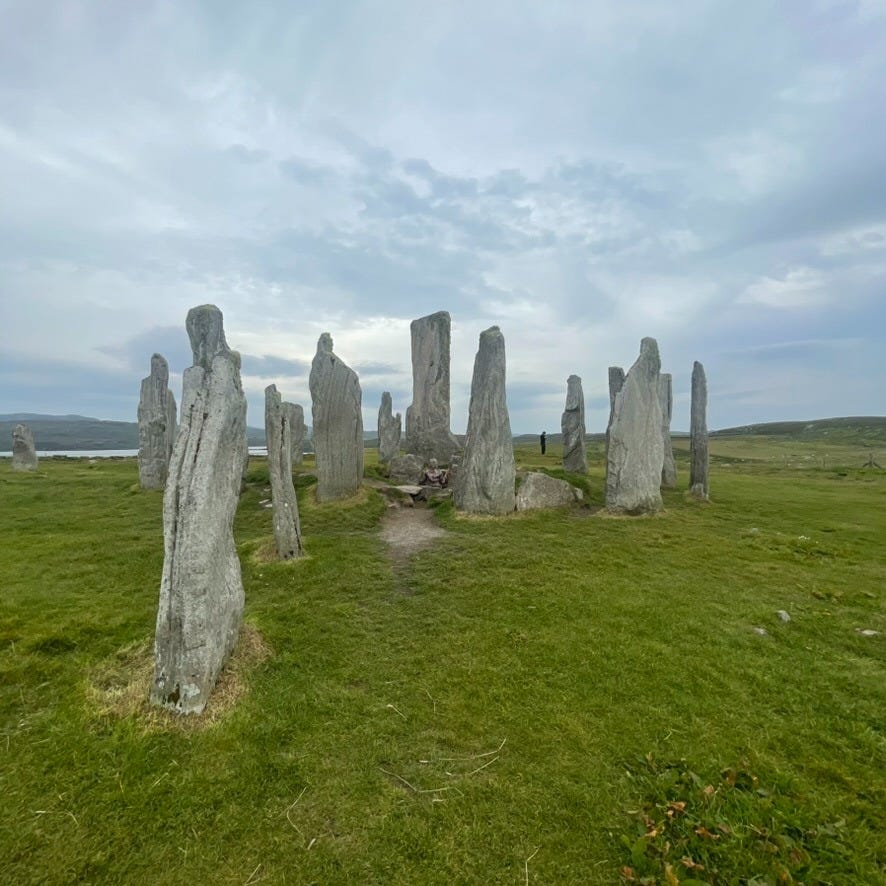
Lewis is the outermost, northernmost Isle of the Hebrides, the archipelago off the northwestern coast of Scotland. The Callanish (“Calanais” in Gaelic) stones are 13 standing stones in a circle, surrounding a central stone, around which are four rows or “avenues” extending out more or less in the cardinal directions, forming a cross. Every 18.6 years, when the moon completes a full nodal or “metonic” cycle — when it returns to its starting point — alternately at the summer or winter solstice, the full moon, at this exact location, from the vantage point of the stones, rises in a way that’s called a “lunar standstill” — rises just above the horizon, appears to stay still, and then disappears. What’s more, the silhouette of the hills, at this consistent point that it rises in this unique way over, resembles a sleeping, pregnant woman, such that it appears that the full moon is emerging from out of her belly. The hills themselves are thought to be a mythical Celtic fertility goddess, the Cailleach na Mointeach, Gaelic for “Old Woman” or “Old Hag of the Moors.” This year, the event would fall on June 11. Additionally, the summer solstice held annual significance at the stones, there were local myths about “a shining one” said to arrive at the stone circle on summer solstice morning “heralded by the cuckoo’s call,” about which there were no established explanations, all such Celtic sun worship having been suppressed by Christianity, The Free Church of Scotland’s explanation being that the stones were simply pagans turned to stone for refusing to convert.
“If anyone can figure out what it all means,” she said, “I figure it’s you.”
*
IT WAS A DAUNTING, if flattering and slightly surprising challenge. Though it was true that, for followers of my paywalled writings and ramblings like Kirstie was, I had, over the past years, been barreling perilously down a path not unlike Father Gwyon’s in The Recognitions who, after his wife Camila, while en route to Spain on a ship together, dies in his arms, in the most nonsensical, preventable way possible (she got an appendectomy, only the surgeon on board who operated on her wasn’t a surgeon, only posing as one, and she died that night, the eve of All Souls), starts diving deeper and deeper into ancient mythological readings, embarking on that treacherous path of seeking the key to all mythologies, following the lead of Sir James Frazer who, in The Golden Bough, connects every aspect of the Christ story to older, more archaic myths, which book of course Gaddis had been reading while writing The Recognitions, and which, incidentally, I’d been reading all winter in the yurt. Seeking some long-forgotten cure to his current plight. When modern devices fail, it is our nature to reach back among the cures of our fathers. If those fail, there were fathers before them.1
It used to be that, when I thought back on the night Kyra lost her mind and, in a fit of madness, leapt to her death off the balcony, the key was that this all happened on the eve of Holy Week. Leading me down a path of digging unceasingly into Dante’s Holy Week story, since his Inferno happens to be set on the exact date she died, and the real-life Beatrice, as it so happened, also died at the same age as Kyra was when she died. Plunging me into a sort of katabasis-mania — obsessed with any story of an underworld descent and return, thinking this was a Hell I’d been plunged into, that I’d have to resurrect out of, which in a way Dante and Frazer were both afflicted with, this obsession with stories of descent and return, both Christ’s and his Hell-harrowing precursors, Aeneas, Odysseus, Bacchus, Attis, Adonis, Hercules, Osiris — I could go on.
What I hadn’t realized, fixated as I’d been with those date-synchronicities and the intellectual idea of Easter, was where that date stems from, how it’s oriented around the equinoctial full moon. Meaning, as the eighth-century English monk Bede, who calculated the proper date of Easter at a time when it was still up for debate, put it in a letter to Nechtan, King of the Picts, in AD 710, the proper date to mourn and celebrate our Savior’s death and ascent back into life is the Sunday after the first full moon after day defeats night, that is, the first full moon
after the equinox, so that first the sun may make day longer than night and then the moon may show the whole of her light face to the world, because first ‘the Sun of Righteousness with healing in His wings’, that is the Lord Jesus, overcame all the darkness of death by the triumph of His Resurrection and then, having ascended into heaven, sent down the Spirit from on high and so filled His Church, which is often symbolically described as the moon, with the light of inward grace. This was the plan of our salvation which the prophet had in mind when he said: ‘The sun was exalted, and the moon stood still in her habitation.’2
What I remember most vividly about that night is this exact huge vernal full moon, standing still in her habitation, beaming a spotlight in through the window. Kyra wrote constantly about the moon, she could be mercurial and prone to moods, and would often, during those full moons, over that apocalyptic lockdown year together, sit drinking wine sitting upright like a girlish hierophant, getting herself into an aquatic and moody state, waxing herself full for the creative act, her aura radiant and glaring yet luminous, sitting there writing, twisting herself up, brow furrowed, till she’d snap out of it and read me what she’d written, short compressed stories like sacred stones, fully formed meteors extracted, as if by sheer mental will, from a crater in the moon itself.
IT’S NOW THE January new moon of 2026, the opposite, shadow side of that summer solstice moon in Lewis. I have since retreated into the forest, read all the myths, and finally cracked the code of these stones, of this interstellar divine union between the moon and the solstice sun. We’ll now embark across the ocean, but before we do, I’ll tell you, the stars exist inside each of us still. I must exhort you, like mad Ingeborg, after she disappears into the freezing night on the mountaintop, exhorts terrified Hans (Archimboldi), when he finally finds her, to
‘Look at the stars, Hans,’ she said. . . .
The sky was full of stars, many more than could be seen . . . on the clearest night in Cologne. . . .
‘All this light is dead,’ said Ingeborg. ‘All this light was emitted thousands and millions of years ago. It’s the past, do you see? When these stars cast their light, we didn’t exist, life on Earth didn’t exist, even Earth didn’t exist. This light was cast a long time ago. It’s the past, we’re surrounded by the past, everything that no longer exists or exists only in memory or guesswork is there now, above us, shining on the mountains and the snow and we can’t do anything to stop it.’
‘It makes me want to cry,’ said Ingeborg, her eyes damp with madness.3
II.
JUNE 6
TOUCH DOWN in Paris off the Kirstie-funded Norse Atlantic budget red eye from JFK, strapped with three book-bricks, narrowed down after a night of painstaking deliberation: The Recognitions, The Golden Bough, The New Science. Kirstie pulls up, a bit frantic, about an hour late. It’s a blasted, humid afternoon. While I wait, I alternate sitting inside and smoking out on the curb, pounding espressos from this weird European vending machine. Texting with Amelia, my lady of just over a year minus a winter hiatus when she got sick of me constantly writing about and talking about publishing (though never publishing) my novel about my deceased girlfriend; she, as it so happened, had just flown to Finland for the month, to host a wilderness camp for girls.
Kirstie’s car is an early-aughts CRV, stuffed to the brim with gear, books, and spare clothes in totes. It’s almost 4 p.m. She’s been driving since 5 a.m. this morning, from Marseilles. I drop my pack in the back and we hit it north on the A-1. We’re trying to get up France and across the Chunnel and north of London, eventually to Ullapool, to catch the ferry across the Minch to Lewis, in two days’ time.
Our stated goal, setting out, is to move completely intuitively. “Any spots you feel moved to hit along the way,” Kirstie tells me, “We can.”
On our way to Calais, the Chunnel’s port town, Kirstie explains how the “houses” work in astrology (I hadn’t realized), the details of where we’ll be staying, initial ideas about the stones and the standstill. I’ve been, since my winter exile but really since 2021, engaged in a nebulous if rigorous search, trying to make sense of inherently nonsensical events, the two deaths over the weekend I was celebrating my first novel, the subsequent shitstorm the novel caused, the seeming impossibility of ever publishing a book again. But most of all, seeking a way out of this paranoid, defensive headspace I’ve been stuck in, which has proven debilitating for both my writing and my relationships. We don’t speak of any of this explicitly, but Kirstie seems to know what I’m talking about when I relay some of what I’ve been thinking: trying to tap into some more ancient orientation towards divinity, the stars, the primordial feminine element.
KIRSTIE’S STORY IS she worked for a long period in tech, for Apple, then for some years as a freelance NYC artist person, doing avant-garde ambient music projects, DJing, film stuff, working camera operator on a project here and there. The land she bought on Lewis is completely undeveloped but beautiful, she can’t wait to show me, she tells me near Arras.
In a way, she’d been in a time of extreme solitude when she reached out to me, and in fact had been envisioning becoming a sort of anchorite on her property — invoking Julian of Norwich, and procuring her book, Revelations of Divine Love, from a tote, which she got at Julian’s anchorage in Norwich (becoming an “anchorite” means locking yourself in a room, generally attached to a church, for the remainder of your days, to be closer to God).
Part of this, I learn, has to do with a separation she was going through with her boyfriend, one of her initial ties to Lewis, who had, for reasons I won’t go into, been effectively exiled from the isle. What’s wild is, since first reaching out to me about coming out, they started talking again — I don’t know any details of it, but how she describes it, it sounds like it’s a wild development for her. His name is an Irish name that translates to “the red king.”
ON THE CHUNNEL, we discuss what exactly we’re out here to figure out, and how we’ll record our quest. Kirstie’s funding comes from an artist grant for a film she’s making on the Isle of Lewis; this is a part of it, for her to shoot an avant-garde film of me in my mystic mode, trying to understand the stones.
The Chunnel is like a ferry, in practice, but is structurally more like a train. You park on it and then the whole thing moves. And you stay in your car.
Once beneath the ocean, we go over the facts.
THE FACTS
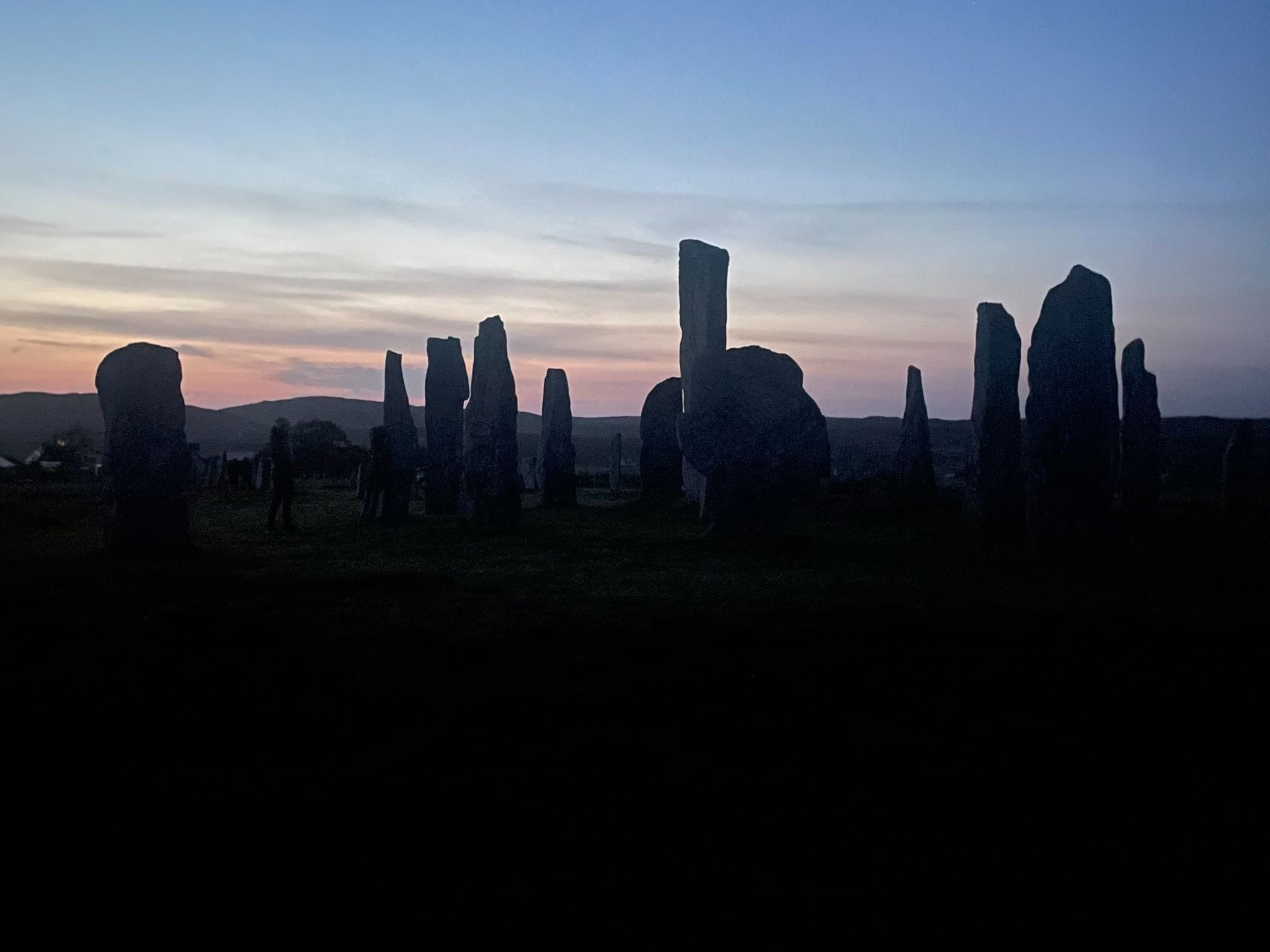
CALLANISH IS 13 standing stones taller than men, in more or less a circle, with what’s believed to be a tomb in the center at the base of a central stone, and rows of stones extending out in all four cardinal directions, the northern tine so prolonged as to form an avenue (and inverting the Birds-Eye-view cross).
It’s thought that it must have been a lunar observatory in the Neolithic period (between ~4,000 and ~2,500 BC), which would check out with the 13 stones in a circle to represent the 13 annual lunations, I think. With the cardinally directed cruciform rows making it so, like at other standing stone sites of the numerous scattered across the UK — Stonehenge, say — at high noon on the solstices and equinoxes, the shadows of the north-south stones overlay each other (though Callanish, it’s said, predates Stonehenge by some 500 years).
“The significance of this particular event on this coming solstice full moon,” Kirstie tells me, “of the moon rising just barely over the horizon and appearing to ‘stand still,’ is that in olden times it was thought that the lunar mother goddess literally visited the earth.”
I DON’T KNOW what exactly draws me to Bede, he’s by no means prominent on a map of England — there are no notable Bede-related landmarks that jump out I mean. But when we emerge out of the Chunnel, and Kirstie asks which route I want to take up through England, something tells me to Wikipedia-search “Bede,” which leads me to St Paul’s Monastery at Jarrow, near Newcastle, the football team of my youth in Aberdeen (ages five to eight) — an arbitrary choice, based solely and childishly (though, in retrospect, quite intuitively and resonantly) on their uniforms (black and white stripes, equal parts shadow and light).
We drive straight north, flanking east of London. It doesn’t get dark till almost 11:00, at which point we pull off for the night at a Travelodge somewhere in the Midlands. Kirstie got us two rooms, I assure Amelia — via text since she’s ignoring my calls, since she thinks I’m off on a romantic getaway rather than on a heroic, historical, highly gnostic pilgrimage. We’ll hit Bede’s monastery in the morning.
ST PAUL’S MONASTARY AT JARROW
WE’RE initially headed for a church with Bede in the name, til we realize tons of churches have Bede in their name, especially in Newcastle, from where Bede hailed.
It’s St Paul’s Monastery at Jarrow we want, where Bede specifically practiced.
The weather is mild if muggy with bouts of rain. We head along a single-lane county road to detour around a stretch of road-closured A-1, surrounded by fields greener than green.
BEDE’S BIG CLAIM to fame, turns out, wasn’t just calculating the exact date of Easter, but coming up with an easy formula for how any newly converted heathen could calculate the date for themselves each year.
And it was the same 18.6-year nodal cycle of the moon, specifically, that he used to do as much.
ANYONE WHO WANTS CAN MAKE A FORMULA . . . IN ORDER TO FIND THE AGE OF THE MOON
reads one of Bede’s quotes, of the dozen or so adorning the walls of the Bede museum, in elegant Celtic cursive, adjacent to the Monastery he spent all walking hours of his days reading and writing in.
POET, TEACHER, SCIENTIST, HISTORIAN — were the self-proclaimed hats he wore, THE HATS MODERN MAN OF LETTERS MUST WEAR, I text Harold.
In fact, Bede was so out there with his calculations and theories, he was once put on trial for heresy by his peers. The problem was, he was so erudite with his writings that no one could argue with the content of them — they simply hadn’t read enough to debunk his theories.
So, they charged him with the heresy of . . . innovation!
THE MONASTERY is down a hill and across a field, by a river. Built with the oldest stones in the UK, having survived a brief reconstruction after the Vikings invaded around 800. On our walk down, the sun comes out. Kirstie busts out the camera and follows me inside.
There’s an old-ass chair with all these markings on it in the secret back part of the chapel, where Bede specifically sat and studied, that an old English dude, the chapel guide, shows us despite it being technically off-limits. The chair, he tells us, was purported to have magical powers: any woman who sat in it was said to soon after become pregnant. Women used to travel from far and wide for this purpose, often taking a little piece of it with them — why the markings.
“But so this Cailleach na Mointeach, the Old Woman of the Moors, who the moon will rise out of, must be tied to fertility somehow,” I muse. “Since all early divine practices, like coming to sit in this chair here, had to do with fertility. I mean the moon is literally emerging out of the pregnant woman, right?”
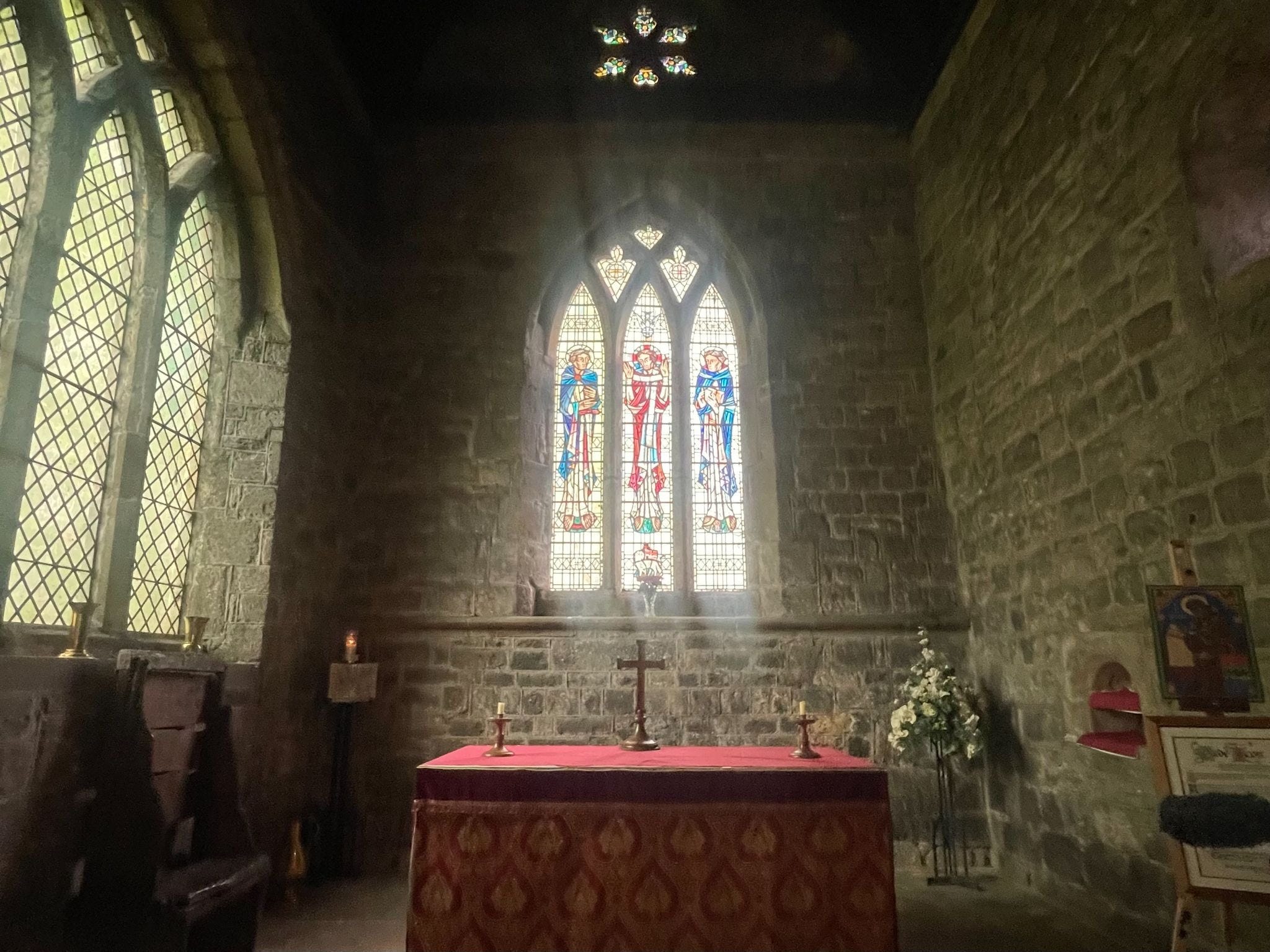
ON OUR WAY to our stopping point for the night, Kirstie shows me this book about Lewis, which expands on the mythical Calleach. In folklore, she was
a powerful giantess, with magical abilities, somewhat like an Australian Aboriginal Dreamtime ancestor. She created hills, glens, lochs and even island chains such as the Hebrides on her travels by dripping stones or peats from her apron; was the fearsome power behind the winter and all bad weather; dictated the people’s yields at harvest time; and even decided upon their success at hunting.4
She was, according to the author, the “foremost pre-Christian Goddess.”
I let Kirstie take the lead across the island, to this funny hotel in the middle of nowhere. It’s the cheapest one on the map, and anyway we’re making great time, so we’re cool with this detour into the sticks. It’s Saturday night, and it’s a wild vibe; there’s a bar and a huge dining hall with a buffet. It’s mostly adventurous geriatrics, a damn congregation of them. Kirstie calls it after one beer; I nurse my second and final out front, talking to Amelia, reassuring her that it’s a strictly theological quest I’m on, no funny business, I’m simply here to rediscover the lost mother goddess erased from mainline religious history.
JUNE 8 (PENTECOST)
THERE ARE LIKE four full hours of dark up here at this time of year, we’re on the road first thing and thru Glasgow before folks are even up. After a pit stop for breakfast in Stirling, we’re gunning it up through the land of the Picts, rolling hills and vast forests increasingly less populated.
MY GUIDES
THERE IS VERY limited “evidence” about what type of strange pagan rituals went down at these stones 4,000 years ago; I make no claims of authoritative scientific proof; you’re saying something about yourself, and the world, by saying what you think could have been happening at such a distant age — it’s an imaginative act. My main guides in this treacherous endeavor are Frazer and Vico, for these reasons:
Sir James Frazer (1854-1941), that venerable Glaswegian, was both the most influential cultural anthropologist and folklorist of the 20th century, and the most excoriated for his parallelomania, his equating of disparate religions unduly, finding patterns across cultures in ways later critics disagreed with. The truth of it is twofold: the equating of Christ with older dying-and-reviving Gods like he does is flat-out risky business in any era, and Frazer garnered significant flack during his lifetime for this, perhaps understandably. But it was also the aura of his book, which people had to “read in secret” for its heresies, which made a cultural and literary impact beyond the academic realm it came out of (The Waste Land, The Recognitions), and so of course academics in the century since its publication have been tearing it down piece by piece, in any way they can, an ironic and hilarious phenomenon when you think about it, since his whole case is that, throughout history, we first had myths about a distant metaphysical divinity, then myths about part-divine heroes, and then about historical humans with the spirit of divinity running through them, in Christ, eventually, but also primitively in the form of “sacred kings,” human representations of the peak of fertility and growth and the rejuvenation of spring, and so when someone becomes this peak symbol of growth in a given arena, it is our human nature to kill and in some cases eat that king; and so the clapback he received was purely natural, per his rules: if you’re an academic and someone emerges as the king of your field, in order to ensure your field is in a healthy state and doing what is relevant and useful for the world, you test that king, you make sure he’s the one who is supposed to be representing you —
If you can kill him, and eat him, then maybe one day you can become king — not realizing that sacred kingship is essentially a burden, a curse, you’re a murderer-scapegoat the minute you assume the role, you’re born already dead. . . .
Frazer is my guide for his orientation, on the light side of this critique, towards a radically humanistic syncretism: of taking the religious practices of every human group beneath the heavens into equal consideration, and finding the similarities rather than the insurmountable differences between them.
As for Giambattista Vico (1668–1744), also another major influence on the great writers of the 20th century (James Joyce), he came up in a time when the attitude towards the ancient past was to romanticize and idealize it, to view ancient poets as these bygone sages, paragons of wisdom we should try, today, to crack the codes of. Vico’s innovation was to realize that no, it was a much more savage and barbaric world back then, and no myth sticks unless it has a tangible, social function, and so the parsing through of ancient myths, for him, was as much a humanities or literary task as it was anthropological, with an understanding of community-forming functions being necessary to decipher a given myth, and thus requiring disparate, seemingly haphazard forms of research and a great imagination. And humility, as well, a clear-eyed view of ourselves, since if we could have been barbaric in the distant past, we of course could still be today, no matter what civilized, humanistic beacons of enlightenment values we view ourselves as. Vico lived in poverty and anonymity and with a complete lack of acclaim from his contemporaries, while raising six kids, in the heart of Naples, where he “expected nothing from his native city but the complete isolation which enabled [him] to work so hard,” he wrote in a late letter.
Frazer’s radical syncretism means it’s not out of bounds, but rather humanizing and unifying, to imagine similar practices found elsewhere in the world as having happened here at the stones, and Vico’s resistance to idealizing the distant past, means resisting “New Age Utopia” theories about the stones, means not forgetting that these ancient rituals came out of a need to maintain an unimaginably difficult and tenuous social equilibrium.
*
STARTING WITH WHAT we can know for sure, we know that, as it’s written on a sign at the stones themselves,
During the Neolithic period (4000-2500 BC) many communities across north-west Europe constructed large monuments of stone and earth. Perhaps the building work gave people a common identity and stability, or perhaps they worshipped here.
Builders frequently oriented monuments according to astronomical events such as midwinter sunrise and sunset. Research at Calanais has shown that it has both astronomical and landscape alignments.
Taking this most cursory view of things, we can see that: 1) this was a place of worship; and that: 2) this archaic worship was orientated towards THE STARS.
THE STARS
VICO’S WORK is expansive and wide-ranging, but his relevance to me, and to the stones, is his tangible, practical theories for why we came up with the first gods — why humans began worshipping something higher — in the first place. His view, in short, is that we first deified the heavens, that the visible planets, the stars, thunder and lightning, were the first gods, and those with privileged knowledge of their movements, the first priests.
My preoccupation with Vico started a few years back. I was trying to come up with a reasonable explanation for why it was that seemingly every single ancient religion personifies the seven visible planets, that is, Saturn, Jupiter, Venus, Mars, and Mercury, plus Sun and Moon, as their first gods. I couldn’t understand this, why the Egyptians, Celts, Norse, Greeks, Romans all deified the stars — a curiosity amplified by where I was, tending to my fire in the yurt all winter, unable to go down to my cousin Eric’s main house once I zipped up the yurt for the night without causing complete chaos since Lila, Eric’s Malinois, would go absolutely nuts if I emerged from the forest like the Green Man of the Woods, collaterally and catastrophically waking Eric’s two-year-old with Lila’s barking. And the sun would set early, so I’d stoke the fire in my yurt and step out to pee or to smoke, looking up, and get floored by the planets, observing how they alone moved while the constellations stayed still, how visible they were in the dark night without artificial light, in a world that felt increasingly dark, all culminating in this event on February 25, my final week in the yurt, where all seven visible planets were visible in the night sky, and rarely aligned. . . .
THE EARLIEST DIVINITY
VICO FRAMES the origins of divinity as we know it around the great flood, which he places around 4,000 years before Christ. The stones, in Vico’s chronology, then, must have been erected sometime in this early period after the great flood.
Vico’s basic theory of the Three Ages, the Religious, the Heroic, and the Democratic, of humans initially deifying metaphysical gods, and then deifying heroic god-men, to eventually deifying political leaders, charts an arc where earliest postdiluvial man, wandering like savages, living in caves, had to look to the heavens to create gods in the name of, based on their immediate needs — fertility, sun, clean water — or that which they sought to prevent — inclement weather or thunder and lightning, illness, famine — and would pray to those first gods, which, since this state of reverence, of humbling themselves beneath something other than their immediate desires, beneath something literally higher, became physically associated with the heavens,
the first object of contemplation in the world was the heavens, which the Greeks called mathemata, or sublime things, and the theoremata, or divine objects of contemplation. In Latin, the act of contemplating took its name from the regions of the heavens, templa coeli, which augurs marked off to take the auspices by observing the paths of falling stars. In the Near East, these heavenly regions gave their name to the Zoroastrians, a name which Bochart interprets as meaning ‘star-gazers’.5
Vico’s big idea, that Joyce starts Finnegan’s Wake with, whose structure Joyce mimicked, is that thunder and lightning, for earliest postdiluvial man, was the first god (Zeus, Jupiter, Jove). His claim is that a class of priestlike storytellers, which he calls “theological poets,” invented new orientations towards reverence, new ways of being — by telling stories about gods or semi-divine archetypes that allowed those who followed them to orient themselves in a way that served the group, and thus increased the group’s chances of surviving winters.
Ideas invented by the theological poets, he claims, were so compelling that they just made intuitive sense and so spread, and stuck, the foundational idea of Jupiter, the brightest and most piercing and consistently visible planet (planet meaning “wanderer,” since they alone move through the otherwise static 12 constellations, and so were easily anthropomorphized). To represent the thunder god of wild weather and storms just made sense. Everyone experienced storms and clung to this fun idea of a thing to sacrifice / pray to — to get the damn storm to end!
In this manner, the first theological poets invented the first divine myth, which was the greatest myth ever invented: Jupiter, the king and father of gods and men, in the act of hurling a thunderbolt. The figure of Jupiter was so poetic – that is, popular, exciting, and instructive – that its inventors at once believed it, and they feared, revered, and worshipped Jupiter in frightful religions. . . .
“But so with these stones . . . we have the ancient reverence for the stars . . . plus some aspect of fertility,” I say to Kirstie as we pull up to Inverness, the last town with actual stores in it, before the port town Ullapool. Kirstie nods, pulls into a parking spot, and kills the engine.
*
AT THE MALL in Inverness, I buy a rain jacket, red with black trim and a nice bill on the hood. In Ullapool, overlooking the Minch, we park in the row of cars lined up to board the ferry, then roam. It’s overcast. We walk down the rocks for a smoke — to a spot Kirstie always goes with the Red King, when they head across, for him to smoke, she says. On the ferry, I nap to this AI-read audio of The Recognitions on YouTube, to get a sense of it before I start reading. I feel like the Vikings in 795 must have felt on the top deck as we pull up.
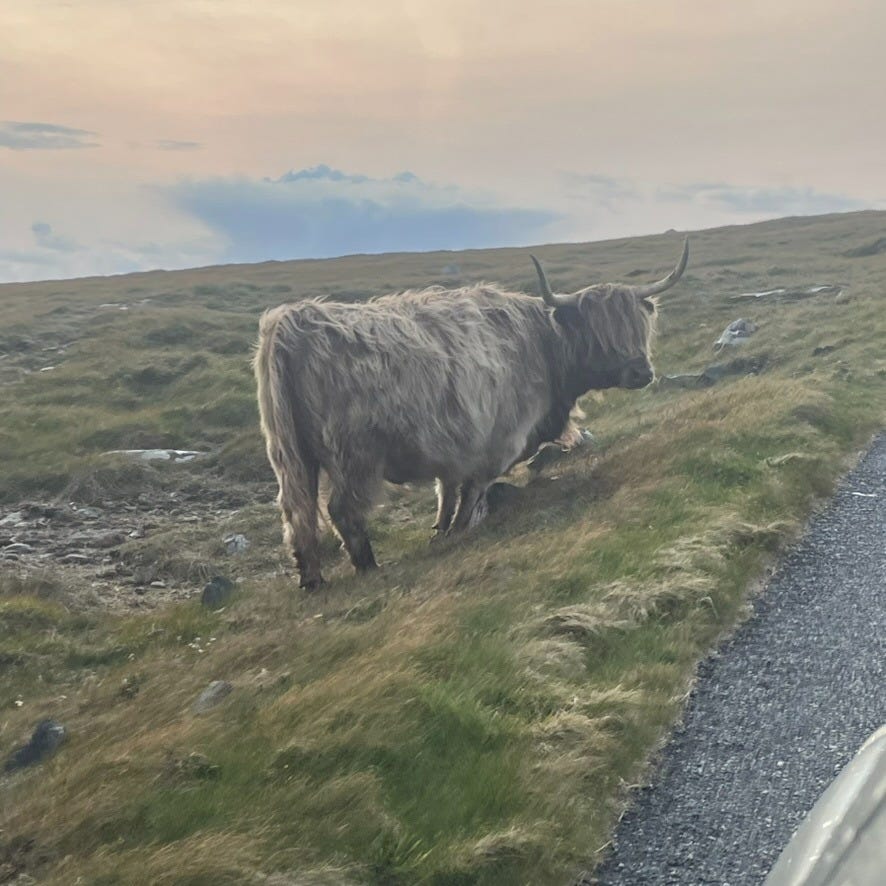
It’s a single, W-shaped road, an hourlong drive, across the isle. If you look at it from bird’s eye on the map there are little light blue diamond-shaped pockmarks all over it, little water pockets. It’s all peat bog; it used to be covered in forest. Each phase of the road, I’m more stunned, the bright greens and the vast sky and the antediluvian, rolling expanse, but Kirstie keeps saying just you wait. We get a glimpse of the Calleach hill partway across. She’s astonishingly vivid, her nose is perfectly placed and her breasts and belly fill out her figure. We drive past where we’ll be staying, in Uig Bay, to try to catch the sunset on the far western side — around 11 p.m. Through a gate that’s unlocked but there to keep the cattle in. Hebridean cows approach, just beautiful gentle creatures with little emo tufts of hair on the front. I can’t understand how this cute trait developed Darwinianly.
At the house, there are two big rooms on the top floor. I try to take the smaller one, without skylights, but Kirstie insists. I drop my bags, try to call Amelia out front but the reception is shoddy.
III.
JUNE 9
IN THE AFTERNOON, when I wake up, Kirstie makes food and we sit at the living room table. Drinking coffee, reading, going over plans. It’s rainy and cloudy, we figure we’ll hit the stones tomorrow, it’s about a 40-minute drive, and tomorrow’s the standstill night.
We’ll research and recover today.
At some point, Kirstie sends me a pdf of this book that’s written exclusively in love letters.
I get excited by this, thinking I’ll write about this trip to Amelia. Before realizing the letters are to his deceased wife.
Kirstie’s read enough of my work to know about Kyra, not to mention we spoke about her in the car. There seems to be an implication to her telling me about this book. At this point in my findings, I’m still operating in a sort of shallow, New-Age Pagan romanticization of the past, like I’ve got to “reconnect with some older, pre-Christian maternal/female guiding force.” This was what Dante did through Beatrice, what Saint Bernard did through Mary, I think, not understanding.
In my notebook, confused about whether I’m Hamlet’s mom for trying to continue to live and love, or whether I’ve been stuck in some traumatized sentimental nostalgia, of not treating what happened for what it was — someone with an illness, who was obsessed with an idea, who acted on that idea in about the most destructive and catastrophic way possible: I just wonder if things have to be so morose and extreme. Like wouldn’t it have been even more divine and powerful had Dante managed to treat his living wife like the deity he treats Beatrice as? I write that day.
When deciphering prehistoric practices, we only have the myths, fragments of the myths, geological relics that can only hint at a story, but nothing of what lies beneath the story. Of why that story was told.
And if you only dig slightly below the surface, and stop there, it can lead to the most misguided conclusions. . . .
*
Kirstie shows me a book, a pamphlet really, that speaks specifically to the stones. It’s handmade and hand typewritten, by a couple. It’s got extra spaces between some words to manually justify the text. There are diagrams.
Their case is that some type of “ceremony” took place at the stones, which they refer to as a “lunar observatory,” when the moon reaches its “South lunar extreme” every 18.6 years, the goal of which was for someone, “perhaps an astronomer priest or priestess, or one of the community’s political leaders,” to appear “silhouetted in the orb” from the vantage point of someone standing in the circle, or from one of the stones set off to the side of it. Conceding that “we might never fully understand the nature of these ceremonies”: “Today, with extensive peat bogs covering the Isle of Lewis, it is hard to picture the scene as prehistoric people saw it — a landscape with clumps of hazel, birch, alder and willow trees.”
It seems plausible that the stone circle may have initially been a sacred grove, the tree being sacred to ancient peoples of forested terrains, being that which brings fire and fences and houses — survival through winters, in short — and eventually the firepower for weapons and tools like the plow, and the plucking off of which tree symbolizes the earliest act of man seeking knowledge of and dominion over nature, a painful if necessary act, as evidenced, say, in the Fall of man, in Genesis, or in Virgil, Aeneas plucking Frazer’s eponymous Golden Bough off the tree in order to light his way through the Underworld. Both Vico and Frazer affirm the plausibility, Vico writing that the “Romans never spoke of a clearing or a sacred grove without mentioning an altar raised there to some divinity,”6 and Frazer that:
In Europe the heathen worship was performed for the most part in sacred groves, which were always enclosed with a fence. Such a grove often consisted merely of a glade or clearing with a few trees dotted about, upon which in former times the skins of the sacrificial victims were hung. The central point of the grove, at least among the tribes of the Volga [Finnish], was the sacred tree, beside which everything else sank into insignificance.7
In earliest societies, this central tree was conceived of initially as a “tree-soul,” and later as a “forest god,” and eventually, once the spirit detached from the tree (once man distinguished soul from body), became anthropomorphized into a “woodland character” — a physical person.
It seems plausible that these stones were once a sacred grove, and that during this rare event of the visible planet coming down to earth at a fixed point, some ceremony was held where an individual of note was said to merge with the planet, likely thought to represent a goddess of fertility, endowing the recipient of the ceremony with semi-divine power.
ADONIS
THE INCITING INCIDENT that led Frazer to embark on his decades-long quest, between 1880 and 1922, while writing The Golden Bough — to try to understand the root of the seemingly widespread practice of choosing then killing a king who was then said to die for a time and return, retrieved from death by a divine consort — was his discovery of a strange rite: at a lake at Nemi just south of Rome, in the center of a sacred grove to Diana, it was said that there was a “King of the Wood,” who guarded a sacred tree day and night, and would only be replaced if killed in single-combat by another aspiring king of the wood, who, if successful, would then break a branch off the sacred tree, and in so doing become king.
This, he learned, was the ritual underlying the Hippolytus myth: Hippolytus is the young mortal consort of the fertility goddess Diana (of water, but also of the Moon), he’s supremely beautiful, he rejects the advances of his stepmother Phaedra; in a rage, she slanders him to his father, Theseus, saying he came onto her; the slander is believed, and Theseus, in retaliation, sends Poseidon after his son, causing Hippolytus’ horses to trample him to his early death. Diana, however, takes favor on him and retrieves him from Hades and hides him deep in her grove, to reign at her side in secret —
This in turn ties back to a larger recurring myth, the most ancient of which is Adonis: of a young, beautiful, mortal male consort of a divine female goddess, who is killed prematurely, who is then sent to the underworld and only resurrected upon his retrieval by his divine goddess consort, spending half the year aboveground, with her, and the other half beneath it — like Adonis is chosen by Venus, the goddess Aphrodite, to be his lover, only he’s killed prematurely, and is sent underground to spend half the year with Persephone — the seed of the grain.
A rite which, in turn, is a later version of the Sumerian Dumuzid, or Tammuz, Adonis’ precursor, a young shepherd boy, also the male mortal consort of Inanna or Astarte or Ishtar — the literal name for the planet Venus — and whose seasonal killing and resurrection is ritually mourned and celebrated annually, most often vernally, though sometimes at midsummer.
When Frazer discovers this King of the Wood ritual at Nemi, he finds it too barbaric and ancient-seeming to cohere with its contemporaneous Roman rites (~300 BC); it must, he thinks, echo more ancient practices. He thus sets out, determined to discover its origins.
If the notion of “the divine,” something higher than man that he must humble himself beneath and pray to, for postdiluvial man, initially consisted of planetary personifications of natural resources or elements, based off the seven visible planets, according to ancient Chaldean astrology —
And if we know that, as groups evolved and became more advanced and self-sufficient, this divine quality got passed on to the hero who left the group for a time and returned, fought the war or completed the task that allowed for the continued survival of the group, forming heroic archetypes that are then prayed to and endowed with the reverent quality previously reserved for the divine planet or nature-gods — Hercules, Orpheus, Bacchus, Adonis —
And that eventually, once kingdoms were established, this position of semi-divinity was passed on to the King, who took on the responsibility of the well-being of the group, meaning the crops and the weather and the resources, such that his virility and youthfulness represented and even determined the well-being of the group (if there was bad weather or famine or disease, it was said to be the king’s fault), his divinity came from his sacred marriage with a divine fertility goddess, usually some representative of Venus, or the Moon in Diana’s case, dating back to the earliest recorded Babylonian stories, where the character of Ishtar, or Astarte, a type of hypersexual Venus symbol of fecundity, would choose a young sunlike Adonis to rule. . . .
At some point, there emerged strange rituals to represent this commonly recurring myth, of the young, virile, beautiful Adonis figure, previously Tammuz or Damuzid in Babylonia, representing the sun, who is chosen by the goddess of fertility — a physical star — coming down to earth, to inaugurate his reign, according to some astronomical schedule — practices which could speak to what happened here at these stones.
In other words, it would be foolish to apply our modern logic to this sacred myth and think, “Adonis being chosen by Venus” means I must deify the woman I choose, and this will resurrect me — like the medieval troubadours thought, like Dante thought. It was probably a much more savage ritual, and above all one with a severity worthy of its seeming necessity for survival through winters.
SACRED MARRIAGE
THE JUMP I failed to make, that I didn’t physically grasp for months after these fateful weeks, til I was upstate in my forest hermitage one morning looking up at the sky with my little phone app where you can see which planets are what, and I noticed that the sun was about to rise in the east, and there was this bright-ass morning star rising above it, and I shone my app on it, and it was . . . Venus.
And just like that, the moments passed, and the sun rose, and met it . . . kissed it . . . married it.
The sun, retrieved from the otherworld, from the darkness beyond and below the horizon, by the morning star Venus.
And so Venus-Ishtar-Aphrodite choosing Adonis, who in some ancient cosmologies is the name for the Sun (Adunai) —
Like how Diana, “not merely a patroness of wild beasts and mistress of woods and hills, of lonely glades and sounding rivers” but “conceived as the moon, and especially, it would seem, as the yellow harvest moon,” chooses Hippolytus and retrieves him from underground, “worshipped as a goddess of childbirth,”8 “Janus, or Dianus, and Diana . . . originally mere doubles of Jupiter and Juno,”9 whose “sacred marriage . . . was annually celebrated by all the peoples of the Latin stock in the month which they named after the goddess, the midsummer month of June”10 —
These were how the myths sounded.
But in actuality, these are rituals when the new king, the “Adonis,” or “Adonai,” meaning sun in some cases but primarily meaning “My lord,” or “King,” was chosen, or in some cases ritually renewed, which is to say ritually killed and replaced at these equinoctial or solstitial ceremonies on a periodic basis, when Venus or the moon came down to the earth or met the sun at the moment it was about to leave — the summer solstice or Samhain — to be replaced with a human stand-in.
THE STANDSTILL
ON OUR WAY to the stones that night, we pit-stop at Kirstie’s land. It’s a little village on the island that has some eerie vibes, there are strange stone monuments that seem to have been sites of human sacrifice at the turnoff, of some Norse or Druidic origin, from when the island was occupied by the Vikings possibly. There’s this weird circular structure that, Kirstie suspects, humans may have been led up and sacrificed on, but no one really knows for sure. We drive past it, turning off the main road that runs loosely along the coast, past a couple houses, up to where the road ends. There’s a trailer parked there with its light on inside, someone clearly posted in it. “Is this dude squatting,” I say, laughing, following Kirstie. We walk along a totally undeveloped path, surrounded by rolling peat, up and down hills, til we hit the coast. People advised her against buying this spot since it would cost a fortune to build a road. But it’s this stunning promontory overlooking the ocean, with a little enclosed lake off the coast, separated by rocks from the sea. A tribe of goats eyes us and runs away when we get too close.
I’M NOT SURE exactly what I expected, but it’s a wild scene at the stones. There are people with cameras set up, doing time-lapse videos. There’s a substantial wook contingent, hippies parked out front in campervans. You drive up this steep winding dirt road, up a hill, to get to a small parking lot, and then there’s a gate leading to the stone circle. Down the hill, on this vast expanse, there’s a secondary site. And the ocean way out there, beyond that. Wooks in the middle of the circle, making pentagrams with roses. Homeless-seeming drunks with dogs and those dreads that could just be dirty hair, ranting esoteric. A lady sitting back against a rock meditating. Kirstie brought her camera, and I start talking to the time-lapse dude, like semi-interviewing him, he’s showing me hi-res pics of when the moon was booming a couple nights back, but I realize pretty quickly that this might be more an internal, observational project. It’s cloudy as shit out, stubbornly so, we can’t see the moon. We do a once-over, walk to the end of the rocks, sit there for a good long while, til eventually deciding to call it for the night when it starts steadily drizzling.
IV.
JUNE 11
IN THE MORNING, we migrate from the two-bedroom house to the big main house, it had been occupied by this British couple but was technically already rented by Kirstie, she just got moved to the small house by the property owner last-minute once he learned we were two guests instead of three.
The new house has this huge sunroom overlooking the Uig Bay. It’s got windows on all four sides and above.
I settle into the sunroom, laying out my books and papers. Kirstie works — reads, journals, I’m not sure what exactly — upstairs. It doesn’t get dark til around 11 p.m. and starts getting light around 3:30 a.m. I start really loving this night stretch, riding it thru til the light returns. The animals start getting up around 4 a.m., it’s glorious and quiet and salty and buzzing in this second God Hour, from 4 to 5 a.m.
Sitting with my lower half blanketed, the faint light of the resting sun illuminating the horizon all around me.
The bay is this wild optical illusion, it’s a vestibule bay, not directly on the ocean, so it fills up a few feet deep every few hours, with the incoming tide, and then disappears once the tide goes away. Such that, during the transitional moments, if you walk on it, the water is only a couple inches deep but appears, from a distance, like you’re walking on water.
I walk down the hill, past three black goats. Down to the bay. It looks like it’s water and like I’m walking miraculously on the surface of it, but it’s quickly sinking. By the time I’m halfway across, it’s hard dark sand pocked with shellfish holes.
JUNE 12
AT SOME POINT in the morning, the lone cell tower on the entire western part of the island goes down. We lose Wi-Fi, cell service. We head into town, across the island, in search of Wi-Fi and groceries.
In town, Kirstie grocery shops at Tesco while I sit in the coffee shop on the water there, working on a Substack post about Faulkner.
Amelia’s texts come through all at once. She’s not thrilled about my lack of service and seems convinced that I’m doing it deliberately.
On our way back across the island, we hit at the stones, to see how they are in the daytime. We both gravitate towards the secondary stone circle down the hill — it’s less populated and calmer. I lie down on the tomb, flat on my back, dead tired suddenly, and fall fast asleep.
I awake to three goats standing over me, staring right at me.
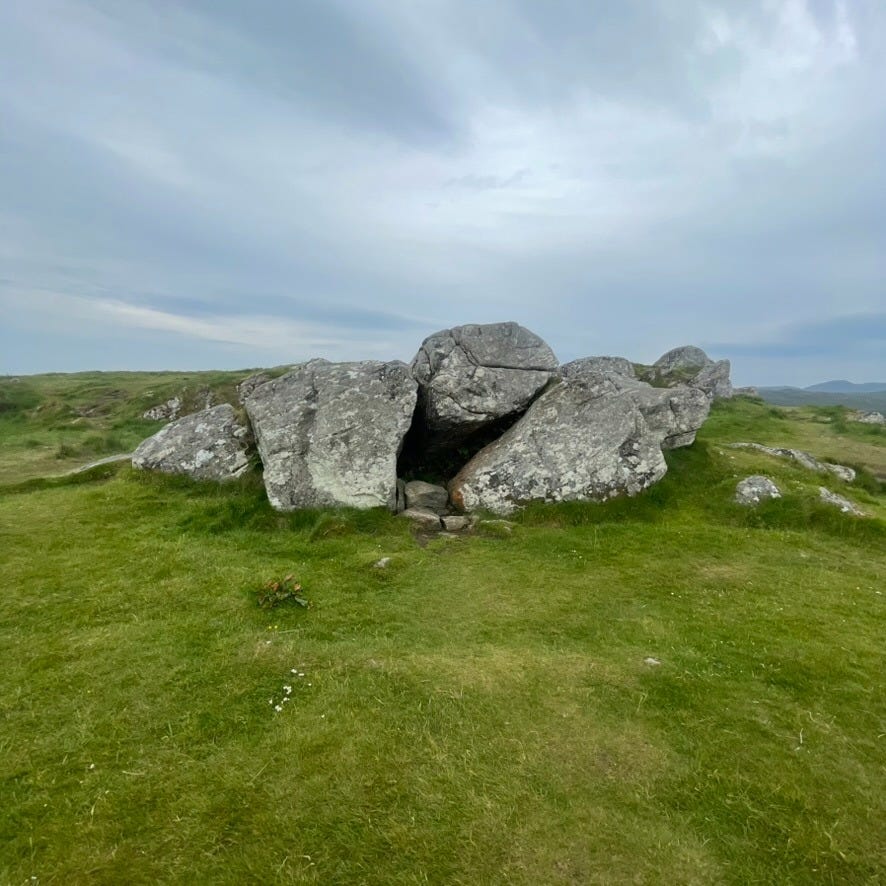
At the main stone circle, I wander up the avenue to the old, chambered tomb off to the side of the stones. It’s supposed to be a “path to the underworld.” Is it a tomb? Is it symbolic? As always, I consult Vico.
THE UNDERWORLD
THE “UNDERWORLD,” as that place the hero harrows and returns from, according to Vico, was first associated with water and constituted the “source of the perennial springs, which they called the river Styx”; later, once humans reckoned with death enough to become aware of themselves as having souls, it was extended to constitute graves, “like that where Homer’s Ulysses sees . . . the souls of deceased heroes”; finally, with the rise of agriculture, it became a furrow, where the seed of the grain dwells, personified by Persephone, where she spends “six months before returning to see the light of heaven” — before the seed sprouts anew. In Aeneas’ descent, for which he “obtains the instructions and safe-conduct of the Cumaean Sybil . . . he enters the ancient forest, which represents the primitive earth in its uncultivated and wooded state.”11
At first, it’s a disembodied source, from below, from which the lifegiving water spouts; next it’s where our souls go when we die, a development for primeval man, to realize we are just like those we kill, typified by Gilgamesh’s sorrow when his brother Enkidu, his double whom he confronts, and loves, dies.
It’s only once we pluck from the tree of Good and Evil, impose our will over nature, realize we can take some agency in how we endure the long dark winter, literally primevally via the planting of seeds and tending to the fields but also in ourselves — can we “enter the ancient forest, the primitive earth in its uncultivated and wooded state,” venture outside the safe, well-lit walls of what we know, exit the comfortable confines of who we think we are — and find that stash of wood, kill those beasts, clear those forests necessary to get ourselves through our collective long dark winter.
In this final sense, the “underworld” is not simply where we go when we die; it’s the dark winter of unknowing, during which we must strive to be our own sun, to find our own candle in the darkness of the ancient forest that we can bring back to the group.
THE STAR OF SALVATION
WHEN IT COMES to the divinity of the star, the coronation of a new king with the arrival of the star that appears to come down to earth, this, too, is both symbolic and literal.
Frazer says, it goes back to the Babylonians — to the cult of Adonis. Where the physical celestial event — when the actual star returned — literally coincided with the arrival of the new king:
Astarte, the divine mistress of Adonis, was identified with the planet Venus, and her changes from a morning to an evening star were carefully noted by the Babylonian astronomers, who drew omens from her alternate appearance and disappearance. Hence we may conjecture that the festival of Adonis was regularly timed to coincide with the appearance of Venus as the Morning or Evening Star.
Christ, too, was born when the Christmas Star appeared, what some, chiefly court astronomer to Rudolf II, Johannes Kepler (1571-1612), believed to have been a Great Conjunction between Saturn and Jupiter and Mars, followed shortly after by a supernova — a literal new star. From the Babylonian Almanac, we know that a rare triple Great Conjunction in Pisces occurred in 7 BC — three times that year — leading Kepler to believe that this, combined with a supernova reported in 5 BC in Chinese almanacs, was the “Star of Bethlehem” the magi followed.12 Great Conjunctions between the two “highest planets,” Saturn and Jupiter, have held outsized significance since the Chaldeans, and the conjunction that occurred near Christ’s birth is significant in that it inaugurated a new “elemental trigon” — each Conjunction, which occurs about every 20 years, when Saturn’s 30-year revolution syncs with Jupiter’s 12-year cycle, enters a new “element”; due to the equilateral triangle on the astrological wheel each subsequent conjunction makes, they remain in a single element of sign — fire, water, earth, or air — for about 200 years, until the axis shifts into the next element due to the alignments not being exact (so for 200 years after Christ’s birth, with the Conjunction in Pisces, it remained in water, hitting Cancer and Scorpio in subsequent Conjunctions). Dante references this as well, how he was born on a Great Conjunction in Gemini, in 1265, and some believe this was the “wheel of heaven” he refers to when he asks when a new leader will come, inaugurated by the stars, to slay the “wolf” of avarice plaguing his contemporary leadership — “O heavens, whose wheels transmute / the state of those on earth . . . / when will he come from whom the wolf shall flee?”13 And while this all might sound too kooky to us today, remember they had no artificial lighting for most of time and life was infinitely more chaotic, the winters darker and colder, and an especially bright star in the sky represented a very literal instance of divinity coming down to earth, into a new semi-divine leader — a primitively literal instance of Greco-Roman hero-gods who are always consort to, or child of, a celestially represented god; Venus retrieving Adonis from his dying mother Myrrha’s womb, then, is a mythical representation of a new king (Adonis being simply the name for every “king” in ancient Byblos, of which King Cinyras, Myrrha’s incestuous lover and father, in Ovid’s version,14 was a historical king of), being coronated by some ceremony at the time that Venus descends down to earth.
In fact, so attached was Dante to the idea that a new king would arrive with the next Great Conjunction, to renew the Pax Romana he’s so nostalgic for throughout the Commedia, to bring divine justice back to the greedy papacy of the newly cosmopolitan Florence of his time, that he has Beatrice prophesy it, that the stars already near at hand promise us15 this leader, which Dante’s son Pietro said was a Great Conjunction that would occur in 1345, with Mars, like in 7 BC, and staunchly stuck to — only for that year to coincide with the arrival of . . . the Black Death.16
JUNE 13
THERE’S a solemnity to how we prepare for this trek to the stones, the moon’s supposed to rise between 1 and 3 a.m. We gear up and around 12:30 a.m. head out, filling up at the one gas station in this whole part of the island, it’s a single pump and there’s no attendant, it’s a quietly optimistic, even exuberant drive out, but once we’re there and settled it’s too cloudy and intermittently rainy, we try to wait it out but we’re not prepared, it’s too damn cold, we sit for about 90, patient, with only a brief, partial glimpse of the moon, then decide to head north to the Butt of Lewis lighthouse, on the northern tip of the isle. Music-wise we’d been on a steady Burial kick once I mentioned Burial being the greatest artist alive, who I can listen to in any context whatsoever, but as we whip it north in the dead of night I on a whim throw on this old Jim Morrison album, I randomly think of it, his last album, An American Prayer — “Let’s reinvent the gods all the myths of the ages celebrate symbols from deep elder forests,” musing in his ’60s prophet lilt, before asking, “Do you know we are ruled by TV?” and then, “The moon is a dry blood beast,” and there’s tribal drumming, channeling some ancient rhythm, portaling nothing short of the Holy Spirit directly into our car —
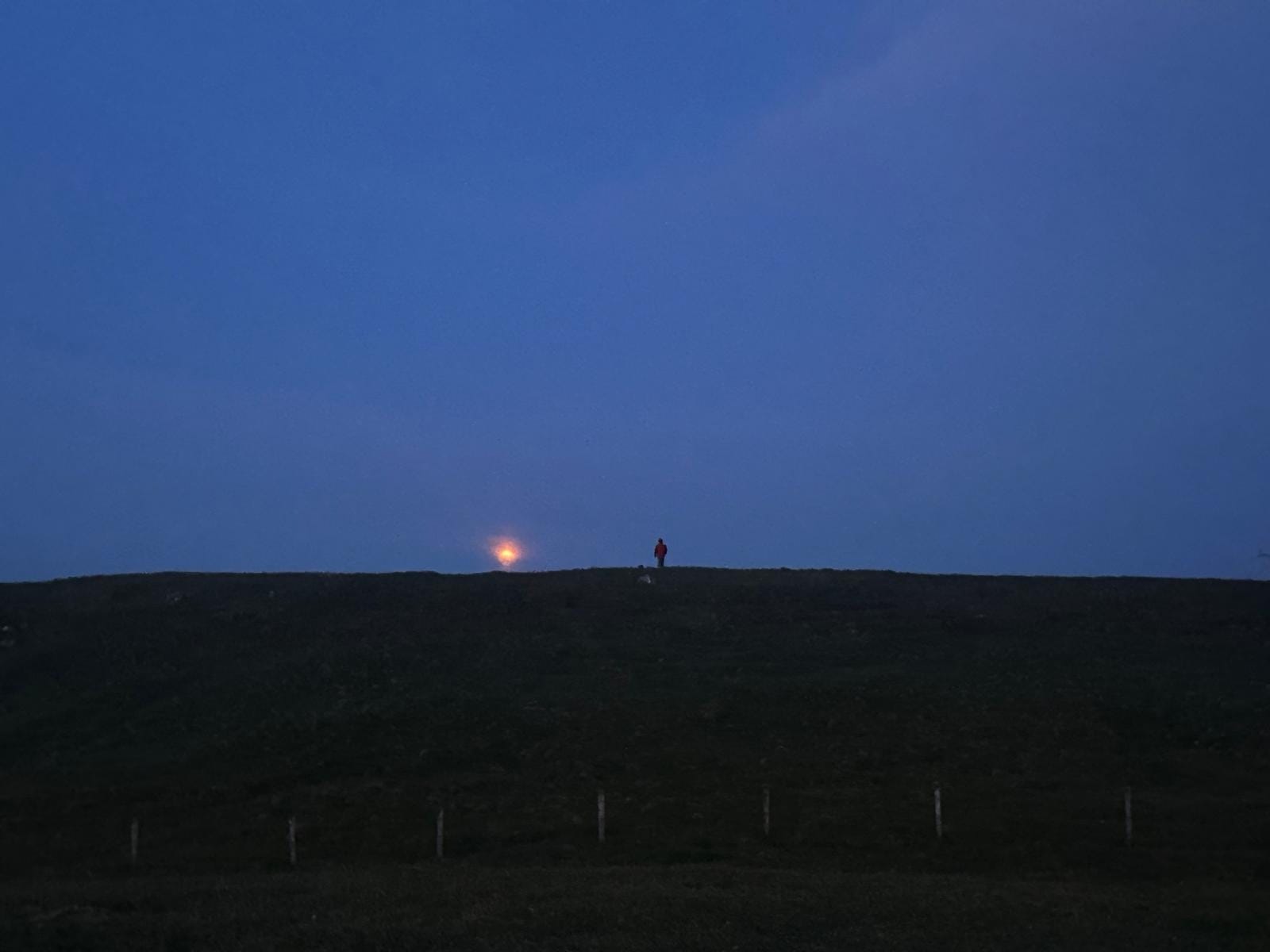
And it’s at this exact moment, right as we’ve forgotten all about the moon, stopped looking for her entirely that, out of nowhere, around 3:30 a.m., she rises huge and looming and yellow — a dry blood beast — over my right shoulder, bouncing in and out of the hills, frantically tailing us.
Kirstie yelps and almost damn crashes when I point her out.
And at the tip of the island, at the lighthouse, we park and walk and it comes beaming over the hill, standing still right at the horizon. I instinctively start to romp up the hill towards it. At the top of the hill Kirstie snaps a pic of the scene just like they said they’d do back in the day — with my silhouette going inside, merging with, sacred marrying the moon.
V.
JUNE 16
ON THE 16TH, we pack up and relocate to the farm. Across the island, right near Stornoway, the main port town on the island. We were initially set to stay in this B&B on the water, but the owner of the property pulled a switch-up at the last minute. This initially seems like a strange omen. But it ends up being all for the better.
Charles, the third-generation owner of the farm, has his own garden in the back, a sauna he made himself with scrap materials. He asks if we want a “cuppa” when we show, and makes us tea, telling us about the all-natural diet he’s been on, only eating meat he hunted himself or grains and veggies he grew and harvested by hand.
The farm, it turns out, is a school for handicapped folks — the exact type of community I lived in when I was little, in Aberdeen. There are buildings and workshops that extend down the dirt road of the property, next to where the animals, goats and chickens, live. This seems like a strange coincidence, especially since we weren’t even going to stay here initially.
There’s some secret thing happening where I’m retracing my earliest steps.
Once settled, we get into a flow where we’re posted across the hall from each other, me in my huge farm-facing room, she in her private mysterious quarters — I get a glance at them once when discussing when we’ll leave for the stones one night, it’s got a four-poster bed in the middle, papers and books strewn all across it — but mostly we keep to ourselves and text each other when there’s a meal ready, a proposed excursion, or, most often, new developments in our findings.
Now that the solstice is approaching, we shift to the final mystery of the stones: “The shining one who is said to arrive on summer solstice morning at the sound of the cuckoo’s call.”
Kirstie had been mentioning the cuckoo bird, and the cuckoo’s call — nudging me — it’s the most recognizable sound, right when we pull up to the farm, she mentions it. Cu-ckoo. You can hear it if you listen. Its ubiquity is such that we don’t even register it. It’s the clock. It’s the arrival of spring.
That night, Kirstie sends me this article. “Sacred kings of the Picts: the last cuckoos.” By a guy David Alexander Nance, from the Scottish Geographical Journal.
THE CUCKOO KING
IN A SERIES of three articles published between 2020 and 2022, David Nance compellingly argues that, in pre-Christian, pre-statehood Britain, some form of sacred kingship existed, where “fighting games” or single combat would determine the ruler of the land, that is, the one whose virility and beauty and seeming invincibility and exile during the winter months would be held responsible for the return of the crop come spring — a kind of personification of fertility and strength, a figure to be hailed and revered and whose reverence was thought to ensure not only the fertility of the crops, but the reproductive health of the livestock and the abundance of the fish in the rivers. This figure of the sacred Irish king, who was represented in figures like Cuchulainn and Gawan, and who has echoes in Adonis — it was precisely when Venus rose as the morning star on solstice morning every eight years that inaugurated him, Nance argues — was seen as youthful and beautiful and above all divinely virile: as ladies’ men, whom no woman could resist.
Recall that “king” is meant here in a Frazerian sense, as symbols of cosmic equilibrium, of Nature. Sacred kings in Cambodia, for instance, representing fire and water, had “royal functions of a purely mystic or spiritual order; they have no political authority.”17 They simply reign, they don’t rule, and according to one account they live in absolute solitude, never meeting one another and never seeing a human face.
In the case of pre-statehood Scotland, Nance argues that the planetary alignments at the stones, and the naming conventions of many standing stones scattered across Britain, and the etymological roots of three ancient British mythical figures — Cuchulainn, the Ciuthach, and Gawan — all speak to the existence of some form of sacred kingship on the island in a way that was inextricably tied to an ancient mimicry of the cuckoo bird.
THE CUCKOO is unique in that, in the northern hemisphere, it arrives at the start of spring and migrates away at the end of summer — sometimes thought to be at the summer solstice, sometimes at the Celtic end-of-summer festival, Samhain, our Halloween or All Soul’s Day. It has thus become synonymous with the arrival of spring, and on the Isle of Lewis specifically it was thought that when it touched down, landing on the central standing stone, its call inaugurated spring’s arrival, instilling in the plants their power to sprout.
The significance of the cuckoo is it’s a brood parasite, meaning it doesn’t raise its own children, it drops its eggs into the nests of other birds, its chicks knock out the eggs of the host nest, so that it can get all the surrogate mothers’ resources for itself. Given this behavior, for early man, it was thought that they were exclusively male. Thus, combined with their arrival at this time of fertility and growth and springtime abundance, after the long dark winter, and their departure as soon as the sun was about to leave again, they became associated with male strength and virility and invincibility incarnate, and thus, Nance argues, became the aspirational symbol for the human male tasked with carrying the burden of sacred kingship. In pre-Christian times, too, most societies moved exogamously, where the queen would choose the king based on his skill and strength in single combat; we see this throughout ancient myths of the strong wandering warrior arriving on the foreign land to win the hand of the queen.
A likely ritual the lunar standstill speaks to — though more likely it’s the eight-year cycle of Venus, the time Venus takes to return to its starting point, and that the “shining one heralded by the cuckoo’s call” speaks to — is a ritual killing of the sacred king at the end of his rulership, on a standing stone, in order to inaugurate the new king, at Samhain, or the summer solstice, when Venus comes down to the horizon, when the cuckoo bird leaves for the winter, thus taking on the role of the cuckoo bird as the invincible, virility-incarnate, new Lothario king, tasked with dwelling in the outskirts, fending off all challengers, as a symbol for the group to endure the long dark fallow months.
THE TAIN
THE TÁIN BÓ CÚAILNGE, or Cattle Raid of Cooley, sometimes called the Irish Iliad, is one of the lone surviving stories from the British Isles that provides a glimpse into how the Picts operated prior to the formation of monarchies, and the arrival of Christianity onto the island — as early as 314 AD, since there were Brits represented at the Synod of Arles in this year, though the island was overrun by Saxons between the fifth and seventh centuries, and it wasn’t til 590 that Pope Gregory sent Augustine to convert the last Anglo-Saxon king, Ethelbert, who was baptized in 597, as we know from Bede.
The earliest written version of The Tain, The Book of the Dun Cow, is from the early 12th century, but this text references material dating from at least the seventh century. It’s estimated that the action of the story occurred between 500-100 BC, though it’s thought to be much older. It’s part of the Fenian and Ulster Cycles, the lone surviving texts from Ireland and Wales, to which latter group The Tain belongs — and is the first book, as chance or the devil would have it, that I myself ever read, as a young lad living in Aberdeen in a community of handicapped folks, and that I have held onto since.
While there is literally an explanation in the beginning of the book for how its hero Cuchulainn got his name — that “Cu” means “hound” so his name means “Culann’s Hound” — Nance argues that this was a later addition by medieval scribes, when the original meaning was forgotten, and that the original name might have been “Cuculind,” or “Cuckoo-dragon,” the argument being that this etiological link, along with the fact that there are countless single standing stones scattered across Britain all with some nominal tie to the word “cuckoo,” suggests that Cuchulainn is a relic of this older type of sacred king who exhibits these cuckoo-like qualities of unknown parentage, increased virility, a lothario aspect, a seeming invincibility, and exile into “the otherworld” during the winter months (like the cuckoo migrates).
The plot of The Tain is essentially that a greedy queen, Queen Maeve, tries to steal a bull from across town, in order to prove a point to her husband, King Ailil, that she has more wealth than him, and in the process sends just about every soldier she can find to single-combat Cuchulainn, a young semi-divine exceedingly beautiful and powerful boy who alone is tasked with defending the Brown Cow of Ulster, since the rest of the Ulster Men are knocked out asleep due to a curse, to which Cuchulainn is immune to due to his half-divinity, as the son of the sun-god Lugh, his father in “the otherworld.”
Upstate this past fall, once I made this connection, reading back both the “youth” version of The Tain I had on me from my childhood, and then the Penguin Classics version translated by Ciaran Carson, I can see the connection Nance is making. “Though he was small he was very handsome and many women fell in love with him.” He’s supernaturally gifted with strength and vigor as a child. When it’s time for him to marry, Cuchulainn finds a woman Emer, but her father Forgall is not having it and sends him to the Land of the Shadows — “full of danger, hoping he won’t return alive.”
Cuchulainn not only returns from the Land of the Shadows alive but returns stronger, to find that Forgall has locked Emer in a tower and won’t let him in. Cuchulainn kills her father’s guards and her father — and her two brothers as well, in the Penguin version. He takes his wife Emer.
Later he falls for a different woman, Fann, in the Land of Shee. He forgets about Emer. It’s not till the Druids intervene, giving Cuchulainn a magic potion, that he returns to Emer and forgets Fann completely.
The rest of the book is Queen Maeve sending fighter after fighter after Cuchulainn, and Cuchulainn killing everyone, often, in the Ciaran version, at standing or “pillar” stones, til finally he has to fight his foster brother and best bro and half-brother Ferdia. After three days of fighting, he finally defeats his bro. Cuchulainn carries his body across the river and lays him down and closes his eyes. His father Lugh, or Laeg, the Celtic sun-god, thinks he’s dead. He’s too weak to fight, but the enemies who are still approaching don’t know that, so he tells Lugh to tie him to the standing stone:
‘Tie me to a boulder there and put my sword in my hand. Then leave me there alone. . . .’ So Laeg brought Cuchulainn down to the river and tied him securely to the boulder. He placed a sword in Cuchulainn’s hand and reluctantly went away. . . . Only the thongs that tied him to the boulder prevented him from slumping to the ground.18
I WAS STUNNED when I first read this. We have the sacred Lothario-king Cuchulainn single-combatting every man in the tribe, then tying himself to the standing stone and slumping over as if dead. In another part he’s getting shot at with arrows at a standing stone but then jumps and the arrows break on the stone. At yet another telling moment, Cu gets injured and has to sleep for three days, and here we learn that “From the Monday after Samain until the Wednesday after Imbolc, Cu Chulainn had not slept, except in brief snatches at midday, leaning against his spear with head on fist and fist on spear and spear on knee”19 — Samain being the Celtic “summer’s end,” when “the borders between the natural and supernatural worlds were thought to dissolve,” all the way thru the winter, to the Celtic spring festival, “Imbolc,” the “time of ewes coming to milk” — mirroring, also, the cuckoo’s migrational travel away from the Northern hemisphere thru the winter, of whom it was thought that during this time he was gone “to the otherworld,” and cohering with Nance’s theory that it was every eight years, when Venus returns to the same point in the sky with the Samhain or solstice sunrise that the new king was sacrificially killed, to be replaced by his successor, unless he could prove he was still virile enough to be king — like in the versions I read, where “A sudden battle spasm came over Cuchulainn. He broke the thongs that held him to the boulder and rushed into the fight. His sword carved a path through the men opposing him.”20
In the end, in my versions, he spares Maeve, and she ends up making out with the Bull — though the Brown Bull kills her husband’s White Bull and ends up escaping back into the woods, and returning to his original owner, continuing early man’s ongoing conflict with working through the unbridled force of the forest versus the contained force of the proverbial city, only touched on in an archaic and intuitive way back in this myth.
In still other versions, Cuchulainn dies at the stone.
IN TERMS OF the earliest myths set on the Isle of Lewis specifically, Nance points to the myth of the Ciuthach, pronounced “kewach,” almost phonetically identical to cuthaig, or “kewag,” Gaelic for “cuckoo,” associated with a powerful, sometimes hairy warrior who lived alone in a cave on Lewis except when he was goaded into single combat for a week. “A recluse, an expelled scapegoat shunned by his society or at least living apart from them in caves and, in the knowledge of his certain death by the hand of his successor, considered a dead-man walking,” whose responsibilities may have mirrored those of the Irish Kings, “to maintain cosmic equilibrium, ensuring the well-being of the land and waters, its people, crops and animals.”
He is mentioned in several Irish tales of the Fenian Cycle set in the Hebrides and was thought to be the “hero of the Picts.” In Marbhadh a’ Chiuthaich, ‘the killing of the Ciuthach,’ set on the north coast of the Isle of Lewis — right up on the hill above the Uig Bay, where we were the first week — he is described as “a great warrior that no man could overcome and, typically, could only be killed with a magical weapon while his back was to the Creag Ciuthach,” a rock on Lewis. In two other tales, Diarmaid and Grainne and Dan Chiuthach, elopements in caves in the Hebrides result in infidelities by the women with Ciuthach, “indicating a link with the polygynous ‘king’ of the Hebrides.”
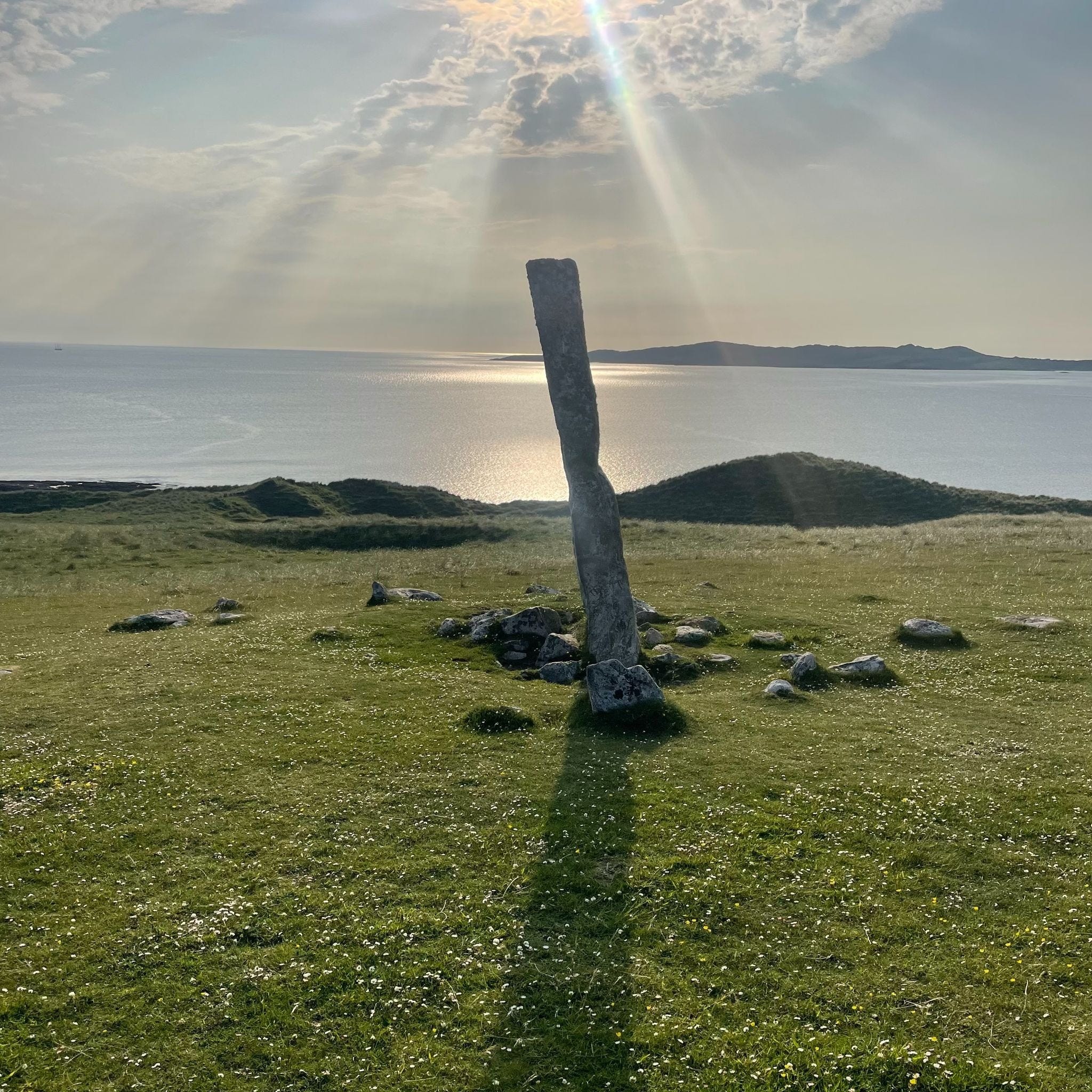
I don’t even realize I keep being drawn back to the cave the Ciuthach was said to be hidden in, by the standing stone he was killed at, by the sacred Cnoc na Cuthaig, the “Hill of the Cuckoo” he fights on in the Marbhadh a’ Chiuthaich story, because it’s no longer even called that. It’s now Cnoc na Croiche, or “Gallows Hill,” “traditionally where chief clans held public hangings,” the sign on it reads.
Every day at the farm I walk out back past the animals, and into the woods, and come up on a cave by the water. Then across the forest, up the hill overlooking Stornoway. The minute we touch down on the farm I’m drawn out there, I look on the map and see there’s a path to the water and ask can I walk there, it’s raining heavy out but Kirstie says you can try, I’m pretty sure there’s a path, if you walk to where the dirt road ends you should be able to if you keep going, it’s probably pretty swampy. The cave the Ciuthach hid in is where the water meets the sea, there’s a bench there. I walk there and hide out all day each day, only returning when I’m needed.
THIRTEEN
THREE DAYS BEFORE the solstice, Kirstie sets me up to speak to this astrocartographer dude, Phil. A type of astrologer who looks at your chart based on where you were born on the map, and other secret methods he seems uniquely hip to. I say I’m game, sure, he’s a friend of Kirstie’s and she thinks it will be illuminating for my research. We set up the Zoom at the kitchen table. After some small talk with the three of us, Kirstie leaves us to it, and this guy, Phil, who had my chart before, to prepare, dives into an absolutely stunning rant.
Essentially, he says that the main way he reads charts is through harmonics, something about the fraction between the alignments of planets at the moment of birth, I don’t totally understand it all but my chart, he says, has to do with the number 13, and the 13th harmonic, everything in my chart is aligned in multiples of 13 apparently. Which has all these implications for why I am the way I am, which checks out, but that’s between him and me — that’s not why I bring it up.
Thirteen, I realize, is the number of stones in the stone circle. It’s also the number associated with the moon, I won’t read it til months later but in Bede’s Reckoning of Time, the whole struggle with the calendar has to do with the fact that there are 13 lunar months per every 12 solar months, and the math gets a bit complicated, since it’s not quite 13 months, it’s about 11 extra days each year into the 13th lunar month that it takes the sun to complete the 12 solar months, this was cause for much difficulty in early calendrical systems, such that for a time they’d add a 13th month to five out of every 19 years — when the moon comes around to its starting point again — and this extra month even has a constellation, Ophiuchus, the snake bearer, which falls right in the liminal time between Scorpio and Sagittarius — around Halloween and All Soul’s — the liminal time between life and death in the year, and XIII is the Death Card in Tarot, and Ophiuchus is connected to Asclepius, the son of Apollo and founder of medicine, still symbolized with the caduceus symbol in medicine, the snakes wrapped around the rod, a charged alchemical symbol, of using the snake, the venom, the evil, for good and healing, the poison for the remedy, this is how we make vaccines, fusing the good with the bad for a greater good, being able to view the terrible thing you underwent as part of some larger, more renewing story —
And this number 13, why Friday the 13th is unlucky, why we don’t have 13th floors, it’s connected to Judas, it’s Christ and his 12 disciples like it’s the Sun and the 12 constellations, making Judas the 13th guest, a story mirrored in the Norse myth Balder, son of Odin and Frigg and brother of Thor, who like Christ is the “shining one,” the light-god associated with the sun, who is said to never die unless stabbed with the sacred mistletoe, and it’s at a fateful dinner in Valhalla that he dies, Loki arrives as the 13th, uninvited guest, who tricks the blind Hoor into shooting Balder with the mistletoe — there’s got to be something here with the 13th moon to the 12 solar months, the direct opposition of the moon to the sun when the moon is full, the fear around the full moon and its association with the terrifying unknown, the monstrous other, the shadow, it’s why Borges writes that Judas was the disciple most similar to Christ, that
Judas, alone among the apostles, intuited the secret divinity and the terrible purpose of Jesus. . . . Judas in some way reflects Jesus.21
Like the moon reflects the sun —
Like we want to embody the light like Christ like Balder but there’s always also a shadow element we must remain attuned to, like Bede says Christ’s death and rebirth is about, it happened on the first full moon, the time the moon fully reflects the sun, in the time of year when the day surpasses night, when the greater light surpasses the lesser light, I’m not trying to be heretical and cheeky but don’t you see how much this all relates to the stars.
And perhaps if we try to cancel the number 13, we’re overlooking the shadow lunar element of existence that we’d be better off acknowledging in ourselves and alchemizing into something useful, like Asclepius does the snake venom for medicine, like I might my extended exile due to all the swords in my back, like Christ was able to turn the lance stabbed in his chest into a cupid’s arrow of love — though I won’t understand this for many moons, til I get to the last book in my search, Parzival.
PARZIVAL
WHAT MAKES PARZIVAL unique, why Emma Jung, Carl’s wife, says it’s not a heresy of Christianity but rather a continuation of it, is that it’s the first myth in which the hero makes mistakes and must go back and understand what he’s done. Parzival is not like Christ, like Aeneas, like Odysseus — he is not the light, the sun that renews, the model we should follow. He is the light and the darkness. Christ and Judas. Balder and Loki. The 13th member of Arthur’s 12-person Round Table, the last supper, the feast in Valhalla, for whom there is no plate, like there is no sun for the 13th moon. His name means pierced through the middle. His divinity, what allows him to be the keeper of the holy grail, is his ability to hold the opposites within himself, both the ways he’s like Judas and the ways he’s like Christ.
Parzival is a young boy born in the wilderness with no knowledge of his father, his father was a knight, he’s protected by his mother in the woods, he is naivete incarnate, he does what his mother tells him, to follow god, to treat women well and kiss them and accept their rings if they offer one, to act with courage and honor, he’s out playing one day when he sees a trio of knights, he thinks, based on how they’re dressed, how regal they look, that they’re gods, he asks how he can become a knight, they tell him, laughing, that he must go find King Arthur, he is the “simple” or “pure” or “innocent” boy, he doesn’t get the joke, he decides he will go adventure and find King Arthur, he tells his mom and she is devastated, but he leaves nonetheless and he comes across a beautiful woman and, thinking he’s doing what his mother told him, kisses her and takes her ring, she’s appalled and says her husband will disown her, he doesn’t realize what he’s done and just keeps moving, he shows up at the Round Table and outside he sees a knight with red armor that he feels would suit him quite well, turns out the red knight had just been in a dispute with the Round Table for spilling wine on Arthur’s wife, the queen, but Parzival, looking like a goofball because his mom, devastated that he’d be leaving to become a knight like his father, who of course left her to do knighthood and died, dresses him up in a goofy outfit of like twine with holes in it, hoping they won’t accept him, but despite being a young lad he’s strong and beautiful like Cuchulainn and like Adonis before him, he walks into King Arthur’s hall and demands to become a knight, and someone jokingly goes, if he can go out and confront the red knight, he can become a knight, Arthur agrees, not thinking he will, but Parzival’s all, Bet, and goes out there and challenges him and kills the red knight — with an arrow, not a sword — and takes his red armor and puts it on over his goofy madman’s outfit his mom put him in, he doesn’t yet realize how he’s comporting himself incorrectly.
Parzival is about the oldest struggle in the mythological strivings of man, between the “heathen” or “unbaptized” or “savage” or “unconscious Nature,” on the one hand, and the “light” or the “civilized” or the “virtuous” or the “logos” on the other — the Forest versus the City. It’s the story of Gilgamesh, the king of the Sumerian city of Uruk, the strongest most beautiful most powerful “king” (of the City) only his Nature side rears up, so he must confront Enkidu, the man outside the city gates, who “eats grass like the animals,” they must wrestle and duke it out. Enkidu wins but they decide to be friends. And together, they go through the dark forest and defeat the god of the woods, together. Man must confront and come to terms with and channel his savage side, indicated by being closer to nature and outside of the city gates, home to the hills and the beasts, in order to raze the primeval forest and create civil conditions for himself and his society.
This, too, is how Parzival ends, he must fight his long-lost half-brother, Feirefiz, who is part “heathen.” Parzival’s sword breaks, and Feirefiz wins, but they decide to become friends instead.
The problem the mystics of Toledo, who created the Parzival story, realized and sought to rectify was how a shallow understanding of Christianity, and the Christ story, and really any religious framework — anything Virtuous — is immediately coupled with Evil. Every time I do anything Good, I get puffed up with Pride, which leads to Evil. I’ll write a single good page, and immediately I look at it and pride wells up in me and I think, I am the light, everyone else is wrong.
And this was the crusades: We are the light, all the unbaptized heathens must die.
This is what happens when you don’t fight Feirefiz, don’t confront Enkidu, in yourself.
And it’s in the middle way, Parzival’s name means pierced right through the middle, or through the valley. On one side is the heathen Feirefiz, on the other is Gawan, the “hawk of May,” synonymous with the cuckoo bird in archaic times since the hawk was believed to become a cuckoo come spring, the Christian evolution of Cuchulainn, in Parzival Gawan is the Christian knight who doesn’t come from the heathen beginnings of Parzival, of Cuchulainn, raised in the fields shooting sparrow hawks with his arrows rather than a sword — indicating heathen rather than civilized, nature rather than society, forest rather than city. Gawan is the good force; like Cuchulain, he treats every nice lady he approaches with grace and meets her every need — like the cuckoo bird.
But he is not the Grail King.
Gawan gets caught in the House of Wonders, a type of Calypso or Circe’s island where women seduce him for eternity, he’s medieval Christian “self-perceived goodness” “minnesinger lady-worship” run rampant.
Falling in love with your own righteousness, saving every nice-looking lady you come across, does not make you the Grail King.
I’d been like Gawan, puffed up with pride, refusing to acknowledge the shadow of what happened, lost in the castle of wonders. I had to wander, godless, for five years, til I could even begin asking the right questions — like Parzival must do, he fails the first time he meets the Grail King, by not asking the right question, he must wander for five years, and reflect on what he’s done.
*
THE PURSUIT OF the holy grail — the quest for the secret meaning of the sacred stone in the far-off land — then, means doing the work to become a whole, individuated self, by confronting your shadow, by seriously looking at your role in contributing to Evil, whether in how you’re too attached to your idea of how Good you are, or how you too have underlying chthonic forces you’re not fully aware of, which amounts to the same thing. About realizing that you are Christ and Judas, that any virtue comes with vice, that even the worst possible things, if you can confront them fully — harrow hell — and alchemize them into a larger understanding, can become divine. This was the impetus for the authors of the grail story, to create a secret code for understanding the Christ story in a tangible, embodied way, for how to partake in it, continue it in a way that didn’t result in walking around, chest puffed, annihilating Judas-heathens outside your purview of rightness, thinking you’re the light, acting like the Old Testament God of Vico dropping literal thunder, literal angel of death bombs onto others; or, more personally, lest we fall for the Christian trap of thinking Evil lies elsewhere: of manipulating matter, nature, deifying the light of our screens rather than the light in the heavens, creating an enclosed, vacuum-sealed space of rightness, gratification, banishing others, canceling out anyone who makes you confront your shadow — playing god.
The grail itself, in some versions, is a cup, thought to be the vessel that caught the blood of the staff that stabbed Christ. By holding the cup, you are saying: the act of betrayal that led to Christ’s crucifixion is physically leading to good, through my actions — as it led to good through Christ’s resurrection.
In other versions, like in Wolfram’s, it is a sacred stone. Some think this stone is connected to the table at which they ate the grail feast and, drawing from the Gospel of Nicodemus, the stone of Christ’s grave that was lifted when he arose.
But as Emma Jung articulates so well in The Grail Legend, Christ comes out of a long continuing progression where divinity was initially the stars, completely transcending human consciousness, metaphysically removed, before gradually leaving this place of external projection and penetrating more and more into the human realm, “in the mythologems of the god-man (Gilgamesh, Tammuz, Osiris),” before finally incarnating into one particular, historically real person, Jesus, “whereby God descended fully into the here and now of human reality.”
The idea of gathering secret relics from the event of Christ’s death seems insane and superstitious until you realize the symbolism, that the figure of Christ is the first time divinity, the stars, have descended down to the human realm (the moon comes down to earth and stands still; the full vernal moon beaming in through the window), and the grail, to the mystics, was an attempt to continue the spread of divinity un-egoically, in a way that doesn’t simply involve righteousness and war.
The descent of God into the human realm would have remained incomplete — especially as the historical figure of Christ already belonged to a very distant past — if a further step had not been constellated: the realization of the actual existence of the god-man in the soul of every single human being. The medieval mystics were the first to give expression to this realization with the intensity of individual experience. . . . In this sense the vessel or the stone signifies the whole psyche (not the ego) as a realization of divinity reaching right down into matter.22
In this light, Wolfram’s explanation of the grail makes the most sense: the symbol of the grail, the goal of perfect integration of all four aspects of the self, the cup, the wand, the sword, and the stone — to individuate oneself, to be able to recognize the divinity in you, meaning the ability to affect others with your actions, and to be able to orient them in the proper way — is the lapsit ex caelis, a stone fallen from heaven. A literal piece of a star come down to the human realm — continuing an older tradition from antiquity of “sacred stones thought to be meteorites,” of the earliest traditions involving sacred stones set up such that the most visible stars, when they touch the horizon and cast shadows out long and into the stone circle, symbolize the penetration of divinity into the earthly realm. Only now, if the grail stone is a symbol for every living human’s goal of individuation, we must allow it to come directly from stars, to penetrate our bodies, just like Flegetanis, the heathen who told the story to Kyot, saw the grail brought down from the stars:
To the circling course of the stars man’s affairs and destiny are linked. Flegetanis the heathen saw with his own eyes in the constellations things he was shy to talk about, hidden mysteries. He said there was a thing called the Grail whose name he had read clearly in the constellations. ‘A host of angels left it on the earth and then flew away up over the stars.23
VI.
JUNE 21
ON SUMMER SOLSTICE MORNING, around 4 a.m., we pull up to the 13 stones in a circle, the sun has yet to rise but it’s coming, it’s fully lit out, and the stones are just blown, the vibes are off somehow, everyone standing in a row like waiting for some new store to open, we look at each other and are all like, Nahhh, we retreat to the adjacent stone circle down the hill that no one is ever at, we park and Kirstie busts out the homemade mead she made, I’ve been hearing it clanking around in back of her CRV all week, I hadn’t known what it was, it makes a hollow sound when she pops the snap cap open, it’s honey orange and sweet and a bit sour, and there are herbs floating it, we each pour a cup and we sip, and then she whips out her homegrown psychoactive mushrooms, she’s been sitting on them, saving them to do with the Red King for whenever he comes back around, but she’s like fuck that, this is more important, we split the bag and munch the body of the old mushroom god, chasing it down with honey mead, I zip up my red North Face windbreaker, my suit of armor over my madman’s garb, adjust my white Saint Francis cap with the red dot on my third eye, and we walk.
Along the path to the stones.
Past the initial circle and the further circle up the hill, Kirstie following me, lugging her camera, and the sun is coming, illuminating the heavens, we sit in the circle, making a little altar to Julian of Norwich — propping her up on a stone, the book we’ve been carrying around like a sacred relic, Revelations of Divine Love — and we wait.
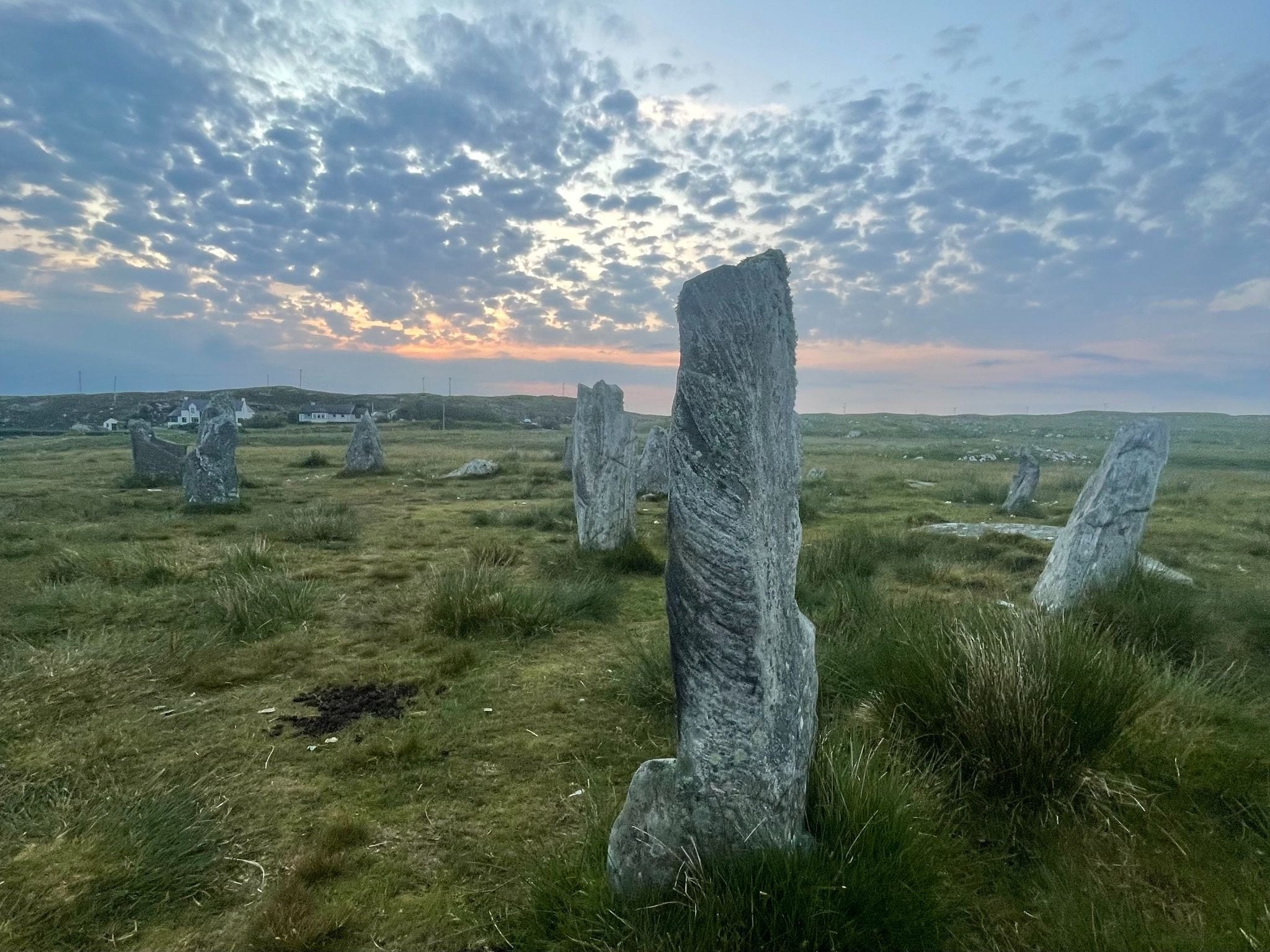
At some point, the booms hitting, I wander off by myself, Kirstie went back to the car for something, and it’s just me and the sheep at the stones, I can’t see where Kirstie went given how the ground lips down from where I’m sitting, though I can see the main Callanish circle with the neopagans all standing in a row, stiff and awkward, waiting for something, not realizing that the stones are in them, their bones are rocks are stones fallen from the stars, and I look out and see this one sheep sitting like a sphinx chewing placidly, her little lamb off to the side stumbling around all tottering and vulnerable, like the first creature of the sea to walk on land, there are little mother-daughter lamb duos all over, and I can’t help myself, I get to walking, down the way, towards the lambs, it’s much more marshy than I expect, I’m shin-deep in marsh water striding across, batting down the waist-high grass in parts, they can sense me coming, turning their heads, a twitch of discomfort, I’m arriving uninvited to their calm solstice party, Baa, they say, but I keep my energy steady, I come in peace, I don’t know if it’s the booms or what but I can feel them acutely aware of me there, I’m walking past you guys, I’m not here for any trouble, I keep going towards a hill in the distance, I approach a barbed-wire fence, there’s an old goat with no baby nearby, an old male goat with a long beard, he starts coming at me going, Baaa, baaaa, I look right at him at his little goat eyes and I say, I don’t know what you’re on, but I’m going over here, and I keep climbing, climbing, til right as I hit this stone all alone at the top of this little mini hill, my eyes locked on it, it’s not standing by lying, I sit alight on the sacred stone and right as I do the sunlight comes piercing over the horizon, right down the middle of the valley and I look up and stare at the sun and let it penetrate into me, feel it completely in my bones, taking a seat at my sacred table, I look down the way and there’s Kirstie in the stone circle, camera to her eye, looking like a one-eyed Cailleach or Bridgit spirit, beanie a yellow sun-dot in the distance, I sit there on the stone and just feel giddy, thinking about the baby goats, I’m not here to hurt you guys, you can have your party, but it’s incontrovertible, I think, going somber, the booms making me suddenly aware of my dry mouth, sending a shudder through me and making me keel forward, the light flicker slightly, there’s no denying a realization so obvious — I am the thirteenth guest.
ST JOHN’S DAY
ON OUR LAST DAY together, St. John’s Day, we drive down to Edinburgh, past Edinburgh out to Roslyn chapel, of Da Vinci Code infamy, where the bones of Christ were said to be stored, and it’s a quaint church with a friendly tour guide, after the tour we go around the chapel with the tourists looking at every little stone carving in the walls, and the descriptions, and what jumps out at me, what I keep thinking about long after we’ve left, are two strange syncretistic symbols: a pillar resembling the tree of Yggdrasil, the Norse tree of life; and then this Green Man carving, a stone man whose face is made up of leaves, whose face is a tree trunk, for which there is no agreed-upon explanation for why it’s here, in this Christian Church —
THE GREEN MAN
TO PLUCK from the sacred tree like Eve like Aeneas is to chop down wood for fires, raze the primeval forest, clear the way for crops, build fences for towns. It’s reasoning our way over our unconscious urges. It’s collecting wood to spark and stoke the sacred primeval fire to overcome the long dark winters. It’s Asclepius taking the snake venom to make medicine, merging the poison with the remedy, the pharmakon. It’s a charged iPhone and a Wi-Fi hookup and remote work during a global pandemic. It’s reading Plato during a military coup.
Twisting nature to serve our needs and desires with a detached, disembodied logos.
The cuckoo bird gives off the impression of divinity, disappearing when it got dark and returning when it got light again, because it was a parasite. The mistletoe, sanctified in early Germanic myth as sacred because it stayed green all year round when all other trees wilted and died, only they didn’t realize it did this because it was a parasite, leeching off the Oak King. When Dante and Beatrice encounter Christ in the Garden of Eden at the top of Mount Purgatory, in the form of a Griffon, half Eagle (divine/heavenly) half beast (incarnated/earthly), and they come upon the tree of Good and Evil off of which Eve plucked the fruit, they bless the double-natured Griffon-Christ for not plucking the fruit, “not plundering with your beak this tree’s sweet tasting fruit / that later wrenches bellies in pain,” to which Griffon-Christ says his only line in the poem, “This is how the seed of justice is preserved,” and he proceeds to take the “shaft” or “cross” which he had been carrying, driving the chariot with, “drew it to the foot of the widowed trunk / and left it bound to the tree from which it came.”
Double-natured to mean both God and man, and so we praise him, but bird and beast also means thinking ethical reasoning man of light, and savage forest unconscious man relegated to the outside, it was an uprising of slaves, fishermen, plebians, and prostitutes after all that his religion accepted, he himself buries himself in the earth, this too is part of the meaning of the seed of justice, being buried seeds underground like Christ is buried before popping back up come spring.
And he doesn’t just put the branch the golden bough the fruit the mistletoe back onto the tree, instead he binds himself as the seed of justice back onto the tree — “from whence it came” referencing the Apocryphal Gospel of Nicodemus wherein Seth, Adam’s noncanonical son, returns to the Garden of Eden in search of ointment for Adam’s headache, and returns with a seed from the withered Tree of Knowledge of Good and Evil, and with that seed plants a tree, the wood of which, medieval mystics thought, was used to make the cross Christ was nailed to — “returned it from whence it came.”
This selfless act of loving and redeeming Adam and Eve and the Serpent, the shadow side in us that acts according to darker chthonic forces, is to say, we are in our body bound to the tree we plucked from to create fire and fields and walls and cities and technology and phones and AI and our online Ego Temples (those things we, like the perennially green mistletoe, the virility-incarnate cuckoo king, parasite off of); by binding ourselves, we’re saying: We, too, are the tree, and in so doing, in ourselves, enacting the withered tree’s renewal.
Look what happens once Christ binds himself to the tree-cross, when Dante’s Griffon-Christ ties the cross back onto the withered tree of good and evil:
As our plants, when the great light falls on them,
Mingled with the light that shines
In the rays that follow the celestial carp,Begin to swell their buds and are renewed,
Each in its proper color, before the sun
Hitches his steeds to other stars,So, taking on a hue less red than roses
Yet deeper than violets, the tree renewed itself
Where its branches just before had been so bare.24
By tying himself to the withered tree, this causes the renewal of the tree — just like how plants when the equinoctial sun (“the rays that follow the celestial carp,” that is, that follow Pisces, that go from Pisces to Aries, the moment day defeats night, when the year restarts, the spring equinox) shines on them begins to swell their buds —
The significance of this act, Dante is saying, is to say, we are the plants, we are the Nature the trees the forests we conquered.
We are those we offshore who turn our plants, our animals, to food, sight unseen, while going around self-righteous entirely disconnected from the cyclical processes that make us go — .
And how surprisingly botanical even ecological the mythos of Christ is, it’s renewing the tree we lost when we started taking without thinking, plundering careless, pillaging, it’s becoming the tree like the Green Man is the Tree — Christ is the Green Man, one with the tree he ties himself to, and how difficult it can be to parse thru what this means, what constitutes this forest force we must tie ourselves to and become one with, who tangibly is the chthonic Enkidu Feirefiz Judas Snake, how can we identify this in ourselves, deep in our unconscious, the scary 13th moon that disrupts the balance and equilibrium of the 12 solar supper-plates, in a non-destructive way.
Everyone a follower of their own logos-god, unable to see past the light of their phones, to look up at the lights in the heavens, who see Uber Eats but no seeds in the soil. But if the secret of the grail is seeing the way those shadow forces allow you to go on your necessary transformation — even these forces I must bind myself to, love.
STARGAZER
ONLY IT’S JUST NOT good enough anymore to say we must go back to the forest, live beneath remember how to revere the stars, there’s no going back, the shepherds the heroes the farmers are all elsewhere, you don’t revere the stars unless you have to —
I have been watching them, though, since coming up here. Using my phone — piercing right down the middle — to identify which planets are where, what Flegetanis Zarathustra the ancient priest-kings did with their naked eyes. It’s just this free app I use to check what’s where, and in what constellation, I don’t even think I realized each constellation is just static like that, in a row across the sky. . .
I now understand why Jupiter was thunder, that planet, no matter how cloudy out, is always so damn bright —
A different somatic understanding once you witness an entire revolution of a planet, across the entire wheel, back to where it started. A tangible sense of the eternal — the stars are the gods because they stay when everything else goes, “All this light . . . emitted thousands and millions of years ago” — when things go up and down and all over they stick to their revolutions, that’s the difference between star-gods and the phone god, if nothing is eternal then everything is now, me, take — but the full revolution gives you the eternal with the recurring, and eventually, seeing the thing Whole.
This is the meaning of the four elements, corners of the table, the four alchemical leg-components, all four seasons coming back around but held in one in you, this is how you become a whole human, being able to see when you’re veering too far in any single cardinal direction — too much intuition, thinking, feeling, or physical (fire-wand, sword-air, water-cup, earth-stone).
— and that’s what she saw, she saw the whole the eternal the cosmic in that ancient meeting of victorious Sun with Nisan 13 moon, and couldn’t cohere that primordial mourning and rejoicing with the closed static screened-off world —
It was too much fire and water and air, she needed the sacred stone to ground her back into her body, in the earth, to finally rest.
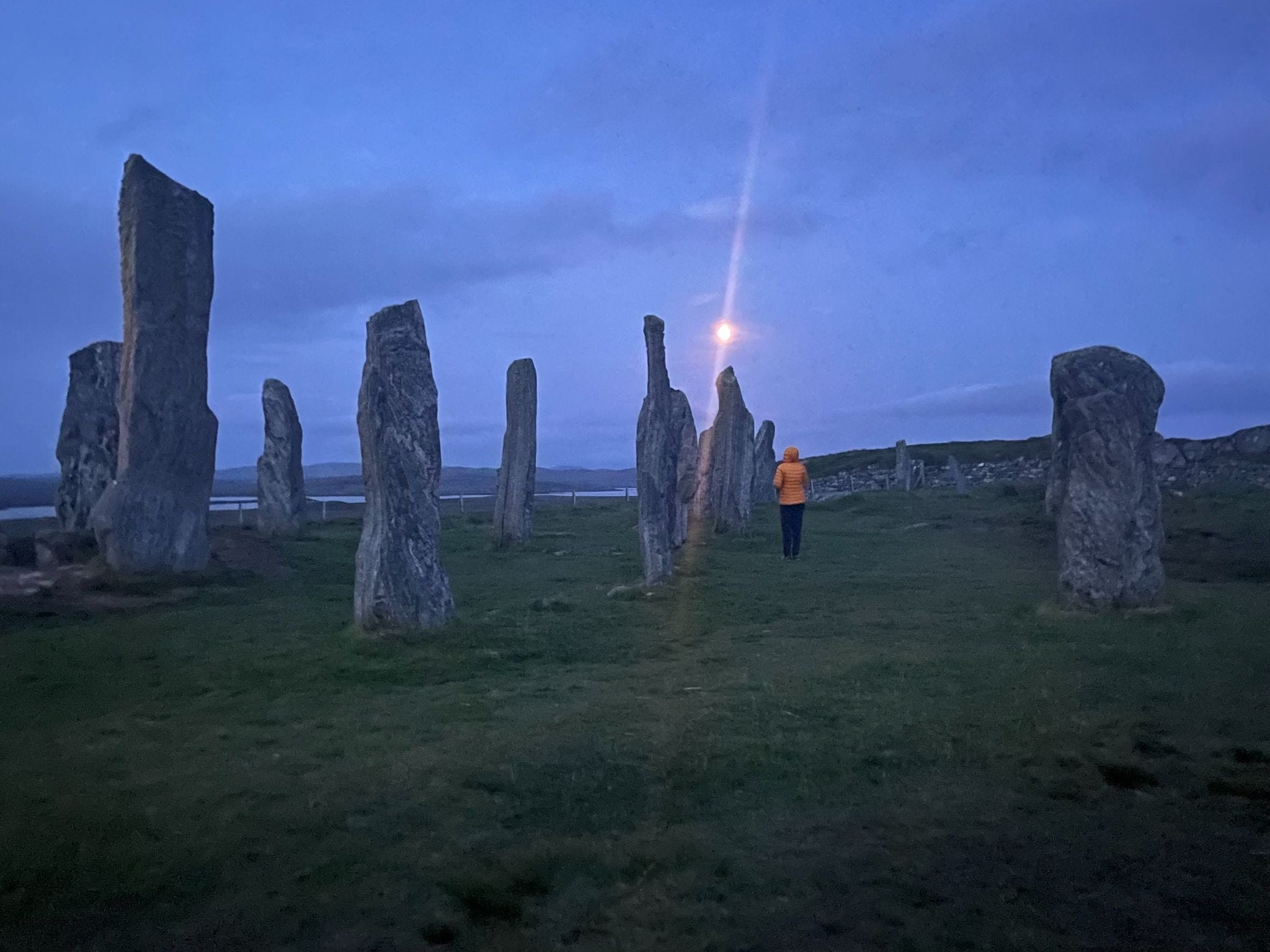
VII.
JULY 1
AND ALL THAT following week in Paris in five-star lodgings for the major sportswear brand gathering, a funny joke God plays inviting me to that after everything before, and Amelia wraps up her time with the girls in Finland, visits her friend in Brussels, but happens to have plans to meet her mom for a trip in Paris the week after I’m set to leave, I at the last minute change my flight and she takes the train down early, a brief 72-hour window, I know it won’t last as there are no longer real forests to raze, no heroic tasks I’m useful for, but for now, I’m funded for the random freelance sportswriting work, the last armas scienza left, and of course like Gawan the first thing I want to do is pour it into a lady, but I try to stay Parzival’d, within myself, I set up hotels, pick her up from Gare du Nord, about a mile north, and she gets in late, and in the morning it’s the hottest day of the year, of the decade, of the past 19 years possibly, some great peak of the sun’s nodal cycle, and the ancient midsummer baptismal ritual is deep in our bones without any Druidic guidance, we know we need a place to bathe to honor Adonis, or St. John of the deep water —
In these midsummer customs of Sardinia and Sicily it is possible that St John has replaced Adonis. We have seen that the rites of Tammuz or Adonis were commonly celebrated about midsummer. . . . In both of them water plays a prominent part. At his midsummer festival in Babylon the image of Tammuz, whose name is said to mean ‘true son of the deep water’, was bathed with pure water: at his summer festival in Alexandria the image of Adonis, with that of his divine mistress Aphrodite, was committed to the waves; and at the midsummer celebration in Greece the gardens of Adonis were thrown in to the sea or into springs. Now a great feature of the midsummer festival associated with the name St John is, or used to be, the custom of bathing in the sea, springs, rivers . . . and it was an old practice for men and women to bathe in the sea on St John’s Eve, that is, on Midsummer Eve . . . they say that on that night the sun and moon bathe in the water.25
Whether John or Adonis it doesn’t matter who, it’s the sun at the heat’s peak that must bathe in the moon water, the sun’s torch we must prepare ourselves in deep water to carry, to rise up as new suns, reflecting off each other reciprocal moons and it’s scorching at dawn and Paris apparently notoriously has no swim areas save the Seine so we’re typing river, lake, pool into Google and on a whim hop on a train an hour or so north and end up in this little suburb, a bridge to this river-pool, the pool a part of the river, but the line is out the ass and it’s too hot to even stand in line, so we take quick cover at a fancy cake shop and drink cold cokes and eat strange sandwiches and on a new whim see this lake that’s apparently swimmable, about 40 minutes away, we hop into an Uber it drops us in a parking lot next to a highway, we roam pores open delirious around the lake, it’s a wild scene, it’s all lake people, a different more rambunctious vibe, and we lie there on the faux beach it’s like dirt sand, cheerful and having a laugh at where we are, what we’re doing, following each other, jumping into the water, it’s suspiciously warm, an alchemical cauldron, there’s no way there’s not bacteria floating in here, we’re back in the putrefactional primordial soup, we swim and lounge and bury ourselves in the sand-dirt on the rock-beach then do a loop of the whole lake, and when it’s time to head back we realize the closest train is a long walk through the forest, but we’ve got a bit of water and a final 1664 beer left, we crack it and I carry what she needs carried and I point the way and she leads, back across the sketchy highway we got dropped off at the edge of, and then it gets green and lush and shaded, it’s a narrow path and Amelia is wearing a shiny sundress over her wet bathing suit, and flip flops, moving lithe and agile and curious, a beautiful otherworldly creature leading me through the trees in and out of the sun and the shade, along the path through the garden glade, and I follow her out into the light, ascending the high flights of stairs to the station, onto the elevated train, sunlight beaming down on us and on everyone hot and sweaty and sun and lake-soaked, finally ready to reenter the city gates together.

Sean Thor Conroe is the author of Fuccboi, The Walk Book, and Savior, out next year from Dalkey Archive.
Gaddis, The Recognitions, 48
Bede, Ecclesiastical History of the English People, 315-6
Bolaño, 2666, 830-1
McHardy, Contemplating Calanais, 25
Vico, The New Science, 320
Ibid, 350
Frazer, The Golden Bough, 83-4
Ibid, 108
Ibid, 120
Ibid, 119
Vico, The New Science, 324-5
Matthew 2, 1-12
Dante, Purgatorio XX, 13-15
Ovid, Metamorphosis X, 298-559
Dante, Purgatorio XXXIII, 41(-5)
Woody, “Dante and the Doctrine of the Great Conjunctions.”
Frazer, The Golden Bough, 79
Ibid, 87
Ciaran, The Tain, 105
Mac Uistin, The Tain, 91
Borges, “Three Versions of Judas”
Jung, Emma, The Grail Legend, 159
Von Eschenbach, Parzival, 244
Dante, Purgatorio XXXII, 53-60
Frazier, The Golden Bough, 341
 | A guest post by
|