


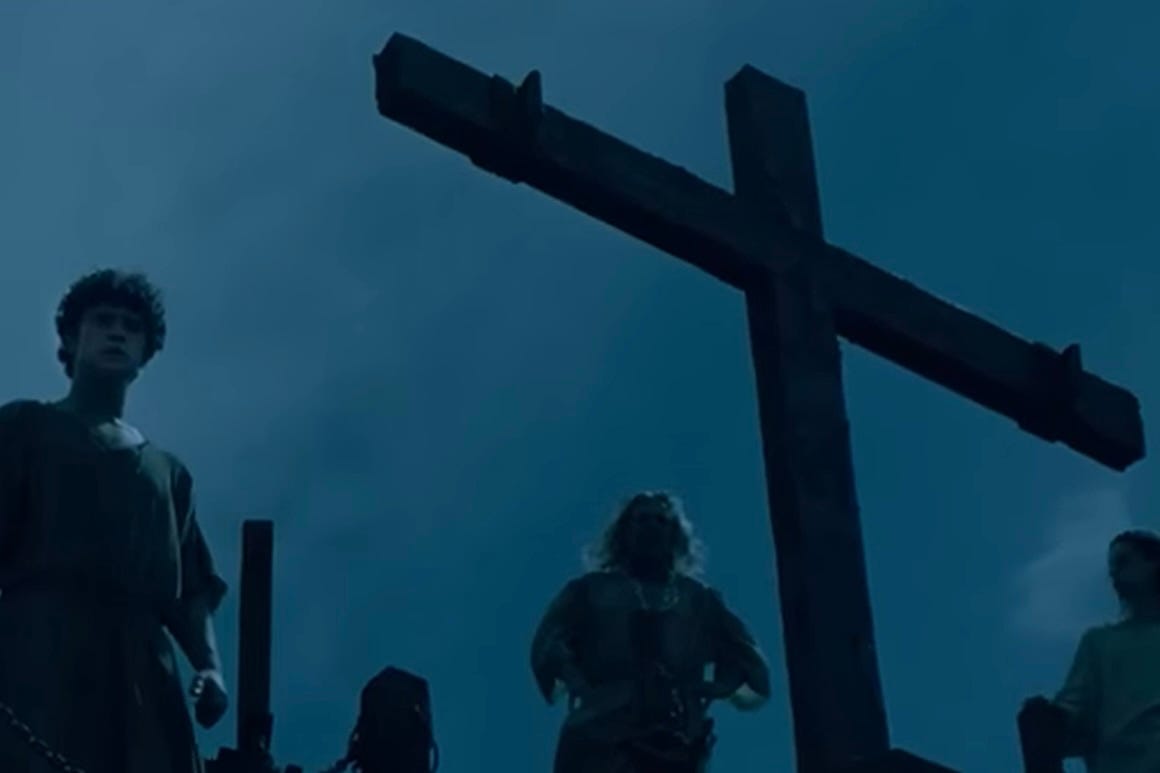
A long lineage of Jesus films depicts Christ as almost otherworldly, serene, and calmly removed from the people around him. Movies like Cecil B. DeMille’s The King of Kings (1927) depict Jesus as bathed in a soft glow of light, and as he moves through Jerusalem he seems to barely touch the ground. While Christian doctrine professes that Jesus is both fully divine and fully human, depictions of him in film almost always place a heavy thumb on the scale of divinity. There have been a few notable exceptions — and it’s within this counter-stream of Jesus films that Lotfy Nathan’s The Carpenter’s Son fits most squarely. It depicts a world filtered through horror and a deeply human Christ, both of which are uncommon but not unique within the canon of Jesus films. Despite its connection to this interesting lineage, The Carpenter’s Son remains a rather surface-level exploration, shying away from some of the more disturbing issues it hints at.
The film narrates the lost years of Jesus’ childhood, telling the story of a 15-year-old boy (Noah Jupe) who knows he’s not like the other children but isn’t quite sure what he is. He’s called the Boy in the credits, and not referred to as Jesus until the film’s climax. His father, the Carpenter (Nicolas Cage), is in equally turmoil, unsure whether his child is “of the angels” or a spawn of the devil. Regardless, the Carpenter recognizes the power and danger of the Boy, and does everything he can to protect the world until his son gains enough maturity to understand his powers. The Boy finds himself drawn to a peer (The Stranger, Isla Johnston) who refuses to go to school and entices him to commit violations of ritual law, such as touching a sleeping leper. While the identity of this Stranger is treated as a major reveal, it’s pretty obvious from the beginning who the Boy is palling around with. This becomes the overriding question of the story: Will the Boy follow his father’s advice and grow into a pious believer, or follow the Stranger down a different path?
At the start of the film, a Blair Witch-style title card informs us that a number of other Gospels filled in the narrative gaps that the four canonical Gospels left behind. We then learn that what we are about to witness is based on a text (most often dated to the second century C.E.) called The Infancy Gospel of Thomas. This tells us a great deal about how Nathan has conceived the film along with its relation to the canonical Gospels.
The canonical Gospels certainly reveal gaps in Jesus’ biography. Matthew and Luke offer birth narratives, though they differ wildly — our traditional Christmas pageants are usually a blend of the two. John begins with a poetic description — Jesus as the Word of God that has existed since the beginning of time — while Mark simply dives into Jesus’ adult ministry. Only Luke includes details of Christ’s childhood, and it’s just a single story about a 12-year-old Jesus lost in Jerusalem: his parents find him in the temple, teaching the Rabbis from the book of Isaiah. This leaves us with years unaccounted for, and many questions.
Though intriguing, the title card of The Carpenter’s Son presents two challenges. First, it seems to imply that the Gospels, Infancy included, form a single story that can be collated together. In reality, the Gospels offer differing takes on the story of Jesus rather than existing as parts of a narrative whole. Secondly, referring to the film as “based on the Infancy Gospel of Thomas” is a bit of a stretch as a comparison. Both the Gospel book and the film center Jesus’ adolescence and Joseph’s deep concern with his son’s growing powers — the Infancy Gospel even refers to Joseph grabbing Jesus by the ear to admonish him — and both contain a number of scenes in which members of the community complain to Joseph about trouble the boy is causing. But the Infancy Gospel depicts Jesus as more of a bad seed who runs around cursing people who upset him — sort of a first-century Palestinian Anthony sending his enemies into the cornfield — until he decides to stop cursing and heal instead. There’s little of that in The Carpenter’s Son.
The most striking departure from the Infancy Gospel is the absence of Satan, the primary antagonist in The Carpenter’s Son. In the Gospel, there’s no evil force tempting the young Jesus onto the wrong path, no explanation for why the adolescent goes on a cursing spree. The Infancy Gospel leaves us with the unsettling idea that Jesus might have been a divine being whose wrath could outweigh his benevolence — or, at the very least, that he had to learn how to temper it. Midway through the Infancy Gospel, Jesus decides to stop cursing people, “and immediately all they were made whole who had come under his curse.” The young Jesus then spends the rest of the text healing and resurrecting people, often after being mistakenly blamed for causing the harm in the first place.
The Carpenter’s Son doesn’t depict Jesus doing much cursing, and even his miracles are muted. His resurrections are limited to the grasshopper he absentmindedly crushes while listening to his parents argue about the best way to raise him, and his deviant behavior is just the hijinks of any high schoolboy, like when he takes the opportunity to watch through a window while his neighbor showers outside. Indeed, his mother (played by pop star FKA Twigs) argues that he’s just a boy, leading the Carpenter to fire back, “He’s unclean and always covered in filth.” Most parents of teenage boys can probably relate to this feeling. But it’s these very human qualities that put the Boy at risk of being led astray by the devil.
The narrative in which Satan tempts Jesus has a strong cinematic antecedent in Martin Scorsese’s The Last Temptation of Christ (1988). Based on the novel by Nikos Kazantzakis, The Last Temptation depicts a deeply human Christ (played by Willem Dafoe) conflicted over whether to accept his divinity. The “temptation” referred to in the film’s title is Satan’s offer for Jesus to step down from the cross and live his life as a human, rather than accepting his identity as Son of God. The film was met with a number of protests and boycotts from Christian groups, most of whom objected to the film’s nudity and portrayal of Jesus as a sexual being. (Granted, the scenes of Mary Magdalene in the brothel are fairly gratuitous.) This controversy seems an oversimplification — it’s possible that underneath the outrage at sexual themes lies a more difficult discomfort: a Messiah struggling with responsibility, human enough that he considers throwing off the weight of his divinity.
While The Last Temptation of Christ doesn’t dive as fully into the horror genre as The Carpenter’s Son, there are clear elements of horror in Scorsese’s film. The resurrection of Lazarus is a terrifying scene complete with a slow zoom into the depths of the tomb, followed by a jump scare. Stylistically, The Carpenter’s Son lies closest to another Gospel horror movie: Mel Gibson’s The Passion of the Christ.
Much of the lighting and camerawork in The Carpenter’s Son, particularly the nighttime scenes, recalls Mel Gibson’s depiction of Christ in the Garden of Gethsemane the night before the torture that will occupy most of the film. Gibson shot this scene in a strong dark blue hue, with darkness seeming to creep in from the edges of the frame. Even Lorenz Dangel’s score for The Carpenter’s Son feels reminiscent of Gibson’s film: eerie, minor chords creating an atmosphere of menace. In The Passion of the Christ, Gethsemane is where Satan tempts Jesus most directly, offering him an escape from the torment he is about to undergo. But Gibson’s Christ is too superhuman for this to be a legitimate possibility. It seems like more conservative audiences are willing to consider that Satan might have tempted Jesus, but not that Jesus would ever have thought of relenting.
Another stark difference between The Carpenter’s Son and the Infancy Gospel is the speculated theological function behind the utilization of horror. There’s no scholarly consensus on the purpose of the Infancy Gospel; Oscar Cullman has argued that the author was just a poor writer, such that it didn’t occur to him that depicting a child Jesus as killing other children would be a bad look for the Messiah. Kristi Upson-Saia suggests that it’s actually an anti-Christian document that’s intended to slander Jesus and his followers — which doesn’t explain why the Infancy Gospel would also depict Jesus as the powerful Son of God.
But there’s another possible way to read the Infancy Gospel, a potential meaning that falls by the wayside when we assume the primary characteristic of God is benevolence. Maybe we’re supposed to be afraid of Jesus — and maybe the unknown author of the Infancy Gospel was simply tugging on some loose threads already present in the Gospel accounts. There are clear places where Jesus inspires fear, such as when his disciples wake from a nap on a ship’s deck to find him walking across the water toward them, mistaking him for a ghost (Matthew 14:25-27; Mark 6:47-50). When the disciples see the risen Christ in the Book of Luke, they also mistake him for a ghost (Luke 24:36-40), and the original ending of the Gospel of Mark (before a later scribe added a happy addendum) has the women finding the tomb empty and running away in terror (Mark 16:1-8). Through centuries of softening the edges of these stories, we’ve domesticated Jesus to the point where it’s impossible for us to imagine him as frightening. The Gospel accounts suggest otherwise.
The Carpenter’s Son, by contrast, actually presents a fairly tame view of Christ. The horror emanates from Satan, not from the Boy himself. Unlike the Infancy Gospel, which seems to ask whether Jesus might be a figure to be feared, The Carpenter’s Son suggests that it is only Satan we need to fear. And since the Boy resists the temptations of Satan by film’s end, he’s ready to enter the Gospel accounts that we all know — making this film the kind of gap-filling exercise that its title card proclaims it to be. It’s easy to wonder if there’s a deeper theological horror in this story, waiting to be uncovered.
There are certainly other flaws in the film. The audience’s tolerance for Cage’s histrionics will be tested, and Twigs’ portrayal of the Mother ultimately fades into the background, since her character offers little beyond a pious counterweight to the Carpenter’s melodramatic doubt. As a late-night, unsettling mood piece, it succeeds admirably. There’s plenty of style, plenty of atmosphere, and a good degree of menace and dread. But it doesn’t have the gravity it aspires to, or that its devout detractors are afraid it might have.

Brandon R. Grafius is professor of biblical studies and academic dean at Ecumenical Theological Seminary, Detroit. He has written for publications such as Salon.com, The Christian Century, Sojourners, and The Los Angeles Review of Books.

The subject as described is to me a shame. Everybody's mutual friend Walter Kaufman explained hus beliefs about Jesus in the Faith of a Heretic book in where he says Jesus's tendency to curse the olive tree and etcetera others, makes him seem more vindictive than the average Joe. I just donot agree, like a strain of hard boiled cruelty does not match the personality of the man who confronted Rome in the name of brotherhood.
This is the first I've heard of the Infancy Gospel, and it seems that stories of Jesus' boyhood are largely speculative. A film like this is ambitious, balancing human and divine. I want to see the film for myself. I agree that Hollywood often falls short when depicting the human Jesus, and no doubt how the depiction goes, somebody won't like it.