


Some of the most important cultural questions arrive disguised as aesthetic ones. An honest account of contemporary life — including the literary life — requires understanding how our society chooses to see itself. The art it produces, the people it admires, and the styles it emulates are among the clearest records of its values and desires.
Today, we launch our Style section and proudly introduce Savannah Huitema, who joins The Metropolitan Review as Style Critic. Here, with her unflinching eye and sharp sociological range, Huitema reads American beauty — left and right — and argues that, in an age of instability, both sides now reach for a shared end: legibility.
—The Editors
I know her face, and so do you. I know how her Breck-girl blowout falls around the gold cross at her throat. And I know the way she enters a room and approaches a podium before casting a sanctimonious gaze.
Melissa Rein Lively, founder of America First PR, describes in Marie Claire the Trump woman as “elegant, powerful, hyper-feminine,” adding, “Femininity is our weapon, and by being beautiful and elegant, you can get a lot more out of life than you can by looking like crap.”
MAGA beauty — the aesthetic now labeled Mar-a-Lago face or conservative-girl makeup — is expensive, disciplined, and unmistakable. She has “Idaho curls,” false lashes, filled cheeks, plumped lips, and thick, peach-tinted foundation. The Trump woman wears a form-fitting skirt suit, sky-high stilettos, and a $50,000 Rolex Cosmograph Daytona.
Not including maintenance, the cosmetic work alone can cost upward of $90,000. The price of entry is part of the point. Her face belongs to the same aesthetic order as the Trumpian interior: spaces drenched in gold, or aspiring to be. Vermeiled, bombastic, yet eerily hollow. The literalism of gilded Rococo mirrors and a goat statue covered in $100 bills somehow cannot be decoupled stylistically from flash-white veneers and chin implants.
Commentators have already dissected the surface aesthetics of MAGA beauty, a discourse that now circulates broadly as a punch line. The popular impulse to critique the parallels between Mar-a-Lago face’s exaggerated verve and the drag queens that the right disdains is understandable. Yet the more interesting approach isn’t to deride these women; it’s to ask why this aesthetic suddenly feels adaptive, not only on the American right but across American life. It appears that certain styles, more conservatively coded, have become survival traits in a country that no longer feels stable. This is an impulse toward safer, more recognizable constructions of appearance.
Political transformation often appears in fashion before it appears anywhere else. Before America explains itself politically, it arranges itself aesthetically.
In the early ’90s, grunge — flannel, ripped denim, the deliberate rejection of polish — emerged before the recessionary mood was fully announced, before Kurt Cobain’s death, before the cultural fatigue with Reagan-era gloss and its sharp-shouldered powersuits had a name. Minimalism arrived shortly thereafter, bringing along Helmut Lang’s stripped silhouettes and Calvin Klein’s beige and bone.
As America swung into the Obama years, naked dresses were standard fare on red carpets. Exposed nipples were, for a time, almost a status symbol. So was the one-of-a-kind vintage shirt found on a thrifting spree in Brooklyn, because it suggested that its wearer was fully self-authored.
Elite aesthetics prized choice — identity presented as fluid and revisable. The Liberal It Girl aspired to seem ungoverned: sexually free, sartorially experimental, and unburdened by obvious hierarchy or need. Bodily autonomy became its own aesthetic language. Her look was avant-garde and ironic; she dressed like Chloë Sevigny ruling the downtown scene in leopard prints and red leather.
The party couldn’t last — style knew it before the markets or the polls did. Moods reach the body before they reach the ballot. It seems that Fukuyama’s famous 1992 prediction was a hair off after all: the liberal assumption that open societies and cosmopolitan individualism would render the old troubles obsolete began to feel passé. We were nowhere near history’s bookend.
The surrounding culture grew increasingly anxious about sex, gender, and the body itself. Fashion historians discussed a shift toward more conservative fashion — an emphasis on femininity and “romantic looks.”
In moments of societal unease, style often turns toward legibility, gravitating toward clearer markers of belonging. The pop-sociological “hemline theory” is the most basic incarnation of this idea — skirt lengths rise and fall with a culture’s appetite for risk as it oscillates between conservatism and openness.
Milkmaid dresses and tradwife trends did not emerge from nowhere. The old feminine shapes had begun to look freshly useful. Even American Eagle found a way to capitalize on the mood, reducing dated ideals of norms and breeding to corporate packaging in the 2025 denim campaign featuring Sydney Sweeney. (Trump called it “HOTTEST.”) And American Eagle isn’t the only one. Nostalgia, tweed, polos, and puffy sleeves have become ubiquitous in storefronts, and even in the styling on popular album covers. (Consider the feel of the cover art on Olivia Rodrigo’s 2026 you seem pretty sad for a girl so in love, or Lana Del Rey’s 2025 Henry, Come On.)
It’s tempting to dismiss MAGA beauty as brash costume — even drag. But doing so overlooks its deeper political and emotional function.
The Trump woman visually brands herself as an insider. The look signals fluency in the tribe’s rules and comfort within its hierarchy.
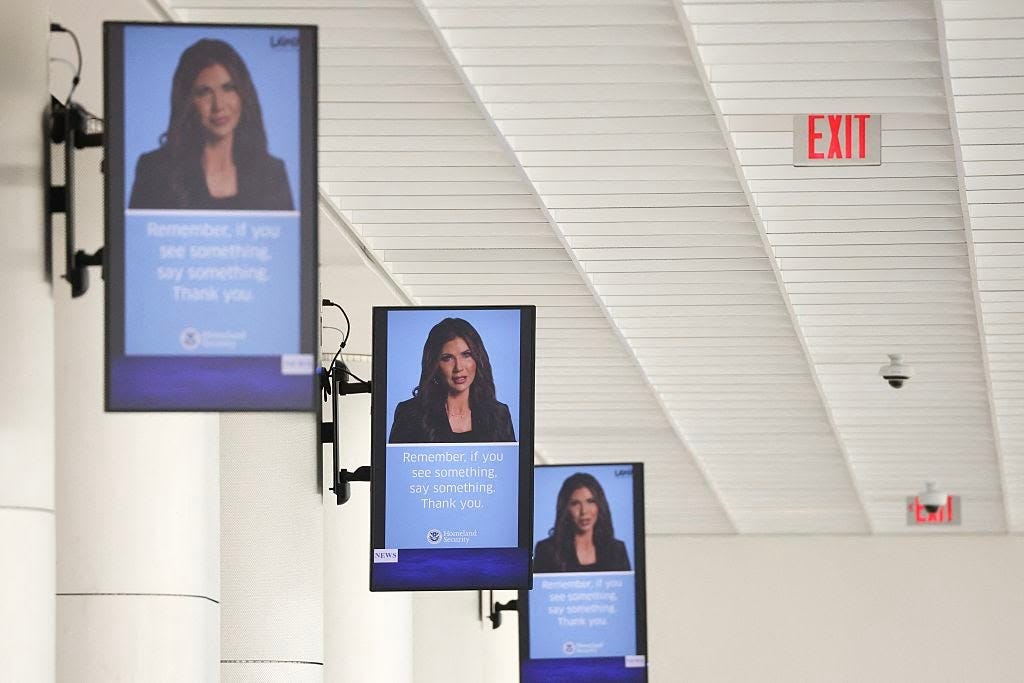
Last year, when former Homeland Security Secretary Kristi Noem visited a federal detention center in El Salvador, she wore a shiny gold Rolex. Her makeup, perfectly painted, sat immaculately over taut skin. There stood a stone-lipped Noem in front of caged migrants, their heads shaven, their naked bodies exposed in the low-resolution blur of a grim, state-sponsored photograph.
She was marching comfortably through power’s orbit, even in the most dismal of settings.
Noem knew the rules of the tribe and had paid the price of admission. Even as the world outside destabilized, the promise remained that the Republican Party’s order would continue to hold her within its arms — and therefore keep her safe.
The Republican Party would sequester the tangible enemy (them), brazenly showcase where power lies (with us), and explain exactly what a woman is (that).
This is the emotional appeal of MAGA beauty: clarity when clarity feels forsaken. It declares allegiance. It unabashedly acknowledges that cultural desire has shifted from standing apart to being held within recognizable forms. Not necessarily because freedom is consciously rejected, but because ambiguity itself begins to wear heavy.
Liberal culture likes to imagine that it stands outside aesthetic conformity. It is suspicious of visual symbols, because it understands that looks can deceive. Nationalism can lacquer itself in a fake gold gauze. State domination in Latin America can iron its hair into gentle beach waves.
But while mocking MAGA’s blunt performances of belonging, liberal elites have missed how thoroughly their own aesthetics anticipated this very turn.
Liberals idealized the endlessly self-created individual: untamed, perpetually revisable, singular. A daily construction of personhood as ultramodern and splashily-paletted as a 2011 Takashi Murakami painting. But this dance becomes exhausting, even embarrassing, in an erratic world. When things fall apart, how can one suffer appearing messy and unique? How can one bear the burden of constant self-authorship?
The anxiety was stanched by the “everyman” plain tee costing $800 at Brunello Cucinelli, or the ubiquitous Bottega bag lacking a conspicuous label. Nipples were covered.
There was all the individuality and risk of an airport terminal.
Aesthetic identity was no longer discovered; it was curated into coherence and displayed on a social media feed as evidence of moral seriousness and sobriety. The chaotic glamour of the early 2010s gave way to the measured style of self-regulation. Quiet luxury arrived in the form of Loro Piana cashmere, Khaite downtown knits, and understated coats from The Row — clothes designed to signal to those already on the inside. Modeling for these brands, it felt that the more the piece cost, the less it was allowed to say so when I wore it — but if you knew, you knew. (My agent once told me that my diamond earrings looked cheap. “Look expensive, but quietly” was the law of life. I committed many crimes.)
Today, while pointing out the classist, sexist roots of MAGA beauty in the Antebellum South and early pageantry, the Liberal It Girl and her friends can’t help but to innocently dress “Old Money,” or wear 1960s style baby-doll dresses and barrettes, as if they could also evoke their own idealized past.
The tribe signals. Just stealthily.
And so liberalism also wears the times on its skin as a parallel construction. Not by adopting the overdetermined cosmetics of Mar-a-Lago — so reminiscent of the gilded filigree loudly creeping through the Oval — but by clamoring toward its own containment. Softer, cleaner, coherent, and in its quiet way, no less conservative.
The body that had been displayed as proof of freedom has retreated into ballet flats, longer skirts, prairie sleeves, and high necklines. Dressed in a soft pink cardigan, she bakes sourdough bread and gardens out back for the viewing pleasure of her followers — never one to miss a trend cycle.
Makeup has likewise become “clean-girl” minimalism, the innocent face subtly botoxed and deep-pore-extracted into the illusion of having scarcely been touched. But little costs more than looking like you spent nothing. That’s the expensive secret every Tribeca aesthetician knows.
The cool girl, once glitter-specked, wild-eyed, and self-invented, looks composed, almost sheltered. The resurgence in popularity of heritage brands associated with a nostalgic American past and the trend toward more gendered looks is the same political mood speaking in a different accent, even if it’s not, simply stated, MAGA by another name. This year, Ralph Lauren surpassed an $8 billion valuation threshold for the first time in its history.
Plastic surgeons report a recent decline in requests to lie under the knife to attain the aggressively overfilled Palm Beach face. But the exposed bodies at this year’s Met Gala do not necessarily announce liberation — they may simply suggest that containment has begun to feel claustrophobic. Even the metallic breastplates that appeared so frequently suggested that protection, a kind of armor, remains fashionable. Yet no order can hold forever.
When I see the cosmeticized face of White House Press Secretary Karoline Leavitt, I can disagree with the policy ideas she imparts. I can feel disdain looking back at images of Noem’s propagandistic misadventure in El Salvador. But it would be dishonest to say I cannot empathize with the Trump woman’s spiritual need.
In a culture unmoored, legibility begins to feel like safety, even when it means permanently altering one’s face — a vow carved into skin that forecloses defection.
Across the political spectrum, it’s long been true that wearing certain forms of beauty means to receive the tribe’s recognition and to earn a sense of safety and belonging in return.
But I wonder whether, decades from now, some of us will look in the mirror with regret. Because certain things cannot be removed once the moment has passed.
We will still know her face. Some allegiances were never just skin deep.

Savannah (“Sav”) Huitema is a New York City-based writer, attorney, and fashion model. She serves as Style Critic at The Metropolitan Review.
 | A guest post by
|
Welcome aboard, I think your a very interesting and inspiring person, Looking forward to seeing your knowledge and insight on everything you do and see. Praying 🙏 for your success in your life ✨️ 💛 Dreams.
Can’t resist brining him in here:
“In all unimportant matters, style, not sincerity, is the essential. In all important matters, style, not sincerity, is the essential.”
- Oscar Wilde