


For decades, the Mexican-born journalist Alma Guillermoprieto has been respected, if not revered, as the preeminent English-language chronicler of the trials and triumphs of contemporary life in Latin America. When she speaks, people in the know tend to listen.
The Years of Blood: Stories from a Reporting Life in Latin America, published last year, is Guillermoprieto’s latest and final collection of reportage from the region. There is plenty of bloodshed in the 21 compiled stories — and while there is plenty of life too, these are largely not the kinds of tales she originally set out to record.
“People sometimes ask me why I like writing stories that can be terribly violent and cruel, and the answer is that of course I don’t,” Guillermoprieto writes in her introduction to the collection. “This is not what I expected to do with my life.”
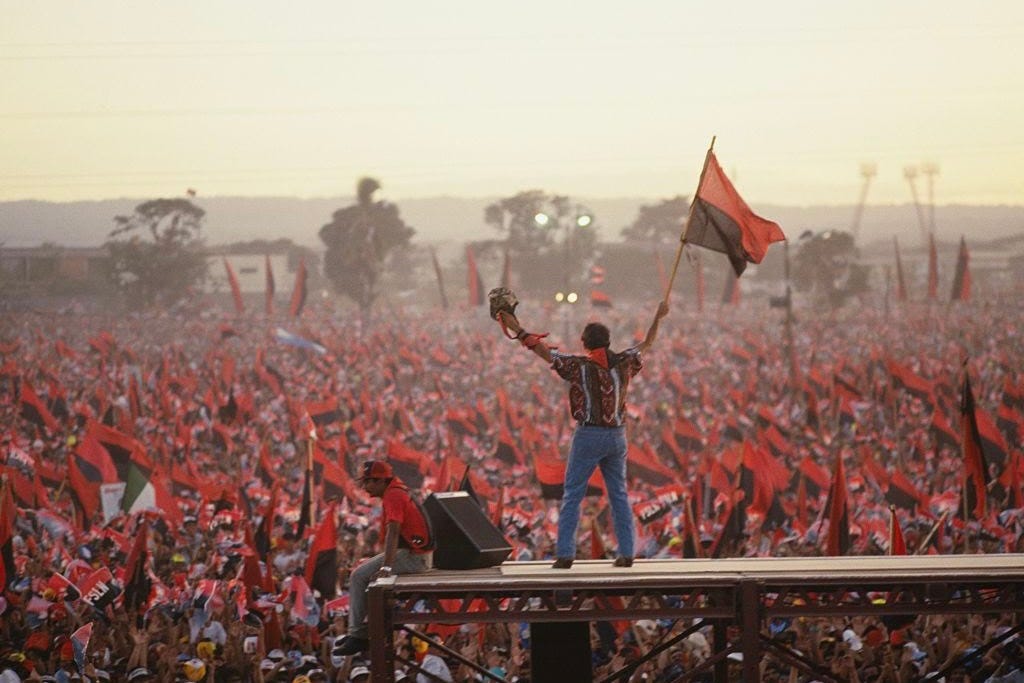
Indeed, Guillermoprieto’s path into journalism suggested a very different kind of journey. Guillermoprieto dedicated the first part of her adulthood to dance, studying with the renowned American choreographer Merce Cunningham in New York and briefly teaching at the National Art Schools in Havana. She began her career in journalism in 1978 in Nicaragua, at a moment when the Sandinista-led uprising against the dictator Anastasio Somoza was gaining momentum. Somoza fled Managua the next July as the Sandinistas poured into the capital, led by the soon-to-be president Daniel Ortega. For many in Latin America, it was the beginning of a heady decade: oppressed people were struggling for their rights, dictatorships were steadily falling, commodity prices were rising, and it appeared the region could be on the precipice of a proud, new democratic dawn. That is, understandably, what Guillermoprieto thought she might spend her career covering. But it did not work out that way.
There is, as a result, a soul-searching, melancholic quality to the questions Guillermoprieto poses in the collection’s introduction. She wonders how she could have been so naive as to think the Sandinistas could have managed to govern in line with their highest guerilla ideals, or to think the peace accord between the government and the Farabundo Martí National Liberation Front (FMLN) could bring lasting peace to war-ravaged, traumatized El Salvador. “We look back on the dreams of change we failed so resoundingly to achieve and wonder,” Guillermoprieto writes, “What were we thinking?”
Indeed, there are so many varieties of failure chronicled in the pages of The Years of Blood it is exhausting to catalogue them all. Many of the failures are driven by forces beyond the region’s control: Guillermoprieto traces the eruption of gang violence in El Salvador to U.S. immigration policy, and the eruption of drug violence in Mexico and Colombia to U.S. appetites and foreign policy doctrine. Then there are the more anodyne failures of men and women who claimed to represent high ideals but ultimately were devoted to the pursuit and consolidation of personal power; Evo Morales in Bolivia, for example, suffered what Guillermoprieto calls an “enduring presidential vice: he could not bring himself to get off that chair.” The reign of Daniel Ortega and Rosario Murillo in Nicaragua has been even more monstrous and ruinous.
There are, in Guillermoprieto’s eyes, two primary consequences of this multidimensional mess: the first is that violence has triumphed as a form of political expression in Latin America. The second is that, after a blossoming of electoral democracy in the last decades of the 20th century, democracy is no longer even an aspiration in the 21st.
Nowhere is this clearer than in El Salvador, where Guillermoprieto traveled in 2011 for a New York Review of Books story and immediately encountered a cab driver with no memory of the infamous slaying of four American nuns just 31 years prior. The trip did not improve from there; Guillermoprieto found a country teetering on the brink of unraveling with a bankrupt government, a 38 percent poverty rate, a stagnant economy, and a profusion of gang violence propelled, in part, by the arrivals of mareros who had been deported to the country from cities like Los Angeles.
When Guillermoprieto was reporting in San Salvador, Nayib Bukele, the 30-year-old president of a branch of the Yamaha Motor Company, was on the verge of entering electoral politics for the first time as the FMLN’s mayoral candidate in the small suburb of Nuevo Cuscatlán. Just eight years later, having been elected mayor of San Salvador and then thrown out of the FMLN, Bukele won the presidency.
Bukele’s approach to the presidency led to an unraveling of sorts. In 2021, Bukele fired the attorney general investigating his government for corruption and replaced all five magistrates on the Constitutional Court with his own appointees, who quickly ruled that he could run for another term in 2024 — despite a constitutional ban on immediate reelection. The following year, the legislative assembly, controlled by Bukele’s Nuevas Ideas party, authorized a state of exception that suspended due process and gave the government sweeping authority to combat gang violence. The state of exception is still in place three years later, with roughly 2 percent of the country’s population in prison and a growing number of the government’s critics in exile. In September, Human Rights Watch warned that the country’s democracy was “dying.”
Nevertheless, Bukele’s approval rating remains sky-high, exceeding 80 percent in a poll conducted over the summer. Perhaps more chillingly, just 1.4 percent of respondents said the concentration of power in a single person was a problem. In slashing the murder rate by as much as 97 percent and drastically reducing the power of the gangs that once dominated large swaths of the country, Bukele has given Salvadorans — at least those whose loved ones have been ensnared by the prison state — a benefit democracy seemingly could not deliver.
But democracy was failing in El Salvador long before Bukele began packing the courts and altering the constitution. The corruption of the two main parties — and their inability to curb crime and address inequality — prefigured the emergence of a leader who could make the country’s challenges seem less intractable. As Guillermoprieto notes, “Elections are but the end product of a democratic life.” Bukele is popular now, in fact, much more popular than democracy itself across the region: Guillermoprieto cites a Latinobarómetro poll that found 54 percent of respondents open to a non-democratic form of government so long as it was effective. But Bukele will not be popular forever, and when people eventually tire of his reign, his assault on democracy will make it that much harder to remove him.
El Salvador is a dramatic example of democratic backsliding in the region, but it is not the only place where democracy is imperiled. Nor is a traditional dictator a necessary component of democratic decay: Will Freeman has argued that Peru is a paradigmatic example of a nation where the democratic state apparatus has been left intact but is nevertheless “unable or unwilling to constrain predatory private powers — narco-traffickers, illegal gold miners, human smugglers, corruption rackets — and the officials and politicians who go into business with them.”
Freeman names Mexico as another example of a country where democracy is fading without the presence of a traditional strongman, and the second half of The Years of Blood shows us exactly how this process happens. In “The Morning Quickie,” we see a political associate of Andrés Manuel López Obrador, then serving as the mayor of Mexico City, captured on film accepting a briefcase full of cash from a rich businessman. In “Risking Life for Truth,” Guillermoprieto tackles the enormous dangers facing local newspaper reporters who report on the drug trade. In “A Voice Against the Darkness,” she pens a searing, moving tribute to slain journalist Javier Valdez. The final two stories in the collection, pieces of investigative reportage on the femicide crisis in Ciudad Juárez and the kidnapping of the 43 students from the Ayotzinapa Rural Teachers’ College, are riveting examples of Guillermoprieto’s mastery of the genre.
All of these stories take place in a democratic Mexico, after the country managed to topple the PRI’s perfect dictatorship at the turn of the century, and they together demonstrate how democratic life can be kneecapped by forces other than tyranny.
Elements of this might sound familiar to readers in the U.S.. Here, as in Latin America, we too are experiencing the corrosive effects of inequality and corruption on democratic life. Donald Trump is only referenced glancingly in The Years of Blood, where Guillermoprieto identifies him as a stylistic successor of Hugo Chávez, but the volume offers a lens through which to understand both his ascent and why Democrats’ appeals to the sanctity of democracy fell short at the ballot box last year.
Trump and his cabinet, for their part, are certainly interested in Latin America. At the beginning of January, the U.S. intensified its neo-imperial engagement with the region by kidnapping President Nicolás Maduro of Venezuela (a man Guillermoprieto variously calls “clumsy,” “goofy-looking,” and a “fool”), with Trump declaring that the U.S. is now “in charge” of the country. The Trump administration has also threatened Gustavo Petro, the president of Colombia, bombed boats in the Pacific, and appears to have regime change in Cuba next on its agenda. This aggressive posture towards the region comes as Trump and his lieutenants simultaneously attempt to excise Latin America from within the U.S., prosecuting a project of terror against migrants that the Department of Homeland Security claims has already resulted in two million removals and “self-deportations.” After creating and enforcing a hemispheric order that has left much of Latin America beset by inequality and violence, the U.S. finds itself grappling with some of the same issues.
Those opposed to Trump, then, must look to Latin America too. As Greg Grandin has argued, activists and center-left leaders in the region have an intimate understanding that if democracy is to work, it must deliver for people — must be true social democracy. The alternative is chilling.
If you’re concerned that The Years of Blood is a slog, rest assured: what has always made Guillermoprieto such an engaging chronicler of Latin America is her wit, curiosity, gift for portraiture, and sensitivity to the hopes and joys of the regular people who animate her stories. Guillermoprieto has professed not to closely follow politics or even vote, and her main enthusiasms — for food, art, and performance — shine in stories on the cholita wrestlers of El Alto, Alfonso Cuarón’s 2018 film Roma, and a profile of the late English food writer Diana Kennedy, who devoted her life to Mexican cooking. Guillermoprieto writes that when Kennedy moved to Mexico in 1957 with her foreign correspondent husband, she fell in love in the neighborhood markets of Mexico City with “a universe of flavors, colors, textures, shapes, and aromas several light-years removed from her own.”
The profile of Kennedy is notable not just for its delicious descriptions of cactus fruits, hibiscus flowers, and moles oaxaqueños, but because it conveys why an outsider like Kennedy — or many of Guillermoprieto’s English-language readers — might fall in love with Mexico or Latin America. The inclusion of these stories, in turn, animates the significance of the political events Guillermoprieto spends the bulk of her time tracking. The cost of inequality and violence in Latin America becomes clearer the more time you spend with Guillermoprieto, often at street level, immersed in the textures of everyday life in the places she visits.
It is fitting that Guillermoprieto begins the introduction by recounting an interview she conducted decades ago with a 26-year-old Colombian man who was being held in a jail on the outskirts of Medellín. The man, whom Guillermoprieto calls Néstor, was accused of participating in a gruesome massacre in the small town of Segovia. During their conversation, he haltingly filled Guillermoprieto in on the details of his life, attempting to scratch out a living as a freelance gold miner and seeing one or more brothers — Guillermoprieto can’t be sure — gruesomely murdered. At the conclusion of their hour-long conversation, Guillermoprieto tells us she was “so full of Néstor’s mumbling despair” that she couldn’t think and couldn’t write, either. She was supposed to produce a story for the New Yorker about the Segovia massacre, but couldn’t. Guillermoprieto credits Néstor with helping her understand that the story she needed to write about Segovia — the story of bloodshed in Colombia — was not, as she first thought, a story about “evil murderers pitted against innocent civilians,” but rather one of the U.S.’s “reckless exercise of its immense power in Latin America.”
Guillermoprieto has told that story for more than 40 years, all while making space to relate in vivid color “the great, bubbling-over, defiant life” of the region. She ends her introduction by passing the baton, articulating her hope that “in the not-too-distant future a much younger writer will be able to report and write the stories of how peace was consolidated throughout these lands.” We should be so lucky to read those stories. It is only a shame Guillermoprieto herself hasn’t had occasion to write them.

Abe Asher is a writer whose reporting has been published in The Nation, Jacobin, VICE News, and a variety of other outlets.
 |
|