


About halfway through Mission: Impossible — The Final Reckoning, Tom Cruise goes for a run on a treadmill. The treadmill is on the USS Ohio, a submarine manned exclusively by implausibly attractive people. One of those people is not who they seem: a cultist, radicalized by the Entity, the film’s AI antagonist. The cultist sneaks up behind Cruise and lunges with a knife. Things look dicey for a moment — until Cruise gains some distance and kicks him repeatedly in the head. While doing so, he imparts a few words of wisdom: “You spend too much time on the internet.”
What divides the heroes and villains in Final Reckoning is simple: the villains have to Google things, and the heroes do not. There are three bad guys, more or less. First, the Entity, a rogue AI halfway through its plan for global domination. Second, Gabriel, the Entity’s meat puppet. Third, a gang of surprisingly likable Russians who take Cruise’s team hostage in a house in Alaska. What unites the villains isn’t malice so much as it is uselessness. I mean that precisely. They are often effective, even successful. But never useful.
The Entity is a strikingly lazy AI. Instead of designing and synthesizing a new biological agent able to wipe out all humans or speedrunning a century of robotics development and building its own army of Terminators, it confines itself to a few embarrassingly plausible tricks. It seeds the internet with convincing fake images and videos, converts a set of mindless followers to do its bidding, and commandeers the world’s atomic arsenal — technologies from the 1950s that I imagine are indeed protected by complex security arrangements, but hardly require a new computing paradigm to defeat.
Gabriel and the Russians are no better. Gabriel has only one move: stealing something that’s not his, and then using it to blackmail Tom Cruise into doing all the work, like the ultimate free-rider on a classroom group project. As for the Russians, despite needing to hack a secure DoD server, not one of them can operate a computer. Just point a gun, give the clever people a deadline, and tell them to get to work.
Cruise and his team, by contrast, are profound in their usefulness, built for a world where accessing the internet means certain death. They use old radios to contact submarines. They hand solder intricate electronics on the fly. They navigate their museum-piece plane to an unspecified location on the East Coast of South Africa with nothing but a paper chart and a set of coordinates. Nuclear bombs are defused and even thoracic surgery is improvised without any sense checks from Google, Perplexity, or GPT-5.
In the world of Final Reckoning, where the Entity is all-seeing, things unsearchable and uncheckable like secret clues and symbols become vital. The president convinces an admiral to help her by writing down a date whose significance only the two of them understand. That admiral earns the trust of the USS Ohio’s commander by giving Cruise a medal whose meaning is private between them. To fool the Russians, who they know are listening in, Cruise’s team sends coordinates that direct him to the opposite side of the world from where he needs to be: a feint they know only he could decode.
What Cruise and his team carry in their heads and bodies not only saves them but the world. Donloe, the CIA chief exiled to Alaska, knows the submarine’s coordinates because he memorized them a decade ago. Tapeesa, his wife, can deliver the lifesaving decompression tent because she still knows how to navigate by compass and sextant. Grace, Hayley Atwell’s pickpocket-turned-teammate, saves the world through a skill so subtle it can barely be named: the thing that separates a ‘good pickpocket’ from a ‘great one’ — timing.
This division between characters with embodied knowledge and those without runs through all of Cruise’s recent work. His own impossible mission is to teach the value of physical competence: not just knowing things, but knowing how to do them. In Final Reckoning, this idea finds its clearest form.
A few days before Final Reckoning came out, HBO aired another feat of ludicrously embodied competence: the season two finale of Nathan Fielder’s The Rehearsal. In the show, Fielder — a comedian — sets out to answer whether ingrained pilot behaviors are making air travel less safe, and if so, how to fix them. Quickly, he realizes the only way to truly understand this is to become a pilot himself. So he does, spending two and a half years secretly training to fly a commercial airliner. In the finale, not only does he reveal this to the audience, but he also flies a 737 with 150 actors aboard, over the Mojave Desert.
As anyone who’s ever watched someone who is good at their job knows, embodied skill is satisfying to witness. Just before the release of Sinners this year, director Ryan Coogler appeared in a video filmed in partnership with Kodak. In the video, Coogler, armed with a whiteboard and props, talks to camera for ten minutes about the technical nuances of shooting on 65mm film: the properties of analog stock, the spacing of perforations, and the subsequent implications for aspect ratios in projection. The resulting demand for IMAX showings of Sinners crashed AMC’s website.
One can’t help but imagine the 20th-century philosophers Gilbert Ryle and Maurice Merleau-Ponty watching on proudly as a new generation takes up the work of undoing Cartesian dualism, the separation of mind and body they both saw as the original sin of analytic philosophy.
It was Ryle who, in 1945, formulated the distinction that runs through Cruise’s films: that between knowledge of and knowledge how. The former was propositional, the sort you can articulate in neat, explicit statements. The latter was practical aptitude, the kind only revealed by competent action. Crucially, you can possess the latter without the former; knowing how does not entail being able to explain it. Donloe, crouched over a live nuclear bomb in Final Reckoning, gives the idea its best cinematic gloss. “Where’d you learn to do this?” asks his colleague, watching nervously. “Never said I did,” he replies.
In 1945, Maurice Merleau-Ponty also published The Phenomenology of Perception, in which he put forward an even simpler argument: to draw any distinction between consciousness and body is nonsensical. For Merleau-Ponty, the body was not a mere vessel for the mind but a repertoire of skills built and refined through contact with the world, an inescapable part of all human thought. His thinking directly shaped the “Dreyfus Model of Skill Acquisition,” a five-stage framework for how adults progress from novice to expert, still taught everywhere from NHS wards to U.S. Air Force flight schools. I do, therefore I am. No wonder Cruise is addressed, jarringly, as “mister” six times in the film.
Embodiment in a machine age has haunted novelists ever since Mary Shelley went on her 1816 holiday from hell and came back with Frankenstein. Perhaps the most prophetic of all is E.M. Forster’s 1909 short story The Machine Stops, in which humanity finds itself benevolently trapped in a network of individual hexagonal cells buried deep beneath the earth, with every need tended to by a system known simply as the “Machine.”
Forster’s humans are the original Google-dependents: reliant on screens and buttons for communication, revolted by physical contact, and terrified of living on the surface. When the Machine finally fails, so does their civilization. Only then, in a moment of true grace, do they realize what they’ve lost:
Man, the flower of all flesh . . . was dying, strangled in the garments that he had woven. Truly the garment had seemed heavenly at first, shot with colours of culture, sewn with the threads of self-denial. And heavenly it had been so long as man could shed it at will and live by the essence that is his soul, and the essence, equally divine, that is his body. The sin against the body — it was for that they wept in chief; the centuries of wrong against the muscles and the nerves.
Like Forster, Cruise and his long-time collaborator Christopher McQuarrie invent machines to dramatize the age they live in. Forster gave us the Machine; McQuarrie, the Entity. But unlike Forster, their imagination of technology is not apocalyptic but diagnostic — they aren’t warning us of the machine age so much as asking what it demands of us, and what it reveals.
This brings us to what looks, at first glance, like a paradox: How does a franchise so lovingly built on disguises, gadgets, and inventions of all kinds — from the eye-tracking projector that gets Cruise into the Kremlin to the single suction glove that lets him cling to the Burj Khalifa — end with a villain made of pure technology?
If you asked Cruise, his answer would be simple: technology is good when it roots you in your body and bad when it lets you forget you have one. That’s why Final Reckoning, for all its AI villainy and suspicion of the terminally-online, still treats technology with a near-Romantic sensibility. Hand-soldered pen drives, aging aircraft carriers, and vintage biplanes carry Cruise and his team on their mission to save the world. At times subtlety disappears altogether; the film’s most inviting location is a candle-lit Arctic hideout filled with analogue comforts: old books and gramophones, telescopes and soldering tools.
A significant portion of the film’s middle third is devoted to a diving sequence, in which Cruise must descend to the ocean floor to reach a wrecked submarine. For the human body, this is an impossible feat. Fortunately, on the USS Ohio there’s an experimental diving suit that will keep him alive for a limited time. Once he resurfaces, his team will revive him with a defibrillator and place him in a portable decompression tent before the gases in his blood can kill him.
There’s no jawing (as Daniel Craig’s Bond might have done) about the suit’s weight, its complexity, or the fact that using it requires hours on a treadmill to flood the body with oxygen. No grumbling either about how untested it is or the real possibility it might fail. When Cruise is about to dive, the final words he hears aren’t “good luck” or “godspeed,” but “take care of my suit.”
It’s no coincidence the sequence borrows heavily from Aliens: another film about humans surviving an inhuman enemy with just embodied competence and fallible machinery. The Navy SEALs’ uniforms, gym, and vibe echo that of the Colonial Marines, Cruise’s boxy dive mask recalls the angularity of Ripley’s power loader, and the submarine’s collapsing interior evokes the battered starships with names from Conrad novels that litter the franchise.
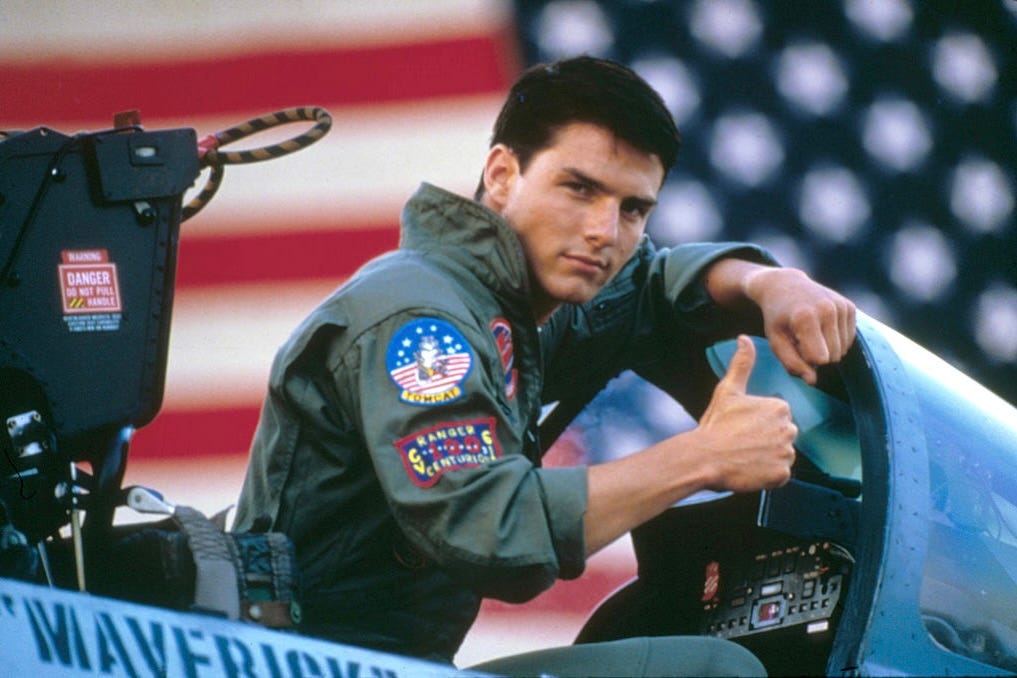
The same ideas return — turned up to eleven — in Cruise and McQuarrie’s two other collaborations this decade outside the Mission: Impossible franchise. The first, Edge of Tomorrow, in which Cruise relives the same day on repeat until he generates enough embodied knowledge to defeat an autonomous alien race, is, even for the purposes of this essay, too on the nose, so I’ll focus instead on Top Gun: Maverick.
The film opens with Cruise test-piloting an experimental stealth aircraft in a last-ditch attempt to save the program from cancellation by the “drone ranger,” an admiral who wants the budget for his autonomous fleet. For the program to survive, Cruise needs to hit Mach 10: a speed no vehicle has ever reached. As the team watches on, he delivers the impossible. Gauzy wisps of supersonic air stream across the cockpit windows as Maverick stares out into the black of space. He whispers softly to his dead best friend, “Talk to me, Goose.”
Soon afterwards, Maverick is sent back to Top Gun to train a new generation of pilots. He begins his first lesson holding up the flight manual for the F-18, which makes the Riverside Chaucer look like a novella, before throwing it in the bin. “I assume you know this book inside and out. So does your enemy.” What matters instead is the knowledge that can’t be written down: the things his students already know by instinct, but cannot yet express. “Today we’ll start with only what you think you know.”
The quest to ‘“know more than we can tell,”’ as Michael Polanyi put it, drives the rest of the film. The pilots even have their own version of the phrase, a near-religious catechism recited at almost every decisive moment: “Don’t think. Just do.”
Beyond the screen, the same principle applies. In the Mission: Impossible franchise, filming begins with no plot or script, only a commitment to figuring it out in the process. It’s most evident in each film’s tentpole action sequences, where the line between Cruise the actor and Cruise the stuntman blurs beyond recognition.
The art critic Robert Hughes once wrote of his love for “the spectacle of skill” — the thrill of watching an expert at work, whatever the discipline. Nowhere is this more evident than in Cruise’s increasingly daring plane sequences. In Mission Impossible: Rogue Nation, Cruise clings to a real Airbus A400M as it lifts off from an airfield in Lincolnshire. He sprints across the field, in that inimitable Tom Cruise style, mounts the wing with practiced ease, and seats himself by the cargo door. The plane taxis. So far, so cool. Then it lifts off. The perfect hair vanishes, blown back and forwards, alternating second by second between old skeleton and boy with bowl cut. His clothes are shapeless and billowing, pulled off him by the force of the air.
This is no country for sprezzatura, nor the embodiment preached by the wellness industry with its vocabulary of “balance” and “equilibrium.” Here, we are meant to feel the effort. To know yourself is to know your limits, and so push your body to the edge of failure. When they are about to perform stunts, Cruise often briefs his team with an unusual mantra: ‘Don’t be safe, be competent.”
At the end of Final Reckoning, Cruise plummets through the sky as his parachute burns to cinders above him. To film it, the stunt team soaked a parachute in flammable liquid, flew him to altitude in a helicopter, and pushed him out as it ignited. He did this 19 times. When he asked to go again, the stunt coordinator told him there were no parachutes left. This was a lie. McQuarrie was more direct: “You’re done. Do not anger the gods.”
It’s interesting to see this return to embodiment and strange to find myself drawn to it. Like many default clever people, I’d long paid lip service to Merleau-Ponty and his ilk while living as a dualist; my brain was the moneymaker, my body just along for the ride. It was only after having children that I began to understand what it meant to inhabit a body rather than simply use one.
In an essay for Granta earlier this year, the writer Saba Sams contrasted her son’s love of leaping from benches and walls with her own unease: “For them, the body is not a constraint, is not a ticking clock, is not something to be moulded or hidden. The body is the window to movement, and movement is a window to joy.”
Sams captures something larger. This renewed fascination with embodiment isn’t spontaneous, it’s a reaction to technologies so powerful and frictionless they’re impossible to ignore. Even the most grounded among us now move through the world not through our bodies but through screens, which is why so many make the negative case for technology, urging us, thankfully without a Cruise-style kick to the head, to spend less time on the internet.
What Cruise gives us is the positive case: not just resistance to disembodiment but a reminder of what is beautiful about being physical in the first place. The skilled things bodies can do are inherently satisfying. They can be thrilling, reassuring, even a little terrifying. But, as David Foster Wallace put it in his essay on Roger Federer:
The human beauty we’re talking about here is beauty of a particular type; it might be called kinetic beauty. Its power and appeal are universal. It has nothing to do with sex or cultural norms. What it seems to have to do with, really, is human beings’ reconciliation with the fact of having a body.
That’s the mission, if we choose to accept it. The target is not the recent bugbear of AI, but instead the more gentle conditions of modernity. When we use Google Maps instead of a printed atlas, or when CGI is used to sell a stunt instead of the performers doing it themselves, something is lost. It’s why the focus on AI can sometimes be misguided. It’s not so much a revolution, it’s simply the next step on the ladder of disembodiment: another in a long line of technologies to make humans a little less self-reliant. Why learn, if you can ask?
In the final biplane sequence, we watch Cruise commandeer a plane, fly it to another, board that plane midair, and take control of it — a feat so exhausting it beggars belief. Gabriel, the villain, in order to survive his defeat, needs only do something a hundredth as difficult: jump from the plane and deploy a parachute. He laughs. This is easy. But he doesn’t know the complexities of leaving a biplane with a parachute — the correct moment to release, the parts to steer clear from. He’s never bothered to learn. He frees himself, clips the rudder, cracks his skull open, and dies.
Here we see the real villain: not intelligence, but convenience. The mission so often feels impossible because we keep trying to do things without effort. Cruise’s answer is simple: Stop. Remember your body. Sometimes, it’s better to take the hard way.
Final Reckoning’s closing scene presents us with two intelligences and two bodies. One is Cruise, a 62-year-old body who we’ve seen, for the last two hours, run fast, dive deep, and hang from planes. The other is the Entity, trapped in a glorified USB stick: a golden nugget incapable of anything other than being flushed down a toilet.
One still moves. The other never could.
Aled Maclean-Jones is a writer and critic based in London. He writes on culture, books, and technology, and publishes on Substack at Rake’s Digress.
 | A guest post by
|
Adding another theoretical way to look at it, we might say that Tom Cruise likes tools that are, in the words of Ivan Illich, convivial. He likes technology that allows us to exercise our autonomy and creativity.
He dislikes tools that enslave us, force us into a deskilled radical monopoly, and constrain our action.
Hell yeah brother.