


Twenty years ago, the year of Saul Bellow’s death, I chanced upon an unusually clean copy of Ravelstein in a ramshackle bookstall in New Delhi. India is an unexpected place to wind up reading, for the first time, this midcentury urban intellectual, comic dissector of America’s moronic inferno. But, as it happens, amidst the street chaos and the tiresome pressures of train travel and seedy hostels, I found that my irked, overstimulated soul was peculiarly receptive to the master’s comforting genius. I consumed the book in a couple of hours at a restaurant counter. I remember thinking that I would not soon forget the experience. But, hardly in my 20s at the time, I’ve wondered since what I detected in it. What did the man have to offer me, so green, so goyish? This was Bellow’s very last novel, written in his 80s. Riffing on topics of Jewishness, sickness, aging, dying, marriage, politics, history, friendship; he was a very adult sort of thinker, a mature man’s writer. Yet I was so thrilled by this that upon my return home I read all of his work, and later his essays and letters, then the multitudinous biographies, memoirs, and studies that came out in the decades following his death. Today I am that rare creature: the millennial Bellovian.
The 2000s was an era with a certain showy yet wan style in literature. David Mitchell had bumbled onto the world stage with his egregious Cloud Atlas. The Big Writers with Big Initials — George R.R. Martin, J.K. Rowling — were pumping out their wearisome commercial blockbusters. David Sedaris was eking out a drearily comic thing seemingly every year. James Wood had coined the phrase “hysterical realism,” which correctly diagnosed a certain quality of prolific and anxious postmodern melodrama in then-popular novels by Zadie Smith, Jonathan Safran Foer, Junot Diaz and David Foster Wallace. The barely beating heart of American poetry, gluttonized upon the empty calories of flarf, was being bashed to death by carnival-barking anti-poets Dorothea Lasky and Kenneth Goldsmith. In nonfiction, the period was profusely Gladwellian, chockablock with lightly researched volumes that claimed to easily explain world phenomena. Every other person seemed to be carrying around a copy of Freakonomics. The only books that could have been considered popular foreign lit were two memoir-travelogues written in English, Shantaram and Eat, Pray, Love, stories that cozily revealed to bourgeois fans of the midlist the soul-awakening potential of global tourism.
But it wasn’t all bad. We were still talking about what would become known as Jonathan Franzen’s only good novel, and Alan Hollinghurst had put out his masterpiece. But the general mood in publishing was big and blustery. Editors and agents were on the hunt for big voices, big names, big business. Writers like Denis Johnson were still quietly working away, but even though it won its accolades, few actually read Tree of Smoke. Norman Rush’s superb Mortals (2003) wouldn’t be identified as a classic and his best novel for many years. It was the Rowlings who were getting the attention. Harry Potter, A Song of Ice and Fire, and Eat, Pray, Love were made into films and shows — and you’re not a success in American publishing until Hollywood options you.
The readerly soul chafed in such a context. For the soul was hungry. In the 1990s and 2000s, the values and aesthetics of television appeared to have colonized contemporary literature in toto. But I, a sad young literary lad, did not want television in my literature. I wanted literature. But what was literature? Saul Bellow seemed to be it.
Bellow Politicus
The persistent cultural resistance to Bellow, who remains popularly read yet broadly under-appreciated by the taste-making classes, comes in several flavors. Over the decades he’s come to be categorized by critics as a hundred different kinds of “too much”: too much of an intellectual, too European, too comic, too academic, too Chicago, too cosmopolitan, too much the poet and the aesthete, too modernist, realist, Jewish, un-American, too inspired by the Russians — and he does contain aspects of all of those (some would say this is a wonderful thing). The most common and lasting judgement, however, is the vague conviction that he was a neoconservative and a reactionary, and that his prose carries within it the deep grammar of unregenerate chauvinism. As we know, it has become uncouth to read books by writers whose politics we suspect we should abhor, lest our minds become infected. (And Bellow was, as Slate reported earlier this year, physically violent towards his wife, Sasha.)
To this, in part, I could respond that as a younger writer and for half his life, Bellow was a Marxist and a Trotskyist. In the 1930s and 1940s, this strongly political critique was a tough intellectual and social spot to put yourself in, for it made you vulnerable to threats of violence not only from the mainstream but from Stalinists. When Trotsky was assassinated in Mexico, Bellow was there and saw his corpse just hours after he died. Why do we so easily forget that the majority of his early work, including a contender for the greatest American novel of the 20th century The Adventures of Augie March, was written by an anti-capitalist and fellow traveler of the left?
Because it’s simpler, I suppose, for Bellow’s books are not easily boiled down to simplistic ideas. They’re dense and rich and long, and they play with death, humor, social realities, and so, as Bellow once wrote, instead of confronting them we “contrive somehow to avoid them.” His novels require an adventurous and, above all, a literary mind. They make infinite reference to an infinite range of notions and writers and people. They also do what Stendhal said great novels should do: they hold up a mirror in the street reflecting back both the pearlescent beauty of the skies and the muck of the mud puddles below. In Augie March, there are many such mud puddles. In one extended sequence, Bellow describes a pre-Roe abortion. The ugly tools, the politics, the emotions, the aftermath. Mimi Villars, the patient in question, is an ass-kicking figure who could only be described as a “strong female character.” He goes into great detail, the arguments for and against, and the perspective of Mimi and the qualities of the low-rent doctor who performs the procedure, even his prices and the side effects of his treatments. I’ve yet to come across such a stimulating, empathetic description of this common practice in any other novel of the 1950s. Seen in this light, Bellow was a forward thinking commentator on the then-contemporary American social scene.
Yet the best way to approach all this, in my view, is to dispel with the political claptrap altogether. To accept that Bellow, like the rest of us, was from the very beginning a complex person containing a storm of ideas, impulses, views and politics. Left, center, right — these labels as I age feel increasingly less meaningful anyhow. His novels do not admit of a political program. They do not promote candidates or political worldviews. Instead they attempt to examine, in the manner of the writers of the Russian Golden Age, certain social realities as they stand. In later books especially — especially Mr. Sammler’s Planet — he attempts to give worldviews their best representative and allow them to articulate the best argument for their case. In this way Bellow was also sometimes considered a kind of moralist.
Bellow Moralis
His most moral and possibly most significant novel is the perennially controversial Mr. Sammler’s Planet. Though written in the Middle Bellow period, between his fame-making blockbusters Herzog (1964) and Humboldt’s Gift (1975), something about it is spiritually Late Bellow, the era of the 1980s and after when he composed his subtler, more contemplative and less-often read novels like The Dean’s December and More Die of Heartbreak. Bellow was getting old then. He was more settled-in as an auteur and public figure. His mind was turning toward the fundamentals of the human spirit, attempting to use the extant American scene to render ideas eternal.
In the story, aging professor Artur Sammler is an accosted figure: accosted morally by rambunctious hippie protestors in his university classes (“Why do you listen to this effete old shit?”); accosted reputationally by his daughter Shula Slawa, who ill-advisedly steals another academic’s manuscript in his name; and, most notably, he is accosted physically by a Black pickpocket who backs Sammler into close quarters in order to threateningly exhibit to him his penis.
The critical outrage about this pickpocket scene, in particular, overshadowed Bellow’s final years. Nothing was made of it in reviews but that Bellow had become a regressive and crass old bigot. Typical for our age, readers erroneously attributed the somewhat racialized views of Sammler directly to his creator — never a good idea — and dismissed the fundaments of the book out of hand. For the observant reader, however, it’s clear that Bellow catches everyone — black, white, Jewish, young, old, family members, professionals, ordinary men and women — in his net of moral philosophy, revealing their potential for baseness, criminality, selfishness, and violence. It’s the point of the book. Towards the end, for example, handsome Holocaust survivor, Eisen, happily beats the pickpocket near to death with a bag of irons — his art project — a poignant scene that at once reveals Eisen’s own brutality, demonstrates the glee of pedestrian crowds before a spectacle of violence, evokes sympathy for the pickpocket, and drives Sammler to a fuller appreciation, as blood stains the sidewalk, of his quondam attacker’s humanity.
And what to make of happy, brutal Eisen? The same thing we are to make of all the characters, all dark reflections of each other’s worst sensibilities. The story is a treatise on the grave undercurrent of man, the amoral rivers that flow contiguous to our inner Great Lakes of generosity and big-heartedness, its undertow continually drawing society backward into swamps of blood and brutality, the inescapable sous-terrain of irrationality. This includes Sammler. A refugee of the midcentury horrors in Europe, he observed as the high principles of western liberal democracy regressed overnight into viciousness. In this context a young Sammler himself committed, without pity or hesitation, an unnecessary murder in order to ensure his own survival. Thus, Artur Sammler is not the kind to make sunny prognostications about human nature, not about pickpockets and not about himself, nor about where an Enlightenment society tied too tightly to its high-minded ethics may wind up. A professor, a survivor, an intellect, no matter how enlightened and literate, is as likely to kill as any street thug.
The dreams of nineteenth-century poets polluted the psychic atmosphere of the great boroughs and suburbs of New York. Add to this the dangerous lunging staggering crazy violence of fanatics, and the trouble was very deep. Like many people who had seen the world collapse once, Mr. Sammler entertained the possibility it might collapse twice. He did not agree with refugee friends that this doom was inevitable, but liberal beliefs did not seem capable of self-defense, and you could smell decay. You could see the suicidal impulses of civilization pushing strongly. You wondered whether this Western culture could survive universal dissemination—whether only its science and technology or administrative practices would travel, be adopted by other societies. Or, whether the worst enemies of civilization might not prove to be its petted intellectuals who attacked it at its weakest moments—attacked it in the name of proletarian revolution, in the name of reason, and in the name of irrationality, in the name of visceral depth, in the name of sex, in the name of perfect instantaneous freedom. For what it amounted to was limitless demand—insatiability, refusal of the doomed creature (death being sure and final) to go away from this earth unsatisfied. A full bill of demand and complaint was therefore presented by each individual. Nonnegotiable. Recognizing no scarcity of supply in any human department. Enlightenment? Marvelous! But out of hand, wasn’t it?
To my ear, much of this sounds perfectly pertinent to our time. Many of us, with unexpressed reference to the pre-World War Two rise of fascism, have indeed lately found ourselves wondering, like old Sammler, whether Western society is collapsing once again upon its haunches and producing suicidal creatures of decay. We have noted that our most prized liberal convictions, like freedom of speech, have been proving incapable of self-defense. Street crime has again become the topic du jour (despite the fact that it continues to decline nationwide). We see the crying out of certain individuals for complete and total freedom in all things, including the freedom to be bigoted, insane, violent, irrational, destructive, the freedom to censor and detain the free. This is what the novel is about — not contempt for minorities nor for misguided revolutionary youth, but the possibility that an enlightened liberal civilization may slowly cannibalize itself.
This eventuality is not hidden from us, it is within view, something we know very well to be possible. “For that is the truth of it,” says Bellow in the novel’s final lines, “—that we all know, God, that we know, that we know, we know, we know.” We know that it will be asked of us, in other words, not only that we defy the temptation for sheer self-preservation and instead choose goodness and self-sacrifice in an era of strife, confusion, and anarchy, but that we recognize our own contributions of daily evil to times of hardship and decline.
Bellow Mysticus
My own pet theory has always been that Bellow is less a moralist or political writer than a mystic poet, explorer of the human soul, one who combined intellectual play with transcendental yearning.
As support for my theory, read this excerpt, the beginning of chapter ten from Augie March:
When evening came on we were tearing out of Gary and toward South Chicago, the fire and smudge mouth of the city gorping to us. As the flamy bay shivers for home-coming Neapolitans. You enter your native water like a fish, and there sits the great fish god or Dagon. You then bare your soul like a minnow before Dagon, in your familiar water.
I’ve returned to this strange paragraph possibly 100 times over the years. What to make of it. Gorping? Dagon? And that smudge mouth. The Neapolitans — where did they come from? This is strange stuff. I love it. I hardly know what to think each time I reread it. How did he come up with it — what should I do with it? Is it left-wing or right-wing? An absurd question. There is nothing to say here, nothing to do but read it again.
Ultimately, Augie himself is the kind of person a younger generation should be able to understand. Uncertain of his life, ceaselessly energetic and optimistic, he sails off into the world only to take it, not by the throat, but by the shoelaces. A picaro, he takes a dozen odd jobs, fifty slights, listens to a hundred lectures, and learns nothing. He’s dragged to Mexico by an unpromising romance, a woman more in love with her pet eagle than Augie. We spend five delicious chapters there, wondering why the guy doesn’t beat it. Why doesn’t he make a choice, build a life for himself? Finally he starts to, and not because he insists but because that’s what happens in life — either it happens to you or you happen to it. My description hardly covers a fraction of what the book means; it’s also a fictionalized social history of the 1930s, and a road novel, and a heartbreaker. Reading it one sometimes feels that the book is everything, the last truly great American picaresque and essential reading for anyone studying American letters.
Now read this paragraph from Humboldt’s Gift:
At this moment I must say, almost in the form of deposition, without argument, that I do not believe my birth began my first existence. Nor Humboldt’s. Nor anyone’s. On esthetic grounds, if no others, I cannot accept the view of death taken by most of us, and taken by me during most of my life—on esthetic grounds therefore I am obliged to deny that so extraordinary a thing as a human soul can be wiped out forever. No, the dead are about us, shut out by our metaphysical denial of them. As we lie nightly in our hemisphere asleep by the billions, our dead approach us. Our ideas should be their nourishment. We are their grainfields. But we are barren and we starve them. Don’t kid yourself, though, we are watched by the dead, watched on this earth, which is our school of freedom. We are free on earth because of cloudiness, because of error, because of marvelous limitation, and as much because of beauty as of blindness and evil. These always go with the blessing of freedom. But this is all I have to say about this matter now, because I’m in a hurry, under pressure—all this unfinished business!
Marvelous limitation. Of the many metaphysical swerves and bows of curved light in this paragraph, I find this idea the most preoccupying. We are free thanks to our limits, our boundaries, and further, these boundaries are marvelous. Why so? Perhaps because limitlessness is terrifying, and terror a kind of prison. So instead we stroll around in our walled gardens of limitation, free, blind, evil and full of beauty. One could write a dissertation on just this small jumble of ideas.
There are a thousand examples of these Bellovian spiritual trances. He falls into them relentlessly, like a narcoleptic Buddhist constantly slipping into Nirvana in the middle of a conversation. Bellow was fascinated by the great mysteries at the foundations of life. The tendency led him, in real life, to follow the teachings of Wilhelm Reich, who recommended odd practices like screaming your head off naked inside an “orgone accumulator,” a zinc-lined box the size of a telephone booth. Though he later abjured the fad of Reichian therapy, the instincts remained. He desired direct contact and intimacy with the soul, and a way to convey this. In the end, he could only get to it through literature. For the permanent questions he raises, there can be no clear answers. But, as we may have forgotten, for life as for politics and love and everything else, there are no clear answers.
Bellow Colossicus
In our hard-edged age, we give the artist less and less latitude to do Bellow’s omnivorous, freewheeling kind of thing. Yet it seems to have always been a challenge for the serious writer. Back in 1959, in the essay “Deep Readers of the World, Beware!” Bellow wrote of literature that it is “better to approach it from the side of naïveté than from that of culture-idolatry, sophistication and snobbery.” He was already tiring of Freudian and Marxian interpretations of Moby Dick and Ulysses, religious-symbolic resonances detected in the consumption of fictional soda crackers. He wanted to speak to the common reader, to inspire us to give ourselves over to great books, not resist them so fanatically.
Of course, today that kind of thing is standard. High school and college kids are trained in symbol hunting and hyper-intellectual barrier building, over-interpreting everything they read. It has made of many of us very boring and tedious readers, receptive to novels only with recognizable plots often concluding with strong pro-social messages.
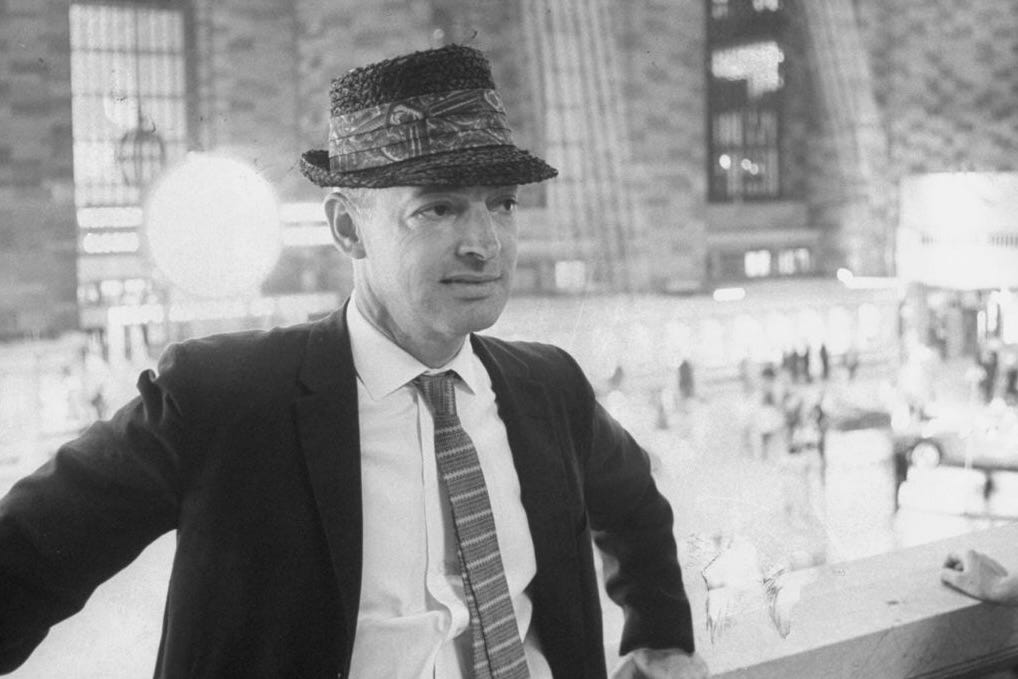
We might do well to forget all that. We might do even better to allow great novels like Bellow’s to happen to us. We live in a very immature age, and millennials are by and large a very immature generation of readers. In his fedora and tailored suit, Bellow strides toward us guffawing, stomping like a colossus into our sandbox, where we scramble to hide our YA novels and Instagram poetry and video games and memes and porn, among other things that respectable adults should not be bothered with. In his work, he pokes fun of the impulses that inspire these unproductive tendencies and attempts to bare to us our own anemic souls. Of course, it makes sense that we should contrive to avoid him.
Ultimately, few write fiction his way any more because few can even think in his terms. Few have his breadth of knowledge, his interests, his multiple languages, his wit and his charm. He thinks with his soul. He opens his maw and yawps the whole cosmopolitan century back at us, depicting the amusing absurdities of capitalism, progress, materialism, technology, modernity, liberalism. Yet, in my view, nothing ties his work together like the spectral and mystic acid trip underlying his prose. On every other page his Dagons gorp at us, his dead observe our grainfields, and this is the most superb and absorbing quality of his oeuvre. It’s been said that he’s not so hot at plotting, that some of his characters lack depth (they don’t). But whatever his failures, he makes up for it all in sheer restlessness, originality, multitudinousness, vastness.
The David Mitchells of the world will never let us alone, though no one I know is still reading Cloud Atlas. Those kinds of writers come off as merely performative, whereas Bellow took the risk of expressing his own immutable self, with all his prejudices and flaws and unanswered questions included. The point of his novels are the novels themselves, as works of art. They do not make a statement nor offer values or solutions, nor do they play by the rules.
If you read him, try letting him move you. If you do, you may well recognize your own soul turning circles inside his walled gardens.

Tyson Duffy is a writer living in Atlanta. His work has appeared in Hobart, Carolina Quarterly, The Millions, and RealClearBooks. Read him on Substack @tliterarian.
 | A guest post by
|
In a way, Bellow saved my life. I was divorced, broke and broken. I took a copy of something huge and complicated back behind the house and started reading it. I can't tell you which one because it was forty years ago, but the book had a green cover and dense, meaningful, captivating prose that spoke directly to me and said enough that I understood I was not unique and there was more that life had to offer for me. Bellow, unique, fantastic and valuable. He was a treasure and the world will not see his like again.
No one does it like Bellow. No one gets the rich contradiction of beauty and petty evil and above all fun of human existence. No one is as deadly on the page as him.
Thanks for this, but I do think you let him off the hook too easily on the Sammler point. The fact is that Bellow descended into reactionary politics, as many writers and artists do. It made his work worse. That book, in particular, is made worse for its racist depiction of the pickpocketer, which he doesn't do enough writerly work to distance the reader from. Many such (trotskyite) instances!
Nevertheless, Bellow remains an absolute favorite, a Chicago GOAT, and you did the best of him justice here.