


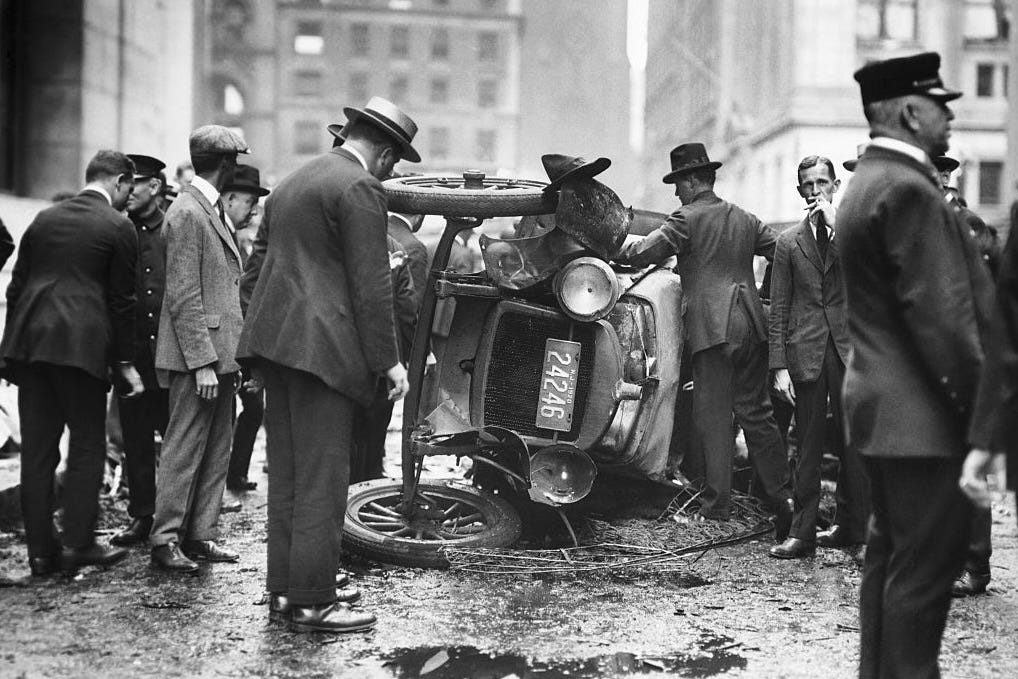
At the turn of the 20th century, the city became a source of concern, something to study, something to ponder. On the back of the Industrial Revolution and the concurrent disappearance of older, more rural forms of life, millions of people in what is called “The West” began to move to urban centers. With Empire and imperialism at their height — recall that the Berlin Conference, where the imperial powers divided up Africa, happened only in 1884 — the city expanded and became the metropolis. This process of cramming human life into smaller and smaller spaces was vividly described by Friedrich Engels as early as 1844, when he referred to London suffering from “colossal centralisation.”
The facts and figures for this period are stunning. For example, in the United States, between 1880 and 1900, the total number of urban residents grew by 15 million people. It is widely believed that London was the first major metropolitan center to reach 2 million people, sometime in the mid-1800s. New York was the first urban center to reach 10 million people, sometime around 1936. In 1800 20.5% of the United Kingdom’s population lived in cities. By 1925 that figure was over 75%.
It is around 1900, indeed 1903 to be exact, that the growth of these cities begins to become an active problem for us. George Simmel writes his “The Metropolis and Mental Life” in 1903, positing the city as an alienating, unnatural nightmare. As the 20th century continued, a robust discipline of urbanism would crop up. So too, would an emerging literature. The city would become the subject of our prose, and the question of how to write the city in fact defines many decisive moments in the history of literary modernism.
Concurrent with Simmel’s negative evaluations of urban life, the Swiss writer Robert Walser moved to Berlin and began penning fanciful micro-stories that posited a rosier view of the city. In his “In The Electric Tram” our author is ebullient: “Riding the ‘electric’ is an inexpensive pleasure. When the car arrives, you climb aboard, possibly after first politely ceding the right of way to an imposing gentlewoman, and then the car continues on. At once you notice that you have a rather musical disposition.” This is from 1908. By 1916, however, Walser’s stories of city life are getting a little darker. The charm of Berlin has worn off, and the city is becoming increasingly sinister. His 1916 story “Full” tells the story of the horse-drawn omnibus that rides through the streets of Berlin, forever full, forever crowded as its good humored conductor does battle with the citizens who refuse to believe his transport is at capacity. There is less joy in these pages, more strange curiosity, and a looming threat of violence when one Monsieur Dreadnought objects to the omnibus’ lack of space.
The modern city, from its inception, had been understood as a place of horror. As early as 1850 — the Year Zero of many studies of urbanism — Wordsworth had named a certain feeling of separation and anxiety that were part and parcel of the urban experience. In Book VII of his Prelude, he writes of the masses in the city: “Have I gone forward with the crowd and said/Unto myself, ‘The face of every one/that passes by me is a mystery!’” The experience of being alone in the crowd would have been relatively novel, an existence defined by loneliness and anxiety. This sense of isolation is transformed by the Victorian poet James Thomson into a properly gothic scene of horror. In The City of Dreadful Night (1870) he writes that “The City is of Night; perchance of Death.” The language Thomson adopts throughout clings to the shadows and alleyways of the ominous and dark metropolis he describes, where “gloom” and “mourners” and “necropolises” reign and madness is never far away:
The City is of Night, but not of Sleep;
There sweet sleep is not for the weary brain;
The pitiless hours like years and ages creep,
A night seems termless hell. This dreadful strain
Of thought and consciousness which never ceases,
Or which some moment’s stupor but increases,
This, worse than woe, makes wretches there insane.
From Wordsworth’s mystification at the crowd, to Thomson’s full-blown insanity, it is poetry in the late 19th century that begins to charter the experience of the modern metropolis. In 1895, the Belgian poet Émile Verhaeren published his Tentacular Cities. At this point the romanticism of Wordsworth is being left behind. Verhaeren was a contemporary of Mallarmé and is closer to Symbolism than he is to Romanticism. Yet Tentacular Cities is saturated with gothic imagery. Whether Varhaeren ever read Thomson I do not know, but they both saw in the city something monstrous. In the first poem of Tentacular Cities, “The Plain,” we begin outside the city, in the country. Yet even here industrialization, which has driven everyone into the city, appears deathly and atrocious:
Frightful and criminal, the arms
Of monstrous machines
Scything the evangelical wheat
Have terrified the melancholy old sower
Whose gesture was as one with the sky
We soon learn about “the black immensity of rectangular factories untold” before we are transported to the second poem, “The Soul of the City” where “the roofs look as though lost” and the city, with its “ungodly viaduct” is built with “shadows upon shadows.” Things continue in this haunted register as Verhaeren tours us through the ports and brothels, the streets and bars and churches of the modern European Gomorrah.
Thomson and Verhaeren are careful, meticulous poets. The City of Dreadful Night and Tentacular Cities are carefully constructed, precisely metered verses whose length verges on the epic. Yet as urban documents, as attempts to render poetically the experience of the city, they are incomplete. Thomson and Verhaeren present powerfully the image of the city, but they fail to capture its immensity, its chaos, its full splendor. This may be due to some Romantic hangover: these poets’ artistic proclivities to unification and order were in full dissonance with the dynamism and disorder of the modern city.
In 1922 two important works are published. The first is, of course, James Joyce’s Ulysses. Ulysses is many things, and one of them is an ode to Joyce’s hometown of Dublin, which he painfully reconstructs in his modernist masterpiece. Joyce, writing in Zurich, Trieste or Paris, often consulted maps and directories of Dublin in order to bring Dublin to life accurately and meticulously. Yet it is not the attention to detail that marks Ulysses as an important moment in the history of writing the city. It is in fact the novel’s chaotic, stream of consciousness character. The immensity and sheer vibrancy of city life are best conveyed by a lack of order and meticulousness. Though deliberate, in Joyce’s prose the city comes alive most intensely not in scenes of clarity and faithfulness to reality, but in the novel’s messier, harder to follow chapters, such as the eighth one, “Lestrygonians,” in which the chaos of Davy Bryne’s pub during lunchtime is evoked through overlapping conversation and Leopold Bloom’s inner dialogue.
Mário de Andrade’s Hallucinated City also appears in 1922. Andrade is considered the father of Brazilian modernism, and in the poem’s “Extremely Interesting Preface” he declares he is founding “Hallucinism” and that we hold “a book obviously impressionistic.” Andrade has already written his metered and rhymed poems and this, Hallucinated City, will be something else. A dedication to São Paulo, Andrade abandons the careful and delicate constructions of Thomson and Verhaeren for a more chaotic and impressionistic style. In “The Processions,” Andrade writes:
Monotonies of my retinas . . .
Serpentines of quivering beings unrolling . . .
All the forevers of my visions! “Bon Giorno, caro”
Horrid cities!
Vanities and more vanities…
No wings whatsoever! No poetry whatsoever!
No joy whatsoever!
Oh! The agitating of the absences!
São Paulo — the great mouth with a thousand teeth;
and amidst the trifid tongue the torrents
Of pus and more pus of distinction . . .
Men whirl past, feeble, short and skinny . . .
Serpentines of quivering beings unrolling . . .
These men of São Paulo,
all equal and unequal,
When they live within my eyes so rich,
seem to me just so many monkeys, just so many monkeys.
There are touches of the horrendous gothic imagery of Thomson and Verhaeren here. Andrade himself was an admirer of Verhaeren. What Andrade has realized, however, is that to do the city justice, a different register is needed. Reaching for impressionism and juxtaposition will, for Andrade, convey the city better than any meticulous application of image after image. All the ideas that will define the avant-garde in the 20th century — the unconscious, immediacy, the work of art generated by instinct first and thought later — Andrade praises in his preface. Yet he is, in a way, misleading us. For the decision to break with older forms of poetry, to lean into the impressionistic and the fragmentary, is also a deliberate attempt to capture the city. There is no natural transition from São Paulo as an infected mouth in the second stanza to the men of São Paulo, who appear as “just so many monkeys.” What unites these images is their location. This is Andrade’s insight into the question of how to write the city, that what must be captured is the immensity and the contingency of the city: so many things happening at once for no particular reason. How to capture so great a confluence? Thomson and Verhaeren’s cities are dead. Not just dead because they appear adorned with the insignia of the gothic and therefore the deathly, but dead because they cannot capture the movement, the vibrancy of urban life. The modern city is an exercise in juxtaposition which Thomson and Verhaeren fail to capture.
Joyce to some extent understands the centrality of juxtaposition in rendering the city, but Joyce is not strictly trying to depict Dublin. His meticulous Dublin is mise-en-scène for the drama of Leopold Bloom and Stephen Dedalus, for modern man and modern consciousness, for Irish nationalism and liberation. So much of Ulysses is interior, and one gets only the occasional glimpse of Dublin as a living, breathing city. Besides, in 1904, the year Ulysses is set, the population of Dublin was a measly 450,000: no true metropolis.
The sheer immensity of city life poses a problem for any budding writer. What would it look like to capture this immensity? In general, the novel tends to follow the dramas of very few persons, teasing out their lives, their conflicts, their tribulations. It can take hundreds of pages to present these intrigues. Thomas Mann’s 1924 novel The Magic Mountain follows loyally such a pattern, immersing us in the sanatorium years of Hans Castorp over the course of some 700 pages. Despite the relatively small caste of lively characters and the book’s remote setting, the specter of urbanization hangs over the book regardless. As the book closes it sounds the notes of the impending mass slaughter of millions of anonymous conscripts on the battlefields of World War I, a slaughter powered by the same forces of industrialization that led to urbanization in the first place.
What is striking about Mann’s The Magic Mountain, and indeed many of his works, is the musicality. I do not simply mean that Mann’s prose sounds good, that it is “harmonious,” but that it structurally resembles a piece of music. Mann conceives of The Magic Mountain as a kind of grand symphony or opera, with different sections having different paces, different feels, and different timbres. At the book’s conclusion, after the last line of narrative, we read “Opera Finis.” An animating question for Mann is clearly how he can push his writing to be more musical. Not just to sound flowing and beautiful to the reader’s ear, but to be organized and constructed like a symphony, to reach for the grandiose heights of classical music. If a sense of grandiosity has been conveyed mostly by the grand ensemble of the symphony, how can a similar effect be achieved in the novel? The Magic Mountain represents an instance of blending mediums, of important ideas and structures from one artistic form being transposed onto another.
I belabor the point about Mann’s musical proclivities because he will not be the last writer in the 1920s to look to other art forms to try and build a better, newer novel. John Dos Passos’ Manhattan Transfer, which appeared a century ago, tries to capture the complexity of the city by turning to the emerging art form of cinema to make its point. For Dos Passos, the montage held the key to conveying the sheer immensity of urban life. In the poetry of Andrade we see the emergence of a modernism of impression as a way of writing about the city. There is no evidence Dos Passos read the Brazilian poet, but he certainly read Joyce, whose impressionistic style could convey much rapidly. The problem with Verhaeren and Thomson was that they sought to depict the city as a single image, one great canvas. Passos ventured that a series of brief interlocked images, shifting quickly from moment to moment, might be a better way to convey the magnitude of life in New York. In a note to Joseph Waldmeir, Dos Passos wrote, “The artist must record the fleeting world the way a motion picture film recorded it.” Having been impressed by the use of montage in the films of D.W. Griffith, director of The Birth of a Nation, Dos Passos realized he had found the key to rendering the city in prose form.
Manhattan Transfer is a remarkable and kaleidoscopic book. Its cast of characters is immense, and many of them do not cross paths. There is Bud Korpenning, Ed Thatcher, and his daughter Ellen Thatcher; Jimmy Herf and Stan Emery; George Baldwin and Joe Harland; Anna Cohen and Gus McNeil. And then there are dozens of minor characters. The fates of these characters diverge and intertwine and some never meet. Some die in despair, or perish by suicide. Some end up rich and wealthy, others impoverished. Bud Korpenning seeks a new life in New York City, but he instead ends up falling from the Brooklyn Bridge as the sun rises, producing one of the more evocative images in the book: “The sun has risen behind Brooklyn. The windows of Manhattan have caught fire.” Ellen Thatcher climbs her way through New York City’s socialite circles before falling in and out of love with Jimmy Herf. Stan Emery, Harvard-educated and debonair, sets himself alight in his apartment. Gus McNeil rises from cucked milkman to slick big-city politician, while attorney George Baldwin remains a bull only in the bedroom as his legal career stagnates and stalls.
The book’s famous opening combines claustrophobia and immensity alike. A ferry arriving in Manhattan, “skidding on the tide, crashes, gulps the broken water” and disembarking its passengers who “press through the manure smelling wooden tunnel of the ferryhouse, crushed and jostling like apples fed down a chute into a press.” The throng of the arrivals is already too much, straining the infrastructure. Man lives already on top of man and he is already objectified, a product in a process, already overwhelmed, crushed and jostling. Dos Passos plays a nice joke on the incomprehensibility of the city shortly after this. The hapless Bud Korpenning tells someone he wants to get to the center of things and is told if he walks down Broadway for long enough he will, indeed, reach the center. Bud himself is a cipher for many critiques of the city, but here he represents a decisive split between the town and the metropolis. Having come from upstate, he is foolish enough to believe that being a good worker is enough, foolish enough to believe a place like New York City still has a center the way a small town might.
Each chapter of Manhattan Transfer is divided into small, stinging, memorable sections that move quickly and disjointedly from one to the other. There are no transitional scenes. The book does not have an overarching plot; rather, it follows the rise and demise of our various denizens of New York. Unlike Joyce’s Ulysses, its plot does not coalesce around a handful of characters. Dos Passos, by employing such a large cast of characters, stages the city itself as the main protagonist in a way Joyce does not fully achieve with Ulysses.
The writers also differ in their impressionistic approaches. For Joyce —and this is another mark that keeps Ulysses from being a great novel of the city — the impressionistic style is a direct result of the stream of consciousness style that predominates the book. Here is an example, chosen almost at random:
A procession of whitesmocked sandwichmen marched slowly towards him along the gutter, scarlet sashes across their boards. Bargains. Like that priest they are this morning: we have sinned: we have suffered. He read the scarlet letters on their five tall white hats: H. E. L. Y. S. Wisdom Hely’s. Y lagging behind drew a chunk of bread from under his foreboard, crammed it into his mouth and munched as he walked. Our staple food. Three bob a day, walking along the gutters, street after street. Just keep skin and bone together, bread and skilly. They are not Boyl: no, M’Glade’s men. Doesn’t bring in any business either. I suggested to him about a transparent showcart with two smart girls sitting inside writing letters, copybooks, envelopes, blottingpaper. I bet that would have caught on. Smart girls writing something catch the eye at once. Everyone dying to know what she’s writing. Get twenty of them round you if you stare at nothing. Have a finger in the pie. Women too. Curiosity. Pillar of salt. Wouldn’t have it of course because he didn’t think of it himself first.
It goes on like this for some time. Passos’ attempts at impressionism are less virtuosic, but they are also more external. Here is a passage, again chosen more or less at random, from Manhattan Transfer:
Sunday afternoon Fifth Avenue filed by rosily dustily jerkily. On the shady side there was an occasional man in a top hat and frock coat. Sunshades, summer dresses, straw hats were bright in the sun that glinted in squares on the upper windows of houses, lay in bright slivers on the hard paint of limousines and taxicabs. It smelled of gasoline and asphalt, of spearmint and talcumpowder and perfume from the couples that jiggled closer and closer together on the seats of the bus. In an occasional storewindow, paintings, maroon draperies, varnished antique chairs behind plate glass. The St. Regis. Sherry’s. The man beside her wore spats and lemon gloves, a floorwalker probably. As they passed St. Patrick’s she caught a whiff of incense through the tall doors open into gloom. Delmonico’s. In front of her the young man’s arm was stealing round the narrow gray flannel back of the girl beside him.
This is less about free association of the wandering mind, an attempt to render daringly in prose the subjective experience of consciousness, and more an attempt to collect all the overwhelming visual threads the metropolis throws at one who moves through it. It is surely true that, as cultural theorist Heike Schaefer argues, Dos Passos is attempting to capture the “sense of disorientation, perceptual overload and acceleration . . . that characterized modern urbanity for many city dwellers.” Yet for literary scholars who discuss Manhattan Transfer, they often assume this goal of his is almost sui generis, as if Dos Passos awoke one day, and decided he must evoke the city using montage. The shift to the impressionistic, however, is part of modernism’s style and part of its attempt to depict the emergence of the city, of the metropolis. Cinema represents one track of modernism, emerging in the same era and from the same urban environment. Dos Passos merely combines these two tracks, melding the modernism of cinema with the modernism of the novel.
Dos Passos’ main technique throughout Manhattan Transfer is the cutaway, the montage. The poets of the 19th century who sought to write the city looked to create one grand image, but Dos Passos realized that the city is best conveyed as a series of several moving images. This movement and montage that Passos borrows from cinema allows him to zoom in, to combine synecdoche and allegory. For example, Dos Passos has shown us a metaphor for the city, an apple cider press that crushes its citizens. Cut away, and enter Ed Thatcher. Honest, hapless, and exuberant at the birth of his daughter, in a bar drinking to celebrate. A stranger strikes up a conversation, promises to pay the bill, but leaves Ed on the hook. Cut away, Ed watches a building near his burn down. Welcome to New York!
Montage is not the only technique that Dos Passos uses to great effect. Each chapter begins with an italicized text, places where an epigraph normally appears. These function as scene settings, the equivalent of what would read on a script something like: INT. A CHEERLESS ROOM. A MAN IS SCARED. This allows Passos to achieve a telescoping effect in Manhattan Transfer, as these details, often broad impressions of New York City, unfold alongside the agonizing minutiae of the lives of its citizens. For example, here is the start of the chapter “Fire Engine”:
Such afternoons the buses are crowded into line like elephants in a circusparade. Morningside Heights to Washington Square, Penn Station to Grant’s Tomb. Parlorsnakes and flappers joggle hugging downtown uptown, hug joggling gray square after gray square, until they see the new moon giggling over Weehawken and feel the gusty wind of a dead Sunday blowing dust in their faces, dust of a typsy twilight.
This is a simple act of scene-setting, instructions for an establishing shot. In its scope — Morningside Heights to Washington Square — it achieves the very same effect as its cinematic equivalent. A poet like Verhaeren structures his work Tentacular Cities with a series of details placed atop one another. Dos Passos grasps movement. Each little still, each section is not very dense, but we move quickly from each to the next, accumulating details over time and not space. After our little scene setting at the beginning of “Fire Engine” we are dropped directly into Central Park, in front of the statue of Robert Burns, into a fizzling date between Ellen Thatcher and Harry Goldwater, then dropped again into a conversation between George Baldwin and Gus McNeil, Gus hoping George can save him from impending legal disaster, all set against the “gusty wind of a dead Sunday.”
The montage effect of Manhattan Transfer is the most obvious, the most acute aspect of the novel. It is also the most widely discussed. Yet what renders it truly a novel of the metropolis is its attention to dialogue, to the sounds of the city. This it shares with Ulysses, but this also distinguishes it from the poetic works we discussed above. Verhaeren depicts everything, but his city is mute — it does not sing. Throughout Andrade’s Hallucinated City, quotations appear in the poems; the bustle of the city contains the frequent askance phrase, ricocheting off the bitumen. Another mark for Andrade, aware that the city, just like verse, should sing.
Joyce himself said that Ulysses was a book “about the last great talkers.” Internal, external, eternal, Joyce’s novel has an awful lot of dialogue of various kinds. As Fredric Jameson writes in “Modernism and Imperialism,” “Encounters in Joyce are already linguistic: they are stories, gossip.” Yet the attention to sound fundamentally marks the city, and indeed the metropolis. In Raymond Williams’ essay “Metropolitan Perceptions and the Emergence of Modernism,” he argues that modernism was born out of the history of the metropolis. As cities grew and grew, as imperialism shifted hordes of wealth from the global south to the global north, the city emerged as a confluence of different forces. It was where power and tradition reigned, yet it was filled with those who would speak out against it. It was anchored by the arrival of immigrants and foreigners who, separated from the native tongue of their adopted cities, saw language more as artifice than natural fact.
The metropolis, so deeply intertwined with the history of empire, is by its very nature polyphonic, filled with different voices. Voices from across the globe, from across the country, from across different classes. Dos Passos often takes this sense of polyphony to the extreme; dialogue is a major component of the book. How the characters speak marks their origin, a quick and easy way to signal that they come from disparate places. This helps enhance the sonorous quality of the novel. When Ed Thatcher goes to the bar to celebrate his daughter’s birth at the beginning of the novel, he meets the German immigrant who will, a few drinks later, swindle him: “The more the merrier,” said Mr. Zucher. “. . . But kids, they eat money. . . . Dont do nutten but eat and vear out clothes. Vonce I get my business on its feet. . . . Ach! Now vot mit hypothecations and the difficult borrowing of money and vot mit vages going up und these here crazy tradeunion socialists and bomsters . . .” It is not just the fact of so many people speaking on top of one another on display here, it is the sheer heterogeneity of urban voices. Manhattan Transfer sounds like a city, buzzing, teeming, and alive. Dos Passos’ emphasis on the aural is often overlooked, but it combines with his montage technique to cement his great symphony of concrete and misery.
In the 100 years since Manhattan Transfer first appeared, the city and literature have both transformed. One might suspect that Dos Passos’ use of montage compromised his pathos as it prevented him from fully developing his characters and the overall plot of his fiction. Instead, delving into the new techniques of a new medium, he found a way to give expression to the city and its denizens. That we may never know everything about the people who are our neighbors is a fact of modern urban existence. Everyone exists as a glimpse, a passing moment, before they cut away from our lives, taken off screen by the closing doors of the subway car or elevator. This does not mean, however, that their humanity and their tragedy are inaccessible to us. Dos Passos’ fragmentary picture of city life urges us to fill in the gaps, to connect the part to the whole, to see in the component the entirety of the machine and in the whole the millions of components that fill its concrete sinews with something resembling a pulse.
Duncan Stuart is an Australian writer living in NYC. His work has appeared in The Cleveland Review of Books, Jacobin, The Millions, and elsewhere.
 | A guest post by
|
Thoroughly enjoyable - thanks, Duncan. Manhattan Transfer will have to go on my reading list now. I was nodding along with your point about Mann's musicality. I cannot reread Death in Venice without hearing Mahler (which is as much Visconti's doing as Mann's). That got me thinking about another great "city book": Calvino's Invisible Cities. Appreciate it comes much later in '72 but curious to know if you've read that and what you think. Thanks.
Thank you for this article. I read the book a few years ago and appreciated this context. I always wonder, when looking back at a book/author that dragged the novel or any art form into a new phase, how well the writer or artist understood what they were doing and why. How intuitive and how describable is the process of formal invention, for the person doing the inventing? How well could they verbalize why they were doing what they were doing? I'm sure the answer varies.
Your focus on the formal aspects of the book also fill me with nostalgia for a time I did not actually live through, when literary experimentation and risk taking was *somewhat* less radioactive than it is today.