


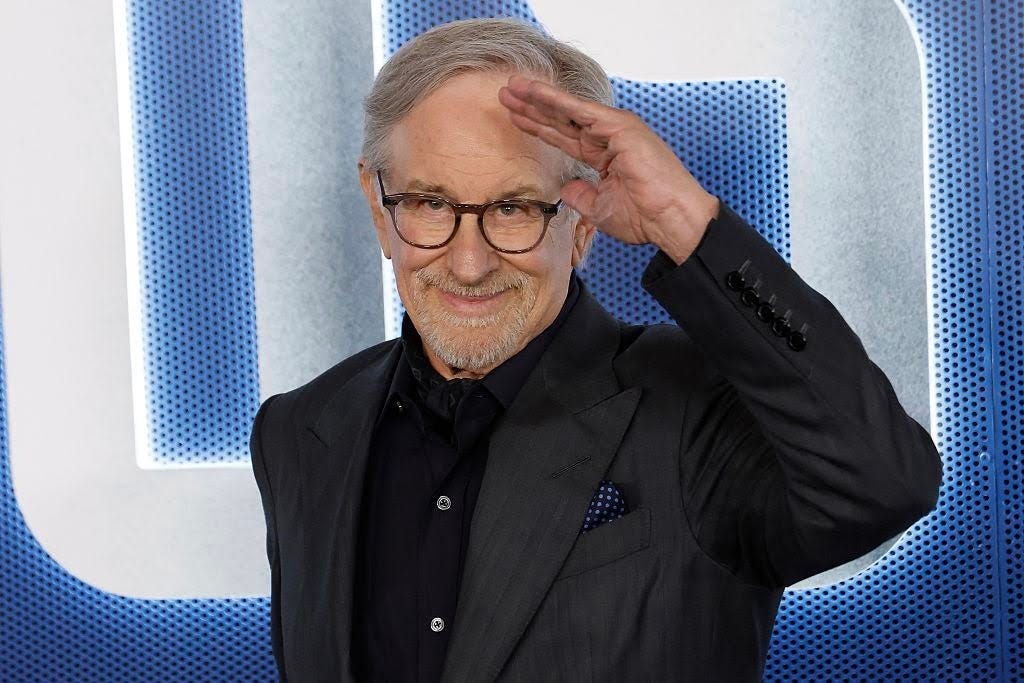
If it seems odd to call Steven Spielberg a 21st-century filmmaker, that’s surely because Steven Spielberg has had an odd 21st century. On the surface there’s been little consistency to his choice of projects. Yet look closer, and some themes emerge. There are the weird one-offs (The Adventures of Tintin), hokey throwbacks (War Horse, Kingdom of the Crystal Skull), a remake (West Side Story), and weird vanity projects (The BFG, Ready Player One). The rest seem to fall into a large, omnivorous category that he has pursued from an apparently genuine interest in confronting this moment, thinking through the ways America ought to see itself — in a classically Spielbergian, fantasist way, of course. It’s this broad field of films that have made Spielberg (though it does seem strange to say) one of the most important American directors of this century, even if his major landmarks and legacy still belong to the last one.
Consider that across just five years, from 2001 to 2005, Spielberg released six films: A.I. Artificial Intelligence, Minority Report, Catch Me If You Can, The Terminal, War of the Worlds, and Munich. Without hyperbole, this is the longest consistent run of films the man ever had. Aside from The Terminal, a merely pleasant piece of well-made Frank Capra treacle, they’re all grand entertainments of the highest order; even if they’re not masterpieces, together they represent quite possibly his finest work as a director. They’re also remarkably timely for a director usually entranced by remote fantasy. A.I. Artificial Intelligence is a blindingly manipulative and cruel work of real brilliance, which has gained more than a few passionate acolytes in recent years. Minority Report, War of the Worlds, and Munich are as definitive as post-9/11 films get — all three astonishingly dark, brutal allegories of surveillance, paranoia, technology, the War on Terror, and conflagration in the Middle East. Where in the ’90s Spielberg had made Saving Private Ryan and Amistad as gestures towards America’s hopefulness at the close of its century of successes, these films are an existential panic attack, in which the great Boomer mythologist began to grasp what a morally gray mess American power really is.
The later American civics lessons of the 2010s — Lincoln, Bridge of Spies, The Post — are his subsequent attempts to claw back a few caveats after all that tempered pessimism of the Bush Era. Spielberg pursued them because they allowed him to take a hard-nosed look at those rare moments when our morally gray mess actually produced serious moral victories (this is the man who made Schindler’s List, after all). Lincoln was especially like this. Yet because the film’s lecture on a historic congressional compromise was written by Tony Kushner, a genuinely great dramatist, it works well as a kind of theater piece. But the same need to turn source material into civics lesson is a large part of what sank Spielberg and Kushner’s West Side Story re-do: it also couldn’t save the film from the dour sheen with which Spielberg and his beloved cinematographer Janusz Kamiński covered over all the vitality and musicality of the original.
I may be alone in saying this, but despite there being a few real classics among those, the best Spielberg film of this century is his least characteristic: the Kushner-mediated psycho-biography of The Fabelmans. It’s one of the great films of this century, and one of Spielberg’s greatest films, period; though few critics or audiences seemed to understand just what was going on there. It’s rare enough that an autobiographical entertainment fashioned from midcentury melodrama parts gets to be that disturbing. But it is: it’s fiendish, sentimental, fucked up, Freudian, Spielbergian, ultra-Spielbergian, meta-Spielbergian. Lying on Kushner’s couch, Spielberg unspooled the sadness of the American nuclear family, dueled with the secrets of his own mother’s sexuality, made clear his obsession with WWII (his father’s war), and came finally to the nub of that American Dream — as it could only ever be conceived by a nerdy Jewish boy from Arizona. What other film, by what other filmmaker, could ever climax as The Fabelmans does, with its subject discovering a terrifying, unparalleled power for cinematic manipulation, one we know will end in him beaming the achieved cultural ideal of the entire American Century out to the minds of billions of human beings? Has anyone had more of an impact on what our world thinks of American art than Steven Spielberg? The Fabelmans is the haunted origin of the wunderkind himself. That it’s also a beautiful, classical piece of entertainment makes that deep suggestiveness all the more perfect, and confounding.
Following up a career-capper like that could only ever render a film like Disclosure Day some kind of disappointment. Yet regardless of the hemming and hawing I’ve seen over the film’s apparent failures (despite my best efforts, I couldn’t entirely avoid the discourse), I found that Disclosure Day worked on me like an old charm. Absurd newsroom finale aside, it’s a dazzling work of movie art by a late-period master, whose blocking and image-making remain so creative and fluid, he can spin something this completely nonsensical and idiotic into a thrilling, dynamic experience. I find it difficult to argue with images. Sense or nonsense, films are composed of movement and rhythm and the juxtaposition of frames with other frames; in Disclosure Day, Spielberg’s style and precision with these elements is still the work of an obvious genius. But as with all Spielberg films, that genius is still peculiarly at the mercy of whatever vehicle he happens to be driving. His famous and unparalleled ability to play on the basic emotional reactions of his audience is always placed — blindly, even amorally — at the service of whatever action he’s trying to convey. A Spielberg film has to fight hard to communicate through more literate tools, like subtext, allusion, or even thematic subject itself; since it’s always battling for the attention of an audience constantly hijacked by pure, active form, produced by the greatest, most shameless artificer American cinema has ever known.
Like his most obvious progenitor, Hitchcock, Spielberg is not exactly an “art film” director, and he almost stands outside the distinction: what he’s great at is finding efficient, clever, and original ways of conveying information. With Hitchcock, information is conveyed in a way that’s intimately exact, usually macabre, so precise it becomes comedic. And in Hitchcock the thinking of the film lies in the observations made about the fundamental strangeness of human psychology. This is one of its great features — that sheer interest, the squirming fascination always floating abstractly in the movement of figures through his films. And yet the subtexts of Hitchcock’s greatest works remain so suggestive and powerful, they sometimes become art films despite themselves, which is how they developed into such objects of fantasy for other directors. Brian De Palma’s main canvas is a technologically expanded version of Hitchcock’s, overlaid with a sort of giallo operaticism; David Lynch’s films turn over Hitchcock’s subtexts in their unconscious, dreaming between the lines, finding in the interstices of Hitchcock’s images a world of sub-rational madness. The works of both directors are clues as to what may have been going on in the deepest, strangest parts of the master’s mind. They are also, crucially, what is missing from Spielberg’s cinema.
Spielberg will try every trick there is, and happily invent new ones, executing them all just as precisely. But as a director he almost subordinates thinking entirely. He’s addicted to process itself, so his plots and scenarios have to do the thinking for him. Which is why he chooses — as Scorsese does (though Scorsese is essentially a moralist) — the material he believes can best convey his immediate interest, as he grafts his style atop it. This doesn’t mean Spielberg isn’t emotional: his gift for sentiment is legendary, he’s the last heir to Frank Capra and Charlie Chaplin. But in the end emotion for Spielberg is just more pure cinematic effect, something many other filmmakers would avoid making so conspicuous (or, if inferior, would handle less dexterously). Spielberg wants the audience involved and is interested in any method that can make this happen. When he starts to get interested in messages, too, his desire to entertain erupts in a paradox.
Such was the issue with Schindler’s List. It’s technically astonishing, emotionally overwhelming, unflinching, and totally committed to displaying its violence as realistic, quick, and cruel. It does a great deal of work to empty its bloodshed of any traditional catharsis or eroticism, which is what it gets right: it often shocks its audience out of their usual relationship with on-screen violence. But the dictum remains: stay interesting. Entertain. The smuggling of the workers to freedom, the moments of suspense in which Jews are saved from almost certain death, the sequences of mordant humor — they’re there to create suspense, to generate audience involvement, to play on viewers’ emotions. Plenty of critics have found much to distrust here. Is it really doing justice to the horrors of the Holocaust to create suspense out of the gas chamber? Spielberg gets away with it — barely — because he’s so intent on counteracting our normal cinematic relationship to history and violence throughout the rest of the film.
Fortunately for Disclosure Day, there are no such textual paradoxes to worry about. If there is a paradox, it seems to stem mostly from the film’s being a rather grand personal fantasy — one which doesn’t have much to do with our actual world. Most of the criticism I’ve seen of the film gets hung up on these foibles: on the magical alien devices, or the unstoppable digital tracking apparatus of the movie’s omnipotent evil corporation WARDEX; but also the heavy-handed “empathy” angle, or the impossibility of reaching the whole population through a cable news network in Kansas City, or the idea that the revelation of clandestine UFO recordings would be treated today as anything other than a spurious fabrication. The whole thing smacks of an unmodern, sentimental misunderstanding of the contours of our braindead, media-addicted world. What we’re left with really is a pure fantasy. And yet the vague sense that going to the movies right now is all a bit passé, only to watch something so out of touch and blithely unrealistic, spurred me into still greater admiration of both the film and the filmmaker.
True, it features one absurd plot point after another, depending entirely on a magical confluence of actions, on characters having constant chancy intuitions, guided mystically towards the film’s final denouement, the titular disclosure. The plot concerns the attempts of engineer Josh Kellner (Josh O’Connor) and newswoman Margaret Fairchild (Emily Blunt) to find each other and Hugo Wakefield (Colman Domingo), who, like Josh, absconded from WARDEX with a plan to inform the world about everything the U.S. has kept secret since the 1947 Roswell incident. WARDEX is run by big baddie Noah Scanlon (Colin Firth), who first kidnaps and later mind-controls Kellner’s girlfriend Jane (Eve Hewson) through the magic of the aliens’ handheld devices. Much of the film consists of Josh and Jane on the run from WARDEX (beginning, refreshingly, in medias res, with a hand-off at a wrestling show), before lying low at an abandoned farmhouse; meanwhile Margaret blunders her way into the chase after suddenly discovering she can speak multiple languages and see people’s lives just by looking at them.
The sequences in and around the farmhouse contain some of the cleverest and smoothest set-piece work Spielberg and Kamiński have ever done, including one of the better car chases in films of late, and a perfectly timed nail-biter involving a crushed car and two speeding trains. Hewson is excellent in an incredibly difficult part, though O’Connor — usually one of the most interesting actors alive — is a bit too soft and muted (it’s a thankless square hero role). Emily Blunt gives perhaps the best performance she’s ever given, in a part that’s mostly technique, though she still manages to summon inspired notes of guilelessness and genuine fear. Josh and Margaret discover that they were both abducted by aliens as children — in what’s surely the most benevolent child abduction this side of Close Encounters of the Third Kind — then blessed with magical intuitive abilities (him, math; her, empathy; so goes the silly formulation). They find themselves eventually in Wakefield’s reconstruction of Margaret’s house, reliving her abduction by wonky CGI animals, leading her child self to an actual fairy-tale house, which ends up transforming into the glowing white interior of the alien spaceship.
Here Spielberg and screenwriter David Koepp go off the deep end like neither has ever quite done before. The sequence is far from perfect, yet it has the unmistakable, giddy rush of filmmakers finally getting to show things they’ve only suggested before — as the The X-Files once did, as other Spielberg films have done — while milking that eerie picture-book scene of the animals and the girl in the snow for all it’s worth. Few scenes in recent movies have required so much suspension of disbelief from the audience, and the sequence will probably test the patience of any audience member already a bit tired of the film’s absurdities.
Yet, watching it, I couldn’t help but be carried along. Far from feeling hit over the head with “wonder” and “awe,” I felt the creaky old magic whirring to life — memories of a choreographic rhythm, a surrender to pure archetypal imagination, of the kind that once marked Hollywood’s greatest cinematic dreamworlds. It made me mourn for a medium that feels so stranded now — either in a constant chirpy pseudo-irony or else in a relentlessly grim pseudo-realism, either of which usually unfold across the same discolored and computer-generated vistas. American film has mostly lost its ability to create a true rhythm; it has lost the touch of organized and timed unreality, along with much of its gift for choreography, and much of its faith in artifice. These are now arcane arts, practiced by a few auteurs here or there, while general audiences slowly lose touch with the original cinematic feeling itself.
But enough eulogies — all art forms wax and wane. Disclosure Day is a mess of a movie made by a historic practitioner of the form, elevating it above most other blockbusters by nature. Yet it’s also a reminder that logic, plot, and reality are nothing compared to remarkable images. That the film can’t quite stick its landing may hobble it in some viewers’ minds, but there’s enough real movie magic throughout to remind them of what that actually looks like on the screen. It’s extraordinary that Spielberg has continued this far into our century, while remaining this expert and this relevant (and despite the protests you hear, he’s very much still relevant): that fact should move us to take better stock of how much territory the art form still has to regain, if it’s going to finally pry itself out from under the weight of these last few fallow decades.

Sam Jennings, The Metropolitan Review’s film critic, is an American writer living in London. He is an Associate Editor at The Hinternet, and he runs his own Substack, Vita Contemplativa. For those interested, his Letterboxd account can be found here.
 | A guest post by
|
This is a beautiful review that really gets at the core of what makes Spielberg such a great filmmaker, and if I liked Disclosure Day less than you do, everything you point out as an asset is indeed an asset and I'm glad he's still directing.
But -- I think you're being a little too down on the remade West Side Story. Obviously (obviously!) it is worse than the original, and there's a couple cloying nods to modern political sensibilities. But it is a lot better than I expected, and particularly deserves praise for being the first adaptation of WSS (stage or screen) to *finally* figure out what to do with "I Feel Pretty," which is the highlight of the film. And I'm not just saying that to damn with faint praise!
Lovely essay. I especially enjoyed your thoughts regarding the ways art can bring unconscious or subconscious worlds to life.