


I. Inauguration of the Pleasure Dome
Christmastime in Las Vegas: tinsel on the slot machines, Santa hats on the pit bosses, short days, vivid winter sunsets, balmy nights. Tourist shortages have recently put the city in a nervous mood, as Americans increasingly choose to gamble from the safety of their couches, but you wouldn’t know that making your way through the crowds that fill the plush lobbies and malls and casino floors of the Wynn and the Venetian and the Flamingo, crowds of staggering variety: couples and families from Tel Aviv, from Dubai, from Shenzhen, all there to experience the most American of cities, that strange neon bloom in the desert built on mob money and defense money and the fantasy of hitting it big. That’s where I was, in town to meet up with my girlfriend and her family for the holidays, and consumed with thoughts of The Wizard of Oz.
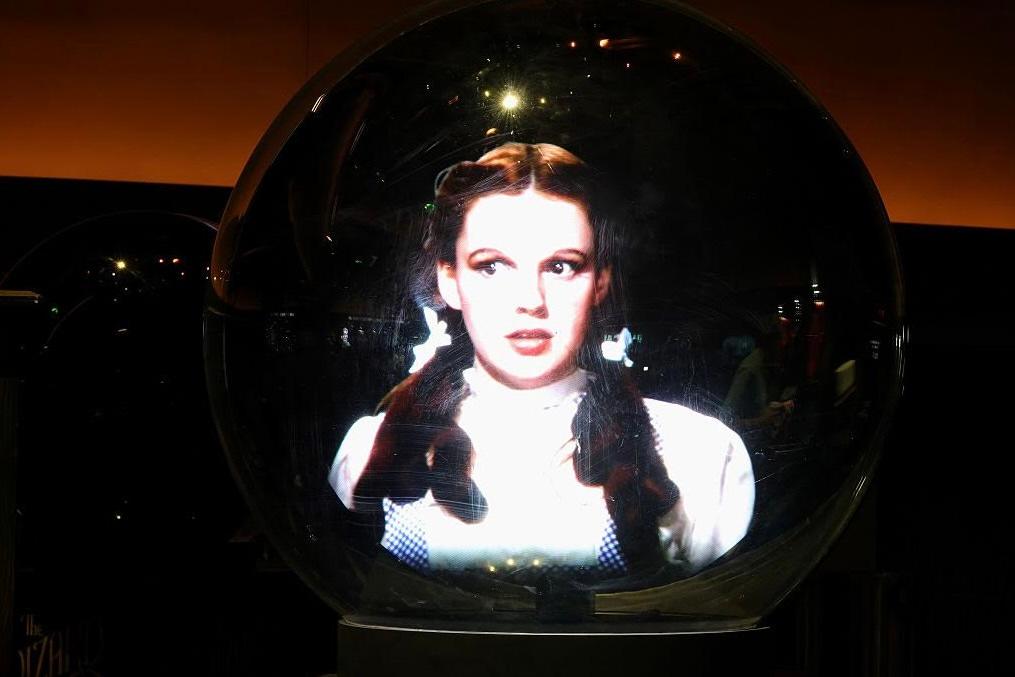
Consumed because we had tickets to The Wizard of Oz at Sphere, a “4-D experience” at the gigantic domed arena which “harnesses the power of AI, alongside traditional VFX, to bring The Wizard of Oz — a film made in 1939 — to life in an unparalleled way,” or so the promotional copy says. And consumed because, ever since I first saw it as a small child, I have considered The Wizard of Oz, if not my favorite movie, at least the Ultimate Movie, the American Midsummer Night’s Dream or Alice in Wonderland, art and entertainment and joy and tragedy all working as one. It means something that Sphere Entertainment has, at a cost of over $100 million, chosen The Wizard of Oz for its inaugural venture into film (not counting a U2 concert film or Darren Aronofsky’s glorified planetarium show Postcard From Earth) and not Star Wars or Marvel or any other more recent cultural phenomenon. Their bet on this nearly 90-year-old film has been rewarded; as of this writing The Wizard of Oz at Sphere has sold 2.2 million tickets, made nearly $300 million, and been extended at least until December, and possibly indefinitely. This 1939 adaptation of an odd children’s story has turned out to be unfathomably deep and resonant. Though suffused with the spirit of the age, with the old spirit of vaudeville and the sadness and hope of the Great Depression, The Wizard of Oz nevertheless has a strong claim to being the most timeless and endlessly renewable piece of American art.
As you file into the auditorium, the Sphere’s 106,000-square-foot wraparound screen is done up to look like an old Hollywood movie palace, with velvet curtains and an ornate ceiling. The lights dim, the MGM lion roars, the fanfare plays, and suddenly the theater disappears and the sepia Kansas sky over which the opening credits roll is in front of you, above you, behind you, filling your field of vision, bigger than any other screen in the world, bigger than life. The music, newly re-recorded and blended with the original vocals at great expense, fills the hall via thousands of speakers, gorgeously clear. For a few minutes, it is enchanting.
But something’s not quite right. Something is, in fact, very, very wrong. These aren’t the characters you’re used to; they’re jerky and unnatural. Dorothy’s face is TikTok-smooth, her freckles disappear and reappear from shot to shot. Cuts have been made — a line here, a transition there — to bring the movie from 100 minutes down to 80, and the film feels sped-up, with no time to luxuriate in the small moments. In the showstopping tornado sequence, the audience is blasted with powerful wind machines, paper leaves scatter, and seats rumble and vibrate until the house lands with a thump, Dorothy opens her front door and steps into the Technicolor land of Oz. But this isn’t the Oz we know, the psychedelically unreal painted soundstage backdrops of the original. It’s a semi-realistic landscape that resembles a PlayStation 3 game. Look up! There’s a bird going into a CGI flower. Look to the left! There’s an AI-generated munchkin just standing around and waving on a loop. Dive into the behind-the-scenes promotional content for The Wizard of Oz at Sphere and you’ll find that the Google Cloud engineers interviewed sound uncannily like proponents of the roundly derided early AI trend of extending the backgrounds of paintings, so we could see what the rest of the Mona Lisa’s body was doing. Don’t you want to know what the Scarecrow was up to in all those close-ups of Dorothy? Don’t you ever wish, while watching The Wizard of Oz in a theater or on television, you had a bigger frame, so you could see residents of the Emerald City milling about in the background?
If you answered yes, you likely perceive The Wizard of Oz as a piece of endlessly remixable IP, a glimpse into a dynamic world which can always be modified and expanded upon. If you answered no, you perceive the film as a discrete cultural artifact and product of a specific place and time, and the frame as a composed space and a productive limitation rather than a constraint. It is the battle between those two incompatible worldviews that has come to define the modern entertainment industry, and as The Wizard of Oz at Sphere demonstrates, the former is currently winning. Yet the most exciting and delightful special effects in The Wizard of Oz at Sphere are all showman’s tricks as old as theater itself: the magnificent tornado sequence, the fake snow that fills the auditorium during the poppy field scene, the drone-powered flying monkeys that swoop overhead. The overwhelming size and clarity of the Sphere screen is impressive, to be sure. But it’s disquieting to watch these real people made into jerky AI marionettes, put into a new CGI landscape that has little of the beauty or artistry of the original, and much is lost when you take away the guiding hand of the filmmaker, who consciously guides the viewer’s emotions through each frame. At the end of the day, I would have had just as much if not more fun in a packed theater, watching the unimprovable 1939 version.
II. The Genius of the System
I had reached no greater understanding of the film’s unique magic, so I set out to look for answers in the accounts of its creation. To my surprise, the narrative of the immortal human artistic impulse vs. the crude and inelegant hand of the machine falls apart when you begin to study the making of The Wizard of Oz. In the late 1930s, when studio logos meant something, MGM stood for glossy prestige pictures, all swirling strings and luscious Technicolor: musicals, sophisticated comedies, highbrow literary adaptations. Under the leadership of Louis B. Mayer and Irving Thalberg (the model for the powerful Hollywood producer in F. Scott Fitzgerald’s The Last Tycoon), they were a factory, an assembly line that turned these films out by the dozen. The Wizard of Oz is the ultimate example of the studio system at full power, of film-by-committee, and its author is best described as MGM itself, embodied in the Technicolor unit, the costume department, the songwriters Harold Arlen and E. Y. Harburg, and everyone else who worked on the film. Victor Fleming is the credited director, but he was one of four (alongside Richard Thorpe, George Cukor, who worked closely with Judy Garland to develop the Dorothy character, and King Vidor, who shot the Kansas scenes). There were 10 writers, some of whom drafted large parts of the story and some of whom merely punched up dialogue and pace. Auteurism simply doesn’t apply here.
Not to say, of course, that human artistic decisions didn’t play a vital role, as they did when Harburg, Arlen, and producer Arthur Freed intervened to stop Mayer, in the role of know-nothing suit, from cutting “Somewhere Over the Rainbow.” But perhaps the alien perfection of The Wizard of Oz comes from the fact that while one can see the evidence of great effort in every frame, from the painted backdrops to the lovingly stitched costumes, the whole thing appears to have been assembled by some overmind, some higher intelligence. It runs counter to the romantic ideal of the individual craftsman, the ideal by which we are taught to understand most kinds of art. And yet, like a medieval cathedral built over hundreds of years by thousands of hands, the film is no less human for it.
When it came out, it was considered neither a masterpiece nor a blockbuster. “As for the light touch of fantasy, it weighs like a pound of fruitcake soaking wet,” pronounced the New Republic’s Otis Ferguson, who also called Garland’s singing and dancing “thumping, overgrown gambols” (somebody kill this guy!). “A stinkeroo,” was the verdict of Russell Maloney of the New Yorker. There were many positive reviews as well, but the film was only a modest success at the box office, and only broke even on its lavish production and marketing budget upon its 1949 re-release. It was television that made The Wizard of Oz a phenomenon; the film was thrown in as part of a package deal for the rights to show Gone With the Wind, and became a yearly event on CBS beginning in the late 1950s, just as color television was beginning to spread.
These facts lend themselves easily to a materialist explanation for the popularity and resonance of the film: a generation of baby boomer critics and filmmakers watched it when they were young (such as David Lynch, whose love for Oz is explored in the documentary Lynch/Oz), showed it to their children, put it in their own films, and it became an enduring classic essentially by accident and circumstance. Yet, watching it, do you really feel that way? Vulgar materialism melts away when faced with its mystical, mythical power. The Wizard of Oz “somehow seems real and important in a way most movies don’t,” wrote Roger Ebert, because “its underlying story penetrates straight to the deepest insecurities of childhood, stirs them, and then reassures them.” Sooner than you think, it says to the child, you’ll be thrust into the adult world, where you’ll find color, opportunity, and friendship, but also difficulty and terror. Authority figures will turn out to be fraudulent or bumbling. You’ll have to rely on your brains, heart, and courage. As adults, we know this to be true.
It is well documented (particularly in Aljean Harmetz’s essential study The Making of the Wizard of Oz) that no one had any fun making the most delightful film of all time. Ray Bolger, Jack Haley, and Bert Lahr (the Scarecrow, Tin Man, and Cowardly Lion, respectively) arrived at the studio at 6:30 a.m. every day for their two-hour makeup sessions, and would suffocate for hours under the brutally hot arc lights needed for the Technicolor cameras. Haley couldn’t sit down in his Tin Man costume; he would lean against a board between takes. Lahr ate his lunch through a straw. Buddy Ebson, originally cast as the Tin Man, was hospitalized and put on oxygen for two weeks after inhaling too much of the aluminum powder in his makeup and finding himself unable to breathe (when they recast Haley, they changed the formula). Margaret Hamilton, the Wicked Witch, was badly burned during a stunt. Hollywood lore has it that the 124 actors playing the Munchkins terrorized the set with drinking, practical jokes, and hotel orgies; though this appears to be greatly embellished, it is undoubtedly true that they were financially exploited, their salaries ending up in the hands of unscrupulous men like Leo Singer, who leased them out like trained animals as “Singer’s Midgets.” Even Toto (played by a female Cairn Terrier named Terry) had to take two weeks off after a crew member stepped on her paw.
All this toil, strife, and exploitation must have had some subliminal effect on the final product, because part of what keeps The Wizard of Oz from being an entirely saccharine fantasy is the darkness, sadness, and pain around the edges. There are moments of cruel sarcasm and sadism, such as in the “Ding Dong! The Witch is Dead” sequence, in which the Munchkins gleefully describe the witch’s death (the falling house was “not a healthy situation for the Wicked Witch / who began to twitch, and was reduced to just a stitch”) and hand Dorothy a bouquet for having “killed her so completely.” There’s the moment no child ever forgets, in which Dorothy, trapped in the witch’s castle, sees the face of Auntie Em in the crystal ball on the table suddenly turn into the face of the witch, mocking her cries for help, or the moment when the flying monkeys tear apart the Scarecrow. And if you know anything about the American entertainment tradition, there’s something melancholy about seeing Bolger, Haley, and Lahr, all of whom came up in vaudeville, playing the Scarecrow, Tin Man, and Cowardly Lion, these creatures searching for a purpose, something to make them whole. The great indigenous art form these men trained in had vanished, utterly destroyed by the very movies they were helping to make, and even in their wonderfully comedic performances, something of this sense of loss comes through.
III. The Brains, the Heart, the Nerve
There’s one major thing about The Wizard of Oz I’ve mostly avoided mentioning until now: Judy, the girl with heartbreak in her voice. Without Judy Garland, The Wizard of Oz would be a great film, but only with her does it become the apogee of all cinematic entertainment. As the film critic Brendan Boyle has pointed out, “Of all the special effects the movie employs, there is nothing more immediately upsetting than the image of Judy Garland crying.” By now it’s well known what MGM did to Garland: fed her speed to keep her going and downers to put her to sleep, constantly criticized her for her weight and called her unattractive, employed members of the studio to spy on her, encouraged her to abort her first child, claiming it would ruin her girlish image, and eventually blamed her for becoming a flighty, unreliable addict and cut her loose. When she died of an accidental overdose at 47, many blamed MGM for what they saw as a slow-motion murder. But you don’t have to know any of this tragic background to see the real pain and fear and sorrow in Garland’s performance, her outrage when she first meets the Wicked Witch and when her alter ego Miss Gulch tries to take Toto away, and her essential kindness towards the Scarecrow, the Tin Man, the Cowardly Lion, and the Wizard. There is something in Garland’s combination of pain and goodness that immediately draws us to her, that makes us long to see her happy, safe, and comfortable again. No other movie star, Golden Age or otherwise, brings out this response.
Then there’s the voice, that inexplicable object. If Garland’s tearful face is the most upsetting thing in The Wizard of Oz, her voice somehow draws those tears out of us, cuts through everything in the world to hit us straight in the heart, as it does in “Somewhere Over the Rainbow.” (If you want to really turn on the waterworks, listen to her quavering, world-weary, gorgeously-arranged performance of “Over the Rainbow” at her 1961 Carnegie Hall concert; the entire audience pin-drop silent. Don’t listen to it in the office or on public transit, though, if you want to avoid concerned glances.) Tears are a constant with Garland. “I asked some professional musicians to explain what made her voice so great but even they were mostly reduced to mute gestures of love,” writes Bee Wilson in a recent London Review of Books essay on Garland. “No one at MGM could have taught her to sing the way she did.” Halfway through the companion podcast (and LRB podcasts are generally quite reserved affairs), discussing the resonance of “Over the Rainbow,” Wilson, too, starts crying.
But even a talent like Garland can’t carry the film on her own, as anyone who has watched her more obscure films is aware. I began this essay intending to find out exactly what makes The Wizard of Oz so perfect, so heartbreakingly gorgeous, so engineered in every frame to surprise, delight, terrify, and enchant. I have to admit, after rewatching it twice (once at the Sphere and once at home) and reading hundreds of pages on its creation and its impact, I still don’t feel as if I’ve grasped it. Perhaps there is no better explanation than to say that it bloomed up out of the collective unconsciousness, whatever subliminal story it tells us was brought into being because it had to exist, and everyone who helped usher it into the world, from the directors and screenwriters to the costume and set designers to Garland to the Munchkins, were midwives in a process they did not fully understand. You can easily detect the authorial hand or the set of social circumstances that produced other great popular art of the period: Gone With the Wind, Casablanca, Citizen Kane. They are wonderful, but ultimately explainable. The Wizard of Oz stands apart — we are still trying to decipher where it came from and what it is trying to tell us. Beautiful, funny, sad, thrilling, electrically alive in every frame, it does for us what we want to do for Garland: it is like a comet, a wondrous, shimmering orb descending upon our bewildered, frightened, tornado-tossed selves to comfort and encourage us. Sometimes one must lay down one’s sword in the war against cliché and reach for a phrase battered and beaten to death by Hollywood’s perennial celebrations of itself, by a thousand Oscar clip shows and smarmy executives and vapid paeans to the power of the silver screen. Sometimes one has to shrug and call it what it is: movie magic.
What are Hollywood movies for, anyway? Are they mere escapism, insidious distractions, showing us beautiful people and places for a while so we don’t have to think about our own circumstances? Are they a cruel dream factory, luring in the young and talented only to destroy them and later strip them for parts to be used in an AI-generated thrill-ride, meant to separate Vegas tourists from their money at the rate of three shows a day, seats starting at $110 with optional VIP Bad Witch Luxury Experience? Or are they that, but also something more? Are they expressions of our will to imagine, to create, to visualize, as the song goes, what lies beyond the rainbow, and then, through months of labor and thousands of people, bring it into being, at least for an hour and 40 minutes at a time? The current moneymen and moguls in Hollywood and the tech industry (but I repeat myself, the two are at this point one and the same) talk of eliminating the human element from filmed entertainment, of a future in which we can all spend our time in a numbed-out haze watching the voices, bodies, and personas of the honored dead ghoulishly reanimated — Mickey Mouse fighting Darth Vader, or whatever. It’s a bleak vision, a kind of cosmic cynicism that makes the likes of Jack Warner and Louis B. Mayer look like pure art-for-arts-sake aesthetes, and I shudder to think of it.
Yet watching The Wizard of Oz tells us that the artistic spirit prevails at unexpected times and in unexpected places, and that at a previous moment when studio power was at its most formulaic and tyrannical, when individual expression was crushed and labor was exploited and abused, some combination of forces nevertheless came together to produce this film: a miraculous achievement, a film that, through all its silly costumes and fantastical songs and knockabout vaudeville routines, manages to speak directly to the indescribable mix of joy and melancholy that arises in each of us when we think of the perils of childhood, of the thrills and disappointments of adulthood, and of the perennial longing for home.

Henry Begler, a contributing writer to The Metropolitan Review, writes the Substack newsletter A Good Hard Stare. He lives in Los Angeles, CA.

Reading Salman Rushdie’s wonderful New Yorker piece on Oz aloud to my wife during a long drive on our first date is when she decided to marry me:
https://www.newyorker.com/magazine/1992/05/11/out-of-kansas
So much rich material in this post! Just smart, beautiful & necessary writing. Really love your work.