


What is the state of American literature today? This loaded question never has an easy answer, and invariably the debate grows tedious, ideological and sociological combatants racing to their predictable corners, fists wearily raised. In my years as a novelist and columnist and now editor-in-chief of this publication, I’ve come to believe that large, conglomerate publishers care less about disgorging excellent literature than they once did — that this pursuit, for a variety of reasons, is less interesting to them. But this critique, on its own, can only matter so much. There are all kinds of caterwauling about a decline in value yet few attempts, from this literary pundit class, to imagine a different future. If the libs get blamed, often enough, for mangling literary fiction over the last decade, it’s not as if MAGA has offered any sort of serious riposte. The high-ranking members of their bunch are borderline illiterate.
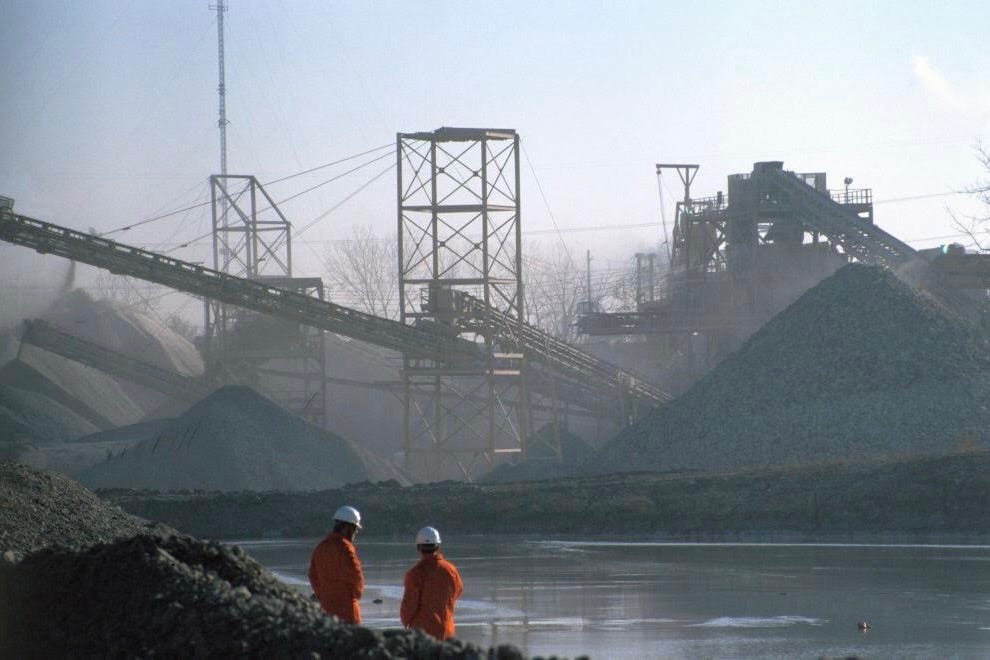
Far more interesting is uncovering talent. The good, or even great, news is that there’s plenty of it. Much of it courses outside of the mainstream now. If we can lament this state of affairs because it means fewer riches for our genuine literary talents, we can also be thankful, still, that there are works of art released into the world worth our time — that even, in certain circumstances, force us to reevaluate how we conceive of literature. Caleb Caudell’s new novel, The Quarrymen, would qualify as such a book. It is, as they say, “difficult,” and it’s one that the slop-brained will have an especially hard time poring over. Describing it adequately is its own adventure for the reviewer, much like the rock that must be split by these solemn men of the Midwest, whom Caudell renders so well.
Reviewers tend to be a sheepish lot, and I won’t be so elliptical here — The Quarrymen is a great work of literature. These works, in any era, only come around so often. When they do, one must pay proper attention.
The Quarrymen is about a 36-year-old man who discovers his father has died. He has not talked to his father in several years, though there was no dramatic falling out, no slammed doors, no screaming matches. His father, George, was a taciturn man who simply drifted away. In his life, he was, like his own father, a worker in a quarry — a quarryman — swinging hammers, drilling stone, performing brutal physical work. Before life in the quarry, his father had spent his youth in a city resembling New York, trying to make it as a musician. George, to his son’s shock, has left behind a typewritten narrative, stacks of papers, “thick columns of tiny ants jammed in traffic or smashed in their tracks.” It’s something like a memoir, and soon we are living George’s life, following an arc from his escape to the city to his return to town, the digressions and ruminations of father and son merging together, forming one enormous stream. At some point, we learn that George has killed a man who slept with his girlfriend. We learn, too, that the great shame of George’s life was that he was impotent; no matter how suave or tough he might have been, a would-be rocker, he could not properly have sex, and he solemnly bore this weight for many decades. There is no plot in any conventional sense, but there is forward narrative momentum, if nothing approaching the tidy resolutions fiction typically demands. That is fine. The Quarrymen doesn’t exist to be tidy.
Caudell, the author of several works of fiction, is a writer from Indiana who channels a certain small-town bleakness and bitterness with remarkable precision. Men struggle through dead-end jobs, women suffer them, and the gears of a greater civilization grind on elsewhere, far out of reach. Caudell’s sentences are dense, labyrinthine, and unrelenting; it’s a pleasure, in a way, to bear their wonderful verbosity because so much contemporary, prestige fiction seems as if it were written merely to be transformed into film. Caudell harkens back to Faulkner, to Musil, and to living giants like László Krasznahorkai. There are no chapter breaks, paragraphs can consume whole pages, and the sentences themselves might be just as long. Somewhere, an editor limply cried out for “signposting” and Caudell shucked him off. “The complacent restless city, a centaur machine fabulation of pimps and whores,” George remembers, or his son recalls for him. For a year, maybe more, George . . .
was always out by himself, lounging amid the tumult between travel hubs and glitzy marqueed squares, leaning against thickly painted white brick, watching the morning sun slanting on the street trees, their slender leaves glittering like glass figurines, drinking his coffee and smoking cigarettes and feeling the melancholic beauty of the moment’s unravelling, the gold limned image thread stranded by the unrelenting hoofbeats of indifferent human destinies, in their turn nothing next to the colossus of time breaking the back of history and hurling all matter into a bottomless pit.
Another writer, whether Caudell looks to him or not, who came to mind throughout my reading of The Quarrymen was Henry Miller. Caudell lacks Miller’s joie de vivre; ultimately, for whatever bile Miller managed, he was a man reveling in his own poverty, his outlook fundamentally Buddhist, if the religion also somehow prescribed an inordinate amount of fucking, real and imagined. Caudell is grimmer. Yet on page after page, with his wild philosophical digressions — Heidegger, Rorty, Jean-Luc Nancy — and the cascades of imagery, the brute similes and piercing metaphors, a life-affirming rhythm emerges. One writes a book like this out of belief: in the vitality of language, in the struggle for light in an ocean of dark. “You don’t want to die alone, no one wants that, it’s a fantasy of youth, a young man’s darkly morose and idealized ending, not a real and proper one, yes, surrounded, buttressed and comforted by love, aided by rites and ushered into the next phase by a formal act, by the one who cared for you, by those you’ve cared for,” Caudell writes. No one “should try to live like a sad poem, a few lines or visions in a paragraph, a mark on a page that entertains or charms for a moment or two, the model of that character, the broken down man with his head on the counter, ordering another round and the bartender sliding the glass, the loner and his barren home where the furniture doesn’t see him. . . .”
A real hope: more people read books like The Quarrymen, and try to write them. If American literature, at the very tippy top, has hollowed out, with publishers scrambling over $2 million AI crime novels and influencer fantasies and dragon sex, that only means there is more room than ever to maneuver below, in the shadows, in these glorious undercurrents. There is room, certainly, for ambition. Caudell has it, and that’s enough to carry a writer a long way.

Ross Barkan is Editor-in-Chief of The Metropolitan Review.
Perfectly said… and yes, I felt as well that this novel could almost be a manifesto in itself as a calling for other novelists to step up.
“There is room, certainly, for ambition.” Well put!
And thank you for bringing such an ambitious novel to our attention, book discovery is tough these days, and this is the sort of thing that keeps me hopeful literature isn’t dead at all—2M AI fiascos notwithstanding.