


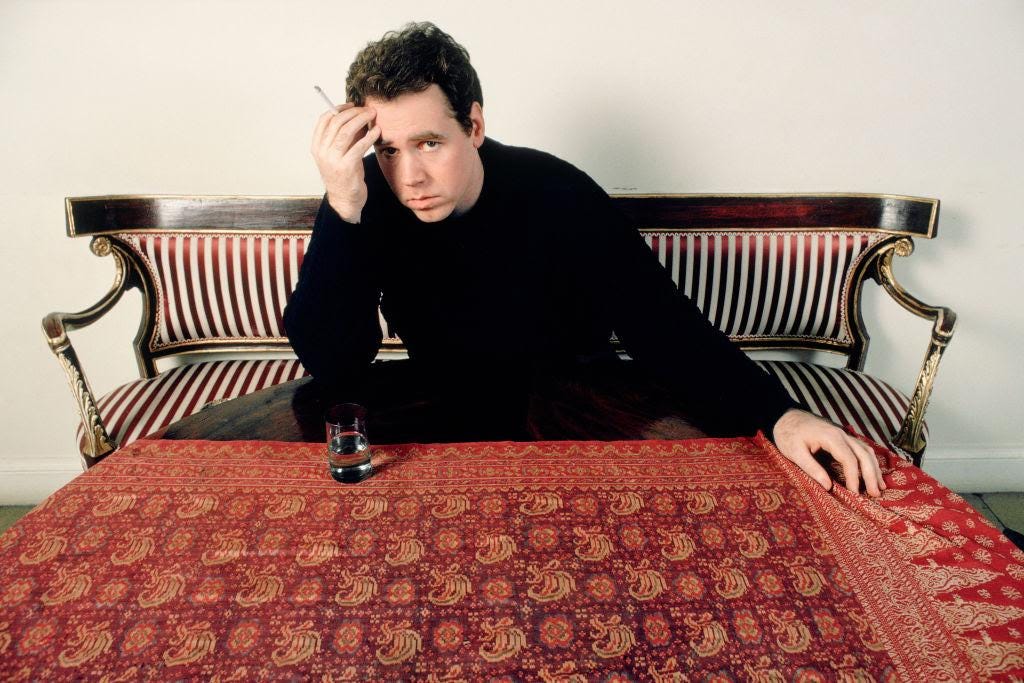
A portrait of the artist in 1986 finds him at Woods Gramercy, an upscale restaurant in what the New York Times is calling “the year of the column in restaurant decoration,” and it’s just about the only restaurant right now that’s trying to make a name for itself with vegetables, of all things; in fact the “Steamed Vegetables” is among the most talked-about dishes on its menu and the most affordable (always a good sign), and what we find here, in contrast to the peach-colored walls, striped with steel-blue columns, are what Susan Squires of the Los Angeles Times describes as “the tables of Manhattan’s publishing power lunchers,” all of whom are “spaced discreetly apart” but if we arrange the dolly shot so that it wends a path, and dips down here and there over shoulders, you’ll hear them talking about things like “the veracity of Thomas Pynchon’s vision of Los Angeles,” or whether it’s smarter to advertise a new hardcover by optimizing radio spots versus “store windows,” and finally we settle on a profile shot, paces back, of the writer himself — somehow both man-sized and boylike — sitting aside from the publishing people in a ladder-back chair, chain-smoking, gulping three mimosas in a row. Freshly 21. “Absolute Beginners” just dropped and it’s wafting in from different directions and 40 years later it’ll still be his favorite Bowie single.
If the serious young author looks “lost and vulnerable,” don’t worry — he’s a college senior and this whole Brooding Author shtick is part of the package. Sad-eyed and sleepless. He wrote a book that “disturbed” reviewer Michiko Kakutani and people in the business seem to appreciate that, thank you Bret, but it doesn’t mean they aren’t quibbling about what this kid is: a boy wonder or a fake. Writing a terse talentless novel and calling it “minimalism.” Yeah OK. Two hundred pages long and it’s got, what, 90 chapters? That’s not minimalism. It’s a music video.
The release and subsequent popularity of this debut novel, Less Than Zero, will soon slingshot the author’s body into an emotional wall such that he spends two weeks sobbing in bed, not quite knowing why, panicked about his future, stalled on the second novel for which he’s already been paid a ton of money (in the $200,000 range, most likely) and isn’t even sure anyone will enjoy it. His editor, Robert Asahina (35), is a calming presence. “We figure we’ll get [the second novel] by the end of the summer,” he says, “but if he needs more time, one month, six months, it won’t matter.” His publicist Marcia Burch is another of these adults who is Keeping Bret Calm, asking if he’d be willing to sign books at, say, a Barnes & Noble, and the answer’s yes, and so she says OK, well, how about a reading at one of these —
“No,” Bret’s quick and firm, “I couldn’t, I’m sorry,” explaining — in what reporter Susan Squires describes as a voice that’s genuinely regretful although, she notices, his face is blank — that if he goes and reads at a bookstore or a gallery he’ll feel guilty about the people who just went there to browse, enjoy themselves, not to hear some kid read his book into a mic.
Burch says OK and then lets it go. She tells Squires, off to the side, “I don’t like to push him.”
Bret Easton Ellis at 21 is tall and broad like his halfback father but he’s thin, slouching, not quite filling the sport coat he bought at the Salvation Army. His “thick white socks [are] crumpled into ancient black loafers with chewed-up heels.” Looking around at these publishing people he confesses to Squire that he can only remember one person’s name, and that he doesn’t understand why they’re fretting over him, trying to make him famous, when all he did was write “a sort of a book.”
He is still very trusting of reporters. Saying things like, “I believe in, more or less, humbleness.” At least two of them will write that he had more than multiple drinks during their interview.
“It’s probably presumptuous,” he says to Squire, “to tell them I don’t want to promote [my next book, The Rules of Attraction], because probably no one will want to talk about it anyway.”
Young enough, in other words, to believe that what they’re selling is a book.
“I think he understands that this is a business,” says editor Robert Asahina, “and he’s been a very good soldier. He’s accommodated us, even though it’s made him unhappy.”
Ellis, Squires will write, “has had to grapple with being an icon to some and a cash cow to others, and his manner of adaptation has been simply to submit until he couldn’t stand it anymore.”
The novel came out and he earned lots of money and attention and then had a breakdown and sought therapy and got better. But it wasn’t a one-time thing. Nine years later, promoting his fourth book, Bret Easton Ellis tells a Vanity Fair reporter about talking with professionals but also using exercise as therapy. The reporter confirms that Ellis, 30, is besieged more by anxiety than depression but that he “controls the problem with a drug called Klonopin.”
But in 1986 Bret was already nearly done with his second novel and thank God he didn’t sell it before the first one was published. Less Than Zero was seen as a risk at Simon & Schuster, a likely write-off. One editor, Herman Gollob, famously protested the book by writing, on the manuscript’s in-house cover sheet where editors circulated their opinions, “If there’s a market for callow, fragmentary fiction, about rich, self-indulgent, coke-sniffing, cock-sucking zombies, then let’s buy it.” But there’d be a small printing, with a low advance, and no advertising budget.
Which was fine for the author. “I thought that book was going to sell no copies. I was just happy it was being published.” Hence he took his $5,000 advance with a smile (that’s about $15,000 in 2026) and when it was locked into the Spring 1985 schedule, for a print run of 5,000 copies, he sold the film rights for $7,500.
Then the book was published.
Less Than Zero sold 70,000 copies in hardcover over the next two years. Then Vintage (an imprint at Random House) acquired paperback rights for $99,000 and sold 200,000 of those.
If he’d waited until after publication to sell the film rights, he might have earned a lot more money. But maybe it wouldn’t have become the minor cult classic it is today, with a young Robert Downey, Jr., and maybe the Bangles would never have recorded “Hazy Shade of Winter” for the soundtrack.
You never know with these things.
The Less Than Zero movie was released in 1987 starring Andrew McCarthy and Jamie Gertz and Robert Downey, Jr., and by then the second novel was released in hardcover with a neon book jacket designed by George Corsillo; it wore a motif of horizontally slatted neon collage, very similar to Less Than Zero, which now made the “Bret Easton Ellis” on the cover into a kind of brand name.
Critics took it as more of the same.
Michiko Kakutani in the New York Times: “His characters are so sketchily defined, so uniformly jaded and drugged out as to be indistinguishable from one another, and we’re left to echo their own refrain: ‘It’s all so boring.’” The book didn’t sell nearly as many copies as its predecessor but the author was developing a style. As a teenager he’d fallen in love with Ernest Hemingway, reading The Sun Also Rises in one day or, depending on the version you hear, twice in one day, and the bigger flashpoint came when a high school teacher assigned Joan Didion’s Slouching Towards Bethlehem. Susan Squires saw the influence and called it out in that profile from 1986, saying Less Than Zero reads “like a pubescent version” of Didion — “less artful, more shallow, but similar in style and with an equally anesthetized protagonist.”
Rules of Attraction has three central characters who narrate alternate chapters about the same love triangle. It’s an exercise in voice this time. Modulating a sentence to convey the emotions that a character is too fraught to articulate. He’s experimenting with this idea that the prose style, more than the language, is the medium for communication.
Critics were mostly annoyed but the reviews didn’t matter because the book had done something way more important than cement his literary reputation, or win friends, which was to set him up financially so that, once he graduated, Ellis could finally escape Los Angeles. Find a place in New York. A continental remove from his father.
The former realtor.
Now, in 1982, a general partner in the Robert Martin Ellis Company Incorporated. Selling skyscrapers. Recently separated (her request). Bret tells the New York Times that this is when Bob Ellis “bought a Ferrari and a condominium and wore ‘age-inappropriate clothing,’” chasing younger women but also veering back toward Ellis’ mom, half-successfully, on-again-off-again with perhaps a little more leverage after brokering a sale of the US Steel Building, for which his fee (as Bret recalls in Lili Anolik’s Once Upon a Time . . . at Bennington College podcast) was in the millions.
This is when his son was reaching college age, wanting to study music, but Robert said no, he wouldn’t finance a liberal arts education. “My father just said, ‘It’s a fucking waste of time. You are flushing money down the toilet. I want you to go to business school at U.S.C., regardless of your grades, I can get you in.’ Because he was so connected to whatever.”
This is when Bret’s paternal grandfather stepped in, R.C. “Red” Ellis. A hotelier in Nevada. One time when his mom found pot in his bedroom Bret had to go spend a punitive summer at the ranch, bussing tables at one of his grandfather’s “kinda shady hotels,” and this is the semi-mythologized summer when a 14-year-old Ellis took his first real stab at writing a novel. He’d written a children’s book at age 10, or thereabouts, called Harry the Flat Pancake “about a boy who wakes up one morning to find out he’s a pancake,” an amusing premise that, as he explained to Jaime Clarke in 1999, “also ended up being a study in chaos and corruption for some reason.”
This new one, written in Elko, was about a boy like himself, doing the sorts of things he himself was doing. It was precipitated by a feeling of displacement and marked a point of change in his life.
These are the circumstances under which all of his subsequent novels would be written.
“I’m fairly certain,” he would later write in a semi-autofictional horror novel, “the reason my grandfather paid [my] outrageously expensive tuition had to do with the fact that it would upset my father greatly, which it did.”
Red Ellis was tall and broad like his running-back son but wasn’t such an athlete himself. His sport was buying and running hotels. Bringing entertainment to Elko. He owned the still-operating Stockmen’s Hotel and then he bought the Commercial Hotel and gave it a “$250,000 facelift,” according to Elko’s Daily Free Press, that included a gigantic taxidermied polar bear. White King. Rearing up on its hind legs in the lobby. Ten feet tall in a glass coffin. Sort of a conversation piece. And then later, when business was steady and the purchase practical, Red bought a second taxidermied polar bear, this one for the cafe. He hosted celebrity performers. Resurrected the years-dormant Elko Rodeo. Floated around outdoors like the mayor, tall and red-haired and hazel-eyed and freckled, grinning with his box-candy teeth, tipping Stetson back, when somebody came up to tell him thanks for sponsoring the local baseball team, or giving jobs to folks in need.
A long-ago visitor wrote on Facebook about sitting in the Commercial Hotel’s cafe with his family when Red Ellis stopped by to say hello and lavish attention on the kids. On leaving he reached into his pocket and presented them with a trademark treat:
Two pairs of bright red dice.
Emblazoned on each: a polar bear.
Bret Easton Ellis claims, in Lunar Park, that Robert C. Ellis (grandpa) and Robert M. Ellis (dad) were embroiled in a complicated legal battle when it came time for his college tuition and Red paid the tuition to piss off his son.
But he clarifies, in an email, that this isn’t quite how it happened.
“Ok,” Ellis writes, “I thought my father was probably relieved” about not having to pay tuition, “but I found out my grandfather was always going to pay for his six grandchildren’s college education — so it wasn’t as if he did it to spite my dad which I suggested in a Vogue article I wrote 30 years ago. I learned this after the article was published — I got it wrong. Shrug.”
And yet there’s truth to it. Some strange parallels. Ellis describes his father, in fiction and essays and interviews, as an alcoholic. Manipulative. Prone to violence and spontaneous rages. “He pushed me to the floor, pummeled a bit, punched. It was not a continual thing. It was just something that would happen every so often. I assumed that was how fathers were.”
In Lunar Park Ellis characterizes his father as “careless, abusive, alcoholic, vain, angry, paranoid,” and claims that, even after leaving the family home in Sherman Oaks, “[Bob’s] power and control continued to loom over the family . . . in ways that were all monetary.”
Maybe, in the novel (as in the Vogue piece he refers to, and which I could not find), Bret Easton Ellis took an imaginative leap and mirrored his own father-son relationship in the generation above. Some triangular powerplay. Father sabotages son; son sabotages father via grandfather.
Just because it didn’t happen doesn’t mean it isn’t true.
All he knew about his third novel when he got to New York was that it would have something to do with Wall Street. And so he used connections to get in touch with some young guys who worked there. Traders and analysts. He’d wait til the markets closed and join them at Harry’s, a famous basement bar in Hanover Square. Power lunch-type place. Darkwood everything with moody lighting on twinkly golden fixtures. Leather and steaks. At one point there’s an electric stock board blinking transactions above the bar that nobody looks at but it’s part of the vibe. Tobacco haze and ashtrays everywhere. Masculine energy. According to the founder, Harry Poulakakos, the indoor smoking ban killed “60 percent of our evening bar trade.” He’s shaking his head as he tells this to the New York Times in 2003. Says they used to make almost as much money selling cigars as they made selling Scotch.
So here’s Ellis, 22 or 23 years old, he’s putting on a suit and adopting the proper poise and then popping into Harry’s where he shakes hands with all these guys who are all probably richer, more suave, more “sophisticated” than he is (they’ve certainly been in New York a longer time) but Bret’s not intimidated because they know who he is already. Or they know “Bret Easton Ellis.” Less Than Zero was such a hit in ’85 and everybody’s heard about his Rules of Attraction book party at the newly reopened Cave Canem, an ancient Rome-styled bar and restaurant operating out of a former bath house in the East Village, where they did gimmicky shit like serve quail with the claws still intact, saying Romans used them for toothpicks, and people wore togas, crowns, and someone spotted Judd Nelson and Matt Dillon and the clothing designer Miriam Bendahan showed up in an outfit she described as “late-’70s leopard punk,” standing there enunciating so that they get the wording right, and the whole thing got written up by Liz Smith, a gossip columnist for the New York Daily News, who mentioned Bret quite a lot in those early New York years before she learned about his third book and decided he was bad.
So when he meets these Wall Street guys they likely take him for one of their own. A Gen X “elite.” Somebody who shares their values. Hence the immediate candor when he shows up, “[meets] the new bimbo they’re dating,” lights a cigarette and orders a vodka grapefruit and then just listens to them
talk about buying a car, talk about houses in the Hamptons they wanted to rent, which club to go to, where their dealer was, buying suits, clothes, trips, etc. So after two exhausting weeks of hanging out with these people I understood that my narrator would be a serial killer.
Thirty-five years later if you want to make a reservation at Harry’s you can go on their website and see right there, on the homepage, there’s a big proud banner in elegant letters:
Immortalized in renowned novels such as Tom Wolfe’s Bonfire of the Vanities and
Brett [sic] Easton Ellis’s American Psycho.
While writing American Psycho, Ellis would devote the workweek to writing and research, then on Fridays he’d revise the week’s work, and Sundays were off. He kept seven-hour workdays to better-align his schedule with his friends’, with whom he’d reward himself, afterward, by getting together for drinks and then dinner and probably a club after that, maybe Nell’s (“that’s how our evenings usually rolled”), which was actually a bit of a “concept” when it first opened, in ’84. None of that discotheque sprawl, left over from the ‘70s. Nell’s was sealed-off, intimate, dark. Five-dollar entry on weeknights and $10 on weekends — and allegedly even celebrities had to pay. They were small and affordable but they had standards, and good energy, and they had a bouncer at the door with a red velvet rope who took your cash and either let you in or else he said no — pushed you back — no jeans, you can’t come in here with jeans.
“I’d go to parties fucked up out of my mind,” Ellis told Vanity Fair in a 1994 profile, “and then plan on escaping the party to get even more fucked up.”
Drinking like he did in those early profiles, where interviewers all commented on how quickly this kid threw back his mimosas or vodka grapefruits, like he wasn’t so much interested in the taste as he was in the numbness.
“Numbness as a feeling” is how he would later characterize his work.
During the years he worked on American Psycho, it was also a destination.
He claims to have laughed a lot while writing the prose for American Psycho and claimed, at one point, to have cried while writing some of the violent parts; but really he only said that during the controversy, when his book tour got canceled due to all the death threats (pre-publication death threats, meaning they came from people who hadn’t read the book, threatening to murder him for his violent thoughts).
It makes the process seem emotional but really the writing was so technical, operating within such strict stylistic parameters, that the actual events of a scene — funny or sexy or shocking — didn’t have much influence on the author’s mood. Plus a lot of the research was boring, paging through magazines about clothes or tech or jewelry or whatever his young, murderous, yuppie narrator Patrick Bateman might be obsessed with. Sometimes it meant paging through books about serial killers or pinning magazine cutouts to the wall above his desk but just as often it meant sitting on his bed and listening on repeat to the albums that Bateman himself would listen to, and expound upon, within the text. Bret just smoking, pacing the sparsely furnished apartment, skimming the liner notes for Sports or Invisible Touch to inform the three long, pedantic, error-laden essays Bateman delivers throughout the book.
“I have never in my life had a more difficult writing experience than the month I had to write about Genesis.”
Or he’d get up from one of his white metal folding chairs, like what wrestlers get hit with, and he’d walk around the apartment. He’d open the fridge. Step out onto the 450-square-foot terrace and stare down at Union Square Park, “filled with junkies and homeless people,” and then he’d go inside after a while and open the fridge a couple more times and finally sit back down and write something.
He wasn’t possessed so much by the novel as by the solitude. The cozy tucked-away vibe in a pre-gentrified East Village studio with clean wood floors and white walls and “some patio furniture scattered around,” books piled up on the floor and leaning into walls like a skyline, “along with an elaborate stereo system that had an insanely expensive turntable” and some huge top-of-the-line TV whose specs he could tell you about.
But none of it claimed much space.
And so the prevailing optics were the whiteness of the walls. The high ceiling. The clean surfaces. The “simple wooden desk” and the chair in front of it and the simple white mattress on the floor.
It wasn’t “chicly minimalist,” Bret says, “just empty.”
And so he filled it with people.
Maybe more than he should have.
He wanted his parties to look like Breakfast at Tiffany’s, “where everyone is just smashed into each other,” “packed and fun,” chatting and shouting, shoulder-to-shoulder with 200 other people, leaning in for conversation, shouting over whatever he’s got playing on the insanely expensive turntable, and meanwhile the wallflowers at the party are hugging their drinks, off at the perimeter, bending or kneeling down to skim the tall neat piles of CDs (Genesis, Eagles, Whitney Houston) and books piled up on the floor, towering sometimes 20-volumes tall, and then over by the desk and the chair, where his writing material isn’t exactly on display, their eye might drift across the white of the walls to settle on the magazine cut-outs he’s taped there: men’s fashion, stereo equipment, designer brands.
“Research,” apparently.
Two hundred guests shuffling in and out onto the impossibly long terrace where maybe there’s someplace to sit. A neighbor occasionally calling in a noise complaint toward dawn but that’s when the party would’ve broken up anyway. Everybody leaving, tipsy, Bret included. Stay out all night. Crash at a hotel while a cleaning crew infiltrates the apartment so that when he did go home, later that day or early the next, it would look like nobody’d been there.
Like nothing had happened.
Eventually the building owners told him he couldn’t keep renting, that he had to buy it or leave, and so he called his dad for advice, Mr. Skyscraper out in Century City, who listened to the terms of the sale and said, “What!”
Incensed.
“One hundred eighty per square foot?! Are they out of their minds?!”
Bret bought it anyway.
Happy here. Throwing parties. Making headway on the book. Plus he was living with his boyfriend Jim — whose career, as a lawyer, demanded a closet more opaque than Ellis’ own. And so the relationship was low-key. Intimate. Partly because that’s what gay men of their generation simply decided was the safest thing to do, under the specter of AIDS; but he was also living this way because — remiss as he might have been to say it at the time — it’s what he “always wanted.” In public he needed to sustain this image as the spokesperson for transient, fluid, detached experimental sex. But really, as he said in a 2024 podcast episode, all he ever wanted was “to have sex usually with the same person, in a nice bedroom, after we’d taken showers.”
Growing up closeted in Los Angeles, and suddenly living on the opposite coast, with money and clout and freedom, was its own transgression; being bisexual or promiscuous was edgy for an MTV audience, enough to make you famous, but still not so taboo as just being (somewhat) openly gay, contented, in love.
“I never wanted to fuck a stranger.”
Plus Jim was a stabilizing presence, “a quiet, levelheaded Princeton grad who was always calm and low-key, never prone to drama.” Which made it all the more menacing when, after they’d been dating for a year, Jim asked about the book (which he’d been writing since they met) and so one night, in bed, Bret gave him a couple chapters — a date scene, leading to a rape scene, leading to a murder — and Jim looked up from the pages and told him, off the neighboring pillow, “You’re going to get into trouble.”
Bret hadn’t thought of that. He’d “begun [thinking] of American Psycho as so stylized that it bordered on . . . experimental,” something that “hardly anyone would ever read.” After a beat during which the idea settled, and chilled him, he blinked and performed calm: “Who am I going to get in trouble with?”
“Everybody.”
He always starts a novel in longhand. This is the first draft. “The outline.” Prose on some of the pages and then memoranda all around, for himself, about characters, their quirks, their tics, their verbal habits, physical attributes, various things to keep in mind as he’s puppeting them through scenes — of which he’ll write different versions, in different registers. Maybe just fragments, to see how it works with a certain kind of syntax or rhythm.
So the way he assembled it was to say, for example, that in this first third of the book we’ll see Patrick Bateman go to the dry cleaner, and it’s a long set piece where he’s yelling at them for not getting blood stains out of his sheets, and also there’s a scene where he’s on the phone trying to get reservations at Dorsia, in a panic, because it’s the only way he got some new romantic interest to agree to go on a date with him.
But which scene goes first? And why? The sequence of events is important because the narrator is unravelling throughout the novel and so . . . OK: Bateman will be embarrassed, by the fact that he can’t get the reservation he promised, and this is another straw upon the camel’s back, and it’s why he falls into a bit of frenzy at the dry cleaner’s — except someone will walk in, a woman who wants to go out with him, and we’ll see that he still has the presence of mind to compose himself. But only barely.
Alright so the frenzy needs to be ratcheting up, scene by scene, and so his notes, in the outline, explore the technical aspects of showing, in language, how a person’s losing their mind. What’s the tone for his various moods, and what triggers him from one to the next, and how do you modulate the prose to either swell the feeling of frenzy or bring it down . . . ?
The outline for American Psycho also dictates the handicaps that will be imposed on the language, as a result of the narrator’s personality. Bateman will constantly refer back to “status, products, clothing” as a way of seeing and understanding the space he’s in. Sounds simple enough. But now the novelist’s real challenge, with the prose, is to come up with a system, a syntax, a rhythm that makes these brand-name observations read smooth, natural, almost unnoticeable after a while.
Another parameter for the narrative voice, dictated in his outline: no “metaphors, similes, anything where Patrick Bateman can see [one] thing as something else, because [his perception] is too surface-oriented for that.”
The outline was as long as the novel itself. The first draft in longhand, then three more drafts on a typewriter. There are roughly 10 scenes with violent murders and he left those for the end because they required their own special research about serial killers and decomposition and injuries. He had a friend of a friend hook him up with some criminology textbooks used by the FBI and he’d consult those when the time came.
Another reason for waiting to write those murder scenes until the end is that, by the time he reached the end of the manuscript, he would have been living with Bateman’s voice for three years. He would know all the notes he needed to hit, and how to hit them. As Jay McInerney recounted it to the Times, decades later, “Toward the end of that time he got pretty depressed and wigged out. He had locked himself away. He was morose and depressed. . . . I finally went down to his apartment one night, just to kind of pry him out and take him out. I just thought somebody better shake him and make sure he was alive.”
It would be a few years before he had occasion to talk about the process in earnest.
“I cried a lot, I drank a lot. . . . I was genuinely unhappy; it was not fun.”
In his mid-20s now, nearly broke, he sent the manuscript to Amanda Urban in December 1989.
ELLIS: “Binky Urban, my agent, is the first person who sees everything I write.”
INTERVIEWER: “Has she ever suggested any changes?”
ELLIS: “No.”
Urban sent it ahead to his editor, Robert Asahina, who’s 40 years old when he sits down and reads this novel and finds it annoying at first. Stressful. Bret’s been working on this for three years and it’s just . . . it doesn’t work.
He starts scribbling a frenzy of marginal notes.
Then, around 10 pages deep, he realizes what’s happening. That this is a narrator “who’s completely unreliable,” and he settles into it.
Laughs throughout.
Loves it.
In a conversation on The Bret Easton Ellis Podcast, almost 35 years later, Ellis tells him he can’t remember sit-down sessions where they edited the book. Asahina tells him, that’s because there weren’t any. He suggested, for instance, that the book’s three long essays about pop artists (Genesis, Whitney Houston, Huey Lewis) be reduced to one single essay. He refused. “Is one music review psychotic? No. Three is psychotic.”
Otherwise, as in the first two novels, he suggested a few tweaks here and there, Ellis accepted about half of them, and then they sent it to Copyediting.
Same thing happened here.
After he sends it to the copyeditor, Asahina reaches out to cover artist George Corsillo, who made brand-establishing motifs on the covers of Bret’s last two novels. He wants George to do the same thing for this one and George says sure, send the manuscript — and so he sends it.
After that, Bret’s out of the picture. Asahina starts to run it through the standard pre-publication procedures, in-house.
This is where things fall apart.
At the pre-sales meeting in July 1990 Asahina circulated a pitch memo, or “tip sheet,” which normally included the book’s jacket summary and whatever info might set the recipient up for coverage: the author’s notable press coverage, if their previous books were bestsellers, pertinent credentials.
“The mistake I made,” he said, “was to attach, to the tip sheet, two scenes” from the book. The first scene showed
one of the grislier murders [and] the other scene was just Patrick being Patrick: downtown and drugs and drinking and so on. . . . I presented [the tip sheet] at this pre-sales meeting which took place in a conference room with . . . 20 or 25 people sitting around, my giving an oral presentation of what’s already on the page in front of them, and what seemed most striking, in retrospect, is that nobody really cared.
There were some, he claims, who remarked on the violence. How extreme it was. But otherwise the meeting was professional. Unremarkable.
The excerpts leaked.
Time magazine breaks the story on October 29.
It’s a simple headline in the Books section: “A Revolting Development.” The reporter, R.Z. Sheppard, shares a brief excerpt in which the book’s narrator, Patrick Bateman, cuts strips of skin off a woman’s leg “while she screams in vain” and then starts biting her head.
“I had to draw the line,” says cover artist George Corsillo, of his decision to quit the design for American Psycho. “I felt disgusted with myself for reading it.”
Sheppard reported: “Some women staffers [at S&S] are especially outraged by Ellis’s descriptions of atrocities against females. But no one wants to say so on the record.” Sheppard’s prose is indignant. Trundles forward listing fuckup after fuckup. He contacts the publisher to see how they feel about this horrifically offensive thing they’ve paid six figures for, asks if they think they’ll be able to offload the paperback rights on anyone after it creates so much outrage.
“We’re working on it.” Simon &Schuster reps appear to be in crisis mode already. “No takers.” Like they’re transcribing a CEO’s urgent pantomime. “No comment.”
Spy magazine’s December issue lands a few days later. Joan Rivers on the cover in a green mascot costume. A banner over her head teasing “PARAMOUNT’S NEW GODFATHER.” Another one at her feet, in smaller font, “Plus: Bret Easton Ellis’s $300,000 Deal with the Devil.”
The one-page feature by Todd Stiles features a pair of line-drawn mugshots at the top, male and female, small and cute with big smiles. One says “Bret,” the other, “Binky” — a nickname given to Urban by her grandmother.
Stiles mentions that American Psycho is listed in the Simon & Schuster catalogue for January 1991 with a five-city book tour. Like he’s happy about it. Then he quotes, from the novel, a paragraph in which Patrick Bateman pours acid in a woman’s vagina and rapes her severed head.
The article’s tone starts out flippant but gets angry quick. More righteous than Sheppard in Time. Stiles excoriates, by name, Robert Asahina himself for acquiring the book, which makes sense, but also his boss, editor-in-chief Michael Korda, and then his boss, Simon & Schuster’s CEO Dick Snyder. Shame, shame, etc. Says that “Binky” Urban should remember, next time she’s at a fancy lunch with these guys, that their meal was paid for by sentences like this one: “In my locker . . . lay three vaginas I’ve sliced out of various women I’ve attacked in the past week.”
He suggests Simon & Schuster isn’t just slated for controversy, but a financial timebomb. Penguin Publishing, he reports, has “declined to exercise its paperback reprint rights, and meanwhile Simon and Schuster’s first hardcover print order is 40,000 copies,” which would be a nightmare to cancel — especially when, as Phoebe Hogan will report in New York magazine a month later, 19,400 of those copies have already been ordered, paid for.
“Not much could be more sickening than the misogynist barbarism of this novel,” Stiles wraps, “but almost as repellent will be Ellis’s callow cynicism as he justifies it.”
But Simon & Schuster wasn’t scared off. They were brainstorming. Thinking of maybe tagging the book’s cover with a warning label, or something on the title — in fact someone says maybe a “bellyband” will do the trick, instead of sealing the book in plastic wrap like it’s porn, there’s just this label that wraps across it with a warning about graphic content.
It didn’t sound great, no, but they’d have to get creative because, as New York magazine would report.
“[F]orfeiting the $300,000 advance and dropping the book was never a serious consideration.”
Except for Dick Snyder. Editor-in-chief.
As Asahina would say on the Bret Easton Ellis Podcast, 35 years later, Dick Snyder was a difficult boss, “a son of a bitch,” but also a “genius” for picking out editorial talent. When he brought you onto his team, he trusted you, didn’t scrutinize his editors’ “list” (of acquisitions).
But he was restless by nature. Volatile. Maybe lonely, too. He got married four times and he was perhaps extra touchy in this particular year, this particular month, slogging through the final stages of a miserably public and prolonged divorce from Jodi Evans, another publishing luminary. The separation got so nasty their colleagues were being deposed. Testifying. Dick’s income got leaked; now the New York Times is showing he makes $375,000 (about $2.3 million in 2026). Another article talked about Jodi’s cooking habits, and how they treat the cleaning lady, and how he and Jodi “had great sex after he shot a snake.” Plus he just quit smoking. Of all possible times. Colleagues report walking into his office at 7 p.m. and he’s drenched in sweat, climbing his Stairmaster, 90 minutes deep, mindful about whispers, people talking behind his back, saying he was foolish to give Ronald Reagan $5 million for a two-book deal and now it’s November, the first one’s coming out and it’s living in the shadow of that fucking Trump book, people saying, Dick. Look who voted for this guy. You think they read books? Reporters actually bringing it up to him in interviews! Asking him, to his face, What were you thinking?
All that going on and now he’s got pressure from every direction to cancel American Psycho, a six-figure acquisition, not even two months before publication. It’s embarrassing. He tried to save face by saying he had no idea what was in this book but it’s backfired. Now people are saying he’s either negligent or lying.
Embarrassment aside, there’s Urban.
She’s gonna collect.
It’s November 8 and Amanda Urban is at the New York Public Library’s Decade of Literary Lions gala. Their biggest event of the year. The lion statues flanking the steps outside are dressed in black bowties and top hats. Anna Wintour is here. Ralph and Ricki Lauren. Kurt Vonnegut is here with Jill Krementz. Barbara Bush and her pearls. Tom Wolfe is wearing black.
According to New York magazine, this is where CEO Dick Snyder spots Urban. They step aside. Snyder tells her, all grave, that he’s got concerns.
There’s no account of what Urban tells him in response but subsequent remarks to the press indicate her position:
Refusing to publish a book at this 11th hour, without explanation, raises the question [of] whether there was a form of censorship going on here. What is involved here is a giant corporation responding to pre-publication controversy and . . . abandoning its own tradition of fearless publication.
Then someone hit the gong.
They went back inside for dinner.
It’s November 9 and Urban gets a call from a higher-up at Simon & Schuster who makes his pitch:
“Bellybands.”
It is Friday.
Urban, according to Phoebe Hogan’s reporting in New York, is noncommittal about putting a girdle on 40,000 American Psycho hardcovers. Says she’ll have to get back to him. Hangs up.
But meanwhile there’s no point in even fussing anymore because Dick Snyder, likely shaken from his encounter the night before, decides he should probably read this thing and so he takes a copy of American Psycho up to his country home that weekend, the 75-acre Linden Farm in Cross River, to see what the fuss is about.
He’s not pleased.
He wants a cigarette.
Dick Snyder doesn’t need this right now.
The book’s cancellation is announced on Tuesday.
“American Psycho is not a book that Simon and Schuster is willing to publish even though Mr. Ellis is a serious author whose work Simon and Schuster has previously published.”
No elaboration.
Later, in an interview with the Washington Post, he shed light on nothing more than who’s at fault and where the buck stops: “In my opinion, there was an incorrect decision” by Asahina, in acquiring the book, and that “it was I who decided we should not put our name on this book. It’s a matter of taste.”
Ellis claims in hindsight that he wasn’t surprised when he got word of the cancellation, just two months shy of its release; he’d already been hearing “whispers” about American Psycho causing problems at Simon & Schuster (beginning, presumably, with that sales meeting in July) and they’d gotten “louder and louder throughout 1990,” such that his first reaction — as he remembers it decades later — was “‘Jesus,’” exasperated, “‘this fucking business. This fucking business is so ridiculous.’”
At the time, however, he was a bit more shaken. “Flabbergasted,” according to the LA Times. “I literally couldn’t believe it. I was sick, completely sick.”
“I’m still completely shocked,” in Newsday. “I’m basically numb—and a little bit angry.”
“This might sound dopey, but I have been with Simon and Schuster since 1984. I thought I had a strong relationship with Simon and Schuster. I like that publisher. I thought I would always stay there.”
Staff at his publishing home voiced shock as well, with one anonymous staffer saying it was antithetical to their beliefs and that, if it’d happened with a book he personally had championed, he would resign.
“The most unfortunate thing about this whole controversy,” said the anonymous employee, “is that the book is a piece of shit.”
As Ellis remembers it, Urban was quick to tell him there was nothing to worry about: “I have a plan.” In that 2025 podcast conversation with Asahina he remembers telling her what other people had been telling him: sue.
“Binky was completely against that. She said, ‘Do not get caught up in a lawsuit here. You’re gonna go through a rough time with this book. A lot of people are not going to get it for a long time. And to have this and — no. Absolutely not. I’ve got a plan. I’ve got a plan.’”
Urban was on the phone, she said, to the press with one hand, publishers with the other. When Ellis suggested that there were two publishers with whom she was already in talks, but refused to name them, a third — Atlantic Monthly Press — raised its hand to say they’d be interested.
He headed home with his $300,000 advance and hopped a train back west for the holidays. He later told Vogue about trying to distance himself from the controversy, sitting in a San Francisco hotel room, turning on CNN and there was Gloria Steinem, talking about a boycott of the novel, how this young man will be responsible for violence perpetrated against women.
American Psycho, a topic of scorn in op-eds around the country, was now in limbo. It had cost a major publisher hundreds of thousands of dollars and humiliation for its higher-ups. It was radioactive. It was pornography. It was misogynistic. Dangerous.
It was in Binky Urban’s hands.
She sold it again in 48 hours.
Throughout the ensuing storm of controversy there was only one foreign publisher that didn’t drop American Psycho: Picador UK. They’d been with the author since Less Than Zero and believed in his work even if the [editor-in-chief] Sonny Mehta was no longer in charge.
Mehta was now editor-in-chief at Knopf, a prestigious American imprint of Random House.
A domestic competitor of Simon & Schuster.
Sonny Mehta was quiet. Didn’t say much on his way into the office. Kicked his shoes off at the door and moved around silently in socks. Jennet Conant describes his typical Saturday in a 1993 profile for Esquire:
Sonny Mehta will rise early, breakfast on a handful of pistachio nuts, and begin to read. He will read all morning, reclined on a sofa in the living room of his book-lined Manhattan apartment, getting up only to change CDs, of which he has hundreds, preferring classical music. . . . He will read without interruption until 4:00. . . . He will drink Scotch — Famous Grouse — starting at whatever hour suits him, and smoke — Silk Cuts — continually[.]
His days at the office didn’t look very different. Christopher Hitchens wrote in Vanity Fair, 10 years later, that when Mehta took over at Knopf from Robert Gottlieb, back in ’89, “he moved early to reinstate the office cocktail cabinet, the ashtrays, and the tradition of the bohemian lunch.”
Conant sat across his desk for the Esquire interview and, while pouring himself a small shot of Scotch, warned her in advance “that he loathes interviews, intends to say as little as possible, and will be abjectly miserable until the allotted time is up.” She described his demeanor as one of “eloquent disdain.”
Phoebe Hoban, reporting her American Psycho saga for New York, cornered Mehta at the National Book Awards ceremony late that November, after he’d acquired the novel for “[close] to $50,000.” Came with a question but Mehta dodged. Demurred. If you ask me about American Psycho, he said, I will set myself on fire.
A couple weeks later, at a sales meeting, Mehta gave an outline of American Psycho’s rollout: approximate sale window (March–April), size of the first printing (40,000), and cover price (“probably” $9.95). “Mehta told his colleagues that although [American Psycho] wasn’t the greatest book ever written, it deserved a chance to be read.” He also claimed that he’d sat with Ellis, discussed the book, and agreed to some editorial changes. When rumor spread that the version released by Random House would be markedly different from the version Simon & Schuster had just cancelled, Amanda Urban corrected the record:
“That may be Dick [Snyder]’s fondest hope, “because it’s his only chance to come out looking anywhere remotely good. But that is not going to happen.”
The editing, she said, merely aligned with Urban’s own contention that “some cutting should be done in the beginning sections.”
Far as Ellis recalls, Mehta had no grievances with the novel except a scene where Bateman releases a starved rat into a woman’s vagina (he’d tell Fisketjon, “Lose the gerbil”).
The edits, Urban said, would be light.
The book would not be changed.
Gary Fisketjon, creator of the Vintage Contemporaries line of paperbacks that would now release American Psycho, was tasked with editing the novel and what he really wanted to do, according to Ellis, was reduce the whole thing by maybe half.
Fisketjon wore circular eyeglasses and a dour expression and hair swishing down to the nearest swatch of denim or flannel or Aztec patterning, i.e. his shoulders. He was seldom found without a substance back-and-forthing to his lips: black coffee, cigarettes, cocktails.
Ash Carter, profiling Fisketjon for Air Mail in 2025, has to fetch process details from the authors themselves. How Fisketjon distills his work into a grab bag of lines. “I propose,” he told Tobias Wolff, “you dispose.”
“If you reject all my edits,” he warned Joshua Furst, “I’ll never work with you again. If you take all my edits, I’ll never work with you again.”
Fisketjon holds the editor/author relationship in sacred esteem. Confidential. Won’t discuss it. What he’ll talk about with reporters (sparingly) is the publishing industry, or his own methodology. That he edits at a rate of five pages per hour. That each book is roughly a one-month commitment. “Countless thousands of [authorial] decisions factor into the writing of any book,” he told Vice, “and it defies mathematical odds that each and every one was the best decision.”
One firsthand glimpse into Fisketjon’s work comes from Richard Daniel King, a scholar who pored through Cormac McCarthy’s archive, studying his correspondence with editors. Here’s Fisketjon, in a draft of No Country for Old Men (2005), helping McCarthy reconcile his timeline:
Fisketjon added the note: “. . . ‘[T]he day before’ would imply this [scene] is [taking place on] Monday, since Chigurh [the villain] killed those two on Sunday. And the goatfuck is in fact what Moss [the hero] stumbled across at the beginning, ‘two days before that’ [which] suggests [the goatfuck] happened Friday. . . .” To this, McCarthy has simply added “GOOD”
It’s not to say he’s miserly about these things, but this is the editorial sensibility tasked with American Psycho, a book whose narrator is digressive, irrational, and proudly wrong about almost everything; timelines are deliberately asynchronous, characters are constantly mistaking one another for somebody else; its narrator’s confusion is meant to become the reader’s.
It didn’t go well.
But all these folks are friendly anyhow.
It’s fine.
Back in June the New York Daily News reported they were all at the American Booksellers Convention in Vegas together.
A friend reports such dandy publishing gents as Sonny Mehta, Morgan Entrekin and Gary Fisketjon are cutting quite the sartorial contrast in the gambling desert. Hawaiian shirts and Bermuda shorts are the normal dress code, and these New Yorkers are in suits.
Amanda Urban, the reporter notes, wore a pair of dice on her necklace.
Random House flew Gary out to Los Angeles, where Bret was staying with his mom in Sherman Oaks, and set him up at the Bel-Air. Bret drove back and forth over the hill, so they could work on the book together, until the bookkeepers at Vintage said fuck it, got him a room so he could just stay there. (“Yes,” Ellis told the Paris Review in 2012, “this is how publishers spent their money in the nineties.”)
Fisketjon marked up the book with an already honed methodology: green pen curling through the text, like vines up a lattice, margins cluttered with lowercase letters like bugs at an opera: questions, observations, corrections.
Ellis described it as “a three day frenzy of Gary making suggestions and me resisting them,” the author patiently receiving the small stack of Fisketjon’s several hours’ labor and patiently writing STET STET STET, leaving Gary “extremely frustrated.”
“I think his plan when he acquired that novel was to radically fix it. The problem was that I didn’t think it needed to be fixed.” In the end, Ellis said via email, he accepted about “two percent” of Fisketjon’s edits.
There’s no getting Fisketjon’s side of things because he treats the author-editor relationship as a sacrament. Makes interviews uncomfortable.
Slushpile: What is the craziest or funniest thing anyone has done to get you to read their manuscript?
Fisketjon: This approach never works with me, since this job is not my idea of a joke or a party-trick.
“Gary wrote me a very impassioned letter after the editing process was over,” said Ellis. “He told me, ‘You’re going to be very embarrassed by a lot of this book in five or 10 years.’ And I said, ‘Well, so what?’”
The book was published on March 6, 1991, a day before his 27th birthday.
He was already at work on another novel.
Something bigger.
Publication seems to have ended the controversy. If American Psycho had a direct opponent, it was Tammy Bruce, president of the Los Angeles chapter of the National Organization of Women. Bruce herself said it was not her or NOW’s desire to see the book cancelled, its author muzzled; comments abound from Entertainment Weekly to Fresh Air and the New York Times that NOW’s call for a boycott of not just American Psycho, but of all books by Random House, was an act of protest, not censorship.
You won’t see books being burned or fireworks when the novel is published. What you will see is our attempt . . . to show the gatekeepers of this culture . . . that the women of this country will no longer tolerate gratuitous violence for the sake of profit and entertainment.
Roger Rosenblatt became another opponent when he wrote an attention-grabbing op-ed for the New York Times called, “Snuff This Book,” also calling for a boycott. TheTimes was inundated with angry letters and later published a long rebuttal from novelist John Irving. “If you slam a book when it’s published, that’s called book reviewing, but if you write about a book three months in advance of its publication and your conclusion is ‘don’t buy it,’ your intentions are more censorial than critical.”
Meanwhile Bret was going out there, sparingly, and playing the role of Serious Author,
Like with Terry Gross, host of NPR’s Fresh Air. She had him on the show in 1991, after the book was out, and pressed him about its violence. Respectful but insistent. Asking why he’d put himself through this for three years, researching FBI casebooks, murderer profiles, details about Ed Gein and Jeffrey Dahmer, “I’m interested in hearing what you [Ellis] were going through that made you want to enter this [serial killer’s] mind.”
Ellis gives a neat PR-style answer about the controversy. That it’s out of hand. The book is a satire. He doesn’t understand the outrage.
Gross is undeterred. She asks him: was the violent material something he was “trying to purge from [his] own personality?” To which Ellis answers no. The book is a novel. A satire, in fact.
Of Wall Street.
And, um . . . television.
“Still, though,” Gross working the body now, “when you’re dealing with [a narrator] who stabs somebody in the eyeballs, drills out their teeth, rapes somebody with rats” — getting him on the ropes — “there’s something beyond [an] interest in Wall Street or consumer culture of the ’80s that’s leading to that.”
But then, abruptly, Gross eases up: “I feel funny here!” Hasty, angsty, earnest. “I feel like I’m putting you on the spot.”
Bret says, “No,” consoling, “no no no —”
“I don’t think an author should be forced to explain themselves,” says Gross, sounding almost contrite as she invites this author to explain himself.
And then it sounds for a second like he might do it! The 26-year-old who’s been dealing with this shit for over a year now. Tired of it. A cautious hedge in his voice. He starts to say things like, “Of course there’s um a lot of undercurrents in those [violent] scenes also but um . . .,” trailing off. “I think in many ways . . .,” trailing off. “The violence seems so . . .,” trailing again; exhaling, “it seems so . . .,” pensive pause, “it’s so abstract,” and then the mask slips again —
“Would this whole fiasco have started,” he asks, “if Patrick Bateman was gay and was killing young men?”
And then something catches in his throat. He switches tracks with an audible wince: “The fact that I even have to ask that question just makes me cringe.”
Gross’ voice changes. So do her questions.
The interview lasts another 20 seconds and then Gross calls it a day. Her demeanor notably hastened.
Like something just clicked.
His grandfather, Red Ellis, died in 1991 and when his obituary in the local paper was only a few sentences long someone wrote a complaint saying they were not the voice of the community if they thought this man was only worth a couple sentences.
After that — for reasons related or not — Robert Ellis’ drinking got worse. Recounting, to theTimes, how Bob got wasted that Christmas and created a scene, Ellis told himself, “Okay,” still not burning the bridge, “let’s give it a year. Dads mellow out all the time, so let’s just see what happens.”
They hadn’t spoken in eight months when Robert Ellis died suddenly the following August.
He was 50.
Two years later, during his first major book tour, Bret would finally conquer his fear of flying (“with the help of vodka and tranquilizers”) but in the summer of 1992 he was still traveling between coasts via three-day train rides, “locking himself into a sleeper compartment with a transcontinental supply of marijuana” and a pile of books to pass the time.
He stayed at his mom’s house in Sherman Oaks while lawyers straightened things out with Bob’s estate. In a 2025 podcast episode, celebrating the career of David Lynch, Ellis remembers arriving in LA that week, not knowing what to do, and so going with his sister Amy to see Twin Peaks: Fire Walk With Me. He remembers liking it, though the memory bleeds together with Unforgiven and Single White Female and Buffy the Vampire Slayer — other movies they saw that week.
Bob Ellis wanted to be cremated and so he was cremated and he wanted his ashes spread in Mexico but instead they were dropped into a safety deposit box and left there. James Ellroy, a fellow novelist at Knopf, had written to Bret with words of support about American Psycho, upon its release in 1991, but Ellis didn’t answer until October ’92. He apologized for the delay, explaining he was “dealing with sleazeball attorneys and demented trustee’s [sic] and my father’s golddigging 24 year-old girlfriend and whether my father was a suicide or not, an overdose of insulin, questions, major trouble with the IRS.” Thirteen years later, in Lunar Park, he would write about the fictional “Bret Easton Ellis” inheriting his father’s wardrobe, “revolted to discover that most of the inseams in the crotch of the trousers were stained with blood, which we later found out was the result of a botched penile implant he underwent in Minneapolis.” An interviewer for the Times asked if the story was true, and winced when he got the nod.
“Sorry,” said Ellis. “You wanted to know.”
The big book he’d been planning as a follow-up to American Psycho was delayed by his father’s death and the “protracted legal wrangling over his estate,” as he later explained to Rolling Stone, but also the fact that
“I was really incredibly fucked up all the time,” he says in a tone that is neither regretful nor self-congratulatory. “I drank and did every drug conceivable, and I was really paranoid and freaked out.”
Ellis explained, via email, that when the big novel was delayed, by personal and technical obstacles, it was his editor at Knopf, Gary Fisketjon, “who suggested the short story collection,” assembled largely from stories he’d written in college, “though he [Gary] saw it as a novel,” given the parallel narratives, and overlapping characters. Fisketjon, he says, didn’t want the phrase “short stories” on the book jacket. He thought it would be “misleading.”
“The recurring characters argued,” for Fisketjon, that it be categorized as a novel.
Novels also sell better. I asked how Sonny Mehta reacted to the “big novel” being delayed, and publishing The Informers instead; Ellis says he can’t recall a due date for the big fourth novel. “I don’t remember any pressure.”
Paul Bogaards describes, in a phone call, a similar environment. “Sonny had enormous patience. [He] understood the psyche of writers and what it took to get to the finish line and if there was an interim work he would be happy to publish it.”
In 1994, Ellis was on his first major book tour promoting The Informers, a set of 13 interwoven stories he’d written mostly in college, set in Los Angeles, mostly about disaffected young people like the cast of his first two novels but occasionally vampires and housewives, too. He promoted the book as a “novel” in some places (The Charlie Rose Show, KCRW’s Bookworm), telling a college radio station that The Informers was an intermittent years-long project that he never thought of as a collection. The position he holds now seems to be the one he shared with Jaime Clarke a couple years later:
JC: Do you work on several different projects at once? I read somewhere that you’d go to the stories in The Informers when you were stuck on something else.
BEE: The Informers [comprises] stories that I wrote in between novels. It wasn’t ever supposed to be a full-fledged novel, and I don’t consider it a novel. It’s a group of short stories, and I think it’s better to read it knowing that it’s a group of short stories. . . . [I]f you go into reading it as a novel, you’re utterly confused and you’ll have no idea what’s going on.
He’d been too nervous for a tour with the first couple novels and then it seemed like a bad idea to go out on the road promoting American Psycho when he’d gotten “13 anonymous death threats,” as the New York Times reported, prior to the book’s release, “including several with photographs of him in which his eyes have been poked out or an axe drawn through his face,” and another one saying he would be “raped with a nail-studded baseball bat,” and so they waited until people calmed down a bit and Ellis himself was just about 30. Meeting readers at signings was “strange,” he told the LA Times, and “scary” at times, but also, um, “good.” He wasn’t polished yet, is the issue, and readers didn’t know what to expect. “I get a lot of like, ‘I thought you were, like, this sort of jerk . . . and I almost didn’t come because I didn’t want to put myself through you being rude to me or something.’” As in almost every other profile of Ellis from 1985–95 he is described (even when the article is scathing) as seeming “rather shy and vulnerable,” with a near-constant reference to babyfat. Cherub cheeks. One reader, at the signing, asks if he liked Bennington. Ellis says, “Um, yes.” Another asks if his characters stay with him after he’s finished a book. Ellis says, “No, not really.”
It was his first book tour. “The Informers,” he told Jaime Clarke a couple years later, “[is] by far . . . probably sentence-by-sentence the best writing I’ve done. I don’t know if it’s the best book, but I do think that the writing is, let’s just say, very unembarrassing to me.” [Italics mine].
By far the best. Probably. At least the prose. Maybe not the story. It isn’t embarrassing.
David Cronenberg was committed to directing an adaptation of American Psycho, with Brad Pitt starring as Patrick Bateman.
Cronenberg “thought it was a fantastic book,” as he explained during a public Q&A for his 2000 movie Crash, but he simply “couldn’t find a way to replicate, on screen, the experience that I had reading the book.” He certainly tried. Recruited at least two screenwriters before abandoning the project. The first was Ellis himself, to whom he gave a few pointers:
I don’t want any restaurant or nightclub scenes, they’re a pain to shoot, so take all of those out.
Ellis thought, “OK, well that’s 70 percent of the book. . . .”
Also, I only want to shoot one murder, so take all the violence out.
“Well that’s another 10 percent of the book. . . .”
And I shoot about a minute and a half per page, so don’t write a full 90-page script, make it more like 70 pages.
“I thought, ‘What the fuck are you asking me to write?’” Ellis claims to have written the version he intended to write the whole time. A “greatest hits” assembly of scenes from the novel. Cronenberg “hated it,” according to Ellis, and bailed after the next screenwriter came up short as well (Rob Weiss took a stab as well; his draft allegedly ends with Patrick Bateman turning into a 50-story kaiju and destroying New York). Ellis invited Jim along on the tour and “we almost killed each other.”
Now, in his 60s, Ellis interviews young authors on his podcast and it’s one of the few topics on which he strikes a paternal tone: “[Y]ou cannot take a boyfriend on a tour.”
“It is all about you, all day long . . . I did it in ’94, for The Informers, I went to the UK with Jim . . . so many issues in the relationship come to the forefront when one partner is being continuously feted and the other one is not, and then they act out a little bit. . . .”
But their situation was unique. Jim was, as Ellis has said, closeted, because of his job, while Ellis (whose reputation at least allowed some sexual fluidity) was at risk, “in 1995,” of having his work “ghettoized into the gay section of bookstores,” a serious professional hazard he discussed with Chuck Palahniuk on the podcast in 2020. In the Vanity Fair profile, promoting The Informers, Ellis invited the reporter, Matthew Tyrnauer, to walk around his apartment but “loom[ed]” behind him the whole time, “ill at ease, a symphony of fidgets and tics.” When Tyrnauer asks about traces of another occupant, Ellis said, “My landlord.”
It might not have been the cause of their breakup, c. 1995, but it seems to have been a factor.
Thirty years later, Ellis would remember Jim fondly, on the podcast, and describe their separation as one of the most painful times of his life.
American Psycho again.
Mary Harron is attached to direct. She wrote a script with Guinevere Turner.
Ellis was paid to write a script, and it wasn’t used, but in 2023 he would explain, on the Wolfgang Wee Uncut podcast, why he deserves more credit:
“Everyone says, ‘Oh, Mary Harron did such a brilliant job reimagining American Psycho — ’ Every single scene and every line of dialogue [in her movie] is from my novel. It is {jabbing chest with finger} my dialogue. And yet Mary Harron and Guinevere Turner get [a screenwriting] credit and I get no [screenwriting] credit.”
Wolfgang Wee nods along. He asks, Are you angry about that?
Ellis corrects his posture. Lowers his voice. “It was frustrating.” Shrugs into the mic. “A little bit.”
But really, he clarifies, the frustration isn’t about pride of authorship; it’s about “residuals. If you don’t get that [screenwriting] credit, you don’t get those residuals.”
“So you have no royalties from that movie?”
“No. I don’t.”
He’s got the one credit on that movie that is, ironically, where the money starts and ends:
Based on the Novel By.
He finishes Glamorama. The big novel. According to Adam Begley’s review in the Observer, Knopf paid “a whopping $500,000” for this novel, and Ellis is prepared to give them their money’s worth.
A world tour.
He’s ready to be airborne, public, eloquent, mannered.
He’s being bustled around from airport to hotel to bookstore and back. He’s hitting his marks. Smiling at readers. Taking the same questions, dishing the same answers, and dodging all speculation about his sexuality. Smiling the whole time thanks to the counsel of Paul Bogaards, Knopf’s Director of Publicity and Media Relations, who planned this book’s tour, as well as the previous book’s tour, and will go on to do the next one, and the two after that. They come to know each other well enough that Ellis would feature him in an autofictional novel six years later: “Paul Bogaards would respond,” to news of the author’s debauchery, “with his own e-mails, such as: ‘I don’t care if you have to stick a broom up the writer’s ass to get him upright and onstage — Just Do It.” Twenty-five years later, having jumped from Knopf to create his own company (Bogaards Public Relations), Bogaards will be sitting at home, watching a 2024 documentary about the Brat Pack on Hulu, and he’ll see Bret Easton Ellis suddenly appear onscreen, a talking head, opining about what it was like to be young and famous in the 1980s and Bogaards will say to himself, “Oh Bret,” distraught, “you’re slouching!”
Bret Easton Ellis is still “young,” the papers are surprised to find, but he is manly and he is dressed well. He is smiling under lamps on Charlie Rose and on Book Talk. Good natured. An LA Times reporter will note that Bret Easton Ellis “often makes fun of himself,” and his PR laugh on a camera or a microphone pops out “a-HA-haaa,” like a jolly pistol in a long hallway. The author poses for Rolling Stone and New York Magazine and the Guardian. Lensflare obscures the screen and dissolves on a Barnes & Noble in Toronto, “standing room only,” he’s reading aloud to hundreds of adults for an hour at a time and then sitting at a table for several more hours while they line up to get their books signed, snap photos, and almost every night he’s leaning forward to hear some bashful young reader bend down and whisper (men and women alike) that American Psycho taught them to masturbate, or that The Rules of Attraction made them comfortable with their sexuality, or look: someone’s got his name tattooed on their forearm. (“Not ‘Bret Ellis,’” he clarifies to one reporter, “which is the name on all my cheque stubs.”) Readers want to know if he cares at all that Michiko Kakutani called Glamorama “interminable” (“There are differences between fashion-obsessed hipsters,” Kakutani seethed, “and Hitler”). The answer’s no, babe. He doesn’t care.
Bret Easton Ellis is wearing a baseball cap and loose-fitting leisurewear when he tells a reporter, in Dublin, that he was recently addicted to heroin but only for a month and that his father didn’t speak to him between the end of high school and the publication of Less Than Zero. “[I]t pissed me off,” he says, “but I was frightened of him.” When she asks about how he’s responded to literary fame he says, “I kind of fantasized that I was going to be a lot better-liked,” and a reporter from the Longview News-Journal in Texas notes that Bret Easton Ellis is “particularly well-mannered” and he happens to be in Toronto while the American Psycho adaptation is being filmed and people are saying that a Canadian serial killer was recently caught and among his possessions was a copy of American Psycho and everyone wants to know, Bret, what are you watching these days (“HBO, The Simpsons, Judge Judy, South Park, and lots of MTV and CNN”) and they want to know how he dealt with the American Psycho controversy and so he tells them about the bodyguards and the death threats and.
But his relationship to that novel has changed.
“It’s only recently,” he tells the Toronto Star, that he could speak about the novel’s “autobiographical elements,” the fact that it was “a very harsh criticism of the way I was living at the time,” that the book is filled with “self-loathing” and how “I also thought a lot about my father and when he made a lot of money how he changed.” The Vancouver Sun says Bret Easton Ellis is not only way friendlier than his books would suggest but also he is “pudgy and balding.” A reporter from the Chicago Tribune begins their conversation, “You’ve said this is your first book with a plot. . . .”
Bret Easton Ellis keeps his poise. He plays his role.
He’s gotten very good at it.
But he’s never had to play it this long.
When the tour is over he’s back in New York and he’s either single or he’s in an open relationship with Michael Wade Kaplan, who might or might not be the unnamed lover in a personal essay he’ll publish 20 years later (after Kaplan’s family has asked him to stop mischaracterizing the circumstances of his death) who’s described as being “a decade younger than me, an artist who had addiction issues that we both assumed were under control until they weren’t.” This young lover was away in Berlin for the summer, leaving Ellis to his devices.
Socializing.
Sleeping around.
Drinking, too — which he’d begin to describe, on the Glamorama tour, as something he maybe inherited from his father (same as a wallet-burning penchant for Manhattan haircuts), “but it really isn’t the same as him,” he clarifies to Patricia Deevy, in Dublin. “I’m not the sort of man who drinks a bottle of vodka at night. I have sometimes a few glasses of wine and then it’s like, ‘I’ve got to go to bed now.’”
Glamorama was a couple years behind him now and Ellis was trying to get this new novel going. He said in a chatroom Q&A from 1999 (hosted by Barnes & Noble) that the novel was “still in the planning stages,” and that he couldn’t say much about it except “I think it takes place in Georgetown. And it will be tangentially about politics and the supernatural and be much more autobiographical than my previous books.”
It would also be an homage to Stephen King, whose novel Salem’s Lot he remembers reading a dozen or so times as an adolescent, keeping tabs on his career ever since. An early hero. It would have meant a lot to him if Stephen King had liked American Psycho, but he didn’t. In fact he didn’t much acknowledge it until he had something nice to say about one of Ellis’ books, in 2005, at which point he said American Psycho felt like “bad fiction by a good writer.”
He had all the time and attention to spare for this new novel but it wasn’t working and (therefore?) he’s socializing with a heavy-drinking crowd, which is sorta fun, he’s getting laid, meeting people — although there is this one issue, a sort of “low humming dread” that pervades his day. But he can’t quite name it. So he’s taking more than his prescribed amount of Klonopin. He’ll concede “a mild addiction to benzodiazepine,” which in conjunction with alcohol and cocaine (he keeps it stashed inside his Juno-60 synthesizer — shhh!) can apparently cause insomnia(?). Plus he’s getting love notes from a stalker. Then packages. Which is basically fine except the normal avenue for fan mail is you send it to the publisher, and the publisher forwards it, in a bundle, to the author’s home address. These parcels are showing up straight at his door. And now on top of all that there’s this heatwave in late July with temperatures in New York City tipping over 100 degrees Fahrenheit in the shade. The stalker thing is reminiscent of those weeks leading up to American Psycho’s publication when someone from the publishing house had to sit him down with a manilla envelope and let him go page by page through all of the death threats he was receiving because if one of these people was actually serious, and murdered him, “Your parents could sue us.”
All this going on at once and that’s when he collapses at the gym and has a seizure — “a pretty severe one,” as he describes it in White. An ambulance comes and takes him to the hospital and he’s saying he’s dehydrated and paramedics are telling him people don’t have seizures cuz they’re thirsty and soon as he’s at the hospital, compos mentis, they start prodding him to change his clothes, get situated, because they want to run some tests.
They’re worried something might be wrong.
It could be neurological.
A brain tumor.
It was nearly 10 years since his father’s death and something about the seizure made him realize it wasn’t the drugs or the heatwave or the stubborn novel or the stalker that was ruining his life; it was him.
He cut back on partying, on drugs. He went to the doctor and decided that if he did in fact have a brain tumor, well, he should probably know about it and, also, if somebody was staking out his apartment, at one point even sneaking into the lobby and riding the elevator up to his door, well, he should probably address that too.
He was attending his final all-clear checkup at the Zeckendorf when someone popped into the office to say that a “small plane” had hit the World Trade Center.
After the terror attacks he stayed home a lot. Friends came by and one of them told him a story: a guy she knew had escaped the Towers and when he stepped into the street he was
sprayed in the face with warm water. He had no idea where this water had come from and then it rapidly happened again, dousing his face and the suit he was wearing until he realized almost instantly that it wasn’t water at all but had come from a falling body that had hit a nearby lamppost.
There was a dust cloud in the city and buildings huddled in the fog wondering which was next and a stench of melted concrete and steel and rubber and flesh and glass. “The first book I picked up after 9/11 was [Jonathan Franzen’s] The Corrections, and found myself so immersed in it that I was often as grateful it simply existed in this moment as I was moved by the narrative.”
And now his own novel was starting to work. He cut things off with the guys he’d been seeing. Realized the novel wasn’t about some political operative in Georgetown but about himself.
He sealed his balcony door against the stench of burning skyscrapers and began writing the book about his father.
Ellis was with his family in Los Angeles, celebrating the holidays, when Kaplan “was hit by a freak aneurysm at his studio in Williamsburg.”
Describing the situation (fleetingly) in a 2014 monologue, Bret says Kaplan “was found four days later when police broke down the door after Mike failed to answer any of our calls or emails. It had hit him so fast that he was still tightly gripping the handles to the grocery bags he was carrying.”
Kaplan’s clothes were at his New York apartment and it was hard to go there now. He stayed with his mom and stepdad. He couch-surfed. He dreaded New York.
And now he was thinking of just staying in LA. Why go back? He’d been feeling more and more alienated by the literary scene anyway. His friends tended to be the type who did heroin and got fucked up every night. Not too long ago he’d gone to the 10th anniversary of Nell’s, the nightclub he frequented in the ’80s and early ’90s. He sat in a booth with Gary Fisketjon and Morgan Entrekin and Jay McInerney and it was almost like old times again except someone ordered a Diet Coke, and kept checking the time. McInerney with two kids at home, Fisketjon and Entrekin accruing responsibilities alongside clout. Their mornings were getting earlier and the long nights harder to shake off.
There were “too many ghosts,” he said.
And so he stayed at his mom’s house. Bedridden for two weeks. He skipped Mike’s funeral in Michigan. Couldn’t do it. Just stayed here. “A 39-year-old man traipsing up and down the stairs every morning to the room that he grew up in as a child.”
In time he got back to the novel. But then he got distracted with a gig. A screenplay. “I thought I was going to make a million dollars and I didn’t. I barely made enough money to pay my mortgage that month. But it was instructive. But, mainly, I liked LA again. I liked it.”
Robert Birnbaum: Is it different from when you were growing up?
BEE: Much different, a much different place.
RB: How so?
BEE: Because I’m different.
In September of ’04 Ellis was doing a final pass on Lunar Park, still in the old bedroom at his mom’s house, when he reached the last couple pages — and felt his chest expand. “That was a powerful moment for me because it was when — and this sounds sappy as fuck, but I don’t care — I forgave my father.”
But once it was done he needed something new. “I was roaming LA pretending that Mike’s death hadn’t happened. Just focus on the work. Lose yourself in the novel.” He was looking for a new project. Something big. All-consuming.
It arrived in a package from his agent.
The package came from a 24-year-old admirer with a proposition in mind: he wanted to take something from Ellis’ past and make it new.
Nicholas Jarecki was a 24-year-old writer-filmmaker who’d made one documentary, called The Outsider. It was about director James Toback. He’d also written one book. It was called Breaking In: How 20 Film Directors Got Their Start. He got a $50,000 advance.
Jarecki sent his book and his film to Ellis as part of a larger pitch: he wanted to write and direct an adaptation of Ellis’ book The Informers. He had an idea of how to consolidate and connect the stories.
It would be his directorial debut.
Ellis was intrigued by Jarecki’s pitch. They started working together and, as tends to happen with Ellis’ collaborators, they became friends. They worked together in hotels, visited each other’s houses, met each other’s families. The original screenplay ran 180 pages. Of sharing it for the first time, Ellis said, “Our agents, were like, ‘This is a really good script, but what the fuck is this? There’s no way this is ever getting made!’ So we were basically on our own.”
Jarecki takes the ball. Darts all over town, meeting with producers. Endless. Hopeless. They’d say yeah, they were interested, and then back out, ghost him, go bankrupt. He attended one meeting where the prospective financier paid no mind to the eviction notice on his desk.
Eventually they found their major backer: Marco Weber.
Marco takes the reins for a while, gets some other people on board, and then one day he takes Jarecki to lunch. Fancy. The Restaurant at the Hotel Bel-Air. (Just a few floors down from where Bret and Fisketjon edited American Psycho.) It’s a white-cloth place with patio doors hanging open all day. Fresh air. Ritzy. The tables are far apart because people who eat here have secrets.
Jarecki shows up for lunch, greets Marco, he’s got his storyboards and his smile, ready to talk business but first, real quick, he looks at the menu and tells the server, I’ll have a lobster club.
Thirty-dollar sandwich.
Marco Weber with updates: there’s good news and bad news. The good news is this: he managed to raise the budget from roughly $6 million to something like $25 million. Which is great! Except it’s also more pressure on Jarecki, as director, because it means there’s that much more money he’ll be expected to recoup at the box office when they finally release this three-hour movie that (let’s face it) isn’t exactly motivated by plot. But that’s fine! Really. Jarecki’s confident in the script, the cast, confident that, after two years on this project, he knows it well enough that he can find interesting ways to put that $20–25 million on the screen and so he agrees, yes, a roughly $25 million budget is decidedly a very good thing and anyway the bad news, says Marco, is you’re fired.
Jarecki’s just blinking. Fired? Parsing the news, when a voice descends from on high and he looks up.
A server shows him what $30 looks like when you smear it on bread.
“I completely lost my appetite,” said Jarecki, years later, “for this lobster club.”
But Jarecki and Ellis were in a “fortunate position”: Weber hadn’t renewed his option on the material. “He couldn’t make the movie without our permission.”
What he doesn’t mention, in the podcast, is that Weber couldn’t fire Jarecki without Ellis’ permission.
“We were best friends,” Ellis later recalled about his partnership with Jarecki, and when Marco Weber came to him about cutting Jarecki out of the film — his passion project, the one he’d introduced to Ellis — “and I said, ‘Do it, cut him out.’”
Jarecki was, by his own account, “ruthless” in the negotiation for being bought out. He knew how badly Marco Weber wanted to make this movie, how many people were already on board — and eventually he extracted a seven-figure sum for the script.
Still, he was devastated by the loss; not much older, c. 2007, than Ellis had been during that first profile at Woods Gramercy in 1986. Hadn’t seen it coming.
Young enough to think that what they were selling was a script.
“I lost friends on that movie,” Bret would later say of The Informers. “I made them back but it was just non-stop stress, people threatening to sue each other, lawyers got involved. I was in my car every day screaming on my phone and I became depressed.”
Drama after obstacle after drama.
He wants a cigarette.
He doesn’t need this.
A two-hour cut of the movie was assembled.
Ellis thought it was . . . decent.
But it tested poorly.
The new director, Gregor Jordan, asked Ellis to write some new scenes. Ellis didn’t want to.
But it was in his contract, so he had to.
Gregor Jordan shot the new scenes and then shoehorned them into this movie that was, at the same time, being shaved down to 90 minutes.
The final product was more painful for him, he said, than a casual viewer. What he sees on the screen is the negative space. Everything that could have been there.
He told the producer, with apologies, that he wouldn’t be doing any promotion for the movie. “I just cannot support this movie in the shape that it’s in.”
But he had to promote the movie.
It was in his contract.
And so he makes the rounds. Interviews with magazines “of [the producers’] choosing.” Mostly over the phone. Bestowing on the film such flowers as, “It is what it is,” and “I guess I’m the person who has to promote the movie.”
Asked about the American Psycho musical: “I’m fine with that.” Of the Less Than Zero adaptation: “Less Than Zero is obviously bad, and we don’t need to talk about why that didn’t work.” Of the American Psycho film: it’s “an impossible book to adapt. But whatever, it was the greatest hits from the book, more or less.” He mentions people are pushing him to write a memoir: “It just doesn’t work that way. I don’t know how it works. I don’t know why I write what I write. I mean, it’s impossible to talk about. I don’t know.”
That April, getting ready for the Los Angeles premiere, Ellis remembers buttoning his black suit in front of a mirror, and asking himself, Didn’t you always want this?
A new novel had been percolating for a while. He’d observed the 20th anniversary of Less Than Zero by drinking a bottle of wine and reading the whole book in a sitting. Wondered where those young characters would be today, on the cusp of 50.
His experience on The Informers began leaking into the outline. “2006, 2007, 2008 were terrible,” he told an Australian audience in 2010: he was “involved in a film that is becoming a disaster, people are lying to you, you’re becoming super paranoid, you are drinking too much because of this, you’ve gotten involved with some pretty shady people. . . . in the business, the casting couch has announced itself to you, you’ve taken advantage of it, and you’ve been burned by it as well,” sorta dancing over that latter point, but it’s the locus of his heartache. Ellis hooked up with a young actor. He hints at it often without naming names.“You talk about falling in love with someone at 17, and how that can wreck your life,” he said on theWaterstones Podcast in 2023, “try falling in love with someone at 46. Now that can really wreck your life.”
Lunar Park was dedicated to the partner who’d just died; Glamorama, prior to that, was dedicated to the partner from whom he’d just separated; Imperial Bedrooms is dedicated to “R.T.,” the initials of the novel’s young love interest, Rain Turner.
When the fashion magazine Fantastic Man sent a team to interview Ellis in Los Angeles, in 2009, he warned the visiting reporter, before the tape recorder clicked on, “I am not promoting anything.”
All he’s doing at the moment is writing. Ellis was “precipitously close to finishing” a new novel, maybe a few weeks left, and this, according to Ellis, is where he enjoys “bursts of intense writing” and also the “immense amount of relief in working on something that is all your own.”
He’s isolated up here, standing around awkward with a cigarette. His Diet Coke.
There is a certain kind of writer that I cannot stand that is very popular with academics and with critics. [Their books are] carefully written, streamlined . . . very smooth and almost polite . . . very careful . . . [and] craving respect from the critical community. That’s a limitation. . . . You have to write because you are obsessed by this material and because it says something about yourself. Good manners can work for you for a while as an artist. I suppose as much as bad manners can.
The final product is a 40,000-word novel. Or a “novella,” as he sometimes calls it. He’s noncommittal about labels. Same with The Informers (his book) being a collection of “short stories” or a “novel” — he’d rather just call it a book. Later on he’ll resist the label “essays” on his book White, preferring to describe it as one long essay with chapter breaks.
Imperial Bedrooms shows the cast of Less Than Zero as fortysomethings in LA. The protagonist, Clay, has been given the same last name as his creator, same apartment, and the same job: a screenwriter/producer for a movie called The Listeners.
He falls in love with a young actor. It ends disastrously. He betrays his oldest friend.
It ends with a chiseled paragraph that concludes the overarching story of unrequited love between Clay and his high school sweetheart Blair:
There are many things Blair doesn’t get about me, so many things she ultimately overlooked, and things that she would never know. . . . I now want to explain these things to her but I know I never will, the most important one being: I never liked anyone and I’m afraid of people.
He didn’t like the book when it first came out.
Imperial Bedrooms, he told Three Guys One Book, “became the most autobiographical novel I’ve ever written. When I look at it, it’s almost a memoir of those years compressed into four weeks,” dredged from “the lowest place in my life,” emotionally “shattered.”
But the completed thing felt too short, too surface, too bleak; the language, he said, was pared down “to the point of haiku.” Plus he felt he’d made too many concessions to Fisketjon in the editing. There’s a scene at the end where the narrator tortures two teenagers and Ellis was bothered to’ve made concessions.
That summer he does just a handful of domestic interviews and one of them is conducted by an old friend, Jesse Katz. They went to high school together. Snuck into bars. Ellis loaned him a necktie so they’d look older.
Three decades later they sit in a patio booth at the Polo Lounge and order drinks. Bret gets a Don Julio Blanco margarita with a shot on the side and a glass of water.
The rain becomes a downpour. They’re isolated on the patio. Bret fidgets, drums the tablecloth, lights a cigarette.
He’s on his fourth margarita when Katz observes how publishing has changed in the age of Twitter. Every author “responsible for [them]selves.” It’s “terrifying and yet ultimately, maybe, liberating.”
Bret drinks and agrees and says, “Like love.”
Katz snorts with laughter.
Bret just “pull[s] on his cigarette and says it again. ‘Like love, Jesse.’”
He agrees to another book tour. International again. “I have to do book tours,” he explained to Richard Birnbaum. “I do have to promote myself.”
I don’t sell [so] many copies where I can sit back and let royalties pour in. It really is, the financial aspect of my life is in one way, it’s pretty good. I’m able to make a living off the books I write, but on another level, yeah, I am moderately stressed about money. Not to the point where it distracts me from writing. There is always a worry — maybe I don’t need another nine months on this book.
But he adopted a new uniform for this one. Zip-up hoodies and sneakers and black-rim glasses and a baseball cap and a slouch. During interviews (especially on stage) he would become irreverent, digressive, evading questions with performative distraction or boredom.
Shtick.
Harmless. Maybe it embarrasses the interviewer in public. Fine. He hates this. He’s dragging himself through it.
The shtick hits a snag during his first event in Australia. He’s onstage with journalist Ramona Koval before an audience of roughly 300 people.
Koval opens with a 49-word question that’s asking, in essence, what drew him back to sequelizing his debut novel. It’s eloquent. Thoughtful.
Ellis listens. Stares out over the audience. After a few beats, he says: “Delta Goodrem.” The name of an Australian popstar. He just discovered her last night at the hotel. He was flipping channels and caught one of her music videos. Thought she was hot.
Ramona Koval listens til his monologue trails off. “And this has got to do with what?”
“I don’t know,” he said, “it’s just been on my mind.” Koval asks if he didn’t like that question.
“No I did like that question,” said Ellis, “I just need to hear it again.”
The audience chuckled.
“I didn’t like your answer,” says Koval, “so I’m going to ask you another one.” And so she embarks on another one. Longer this time. More thoughtful. He answers the same way. Later says he was about halfway through his second monologue when he noticed that Koval “had put down her pad and crossed her arms and was kinda glaring at me.”
Koval asks if he no longer takes himself seriously as a novelist.
“It’s hard to [take myself seriously] in this kind of venue,” said Ellis, “because you want to be authentic, you want to be real, but the real me really wants to talk about Delta Goodrem.”
A moment of tension. Koval says, “I think she’s too young for you.”
The audience makes wincing low-blow noises. Uncomfortable. Not liking this.
“I mean,” Bret rebounding, “guys like Clay [the novel’s narrator] are very attractive to these girls.”
Kovel says yeah, but they’re interested in something transactional.
Bret makes noises to the effect that “New York is worse,” meaning the literary scene.
Koval asks, if the New York literary scene is so toxic and punishing, why was he a star of it for so long?
“I was a poser,” sounding stressed suddenly, “I posed during that whole thing, I didn’t know how else to act, I was supposed to be, like, this whatever, this serious young American novelist, and I was groomed for this position that I was not in any way, shape, or form —”
Koval chirps, “Who groomed you?”
“The press!”
“I had a bit of a breakdown in January of 2013.”
He told the story to Vice and as a prologue to his interview with Rob Zombie. “I did more writing in 2012 than I’d ever done in my life — a series of movies, two of which got made, and countless television pilots.” It trickled through the holidays into January thanks to a gig he took against his agent’s advice, allegedly, to work on a CW show by Gossip Girl co-creator Josh Schwartz: a supernatural high school drama called Copeland Prep. He’d never worked for network television before and wanted to see what it was like.
It sucked.
In his final weeks on the show, as he described them in a 2022 podcast, Ellis would submit a script in the afternoon, and then receive notes, with rewrites expected at 4 p.m.
He’d get those done, turn them in, and get notes right back — with rewrites expected by 7.
“I couldn’t do it. I couldn’t do it!”
What he really wanted to do was write prose. And so he started making notes on a novel. Something he’d been wanting to write since high school. About a murder that’s mistaken for a suicide.
The notes took off . . . and then sputtered.
The novel wouldn’t come together.
Later that year he would launch the Bret Easton Ellis Podcast from the PodcastOne studio.
He started to write monologues in prose.
Amanda Urban suggested he assemble some of his podcast monologues into a collection. Bret, noncommittal, brought it up “at dinner one night,” c. 2016, “between the first martini and the second martini,” with Jay McInerney and the novelist, screenwriter, and essayist Matthew Specktor.
Specktor remembers Bret saying (he’s paraphrasing), “Binky wants me to write this book based on the monologues and I don’t know how to do that.” Both McInerney and Specktor are encouraging but it’s Matthew who sees right away how to do it, methodologically, and so he volunteers himself.
Signs a contract with Knopf to join the project in an editorial/curatorial capacity. Tells Bret, Send me everything you’ve got, and a few days later he receives, via email, a Word document. “400 or 500 pages.” He’s sitting there in Palm Springs, poised over his laptop, he opens the email and sees the file’s called “White.doc.”
“I saw the document,” Specktor tells me over the phone, “and thought, ‘Oh man, he’s gonna call this book White?’”
This, he points out, was 2016 or 2017; “that word was very loaded.”
“Then I opened the document and saw the actual title.”
White Privileged Male.
“I thought, [pausing] ‘White . . . is a much better title.’”
He said as much to Bret, who conceded the point.
Specktor read through the monologues and selected the ones he thought were best, with a “chronological-ish structure that worked,” and sent them back to Ellis one by one — “he re-wrote them from scratch and sent them back” — and then Specktor would edit them, thought “not super aggressively” because, for one thing, Ellis was trying on a new style. Something he’d picked up from reading the monologues aloud. “He was very certain about wanting the repetitions, he wanted it to sound a certain way. He wanted a certain kind of rhythm. I think that’s what fed him into White more than anything.”
It was his point of entry for every book to date: finding the voice.
Gary with his pencils.
“The whole page,” says Specktor, “is covered in green pencil.”
Specktor and Fisketjon worked together in a “tag team” approach to the material. In the earlier sections, where Ellis writes a memoir-like essay about the American Psycho controversy, or how he fell in love with Paul Schrader’s American Gigolo, Specktor remembers feeling “this stuff was fantastic,” but requesting, as a caveat, “We can kinda ease up on the fulminating about liberal hysteria,” not because it was bad, necessarily, just that “there was so much of it,” and Ellis, for the most part agreed. “Kept taking the edits and taking the edits,” until they reached the final chapters. That’s when Bret “started piling that stuff back in.”
Specifically in a final essay about Kanye West and the changing nature of celebrity.
Fisketjon was lost in this, according to Ellis, kept webbing the page with ink: “‘Who is this Khin-yee,’” Ellis’s chortling impersonation on the podcast, “‘Khen-yay?’”).
“Bret and Gary were certainly friendly,” Specktor says, “but there was a little more friction in that relationship than I understood.”
Ellis told him, It’s always been like this: Gary wants to cut, cut, cut and I hate it.
But Specktor saw it as something more admirable than that, a throwback, and resisted the simplification. “I was like, ‘That’s not fuckin’ true,’” that he knows firsthand, from talking to Gary socially, that the guy’s a fan — but this friction, he says, is what makes their relationship so fruitful and, in a way, antiquated. Two people who admire and respect each other, they have different sensibilities, and they sit down like professionals and hash those differences out.
As for Bret’s certainty that Gary hates his work: “That might just be Bret,” said Specktor. “Especially with this book.”
Shortly before White’s publication, Ellis received a call from the New Yorker’s Isaac Chotiner for a brief interview.
“Bret should’ve known that that was not gonna go well,” Specktor remembers with a wince. “That was calamitous.”
Chotiner — described as “the Interview Assassin” in a Q&A with the Columbia Journalism Review — starts his interview by addressing Ellis’ frustration, in the book, with liberals’ constant complaint that Donald Trump described Mexican immigrants as “rapists.” He asks why Ellis is so bothered by that.
Ellis (who, in 2009–10, dodged questions about newly elected President Barack Obama, and who in a 40-year career seems to have never been pressed to opine about a president) argues that Trump only said Mexicans are rapists once, “in his very first speech, and didn’t say it again. . . .”
Chotiner: “OK, but Trump says lots of racist things. We can all agree on that, right?”
Ellis: [Pauses.] “Sure.”
Chotiner: Why does people being upset about [Trump’s racist remarks] bother you?
Ellis: No, no, no, no, no. That just twisted up what I meant.
Chotiner: Tell me what you meant.
Ellis: You think I am defending a racist.
It gets worse from there.
But somehow the disastrous New Yorker interview did not hurt the book’s performance; in fact, it helped.
This was a more starkly polarized media landscape than the one in which he’d been raised. What might look, to some readers, like a relatively apolitical novelist blundering through an interview, revealing his political naivete, might look, to viewers on the opposite side of the political aisle, like the exact thing Ellis is bitching about in his book: a pillar of liberal media, the New Yorker, becoming so frothingly radical that it lured this gay, Gen X, coastal intellectual elite into a “gotcha” interview. Why? Because they couldn’t tolerate a moment’s dissent.
Ellis, in his brief panic afterward (he walked gaping into the next room and told his boyfriend, “I just got punk’d!”), might not have seen the opportunity right away.
But Tucker Carlson did.
“My publisher didn’t want me to do it.”
Years later, promoting his next novel, Ellis would explain to The Drift that the “reams of bad press” generated against White did nothing to diminish the interest of readers.
“If you’re invited, believe me, go on Fox,” he said. “Fucking sell 5,000 books.”
Without revealing exact numbers, Ellis has said that his appearance on Tucker Carlson’s show sold out two printings of White’s hardcover.
“The Tucker thing,” Bogaards says over the phone, with a measured pause, “it is what it is. If you watch the interview there’s nothing transgressive about it, there are no pyrotechnics really, he’s very measured in his cadence, he makes his points eloquently.”
Ellis remembers Bogaards being less cavalier. Looking at the sales and telling him, matter of fact: You’re going back on Fox.
Says Bogaards over the phone: “I remember a lot of people saying, ‘What the fuck is Bret thinking,’ and I thought, ‘He’s writing about the moment, writing about what he sees in the world.’”
Then he’s overseas, all over Europe, where his complaints about Millennials (“Generation Wuss”) find more sympathy. “Our interview comes at the midpoint of an international tour,” writes Dougie Gerrard for City AM in London, “one that he forlornly tells me ‘will never stop.’”
Ellis had discovered a lucrative new talent: enraging young people. “Millennial hysteria!”
In encountering so many Millennials, and living with his Millennial boyfriend for almost a decade, Ellis says he found one of their most distinct qualities to be “a love of rules,” a belief “that rules offered a kind of pathway, a narrative that wasn’t . . . otherwise [there], and that all of these rules about what you can say, what you can’t say, how you can express yourself” were a way for these panicked young people to keep a grip on that “narrative pathway.”
Narrative, he could tell them, is not what they should cling to; it’s voice.
Ellis told Vanity Fair that the Covid pandemic changed his career; “the Hollywood dream I had chased for 14 years — of directing the scripts that I had written — died with lockdown.” He doesn’t explain how he reached that conclusion. Only that “I found myself . . . thinking about [high school] classmates,” going through Buckley yearbooks, listening to playlists from 1981. Started thinking about that book he’d been tinkering with for 40 decades, that nearly happened in 2013 after he visited his friend in Palm Springs. “I started looking [online] for [photos of] all the places where we hung out,” he told Barry Pierce in a 2023 interview, “[and] they’re all gone. I had a profound wave of nostalgia for that time. I started writing the book that night, and the next day I had 14 pages. It happened very quickly.”
The voice on the page was familiar — sprawling, indulgent, like a podcast monologue where time wasn’t a factor — but the tone was more nostalgic. Kinda campy. Victorian. Second paragraph starts like this:
When I first sat down to write this novel, a year after the events had taken place, it turned out that I couldn’t deal with revisiting this period, or any of those people I knew and the terrible things that befell us, including, most crucially, what had actually happened to me.
Mary Shelley over here. He’d found a way into the material: it’s not a story about youth itself, but the remembrance of youth.
He and his producer, Adam Thompson, were meanwhile hosting the podcast out of his apartment on Doheny, and after several weeks of the pandemic, when there hardly seemed to be a topic that didn’t bring them back to talking about Covid, Bret suggested they take a stab at serializing the novel. Or the opening chapter, at least. See how it goes.
Once the serialization started, the listener response was effusive, and they carried straight ahead to the end of the novel, occupying a whole episode with narration, at first, and later consigning it to the first half of the show, with an interview tacked on at the end. Ellis sustained a (roughly) 40-page lead on the week’s material, recording the text with a limited set of punctuating sound effects (car doors opening, closing) and fielding listener feedback through the comments (without engaging with it).
Amanda Urban, he claimed, was annoyed. Exasperated. Felt he’d “wasted” his novel (coming now at a rate of roughly two per decade) by giving it away like this (although, as Ellis would point out on the Waterstones Podcast, the basic $6 access for new listeners is more than he’d get for each book sale).
Over and over, for months, Ellis said there was “no deal” in place to publish The Shards, and that he wasn’t eager to seek one out.
He might have been feeling burned out, with respect to publishing, and given his burgeoning success with independent ventures, he might have been flirting with distributing through a smaller press, for less money up front and larger residuals.
But there were financial realities to consider. In 2022, breteastonellis.com began auctioning white cardboard Gift Boxes, with his signature across the top in metallic Sharpie, and a copy of one of his novels inside, for $125. In 2022 a “Signed American Psycho Gift Box” was available for $15,000. Probably a joke, or a symbolic purchase for some top-tier patron who wants to support the show. “I’ve been able to make a living as a writer,” he told Numero in 2020, “but always with stress about money, scraping by from pay cheque to pay cheque.” He called it a point of friction with his “millennial and a democratic socialist” boyfriend, who hates to hear Ellis worry about paying his mortgage every month. “He doesn’t know my tax situation and doesn’t realize it’s all a big mess.” In 2021, Ellis, like many others, took a stab at selling NFTs; at first he was auctioning off ownership of his most provocative tweets (“come over at do bring coke now”), but later in the year his name came up in a bigger enterprise, “Bitcoin Psycho,” in which buyers got NFTs pertaining to American Psycho along with a signed hard copy of the novel. The terms and technicalities are inscrutable, which suggests someone made a proposition and he said sure, loaned them his namesake.
In 2023 he and the podcast’s producer, Adam Thompson, spent almost an entire episode (S7E19) talking about his career, money, his malaise after a meeting with his estate attorney. “The fact that I have an estate attorney, in Century City, suggests a kind of privilege,” as does, he says, “the fact that I have things to leave to people,” though he also “realiz[ed], during this meeting: not that much.”
He said that his boyfriend, Todd Michael Schultz, had just found an article in a French magazine describing Ellis as “the Shakespeare of Generation X.” Bret, at the mic, echoes the label with relish before countering with his boyfriend’s observation: “Yeah. You’re the Shakespeare of Gen X. We’re living in a 1,400-square-foot condo.”
When the negotiations finally moved forward with Knopf, Ellis was struck by how much the experience had changed since his last novel, Imperial Bedrooms, was submitted (more than a decade prior).
Sonny Mehta had died.
Gary Fisketjon had been fired.
Paul Bogaards had retired (and was now going solo).
As his editor/translator told him, when he visited Denmark a year later for the Shards tour, “You are not going to see royalties for this book while you’re alive. We will sell a fair number of them. . . . But [considering] the nature of the business, the expense of books, what it costs to make a book, the advance we have to pay out . . .” Ellis, sounding mellow at the mic as he recounts his editor’s remarks, gets side-tracked by an observation: “Twenty percent [of that advance] goes to the [literary] agent, and then [the author gets] double-taxed: you’re taxed in Denmark, and you’re taxed here in the US. So really, making a living being a writer . . . it’s over. It really is.”
When The Shards was finally submitted to Knopf, for editors’ consideration, Ellis felt more poignantly the change of the guard. If he turned in a new novel, under Sonny Mehta’s tenure, the book would — as he recalled on his podcast — be accepted almost immediately. A couple days at most.
This time the feedback took two weeks . . . then three . . . four weeks . . . five weeks . . . six.
He seemed openly proud of The Shards, when it was done, in a way he might not have displayed in the 1980s or ’90s (“I believe in, more or less, humbleness”) — but in Ellis’ interviews for the book, and podcast monologues, there seemed to be a gap between his pride for the novel and his enthusiasm about publication.
“The patience required to write a novel,” he said in an interview with Brian Pierce, “[and] wait for it to be published, and then to get [it out to] readers, is just an antiquated system[.]” When Knopf finally accepted the book — which was handed to them, he felt, as “a final cut,” carefully edited and already available, in full, through the podcast — the publisher told him it would take more than a year to be published. “I was like, well, fuck, okay, why even bother?!”
At that time, the Bret Easton Ellis Podcast seemed to have around 3,000 subscribers, each paying a few dollars per month, and in 2023 its host was a full decade into the medium. He was comfortable enough to privatize it, breaking away from the PodcastOne studio and rigging a setup in his home office; better still, Ellis and Thompson, his producer, had cultivated such a rapport, on-air, that Thompson became a co-host, basically, a comedic foil with similar obsessions (pop music, Los Angeles lore). The show has a simple and elegant format and, for the past few years, has been almost unfailingly punctual in its weekly appearance (season nine ended in the last week of 2025; season 10 began the first week of 2026). Here, for an unlimited audience, he could write and talk about the topics he liked, with whomever he liked, for as long as he liked — and the audience was already invested.
Maybe that was the way to do a book now.
It’d be lonelier, sure, it wouldn’t have that collaborative thrill he’d had in the ’90s — but where were the people he’d worked with anyhow? Where was that business model?
By going indie, however, he was forsaking an unignorable amount of up-front money: the initial sale, the foreign rights, the audiobook (Ellis re-recorded the entire novel, to publisher specs, later complaining about how often they asked him to slow down, Bret, enunciate. . . .).
Finally he did sell The Shards to Knopf and, working with a new editor, shaved “70,000 words” between the podcast version and the hardcover.
And the hardcover’s a handsome product. It’s got a neon red jacket, designed by Chip Kidd, with a laterally slatted motif, like George Corsillo did for Less Than Zero and The Rules of Attraction. Reviews were largely positive. For an epigraph he chose a quote from George Orwell that says, “If you want to keep a secret you must also hide it from yourself,” and the dedication is just three words long: “For no one.” A change of pace in which Bret the very good soldier, the team player, the Brat Packer, the amenable collaborator with his 4 p.m. rewrites, and 7 p.m. follow-ups, dedicates his seventh novel not to a boyfriend, as he had with the last three, or to his father; no editor, friend, collaborator. A small triumph. “Thank you” for Ellis seems to always mean “sorry” and like he told his producer, “I’m too old to be grateful.”

Alexander Sorondo, a contributing writer to The Metropolitan Review, lives in Miami. He’s the author of the Substack newsletter, big reader bad grades, and his debut novel, Cubafruit, was released last year.
 | A guest post by
|
I enjoyed this, the length, the stylized reporting style. It made me appreciate Bret Easton Ellis as a human being rather than a cultural device. I wish him more silly fun in life.
this is how to write about an artist