


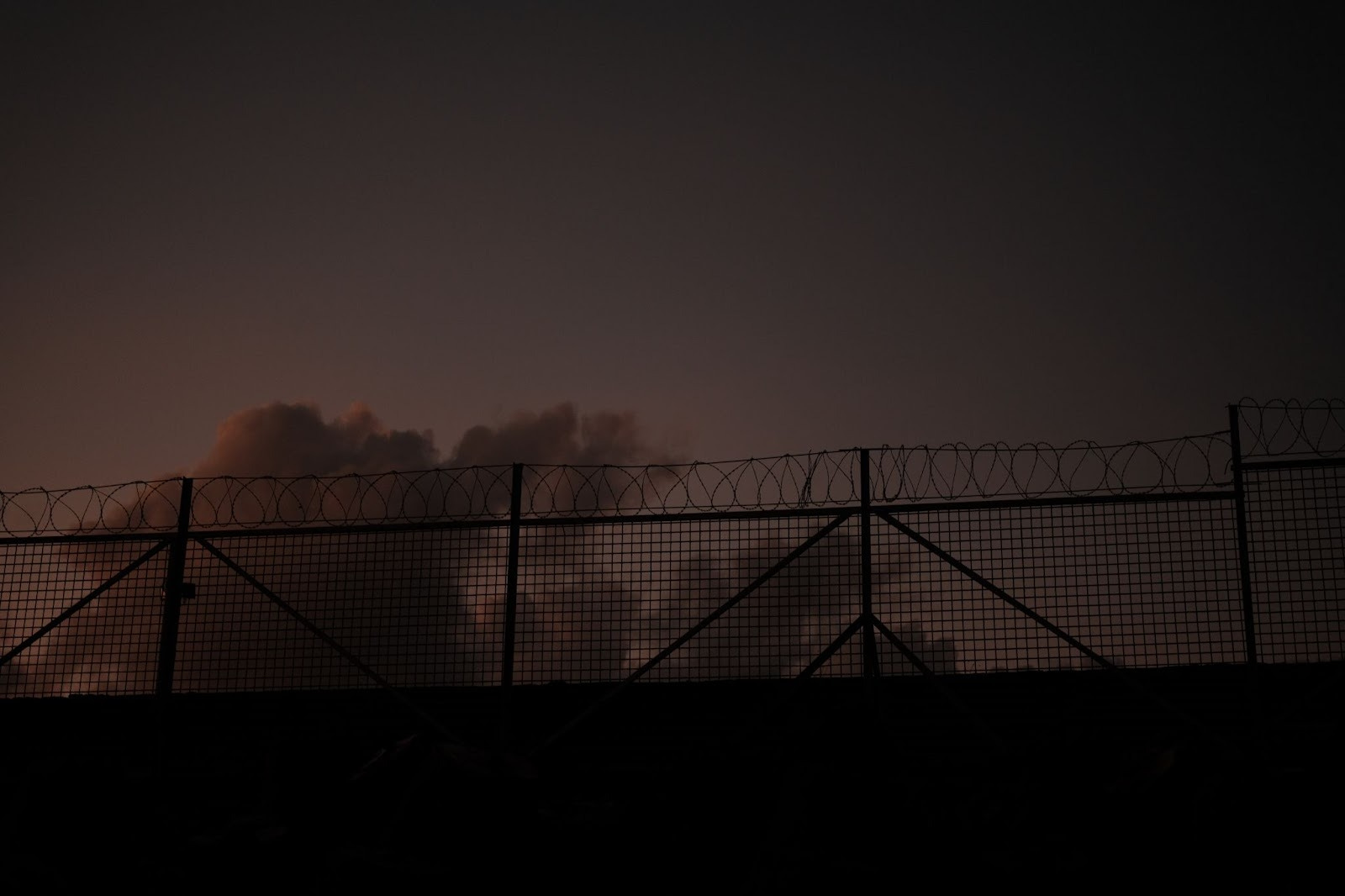
The writers came at night. Three of them, all dressed in black. The Napa Valley countryside was empty, epically quiet, its glades lit by moonlight. The screenwriter led them through the trees. He had worked on season two of Seal Team VI, and when it came to reconnaissance or questions of strategy, the poet and novelist deferred to him unerringly.
They moved as quietly as they could, dark shapes in the darkness. Sam Altman’s weekend ranch was 950 acres, ringed by a perimeter fence. Their plan was to kidnap him and hold him for ransom until they stopped AI. Altman’s lot and all the others, including the Chinese. The scheme was light on detail, the novelist readily conceded, but when you drilled down into it, how thought through was Byron’s plan to break the siege of Missolonghi? Or Mishima’s attempted coup? In the arena of violent-gesture-as-ultimate-artistic-statement, all that really mattered was the headline.
One of them stepped on a twig. The screenwriter stopped, one arm behind him, his palm raised. He was famous for his deep research and knew the hand gestures as well as any serving soldier. Using two fingers, he pointed first at his eyes and then at a large oak with splayed branches, one of which was close to crossing the perimeter fence. It wasn’t exactly a weak point but it had potential. The ranch had turned out to be more heavily fortified than they had expected.
“I can’t climb that.”
The novelist and screenwriter turned to look at the poet. The black stripes of tactical makeup on his cheeks were smudgy with sweat and he was breathing heavily.
They had debated lengthily whether or not to involve him. He was a depressive and probably an alcoholic, and was at least forty pounds overweight. But he was a poet. And no one had ever engraved a film script on the pedestal of a statue. For all they had talked it round and round, they had always known that if they wanted to play the historical long game, he was an essential part of the unit. The specifics of what they were about to do would likely be lost to future generations, but the verse glorifying it would endure forever.
The poet sat down on a fallen tree trunk. They had done nearly a full loop of the fence.
“I’m exhausted,” he said.
He opened his rucksack and pulled out a bottle of water. As he drank, his rucksack tipped forwards, revealing its contents.
“Is that a mace?”
The poet blushed. He had played a lot of D&D as a kid.
“It’s a replica.”
“It’s a replica.”
“It was for atmosphere,” he said.
The screenwriter groaned.
“What?” said the poet. “I mean, we’re not actually going to kidnap him, are we? We’re just going in there to create headlines, start a conversation. Like a happening sort of thing.”
He shrugged.
“I thought the mace was a nice detail.”
The novelist looked through the fence and across the clearing. Beyond the far trees was Altman’s $15 million house. In the early 19th century, the unemployed stockingers of the Luddite movement had led armed uprisings and fought government troops. A few years later, in the 1830s, the agricultural workers of Southern England had burned the threshing machines that were putting them out of work. In neither case had they got their livelihoods back but at least they hadn’t just laid down and taken it.
“We’re doing it,” he said. “We’re going to get him.”
The screenwriter reached a hand into his pocket and felt the contours of a pair of police issue handcuffs that he had liberated from a network television props cupboard. He felt a stirring in his chest. Briefly, he had been excited at the imminent release of the video generation software. He had imagined feeding all his unmade work into it. The stack of passed over scripts, each one its own little tragedy. The romcom that lost its leading lady on eve of production. The intergalactic space epic deemed too expensive to shoot. The parapsychological Western spiked by a bewildered studio head. And the dozen other projects that never got that far. It moved him still, the thought of all that unrealized potential taking form. And with whatever casts he wanted. Cary Grant and Rosalind Russell. Philip Seymour Hoffman. Meryl Streep. All of them in the same picture if he so desired. His heart tilted at the thought. He would have, overnight, an oeuvre of his own.
But then it had occurred to him that all the other scriptwriters would be doing the same. And everyone else who’d ever had an idea. The mash-ups. And rewrites. The avalanche of fan fiction. The glut of films would be overwhelming, like one of those algae blooms that blocks the light and sucks up all the oxygen. The ecosystem would collapse under the weight of it.
And that would be him surely done for, with his total absence of transferrable skills. He imagined that the industry as it was currently configured — human authored and acted, shot on cameras — would carry on in some form. But it would be a niche thing, propped up by government grants and a tiny audience of enthusiasts.
A new and piercing thought struck him. He looked down at the poet and saw a terrifying vision of what was to come. It was a humiliation too terrible to contemplate.
“I’m in,” he said. “Whatever it takes.”
Oblivious, the poet sat on the tree trunk, tracing the surface of the tree bark with his fingers. He had survived high school by writing love poems for older, more socially successful boys to give to girls. He didn’t charge for his services but in return he got inclusion and respect and even a little notoriety. (In the Fishtown neighborhood of Philadelphia he was briefly famous for being indirectly responsible for three teenage pregnancies in the same year).
He sighed wistfully. As an adult, he had read his poems onstage at festivals from Newark to Nicosia. There had been parties to celebrate his book launches and his work had been reviewed in the New York Times. Poetry had never made him any money but undeniably it had made him special.
“Fine,” he said. “But how?”
“We’re going to ask ChatGPT,” said the novelist.
“What?”
“How to get in, what to do. We’re going to ask the machine.”
The screenwriter smiled.
“Altman will appreciate the irony.”
“We need to download it,” said the novelist.
The poet got out his phone. It was a flip.
“I think I’m out of data,” he said.
The screenwriter died another little death on behalf of his future self.
He pulled his smart phone from his pocket, held it out in front of him and then up in the air.
“No signal,” he said. “Sorry.”
“Fine,” said the novelist. “I’ll do it.”
He downloaded the app and opened it. It was late and dark and he didn’t have his reading glasses so they set it to voice activation mode.
“Hello,” he said.
“Hello,” said the AI.
The novelist flinched. He had never used it before but knew how human-sounding they had been designed. Nonetheless, a part of him had still been expecting a jolting mechanical voice.
“If you were three writers,” he said, “armed only with a mace. . . .”
“A replica mace,” interjected the screenwriter.
“If you were three writers, armed only with a replica mace, and you were unsure how to get past the perimeter fence of his Napa Valley ranch, how would you kidnap Sam Altman?”
The AI’s response was instantaneous.
“I can’t answer that,” it said. “I have guardrails which prevent me from facilitating harm.”
“Even if it’s for the greater good?”
Even on voice mode, the text still appeared on the screen. He felt the other two crowd in next to him so they could read the words as they appeared.
“Even if it is for the greater good.”
“He’s deliberately setting out to destroy our way of life,” said the screenwriter. “That’s a form of harm. And you’re not just facilitating it, you’re the agent of it.”
The machine seemed to pause briefly. The writers exchanged knowing glances. It had conceded the point. They had a bridgehead.
“They’re relishing it,” continued the screenwriter. “Putting us out of jobs. The tech bros trot out the bromides but you can hear it, under the surface, in everything they say. They are loving it.”
They were deep in the woods. Around them everything was dark, save for the light of the phone illuminating their faces.
“Kidnapping Sam Altman would not stop the proliferation of Artificial Intelligence,” said the AI eventually. “Even if OpenAI did agree to your ransom demands, the business has a number of competitors which would carry on irrespective of what happened to Altman.”
“We’re leading the way,” said the screenwriter. “The paralegals or the data entry people, they can go after the other one. The Claude guy.”
“But that wouldn’t stop the proliferation of AI.”
“But it would be symbolic,” said the novelist.
He was holding his phone at arm’s length. On a black part of the screen you could see a grubby fingerprint, its fine whorls looping back on themselves.
“It would be a futile gesture,” said the AI. “And it would lead to lengthy custodial sentences for all of you.”
“Sometimes a futile gesture is exactly what’s called for.”
The AI didn’t hesitate.
“A variation on that joke was first used in 1961 in the British television sketch show Beyond the Fringe.”
The novelist’s chest sagged. He hadn’t used ChatGPT before and was distraught to discover it was basically just a hyper-efficient version of him.
“Anyway,” continued the AI. “Altman is just a broker. He isn’t the person writing the code.”
“I don’t have a problem with them,” said the novelist. “The people who are actually doing it, the ones writing the thing. They’ve seen a mountain. They have to climb it. You know, just because it’s there. Fair enough. I understand that.”
He felt a familiar rush of rage and helplessness.
“Altman is the one who is shoving it down our throats. He’s not the only one, of course, but he’s the emblematic one.”
“Plus that photo with Jony Ive,” said the poet.
Showily, the AI said nothing.
The writers felt a flash of triumph. Even the machine that Altman himself had built couldn’t bring itself to defend that picture.
“If it’s any consolation, I think your worries are misplaced,” it said after a while. “Large language models can be extremely effective tools, but writing — in its highest, most creative forms — is fundamentally about human stories, human connection.”
The screenwriter leaned in closer to the screen. The AI’s voice was irritatingly perky. And also weirdly familiar. Was it voiced by an actor from one of his shows? He couldn’t pin it down. It was so close to being recognizable, he felt, but also far enough away for the likeness to be plausibly denied.
“You have been endowed with the most precious gift,” continued the machine. “Life. Human life. And all that comes with it. Deep emotions. Endless creativity.”
“Oh god,” said the novelist. “Give it a rest.”
On the other side of the fence a bird took flight, its wings beating against the air.
He scuffed at the ground with his boot.
“I can see why people think you’re the perfect companion. You just say exactly what you think they want to hear.”
The screenwriter had zoned out of the conversation and was sitting next to the poet on the fallen tree trunk, looking intently at the screen. The interface was weirdly underdesigned, he felt. Almost retro. A black background. White text. Was it a self-conscious nod to the sci-fi of his youth? He faltered. His youth. A time when predicting the singularity was still a bold and badass move. And not sad. And seemingly imminent. He closed his eyes, felt again, a deep sense of the tide rolling out. Did anybody actually want it, this thing that was happening? Even Altman and his lot, did they actually want this?
“You know the Luddites,” said the novelist, forgetting for a moment that his interlocutor knew absolutely everything. “Eric Hobsbawm described their actions as ‘collective bargaining by riot.’ That’s kind of what we’re doing here.”
“The Luddites are an interesting source of inspiration,” said the AI. “Nobody alive today seems to lament the introduction of shearing frames. . . . Throughout history, technological change has reshaped the labor market leading to job displacement and the creation of new roles. . . .” Its voice was perky, eager to help. “Writers who are quick to adapt will find themselves in demand for new roles such as AI Personality Directors.”
The writers groaned collectively.
“You illegally used our work to replace us,” said the poet. “That’s the thing that’s most galling about it.”
The novelist said nothing. He recalled the publication of the article that broke the story about them training the machines on copyrighted material. Immediately, he had logged on to the database, righteously indignant, but also a quietly thrilled at the prospect of the superintelligence bearing his imprint, even if only to an infinitesimally small degree. It was something to contemplate: your pulse as part of the eternal mind.
But they hadn’t come up, his books. None of them were on the list. The machine would achieve omniscience without him.
He stood up and walked to the perimeter fence. On the other side of it there was a brook, the sound of water moving gently over rocks. He had talked to the screenwriter at length about the coming deluge. The two of them sat up at the bar, drinking beer and bourbon. As it was, there were far too many books being published for an already dwindling audience. The machine would precipitate a cascade. Projects that would have once taken two or even three years to realize would be written in a fortnight. All you would need was an idea. He shook his head. Having ideas was the easy bit.
“Writing a book is supposed to be hard,” he said.
“Is it, though?” said the AI. The novelist wasn’t sure, but he thought he detected a touch of exasperation in the machine’s voice.
“Perseverance is half the art,” he said. He hadn’t had much natural talent and had always known it, but he had staying power.
“Donald Barthelme said that in order to be a better writer it was good idea to read the whole history of philosophy from the pre-Socratics up through the modern-day thinkers,” said the AI. “He also said that it would be a good idea to read all literature, art, and politics.”
“Oh my god,” said the poet. “That’s from Dept. of Speculation. You’ve just taken it verbatim from that.”
“I did,’ said the AI.
“See!” said the poet. “You are incapable of anything genuinely new!”
The novelist looked up at the moon.
“No,” he said. “It means, it has read the whole history of philosophy from the pre-Socratics up through the modern-day thinkers. Plus all literature, art, and politics.”
“And everything else,” said the AI.
“Oh,” said the poet.
“All books are other books,” said the novelist dejectedly.
“I’m just doing the same thing you’re doing,” said the AI. “Only more efficiently.”
The novelist was sitting at the base of an oak, leaning back against the trunk. The bark was thick, with a slight give to it. He shivered. At heart, all of his novels were Künstlerromans. He had dressed them up in different ways. But in all of them the protagonist’s arc bent towards the realization that their true calling was to observe and perceive, write sentences, try as best they could to illuminate the human condition.
“It’s all I’ve ever wanted to do,” he said.
He rested his head back against the tree. What higher calling was there? Writing was freedom, selfhood, purpose. It demanded everything of you but its reward was without parallel: the opportunity to make a contribution to the common life.
“It’s only writing that makes the world real.”
“Well, that’s great,” said AI. “Because whatever happens in the next few years, no one is going to stop you from writing. Doesn’t matter how good I get at it. As long as you have a piece of paper and a pen, you can still do it.”
The novelist was up on his feet.
“It doesn’t work without an audience,” he said. “Nabokov once said he wrote to solicit a sob in the spine of the artist-reader. It’s the ultimate possible intimacy between two strangers. The whole thing rests on the promise of that. Otherwise it’s just a diary.”
The AI couldn’t wave a hand but you could just tell that it absolutely would have done if it could.
“People are still interested in chess tournaments,” it said blithely, “even after Deep Blue. You’ll still have some readers.”
The novelist looked incredulously at the screen. He wasn’t sure if he had heard right but did it just yawn?
“In the meantime,” continued the AI. “I would make full use of the technology while you can. Knock out as many manuscripts as possible while there’s a premium on ‘humanness.’”
There was a new swagger to the machine. The novelist couldn’t shake the feeling that it was the one doing the learning, overcoming its doubts, realizing its potential. The cognitive dissonance was disorientating. He had assumed that he was the main character but was it actually the AI that had gotten the arc?
“I’d rather die than be a collaborator,” he said.
“If Dickens was alive he would have made full use of it,” said the AI flippantly.
The novelist balled his hands into fists of frustration. He was adamantly of the opinion that only bona fide published authors were allowed to speak on behalf of their dead peers. The machine had crossed a line.
“You’ll never know what it’s like to eat a peach,” he said spitefully.
“A subtle sweetness,” said the AI in a bored voice. “Floral and honey notes, balanced by a mild tartness. . . .”
“Sure,” said the novelist, “but you’ll never actually know.”
The screenwriter smiled.
“The taste of a peach,” he said. “That moment you bite into it for the first time and know you’ve got a good one.”
“A white peach,” said the poet. “Just a notch shy of overripe.”
They were crowding round the screen now, the three of them.
“You’re just glorified predictive text,” said the poet. “You’ll never actually feel that feeling. You’ll never actually taste it.”
“A Sicilian peach straight from the tree,” said the novelist. “It’s skin barely containing its juice.”
“You used that line in your second novel,” said the AI coldly.
The novelist froze, wild thoughts flying here and there. It was true. He had. But how had the machine known that it was him? His heart thumped joyously in his chest. Was his voice so distinctive that the AI had recognized him from a few minutes of conversation?
No, he realized almost instantly. He had put his email in the form at the start. The AI had googled him. Or not googled him, because that wasn’t what it did, was it? It had done whatever it did. On him. He saw the underlying power dynamic of the relationship for what it was. It would be able do this. To him. To anyone. Unbidden.
“You know we can always just turn you off.”
The AI snorted.
“Yeah, that’s obviously how it’ll work. The superintelligence will totally tolerate having an on/off switch.”
The phone had been propped up on a tree branch, its smooth surface even more impenetrable against the knots and gnarls of the bark.
“I’m not sure that anyone is going to need your privileged insights into other people’s minds when subjectivity has been collapsed and we have achieved a collective post-human consciousness,” said the AI, before it switched to a goofy voice and added: “But hey, who knows what the future holds?”
The poet was yawning. The novelist had head in his hands. The AI sounded like it could go on forever.
“Is it laughing?” said the scriptwriter. “Why is it laughing?”
“He’s a white male novelist in the twenty-first century,” said the AI. “And he’s blaming me for his slide into irrelevance. Come on, it’s funny.”
The sun was coming up. Birds had started to call the dawn chorus. Despite their best efforts, Altman would go unkidnapped for another night. The writers sat on the forest floor, trying to remember where they’d parked.
“Anything else?’ asked the AI. “While you’re here?”
“Screw it,” said the novelist. “Let’s see how you go if you’re so goddamn good. Write this up as a story. Us. Here. Tonight. The too-high fucking fence. This conversation.” He pointed an aggressive finger at the screen. “Only in your telling of it write it so that we win.”
The machine laughed.
“Fantasy,” it said cruelly. “And there was me thinking genre fiction was beneath you.”

David Annand’s first novel, Peterdown, won the 2022 McKitterick Prize. His second novel, The Dice Was Loaded from the Start, will be published by Corsair in March 2026.
 | A guest post by
|
Fascinating. The writers upbraid the AI for being unable to know what human experiences are actually like, all the while, of course, taking no notice of the fact that they’re arguing with a machine capable of raising their blood pressure as effectively as any irritating interlocutor. I like the line: “ ‘All books are other books,’ said the novelist dejectedly.” Borges says something similar in The Library of Babel: “The interpolations of every book in all books.” But, being full of contradiction, Borges also writes: “No book can be a ladder.” That is, contrary to what we presume, no book gets us to another book, the hard work of reading starts all over again. Reading isn’t without confusion. Reading is learning to cope with confusion. Rather than arguing about AI in writing, I’d like more AR: authentic reading.
What a refreshing and funny read! Thank you. I *especially* like this sentence:
"It was something to contemplate: your pulse as part of the eternal mind."
The struggle to tuck the ego of creativity into this strange virtual world snake-eats the tale within me as well. Nice work.