


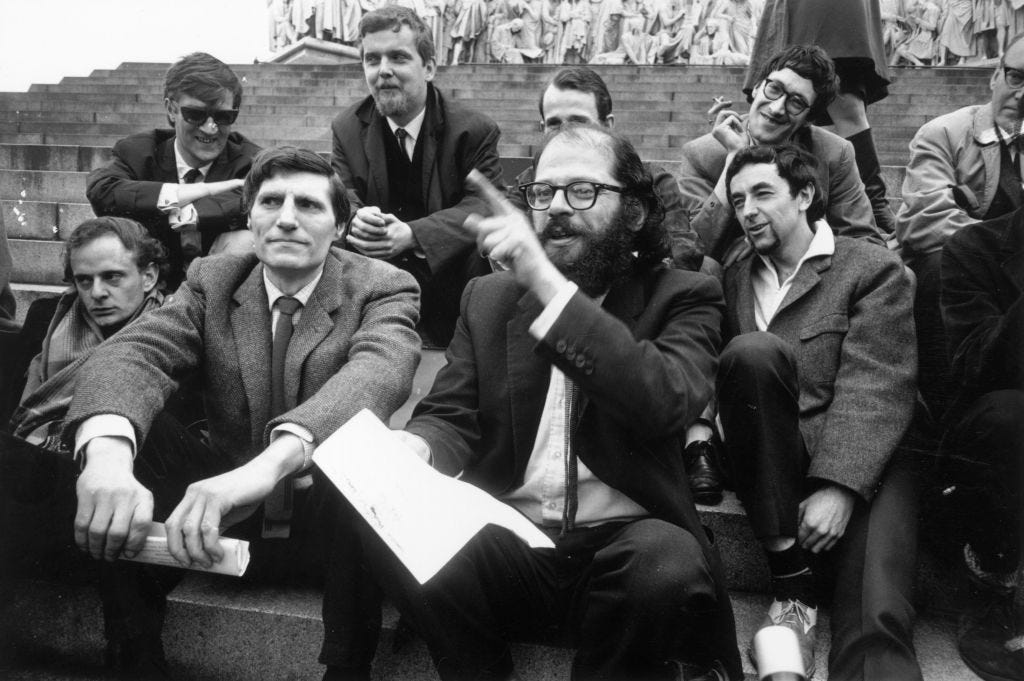
On October 7, 1955, five poets stood on a tiny stage at the back of a small art gallery in an unfashionable part of San Francisco and read their most challenging work. The result was an astounding success that no one expected. It was the right collection of poets reading in the right venue at the right time to the right audience. Against all odds, their work resonated with the approximately 150 people in the crowd and sparked a literary revolution. That night is widely considered the birth of the San Francisco Renaissance as well as the moment when the Beat Generation dramatically expanded and began to go public. Four of the five poets who read were complete unknowns when they stepped onto the stage, but two years later they were being talked about across the country. Before long, Allen Ginsberg would become the most famous poet in the world, and the successful defense of Howl and Other Poems by publisher Lawrence Ferlinghetti would radically redefine what was considered art, and thus what could be published in the United States.
It was Ginsberg who did most of the organizational work for the reading, but the idea had come from artist Wally Hedrick, who was one of the six founders of the 6 Gallery, a relatively new and extremely small-scale artistic enterprise. The co-operative gallery had been founded a little less than one year earlier at 3119 Fillmore Street and from the outset it had been about the arts rather than just art. They showed not only paintings and sculptures, but experimental films, photography, dance, drama, and poetry, as well as events that blurred the lines between these forms or which were too strange to even categorize. At some point in the summer of 1955, Hedrick approached Ginsberg and asked him to put together a series of poetry readings, but Ginsberg refused. At the time, he did not know any good poets in the city and he was losing confidence in his own work.
In early June, however, Ginsberg was in bed with the painter John Allen Ryan, another of the 6 Gallery’s founding members. He had a vivid dream of Joan Vollmer, a close friend who had been shot dead in a tragic accident in Mexico City four years earlier. He spent most of the summer trying to turn this dream into a poem, and in the process he produced a number of his most important works, including “Howl,” which he began around August 10. Work on that poem consumed him as he frantically drafted this monumental work, expanding it from a single line in his notebook into three long sections, each of which was radically altered over a great many drafts.
Ginsberg’s letters from August 1955 show how enthusiastic he was in this poem. Although he would change it substantially over the next eight months, he knew from the first days that this was something special and he sent it to various friends and family members. He even took a copy to City Lights Bookstore to show Ferlinghetti. The responses he got were positive enough that he began thinking not just of publishing it but reading it aloud in front of an audience. Ginsberg soon went back to Hedrick and told him he would organize a program of poetry readings for the gallery.
Although he was confident in his new poem, he still faced a major problem. The New Jersey-born poet had been living in San Francisco for one year, socializing and attending literary events, but he did not know anyone whose poetry he genuinely admired. Who would he invite to read? He wanted his friend Jack Kerouac, who was traveling up from Mexico and would soon arrive on the West Coast, to read with him, but Kerouac was and would remain cripplingly shy, so he refused. He turned to Philip Lamantia, another friend. Ginsberg did not particularly like his poetry, but he was the most highly regarded young poet in the city, championed by the likes of Henry Miller and André Breton and published since his mid-teens. However, Lamantia had recently undergone a religious conversion following a near-death experience and disavowed his entire body of work. He refused to read, but after some coaxing said he would perform the work of John Hoffman, a close friend who had died several years earlier. Ginsberg then turned to Michael McClure. They had met in late 1954 at a W. H. Auden reading and although Ginsberg also disliked McClure’s work, he enjoyed his company (and found him extremely handsome). Both Lamantia and McClure were also popular in the city’s arts scene, which Ginsberg knew would help to draw a crowd.
Ginsberg then turned to the most famous poet in the city, Kenneth Rexroth. Originally from the Midwest, Rexroth had been in San Francisco for a few decades and had established himself as its “cultural minister” (in his own immodest words). He knew and had mentored most of the best young poets, and writers passing through the city often paid him a visit. He had an influential radio show, chaired several literary and political events, was published in major magazines and newspapers, and often advised James Laughlin at New Directions about whom he should publish. There was no one better to recommend exciting young poets, and Rexroth knew just the man for this event: his current protégé, a young Buddhist from Oregon called Gary Snyder.
Ginsberg set out to meet Snyder on September 8th and found him fixing his bicycle outside his tiny, monastically furnished house in Berkeley. The two men got along immediately and remained close friends until Ginsberg’s death in 1997. Although Snyder was younger than Ginsberg, he played an older-brother role due to his knowledge of things Ginsberg wanted to learn — Buddhism, Asian philosophy and language, the outdoors, indigenous cultures. He was currently preparing to leave for a 10-year stint at a Zen monastery in Japan and had just gotten down from a summer in the mountains, where he both worked and traveled. His poetry was filled with images of the natural world and drew upon his experiences in logging camps whilst mixing forms borrowed from Japanese and Chinese poetry, painting, and drama.
Snyder recommended to Ginsberg one more poet: his best friend from Reed College, Philip Whalen. Although not an outdoors-type like Snyder, Whalen was currently working as a fire lookout in the mountains after being pushed into the job by Snyder, and the experience would influence his poetry in various ways. Some of his William Carlos Williams-inspired poems had been passed around San Francisco thanks to Snyder and now he was accepted for the line-up at the 6 Gallery. He wasn’t asked whether he wanted to participate. He merely returned from the mountaintop to find a letter from Snyder informing him that he was going to read. Again, Snyder played the older brother to Whalen in spite of being seven years younger. “This town and these new people will do Philip much good,” he wrote in his journal.
The line-up was finalized. With Kenneth Rexroth acting as “introducer” for the five younger poets, there would be six poets on stage at the 6 Gallery. Ginsberg used this when putting together the text for a promotional postcard:
6 POETS AT 6 GALLERY
Philip Lamantia reading mss. of late John Hoffman-- Mike McClure, Allen Ginsberg, Gary Snyder & Phil Whalen--all sharp new straightforward writing-- remarkable collection of angels on one stage reading their poetry. No charge, small collection for wine and postcards. Charming event.
Kenneth Rexroth, M.C.
8 PM Friday Night October 7, 1955
6 Gallery 3119 Fillmore St.
San Fran
These postcards were disseminated via the 6 Gallery mailing list and also left in hipster hangouts throughout the city, including City Lights, the Co-Existence Bagel Shop, and The Place (which was the bar for artists in the mid-’50s). A poster was made by painter Peter Forakis and copies were put up in a handful of locations, too. Nothing appeared in the local press but it’s likely that Rexroth mentioned it on his K.P.F.A. radio show, although no recordings exist from that year, so it is hard to know for sure. In any case, this was to be the debut reading for McClure and the second public reading for Ginsberg, and Snyder and Whalen had each given one or two readings in Oregon but had little experience. With such a lack of experience, there was no good reason to suspect it would be a tremendous success.
The poets arrived at the 6 Gallery and were surprised to see it quickly fill to capacity. According to McClure, “There were poets and Anarchists and Stalinists and professors and painters and bohemians and visionaries and idealists and grinning cynics.” Elsewhere, he elaborated:
There were elderly women in fur coats who were radical social leaders of the time, and there were college professors there, young anarchist carpenter idealists, artists, poets, painters associated with the gallery. So it was a broad spectrum, intensely radical, and intensely hoping for a change to take place.
It was not a ticketed event and the 6 Gallery was awful at record-keeping, so we cannot know exactly how many people showed, but estimates range from 100 to 250. It seems likeliest that about 150 people crammed into the long, bowling-alley-like building at 3119 Fillmore. Kerouac sat and sometimes lay on the floor next to the stage, and in a chair next to him was composer Jack Goodwin, who wrote the only detailed account of the reading from that era. Neal Cassady was there with his date Natalie Jackson, who died just two months later. In fact, a great many poets and painters and professors were in attendance, but perhaps most important were the absences. Three writers who had previously been considered among the most important in the city — Robert Duncan, Jack Spicer, and Robin Blaser — were all out of town at the time. They would return in mid-1956 to find San Francisco completely changed by these outsider poets and their runaway success.
Perhaps because of his experience, Lamantia read first. No one seems to recall much of his performance and years later he could only remember one of the poems he picked to read. He also disappeared from the scene soon after, and when attendees later recalled the reading, they tended to talk about “Philip,” referring to Whalen, forgetting that there had been two Philips on stage that night. McClure went next with a very successful reading of a number of nature poems. His standout work was “For the Death of 100 Whales,” which lamented the butchering of orcas at the hands of bored G.I.s in Iceland a year earlier, an event gleefully reported in the American media. Whalen then followed with a number of short and extremely difficult but witty poems. Kerouac dismissed them as “too incomprehensible to understand” but most people recalled them being understood and enjoyed by the audience.
After an intermission, it was time for Ginsberg to read. He was — like his audience — very drunk by now. Kerouac had been encouraging people to drink from big jugs of homemade red wine and it was now rather late in the evening. It seems Ginsberg read one or two short poems first and then launched into “Howl,” but given the impact of this particular poem no one ever recalled what he read first. He began the long poem slowly and quietly, building up to a prophetic frenzy, his audience utterly rapt. By the time he finished, many people were in tears and most were on their feet cheering. Everyone wanted to congratulate him and it seems that already people understood that something had changed. The world was no longer the same place it had been a half-hour before. McClure recalled it years later:
In all of our memories no one had been so outspoken in poetry before — we had gone beyond a point of no return — and we were ready for it, for a point of no return. None of us wanted to go back to the gray, chill, militaristic silence, to the intellective voice — to the land without poetry — to the spiritual drabness. We wanted to make it new and we wanted to invent it and the process of it as we went into it. We wanted voice and we wanted vision.
It is tempting to imagine the reading finishing on that high note, but in fact Ginsberg was not the last to read. He was followed by Snyder, who performed work from the in-progress Myths & Texts. He was a stunningly gifted reader and managed to captivate his audience in spite of having the unenviable task of following Ginsberg. Those who later recalled the reading said that he managed this challenging feat. Certainly, it impressed Kerouac enough that Snyder became the focus of The Dharma Bums, immortalized for better and for worse as the “Zen Lunatic,” Japhy Ryder:
His voice was deep and resonant and somehow brave, like the voice of old-time American heroes and orators. Something earnest and strong and humanly hopeful I liked about him, while the other poets were either too dainty in their aestheticism, or too hysterically cynical to hope for anything, or too abstract and indoorsy, or too political.
After the reading, Ferlinghetti allegedly went home and sent a telegram to Ginsberg asking for the manuscript of “Howl.” It is unclear how true this is, for the telegram was never found, but certainly the reading pushed him to move forward with its publication. Others, including Bern Porter, were now interested in publishing what was clearly the poem of the era, but Ginsberg had had some kind of oral agreement with Ferlinghetti since late August and he would stay faithful to that, allowing City Lights to publish his masterpiece. It went on to sell well over a million copies and is one of the best-known poems of the 20th century.
Over the next few months, the poets — except for Lamantia, who thereafter shunned fame — all read frequently around San Francisco. The city’s literary scene had changed overnight. Snyder claimed that “from that day to this, there has never been a week without a reading in the Bay area.” Certainly, there had been poetry readings before the 6 Gallery, but they were very different. They were relatively sedate events, but now the city was overwhelmed with young hipsters imitating Ginsberg and the epic poem that captured the sentiment of a generation. Everyone wanted to hear the incendiary poem that grew and changed as audiences responded to it. By March 1956, the poets were local celebrities and they performed for a packed crowd at a Berkeley “repeat performance,” which was recorded and distributed across North America. Howl and Other Poems was published in late 1956, coinciding with a number of major articles in the national press. In 1957, it was defended successfully in an obscenity trial. And then came Kerouac’s novel, On the Road. The Beat Generation was soon a nationwide obsession, spawning the beatniks and the hippies, and influencing a great many countercultural movements of the late 20th century. It’s hard to see how all that could’ve happened without the astoundingly unlikely success of the 6 Gallery reading.
What is strange about the 6 Gallery reading is that in spite of its importance, hardly anything was known about it until quite recently. The fact that it happened and was an immensely important event has never been disputed. It is mentioned in many hundreds of books and countless articles, essays, blog posts, and documentaries, but the information contained in these is sparse and shockingly inaccurate. Even the date is wrong in about half of the written accounts. The best sources are upfront about the fact that it’s hard to know what happened that night or how it came about, but most are more problematic in that they simply repeat hearsay without questioning it.
This stems from the fact that the reading was not well documented at the time. In fact, it is not just the reading that has been misreported but the history of the gallery and the building and the personal interactions between the various central characters. We know lots about Allen Ginsberg’s life around this time but not during those pivotal months, and the same is true of the other key players in the story. Many of them were obsessive chroniclers of their own lives and frequently kept copies of letters to friends, but during this period they were too busy enjoying themselves and writing poems to note what happened to them. The few documents that were created were later destroyed, including a long, descriptive letter by Kerouac and a journal by Whalen. One incredibly useful source stayed hidden in an obscure archive, overlooked by almost everyone who wrote about the reading. Dozens of writers quoted from this letter but none of them had actually seen it. They merely copied a few lines from one writer who had found it more than 30 years before, and all of them repeated the same unlikely transcription error. A few other letters by eyewitnesses have similarly been overlooked in spite of their tremendous importance.
With hardly any contemporary documents available, the people tasked with writing about the 6 Gallery reading have had to rely upon a shockingly small number of often very flawed sources. The first was a promotional article that Ginsberg wrote in 1957 and did not put his name on because it was so unashamedly self-congratulatory. (He called his performance “the most brilliant shock of the evening.”) Then came Kerouac’s novel, The Dharma Bums, published in 1958. Although a work of fiction, its depiction of the reading is reasonably faithful, but at the same time it is very brief. If you read all the later accounts of the 6 Gallery reading, you will notice quite quickly that these mostly rehash Kerouac’s description.
Almost nothing else was written about the 6 Gallery reading until the 1970s, at which point there was a sudden interest in the Beats among more learned people. During their heyday, the Beat writers were typically scorned by the academy, but following Kerouac’s death and the decline of the counterculture, there was some begrudging respect paid and a number of pioneering young historians began to produce important works. These people naturally went to Ginsberg, Snyder, and others for firsthand accounts, but when you read their recollections, you realize that they are shockingly inaccurate. I do not mean to insult these people by questioning their memories. After all, it was now about 20 years later, and I would not be able to give an accurate picture of poetry readings I attended back in 2006. Human memory is more flawed than people generally like to admit — and that is true even for people like Ginsberg, in whom we sometimes place too much trust when it comes to historicizing. Yet one only has to look at the various interviews to see that these writers not only contradicted each other, but themselves.
With all these different and flawed versions of the 6 Gallery reading, historians, biographers, and other writers have tended to choose the details that sounded best or placed the most focus on their person of interest. They have ignored those claims that did not fit their narrative and gone with the others, regardless of whether or not they were true. Sometimes they have made assumptions based on unclear statements or added small details for the sake of a more colorful description. Later historians have tended to repeat these claims and then distort them in various ways. Over time, the 6 Gallery reading has become increasingly myth-like with various obvious falsehoods believed simply because they have been so frequently repeated. Several years ago, I set out to write the first ever book about the 6 Gallery reading. No one else had put together more than a few paragraphs about it in spite of near universal agreement over its importance, so it was a formidable challenge. However, I believed that with the right approach and the modest goal not of proving every fact definitively, but rather approaching history honestly in order to determine the likeliest of facts, I could write a reasonably comprehensive account. That was published on October 7, 2025, corresponding with the 70th anniversary of the reading.
But how does one approach the unknowable? After all, without the unexpected discovery of something like a previously lost videotape or audio recording, surely it is all but impossible to say exactly what happened that night, or for that matter in the weeks before and after the reading. I knew it would not be easy, but at the same time it was too important not to try.
To begin with, I read and compared all available accounts of the 6 Gallery reading whilst tracking down the sources they provided. I was amazed by how many contradictions jumped out when reading these books and how much was confidently stated but not referenced. The more I read, the more obvious it became that people were repeating dubious assertions and making assumptions without informing the reader these were not based on hard evidence. Even the most scrupulously researched books had reference sections almost devoid of sources when it came to their few paragraphs on this one event. There were hundreds of books, so it was a long but essential process. I was able to roughly divide given claims into those that were plausible, possible, or unlikely. By tracing these publications back over a period of 50 years, I could begin to see who had invented what detail and where it was repeated. A great many well-known facts could be very easily disproved.
Most importantly, I came to realize that almost every account had been based on a tiny number of contemporary sources, coupled with the aforementioned process of selectively choosing details and then repeating other assumptions. I dug up those few sources to scrutinize them and then searched for others against which to check later claims. This perhaps sounds obvious, but particularly regarding events of great countercultural importance, there is an unfortunate tendency to let myths stand or to place too much faith in the memories of people we admire. To question them might seem like an accusation of dishonesty, when it is merely acknowledging that they are human and their memories are — like all of ours — fallible.
Finally, I was able to direct my research toward overlooked archives to prove or disprove the claims I had identified as possible and then find a great many new details. This process went on for several years and led me to write about 100 years of history and dozens of characters, finally establishing a reasonably detailed history of the building in which the reading took place and the galleries that existed there. I cannot say that every single detail was established, but that was never the goal. The goal was to go far further than anyone had before to write as honestly as possible, so that others can build upon my research, putting an end to a half-century of speculation.
Wally Hedrick — who was responsible for some of the most absurd falsehoods — said once that “it’s all gotten kind of myth-like. Everybody remembers what they remember.” He’s absolutely right, but that does not mean we should give up excavating this part of history. Its allure stems from the fact that it occurred well within the modern era and should be much easier to know than it really is. People tend to like these sorts of stories, of outlaws, outsiders, and their improbable successes. But we should not allow mythology to triumph. Parts of this story will probably always remain unknowable, but it is important to approach these mysteries and probe them honestly and thoroughly, to figure out what really is unknowable and chip away at it as we would with any other historical event.
[1] Most texts refer to the “Six Gallery,” but the founders preferred the numeral form.
[2] In the end, Ginsberg would organize just one reading for the gallery but even late in the year the founders considered him in charge of poetry readings and seemed to expect more.

David S. Wills is the editor of Beatdom literary journal and the author of books on William S. Burroughs, Allen Ginsberg, Haruki Murakami, and Hunter S. Thompson.

Thanks for this! Excellent piece.
Nice-uh!