


There’s a channel on Stingray Music, an online streaming service based in Canada, called All-Time Greatest Hits. A typical five-song set goes like this: Billie Eilish followed by Foreigner followed by Gladys Knight & the Pips followed by Rihanna and ending with the Lovin’ Spoonful. Contrary to the passivity that streaming often cultivates, All-Time Greatest Hits demands the opposite. The mood and the genre and the era change constantly. Nothing is put on a pedestal. Everything played is treated equally.
This kind of musical egalitarianism underpins Uncharted Territory: What Numbers Tell Us About the Biggest Hit Songs and Ourselves (Bloomsbury Publishing), the debut book by data analyst, musician, and writer Chris Dalla Riva.
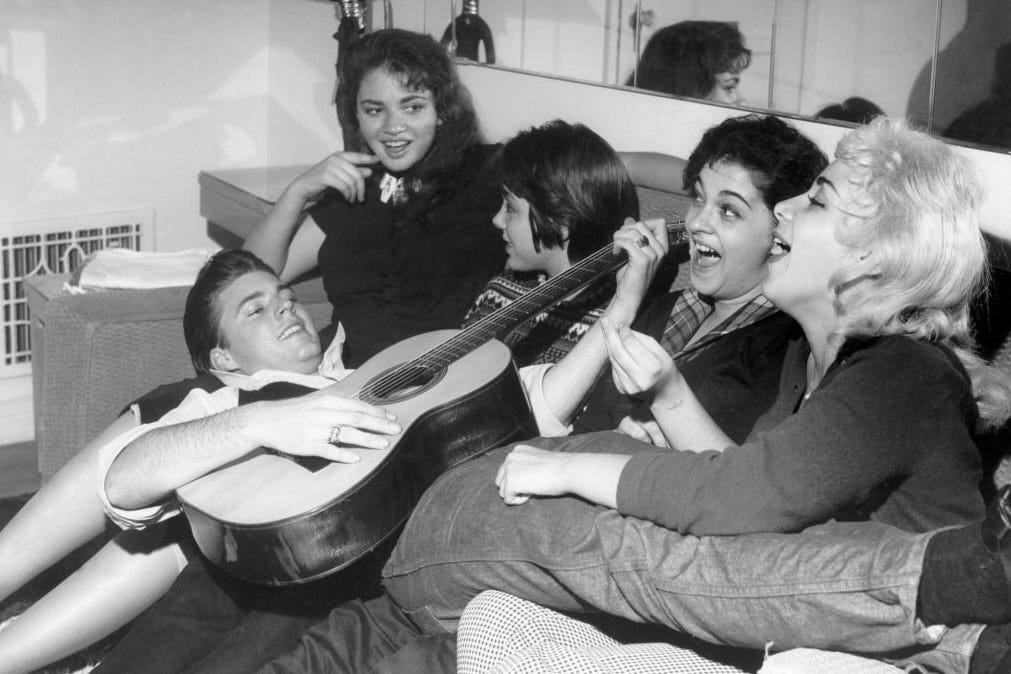
The chart in Uncharted is the Billboard Hot 100, which began on August 4, 1958 and combined three charts published by the magazine that measured a song’s popularity: one based on what was selling in stores, one based on what radio disc jockeys were playing, and a third that combined these two pieces of data with what was being spun on jukeboxes. The first song to top the Hot 100 was “Poor Little Fool” by Ricky Nelson, one of music’s multimedia stars who first rose to fame by way of his parents’ radio and then television show, The Adventures of Ozzie and Harriet.
“Poor Little Fool” forms the beginning of Dalla Riva’s quest: to dig deeper into the way music has changed and evolved over the years. He began listening in 2017 to every song that topped the Hot 100 chart. Casting himself as a kind of musical Don Quixote, he began to “build a dataset that tracked a variety of facts and figures about the songs in hopes of writing about my journey, eventually assembling everything I wrote into a book.” He finished in early 2025 with “Die With a Smile” by Lady Gaga and Bruno Mars. Along the way, he secured the book contract he sought.
Uncharted Territory’s premise is undeniably interesting: the music lover seeking to go deeper. The question then is: How does the music lover document their quest? One option is to become one of the book’s subjects, embedding oneself with those who are on the journey the writer wishes to chronicle. That’s the main reason why, for example, critic Amanda Petrusich’s Do Not Sell At Any Price: The Wild, Obsessive Hunt for the World’s Rarest 78rpm Records is so addictive. It documents how she becomes almost as neurotic as the collectors she writes about — obsessed with unearthing treasures from the shellac era.
Dalla Riva instead situates himself at a distance. There is a personal angle to his listening project (though largely omitted from the text): a Hail Mary attempt to improve his mental health. It’s an important detail that is not included in Uncharted Territory. That’s his prerogative, though I can’t help but feel that with this element missing, what could have been a big, bold journey comes across as potentially inconsequential, at least as it relates to Dalla Riva personally and perhaps the reader too.
That’s a shame. He’s one of Substack’s most impressive success stories — his newsletter, Can’t Get Much Higher, has a well-honed niche: using data to uncover trends and test hypotheses about music and how it is experienced (full disclosure: I’ve contributed a guest essay to Dalla Riva’s Substack). He has built a sturdy subscriber base, been anointed a Substack Bestseller, and has caught the notice of, among others, Ted Gioia, Taylor Lorenz, and CNN. It’s all proof that the model here works. Enthusiasts can become published writers through the kind of hard work that creates luck.
I do get Dalla Riva’s fascination with numbers. When I was young, in the ’80s, I would borrow my local library’s copies of leading Billboard expert Joel Whitburn’s reference books on the charts, poring over the numbers to see how my favorite artists fared against these popularity tests. Hours and hours of page-flipping left me with a still-sharp memory of No. 1s from 1958 up to the mid-1970s, the era that has always entranced me most.
But with digital music essentially reducing recorded sound to a form of data, combined with the onslaught of AI-generated “music,” I continually wrestle with the role of numbers and data when writing about music. How does one employ them effectively while also trying to argue that listening to recorded sound is a visceral and, ideally, ecstatic response to a deeply human and creative act?
When Dalla Riva uses beats-per-minute data to illustrate the rise of the dance-club DJ in the mid-1970s, and how that marker of tempo could create a seamless suite of music that transformed a club into a paradise, the book hints at an answer. No. 1 hits on Billboard during the era are dropped in and vividly illustrate an important evolution in how music could be experienced.
Yet when Dalla Riva uses data from Spotify to illustrate, for example, how the popularity of the solo performer in the early ’70s led to softer, more acoustic No. 1 hits, there isn’t the same sense of discovery. Why? The cultural subtext (why these trends happened or, more pointedly, why they mattered) is missing. It’s important to note that in the book’s passage on the new phenomenon of the DJ, he also frames the data through Francis Grasso, one of the architects of the dance-club record spinner. Numbers facilitate the telling of stories that are centered on individuals or groups who made them stories in the first place.
Thus, Uncharted Territory presents a series of conundrums.
There are only 300 pages in the book and 1,177 No. 1 hit records to wrangle into the narrative. This encompasses nearly 67 years of music, a breadth of musical evolution — evolutions, really — including but not limited to the rise of the Beatles, disco, MTV, hip-hop, Napster, streaming, AI, and at least a few instances of corruption — times when Billboard’s methods of collecting sales data made it easy to cook the Hot 100 books.
The task of covering so much ground is complicated by a restlessness in how Dalla Riva approaches his subject matter. Uncharted Territory continually shifts from history to scientific and data-laden analysis to primer on music theory to memoir.
There’s also the waning relevance of Billboard as well as of the monoculture that made it the dominant music industry publication of its time. It’s no accident that Billboard takes a back seat once the book reaches the mid-’90s.
Uncharted Territory is best enjoyed in the sections where Dalla Riva surmounts these challenges.
The chapters centered on Milli Vanilli (their unhappy story is dealt with empathetically) and P. M. Dawn — whose “Set Adrift on Memory Bliss” became the first Billboard No. 1 after the magazine switched from relying on often unreliable sales data from record stores to data from SoundScan — are masterly.
Dalla Riva also weaves in themes that return throughout the book: the tension between music offered as a product and music offered as a service, and the shift from composing songs with a melody and lyrics to building them out of a track and a hook. He also admirably avoids claiming one era of music is better than the other and champions cross-pollination, especially of hip-hop with country music.
Yet what lingers about Uncharted Territory are the things that nag at me. Small details like characterizing Marty Robbins’ “El Paso” as a “teenage death song” when it’s more accurately a Western murder ballad, or labeling “Me and Bobby McGee” as Janis Joplin’s song when it was written by Kris Kristofferson with an additional credit to Fred Foster of Monument Records. Dalla Riva also has the habit of telegraphing the arc of some chapters as well as what I would characterize as an over-reliance on jargon. The conclusion in which he summarizes his passion project comes across as jarring and abrupt. Some of this may be nitpicking, and it’s hard not to want to root for Dalla Riva and Uncharted Territory.
The book has gained favorable notice and those in Substack’s community of music writers — I’m proud to be a member of what we call “MusicStack” — have rallied to get the word out. Its very existence and how it came to be offer hope to others who dream of doing what Dalla Riva has done (I am very much among this group). What an unhappy position to be in, to only be able to proffer a review with reservations about Uncharted Territory. I take heart, though, in my conviction that Dalla Riva’s best work is yet to come. He’s on his way.

Robert C. Gilbert is an Ontario-based music writer and critic. His Substack, Listening Sessions, documents his life-long love of music. His dream is to one day write a book about Elvis Presley’s recordings in Nashville from 1960 to 1968.

An excellent, fair-minded, and well written review, Robert. You’ve done a great job discussing the strengths and weaknesses of data-driven narratives about musical trends. It’s good to know Della Riva’s Substack led to a book deal. Here’s wishing him great success, and may the publishing gods soon find a similar place for you. Well done!
This is excellent, Robert! I dare say there are a few of us on here who would love to see you review more books!
Congrats to Chris Dalla Riva on the book! For what it's worth, I agree that Milli Vanilli were treated very badly indeed!