

Was 2025 Hollywood’s Turning Point?
On Oscars Season, ‘28 Weeks Later: The Bone Temple,’ and ‘The Moment’


Oscars Season is upon us, and consistent readers can probably guess which films I favor for the biggest awards. One Battle After Another certainly seems like a lock for Best Picture, Director, and Adapted Screenplay — and as our greatest working director, Paul Thomas Anderson deserves to finally be recognized by the Academy. So you’ll get no complaints about that from me. But were I to do any kind of “If I Picked the Winners” piece, it would be Sentimental Value all down the line: Director for Joachim Trier, Original Screenplay for Trier and Eskil Vogt, Lead Actress for Renate Reinsve, Supporting Actress for Inga Ibsdotter Lilleaas, and Supporting Actor for Stellan Skarsgård (who may very well win on Sunday night).
What do the Best Picture nominees have to say about our moment? There’s been a lot of talk about how 2025 was a turning point for Hollywood, the kind of year which people might study someday for the topicality of its “serious” films, or for the fact that some of those films managed to reach bigger audiences than usual. I do think some of this rings true, though it’s difficult to tell what will last. Only half of the films nominated for Best Picture this year are any good. Bugonia and One Battle After Another certainly feel like truthful responses to a particular zeitgeist. Sentimental Value and Marty Supreme would be great films any year. Their resonance is deeper: more universal and more personal at once. F1 has nothing to do with anything besides Brad Pitt’s star power, while Hamnet is a punishing sentimental weeper that misunderstands Shakespeare and has a pretty dim view of human emotion. In previous essays, I’ve written about Frankenstein being just another misfire of a Del Toro film, Sinners being a mediocre movie in prestige dress, and Train Dreams being a snooze — so I won’t belabor those.
This leaves The Secret Agent — another film I really could see being considered a classic someday. Though it sometimes lapses into feeling like something of a cultural dissertation, satisfied with its own themes and engrossed in nostalgia for a time when people had to deal with actual fascism (you know, the “real, heavy stuff” we today couldn’t possibly understand). But as it picks up its pace, ginning up the soundtrack, getting better and fleeter as it goes along, it carries the viewer effortlessly to that sudden sharp-drop bathos of an ending, revealing itself, retroactively, as a rather great film. And regarding Wagner Moura’s performance, only superlatives will do. I still hold that Ben Whishaw’s work in the overlooked Peter Hujar’s Day is the great performance of 2025. But of the lead actors who are actually nominated Sunday night, it should really be Moura going home with the trophy. Hawke, DiCaprio, and Chalamet are all fantastic — I think any one of them could feasibly win. But Moura’s performance is especially astonishing: whether warm, guarded, haunted, silent, or monologuing, he’s transfixing. And the fact that the Academy keeps nominating more films and more actors from non-American films is a happy trend — one I hope only grows more common each year.
Though before I go on to talk about what’s currently worth seeing, I think it’s worth mentioning the exception to that trend: the absence of any nominations for Park Chan-Wook’s brilliant No Other Choice. Here’s one of those films people are truly going to study for years to come, for its contemporary resonance and its pure formal invention. Park is simply one of the greatest, most creative filmmakers of the century, and No Other Choice is a riot of stylistic innovations — of transitions, shots, and ideas for mise-en-scène which no other director would ever dream up. In some of his larger-scale compositions, Park’s use of separate figures and planes for dramatic irony rivals Hitchcock. In smaller scenes — like a comically botched hit job soundtracked by music so loud the murderer can’t hear the murderee — his sensibility is inimitable: every next step is a surprise. No Other Choice deserves comparison with his Vengeance Trilogy as an ultimate example of Park’s high stature in the contemporary canon of great cinema.
But that glaring snub aside, let me turn now to the first two films of 2026 that are actually worth seeing, if you can.
28 Years Later: The Bone Temple
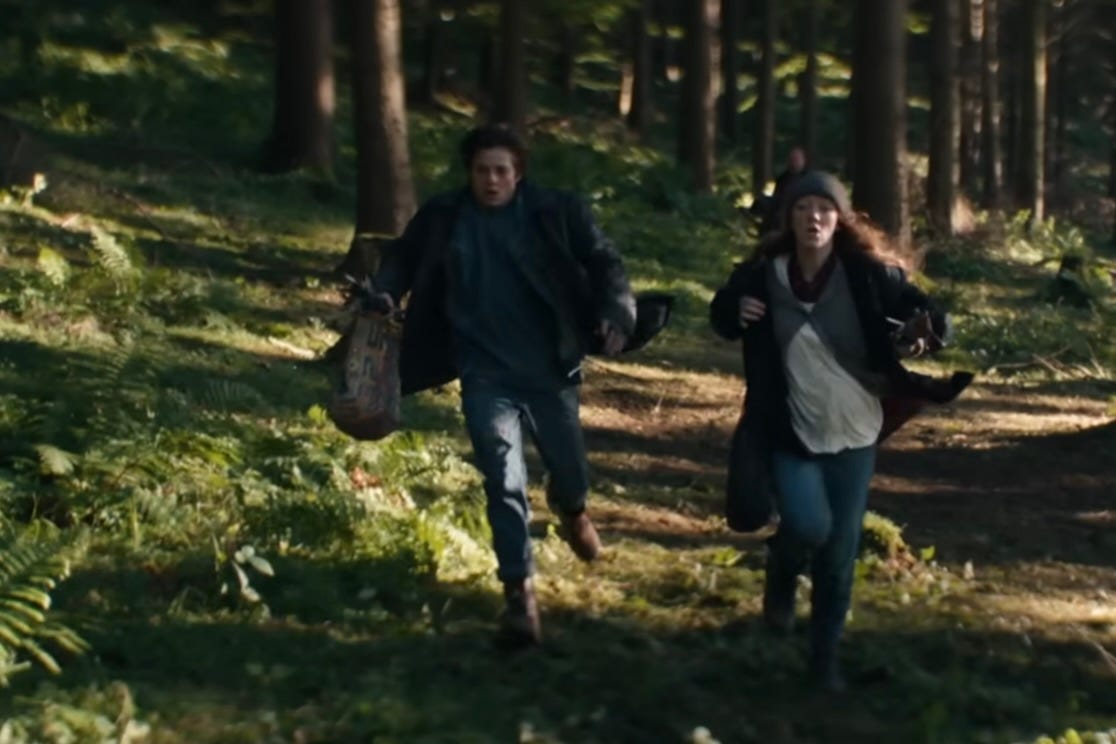
As a sequel, The Bone Temple has a strange heft. It picks up immediately after the final whirligig moments of last year’s 28 Years Later — a savage, punky, surprisingly cathartic work which might just be Danny Boyle’s most creative outing as a director — where the hero, Spike (Alfie Williams), suddenly ran afoul of “Sir Lord” Jimmy Crystal (Jack O’Connell) and his loony, Satanic tribe of Jimmys. At first, The Bone Temple leads us to think we might be in for a tale of the horrifying and continuing adventures of Spike. But screenwriter Alex Garland has other things on his mind. Rather than return us to Spike’s island home, or give us a simple picaresque of post-apocalyptic violence (though there’s a bit of that in the gang’s grueling torture of an innocent farmstead family), we’re consistently brought back to the titular temple, the metaphysical heart of the film, where the slightly mad and absurdly orange Dr. Ian Kelson (Ralph Fiennes) is beginning to uncover a possible cure for the rage virus.
How the movie gets back there is more than a bit contrived. But despite the bloodcurdling, unpredictable voyage of the Jimmys (with Jack O’Connell clearly having the time of his life in another deliciously outsized villain role), I was glad and surprised when it did. The sequences with Kelson and the hulking, naked “Alpha” zombie he’s named Samson (Chi Lewis-Parry) are strange and truly beautiful. Nia DaCosta proves herself a very good director here, her style balanced perfectly between echoing Boyle’s kinetic frenzy and keeping the rest of the film’s zaniness within the frame. And she does excellent things with that frame, always keeping each scene’s sense of space intact, even as she sometimes still chops it, Boyle-style, into so many constitutive parts — a harder thing to do than some people might think (see: Christopher Nolan). It’s an excellent piece of work.
Kelson’s “ossuary” itself is a great, immediately iconic piece of design, a perfect anchor for the surprisingly mythical aspirations of the film, which by the end grows literal, as Jimmy tasks Kelson to perform the role of “Old Nick” for his ingenuous cult. Kelson’s fire dance is just the kind of sublimely weird cinematic moment that will surely earn The Bone Temple its future status as a cult classic. But it’s in the quieter moments of the film that Fiennes’ performance shines, elevating the film nearer to the nervy brilliance of its predecessor. Simply put, Fiennes is one of the finest movie actors in history, with a seemingly infinite range. The character of Ian Kelson requires him to be genuinely dangerous, scary, funny, obsessive, graceful, weird, and somehow also kind — all at once. It is, without irony, one of the best performances of the man’s extraordinary career.
Alex Garland should keep giving his scripts to other directors. What Boyle, and now DaCosta, have given him, in their respective adaptations, is the mediation necessary to make his compelling sci-fi scenarios work as films. Directing his own scripts, Garland always ends up turning out liminal, ungraspably vague allegories. I’ve not seen the much-loathed Men, or the impossibly gray Warfare, but this was true of Ex Machina, Annihilation, and Civil War especially. The first two films are truly vicious and frequently profound — really peculiar films, which would be classics if they weren’t also so uncanny, glossy, and bloodless. But at times, Civil War almost feels like it was rendered by an LLM: everything is such a blur of digital blandness; the edges of its allegory are so sanded down and dulled, it seems like an accidental fantasy. There’s nothing resonant, or even really American, about it in the slightest. But as a screenwriter, the man is — truly — a fitful visionary. Because Boyle and DaCosta understood how to make clearer images out of his ideas, the 28 Years Later trilogy is shaping up to be his best work. Which makes it (happily) one of the more surprising developments in recent film.
The Moment
It’s easy to forget how groundbreaking Richard Lester’s 1964 masterpiece A Hard Day’s Night was. For the Beatles — just one year into their newfound global fame — to appear in the first British equivalent of a Pop-Art Nouvelle Vague film was a watershed moment. But the real genius of A Hard Day’s Night lay in the way it built its humor and sense of playfulness outwards, from the personae of the Fab Four themselves. The movie’s Marx Brothers-by-way-of-the-Goon-Squad style of subversive anarchy was a logical result of the group’s well-established cheekiness, and parries with the international press. Contrasted with their professionalism as touring workhorses, the tension in the film was set: yes, they loved their screaming fans but, crucially, the boys spent most of the film trying to escape their responsibilities, bursting out of the studio, dancing around the grounds, loitering where they shouldn’t, wandering into other offices, getting into chases with the police like in a Buster Keaton short. Like Athena bursting from the skull of the old televisual Zeus, the new youth culture of the 1960s was born with the film, from that need to escape — the joy of the music itself suggested that the spirit of that culture was ultimately uncontainable, even by the suits who descended to profit off of it.
In The Moment, Charli XCX also longs to escape. But in the prison of contemporary pop stardom, there’s just no anarchy available, no break-out possible for a hip young woman of the 21st century. A whole litany of tragic female celebrities lies behind her; the empty morass of trendy internet micro-celebrity threatens to drown her everywhere she goes. Her only escape is a spa in Ibiza, which looks more than a little like a location out of an A24 horror flick. Her team is full of noncommittal yes-men, muttering and side-eying each other like secondary characters in an episode of Succession; the magazine people and label reps and businessmen are obvious, bland parasites and vultures. Yet her chauffeur has never heard of her, and wonders if she makes music “like Leona Lewis.” She’s on the cutting edge — but there is a very long way to fall, if she teeters.
With The Moment, Charli joins a long lineage of films concerned with the vague mockumentary skewering of popular music fame, from that original Beatles breakthrough to This Is Spinal Tap to the Lonely Island boys’ Popstar: Never Stop Never Stopping — yet the film never really finds a through-line for itself. It has no real shape; it never really gathers an argument for its own existence, outside of some clearly necessary personal catharsis for Charli herself. It’s stuck somewhere between searing pop exorcism (the most interesting parts of the film) and toothless backstage parody, which doesn’t go anywhere new. The strobe-lit opening and subsequent first-act club trip suggest a kind of pummeling, gonzo contemporary document that never really materializes. Instead, we get a turgid middle act of haphazard riffs on ridiculous arena concerts, battles between leeching creative teams, and Charli’s own spiraling out from the pressure to keep up with the phenomenon that was brat. Unfortunately — like a thousand other contemporary directors — the only way Aidan Zamiri can think to suggest this pressure is to work mostly in unremitting claustrophobic close-ups. The result is, well, claustrophobic.
All of this is sometimes compelling, and the film is fitfully entertaining when Charli herself is on the screen. She has some great moments that show real promise as an actor; other times, she’s ill-served by both the script and Zamiri’s fragmented coverage. A surprisingly unnerving and excellent scene with an eerie Kylie Jenner is particularly good, suggesting further levels of meta-awareness and weirdness that might have made the film great. But anytime the movie leaves her behind for more meetings and squabbling between groups of managers and anxious businesspeople, the film slows down and the sheer dead air becomes exhausting. The final act, where Charli burns out and disappears, feels predictable and perfunctory.
Yet I’ll give it this: the final three or four minutes of the film are the kind of excoriating satire I wish the rest of the film had landed. After Alexander Skarsgård’s Euro-fop director has convinced Charli to craft a glitzier, stagier “story” for the proposed concert film-within-the-film, Charli finally comes back and agrees to go along with the show, stupid as it is. Though this is too short (I almost wish the back third of the film could have been the whole fake performance itself), it’s still a sublime rebuke to every sentimental, puffed-up, twerking, or just plain cringey tour spectacle today — from Taylor Swift to Dua Lipa to Beyoncé and beyond. As the words “an Amazon Studios film” appear on the screen, along with quotes by hopelessly outdated websites and magazines tripping over themselves to praise her “new direction,” the final moments of Charli’s ridiculous cinematic sell-out performance nearly redeem the whole movie — brilliantly, savagely, reading the entire contemporary music industry and journo-sphere for filth.
So, for at least one sequence, The Moment proves what brat itself proved: that Charli is still savvier than the world expects from its popstars — and that a real artist (even a clever artist of the Spectacle like Charli) will always hold out for their right to individual expression over the demands of the moneyholders. I only wish the rest of The Moment had embraced the bitchy satire of those last minutes. Yet this is the trap: Charli understands celebrity, but even she isn’t powerful enough to go beyond the constant demands of contemporary fandom. She just manages to exorcize herself of her brat-era demons. But every pop star’s need for their audience will inevitably become a conflict, when the simultaneous need for unmediated artistic expression is on the table. What comes next for Charli after The Moment depends entirely on her ability to square that circle, with her integrity intact.

Sam Jennings, The Metropolitan Review’s film critic, is an American writer living in London. He is the Poetry Editor at The Hinternet, and he runs his own Substack, Vita Contemplativa. For those interested, his Letterboxd account can be found here.
 | A guest post by
|
Thank you for mentioning No Other Choice! I was shocked that the Academy snubbed Park Chan-wook again, and for (imo) an even better film than Decision to Leave.
Thanks for thoughtful.
"Eddington" was the year's best zeitgeist-response, to my eyes, and a shame it wasn't nominated.