

What Three Films Tell Us About 2025
On 'Bugonia,' 'Ella McCay,' and 'Peter Hujar’s Day'


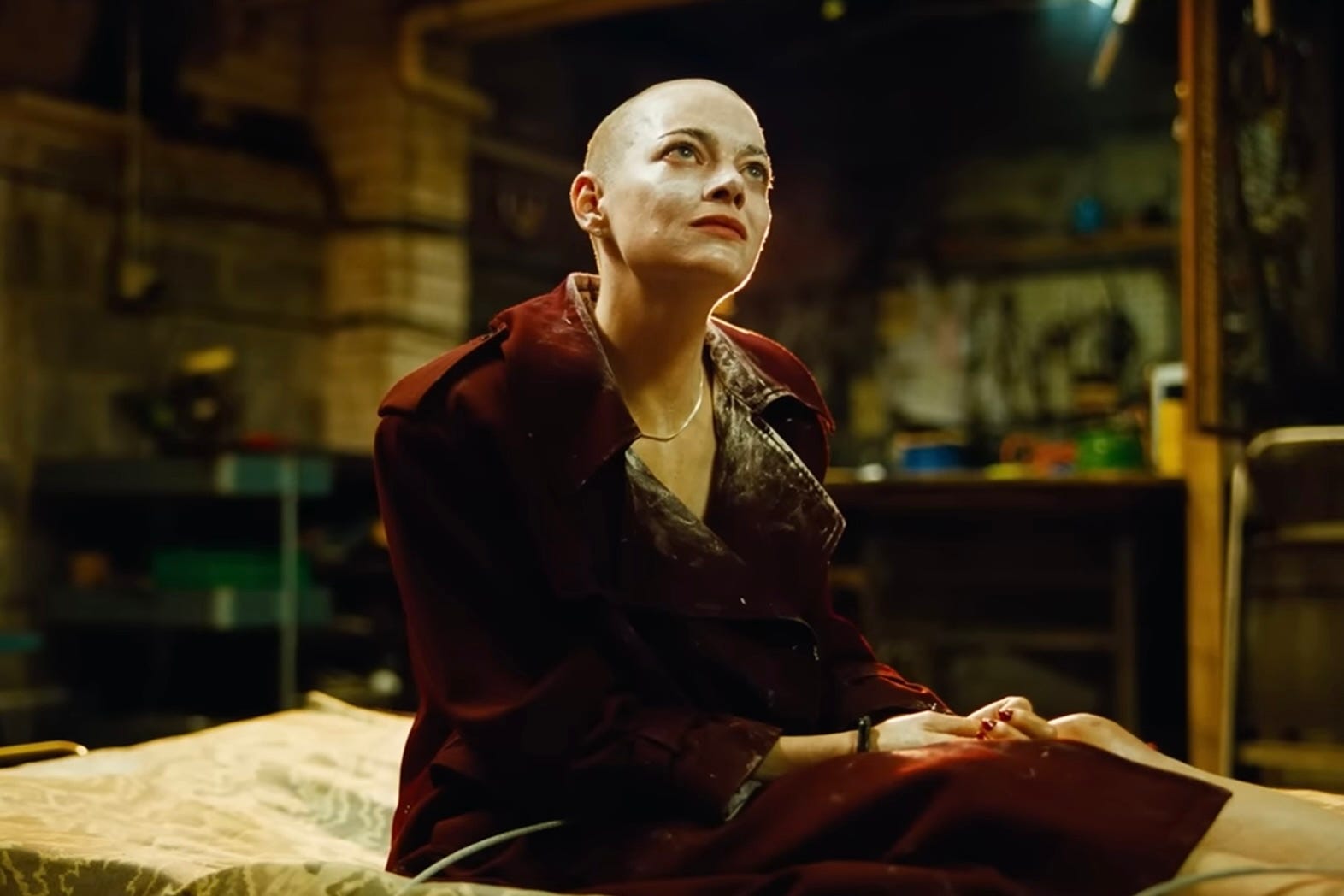
I want to take advantage of the ramp-up to Oscar season — a wonderful time, during which my inner child will always be excited, no matter how pessimistic I’ve become over the years. I believe in being candid, so I’ll admit this serves a dual purpose: (1) allowing me to get to a few films from 2025 which I still have yet to review, and (2) allowing for time, since movies are usually released much later here in London than in the States, and several enticing films (Sirât, Resurrection, Sound of Falling, The Moment, The Secret Agent) haven’t even hit theaters. I still haven’t seen either the new Avatar or the perfectly meme-worthy 28 Years Later: The Bone Temple — it may surprise some readers to learn I want to see both films, and frankly expect to enjoy them. But I have just managed to catch, whether in theaters or available to stream, a few films from last year that I think deserve mentioning. And since I believe in being so candid, I’ll also admit I couldn’t find much of a method for weaving these reviews together. One is a great film, one is a very good one. One is quite bad, though it at least has the virtue of being a fascinating failure.
I rankle at the description of any artist as an “acquired taste.” All taste is acquired. Possessing “good taste” just means you’ve encountered enough examples of a medium to understand some of its contingencies — to understand how a thing might’ve been different than it is, but also why it’s not; to pry into whether that was by design, or because of some failure in the execution. Of course there’s no avoiding subjectivity. But in the end, “good taste” simply means being able to explain why you liked or disliked something, instead of vaguely gesturing to the way it made you feel.
So anytime I notice people talking about how hard it is to get on a film’s wavelength, about how it “just didn’t work for them,” or how they’re worried a director is beginning to repeat themselves — my ears perk up, for these are tell-tale signs that what might be happening is interesting enough to have activated philistine self-defense maneuvers. I’ll never understand the point of being frustrated by artists who cultivate confrontational or overly quirky personal styles and signatures: if they fail, they fail, and there’s a nobility in it. If they succeed, then they succeed, and art wins out. I’m not always sold on the idea of the cinematic auteurist — except for the occasional experiment, film is a collaborative medium, as the cliche says rightly. But I do think we live in a time where the necessities of the industry render the old studio model almost incapable of producing good entertainment, let alone some kind of true movie art.
So if we want exciting cinema, we’re nearly always bound these days to look for evidence of an actual, idiosyncratic personal vision. And yet this has become difficult to do, when the new language of the studio model has done over even the most market-tested blockbusters using the same pop-therapeutic ideals as the rest of contemporary media, which abounds in functionally empty terms of an extremely denuded, limited kind of personal filmmaking. Not understanding the difference between this sort of marketing and the actual thought of a great filmmaker is how you get legions of people thinking Sinners is a great film because of the reasons Ryan Coogler made it. For far too many people, the film’s greatness seems legible precisely because the film has been constructed out of so many political and sociological allegories, which the audience can parse out like a high school poetry class. Coogler’s work on Sinners is a great example of a perfectly good writer whose real savvy lies in constructing the kind of text people want to pick apart, rather than in its actual depth at the visual and formal levels. His film drowns in subtext, yet his direction is visually confused and incoherent (especially in that beloved oner, a show-off piece that’s not nearly as good as it pretends to be). There’s a reason his biggest influence and mentor is Christopher Nolan.
Bugonia
Well, that was a long preamble to a simple statement, which is: I stand by the films Yorgos Lanthimos, one of the few popularly-recognized “acquired tastes,” a man who clearly delights in disturbing audiences that have never seen a film by Pasolini or Haneke. People who love Lanthimos celebrate a filmmaker who revels in the (now quite literally) alien, the chemical, the stark mutilating of normal human action in pursuit of a rigorous surrealism. He’s as easily caricatured as Wes Anderson — except that he isn’t, really, since like Anderson’s ostensibly affectless anomie, the obvious “quirks” of Lanthimos’ ultra-calculated, deadpan, nearly-infantile actors are deeper than they first appear. Because they barely contain that subcurrent of enormous, undifferentiated, inexpressible human pain beneath. Wes is a literate humanist and nostalgic portraitist: Yorgos is an absurdist with a mean streak, who pursues his zealous ambiguities at the cost of everything else (including, sometimes, quality). Like filmmakers as varied as Robert Bresson and Stanley Kubrick, Lanthimos is a Kabuki director — not conventionally realist in the slightest, his method is hyperbole undercut by banality.
Because of this, some people respond to his films with revulsion, while others sigh and feel fairly put-upon, after leaving yet another film whose main goal seems to have been unsettling its audience and making them feel a bit nuts. Other people just think he’s never really topped Dogtooth. I think he works best when his droll signatures are mixed in with other things: as The Favourite mixed in history and period drama, and Poor Things mixed in fantasy and Victorian anachronism (it certainly helped that both films were oriented around truly brave performances by extraordinary women actors). In movies like The Lobster, Kinds of Kindness, or The Killing of a Sacred Deer, his calculations appeared more characteristically, yet each felt like a smaller-stakes experiment in the Lanthimite register. Now, with Bugonia, he’s adapted one highly self-conscious discourse-laden script by Will Tracy (who also wrote last year’s inferior discourse-athon Eddington) into what might just be the most accessible Lanthimos film of all.
Yet the trouble many people seem to have with Bugonia is that, while it takes the sad paranoia of its conspiracy-theorizing kidnapper Teddy (Jesse Plemons) seriously, and takes his exploitation of his autistic cousin Don (Aidan Delbis) seriously, it is not quite as interested in exploring the experience of its one female character, Michelle Fuller (Emma Stone), the pharmaceutical CEO they’ve captured and tortured, believing to be an alien. Part of the reason is that Michelle is, indeed, an alien — a possibility the film toys with until its final sequence (here I should say the film is a remake of a 2002 Korean movie Save the Green Planet! by Jang Joon-hwan, who was himself set to direct the English-language version before stepping down, at which point Lanthimos was asked to fill in). But what I’ve seen in some reactions is clear discomfort with the unadulterated rage the film taps into.
Teddy may be crazy, may be like every frothing, disenfranchised prole gone down one internet rabbit-hole too many — his conspiracies may have him chemically castrating himself and his poor cousin, hooking a woman up to an improvised electric chair, and fantasizing about starships and aliens killing bees. But he is, on the film’s own terms, correct. Worse: he’s correct in the wrong way, a paranoid, exploited, traumatized loser, who suspects the elites of the world have programmatically poisoned the earth. He’s completely right, only the things which his basic insight leads him to do, in the search for retribution, destroy himself and the one person he actually loves. His desperate, pathetic violence is what ends up dooming the entire human race: there’s no reward for being the only one wearing a tinfoil hat to a nuclear explosion.
Yet this is all only the level of rough allegorical analysis I just disavowed myself, above. If we want to read Teddy as a metaphor for MAGA America, we can. If we’re good liberals, we’ll find ourselves disturbed that the film seems to suggest the reactionary paranoia of MAGA-world is well-founded — then we start sympathizing with the female CEO whom Teddy has chosen for his revenge, who lives in a glass mansion and ruthlessly extracts money from sick people under a veneer of girlboss feminism. Keeping to that level, we discover that the film has basically played us — we’re forced by our sense of politesse into endorsing a monster. But of course this is part of Bugonia’s brilliance; why, even if it isn’t a truly great film, it’s a searing, wounding one. If an alien decides the human race must end because we’re all just dumb apes cooking the only earth we’ve got, then we’ll all end together, good and bad alike, the torturers and the tortured. Our political commitments are no good to us if they spin us around in pointless circles, further and further away from our most intimate, moral ones. Our frequently adolescent analysis of art according to those vague principles of political and sociological allegory — searching through entertainment to discover evidence of its “standpoint,” of what its says or doesn’t say about our societal preoccupations (as though a work of art can somehow be whittled down to its content) — will always be a dead end.
Bugonia passes through the whole contour of contemporary discourse this way, collecting more and more pathos as it goes along. And despite the literal nightmares it caused me, it has grown in my thoughts since I saw it. It goes without saying that Plemons and Stone are stunning: though they’re both only 37, they seem like two of the most established veteran virtuoso actors alive. Aiden Delbis is wonderful, too: what could have been just “a character with autism” becomes so much better than that, because his performance (and the written role itself) side-step both high and low expectations to deliver only a character — someone whose autism is not just a help or a hindrance, but another part of his own individuality. Yet what lingers most in the end is the film’s acute sadness and serious anger, its sense of the tragedy and hopelessness of the world in the third decade of the 21st century. If we make it through to the next century, I suspect Bugonia will be one of the films people still watch — like Taxi Driver in the seventies, or Easy Rider in the sixties — to figure out what it felt like to be alive in 2025.
Ella McCay
A James L. Brooks movie attempts to happen in the present day — this couldn’t work, so instead it ends up being set in 2008. Why? I’m really not sure. Perhaps because that was the last time in history before everyone had a smartphone, when people still sometimes left messages on answering machines and had to print directions off the internet (both of which happen in Ella McCay). Ella McCay is played by Emma Mackey, and somewhere in that statement is a metaphor for the entire film. In one scene, our plucky wonk do-gooder heroine gets accidentally stoned, and pours forth earnestly about her favorite public healthcare proposals, and how, dadgummit, she really thinks she could change things around here, as the strings on the soundtrack tinkle sweetly in a parody of a James L. Brooks movie. All of which surely, cosmically, could not have happened after 2016, now that the Heartwarming Hollywood Comedy™ has become as rare in America as a shark attack. In all ways (and there are many baffling ways at work here), Ella McCay is a movie beamed in from a different latitude, a different timeline completely — yet though it’s a flat, confounding mess, there’s a kind of numbed-out charm to it, a lulling mild fascination, in just how alien every line delivery, plot point, and individual scene of the film ends up being.
Ella McCay is also a species of personal filmmaking: clearly a passion project, from a once-successful director who hasn’t made anything in 15 years. Perhaps Brooks simply wanted to see if he could still make one of his characteristic dramedies in 2025. Personally, I’ll forgive a man just about anything if he made Broadcast News and helped create The Simpsons — so I’ll forgive him Ella McCay. But I cannot bring myself to understand what motivated anyone else to make this bizarre film. I’ll save you too many plot points: suffice to say, Ella McCay is supposed to be the kind of thing Frank Capra once made, like Mr. Smith Goes to Washington meets Ruth Bader Ginsburg: the heartwarming tale of heroic woman vs. machine (also her neglectful adulterer father, and her neglectful restaurant-owning husband, and the media, and the entire state legislature). Ella ends the film as the youngest and shortest-termed governor of the state she was born in (a fact the film repeats constantly) — whose capital appears to be in some nondescript New England town small enough that her aunt’s bar sits next to the family’s old house, and the media can find out about the apartment she uses for trysts with her own husband. Which is what gets her in trouble . . . because her husband was the one who told the press . . . whom he then tried to pay off . . . because . . . frankly, I can’t remember. Ella McCay is mystifying.
In one scene, Ella sits in the back of a security detail SUV, conversing with the cop who drives her around town (played by Kumail Nanjiani). The cop consoles her about her family troubles by telling a silly story about his own mother. Ella collects herself after an agitated phone call, sits forward, and says she can’t hear him, at which point he begins to yell his story back to her. It’s awkward. She nods, says “uh-huh,” a few times, and yet the way the film is edited, she goes straight from appearing to fake as if she cares about his story, in the first reaction shots, to suddenly laughing uncontrollably — as though either the script or the editing itself had elided the parts where Mackey was supposed to transfer between real human emotions. The audience is left puzzled: is Ella McCay simply a chronic carer, gritting her teeth and listening to another silly story, or is she genuinely invested and delighted by this man? The film is simply never sure which sort of lovely, kind person it wants her to be. Throughout the movie, you get the same sense, that Mackey (an excellent actor) was handed an impossible part (woman whose only real flaw is caring too much and not believing in herself enough), and constantly forced to flip from one level of emotion to a different key in an instant. And the rest of this daffy film lurches in its orbit around her in exactly the same way.
Take a passage in which Ella’s agoraphobic brother Casey (Spike Fearn) — whom we were formerly introduced to as one of many supporting characters in Ella’s story (yet another person she cannot help but help) — suddenly becomes the film’s main character. We follow him off in a long sequence, as he finally confronts the girl who left him (Ayo Edebiri, playing an Ayo Edebiri-type role), stumbling into his own bad romantic comedy. Prior to which we had exactly one insert of him, and one scene with Ella, to establish a situation we are now expected to care about as a new main focus of the film. Ella McCay does this throughout its long running-time, playing like a half-remembered dream of older Hollywood plots and types and scenarios. It has no real contour: much of the film is just Ella being elliptically driven around from bar to court to home to her brother’s and back — a frugal use of sets, sure, but also a metaphor, in some deep way, for the film’s struggle to be about anything at all. Besides, that is, James L. Brooks’ obvious love for this impossible figment of a woman he’s conjured into being (in his head, not on film).
Yet that’s what gives this truly lousy film its fascination, and why I almost liked it by the end. A film like this — which believes, as James L. Brooks does, that sentiment and purity of character can be sneakily feasible elements, in a realist picture of the world — seems to our cynical age like a dream so unreal it could only be silly. It’s a bald attempt to resurrect a dead style and genre, only in a flat digital garb akin to a Netflix Original movie. So of course the attempt to make this kind of film could only short-circuit: Ella McCay stumbles around, constantly trying to form and re-form itself, as the sheer anachronicity of its old Hollywood mechanisms wear down, and the gears rust, and what once seemed like a lovely fantasy worth projecting on the silver screen now plays as a series of bungled mistakes. It’s one of the most remarkable, memorable failures of a film I’ve seen in a long, long time.
Peter Hujar’s Day
Premiered at Sundance a year ago, and only just released here in England, Ira Sach’s little masterpiece Peter Hujar’s Day may just be the best film of 2025 — or at least the best among equals. It’s a film that takes place entirely in one apartment, in the course of a single conversation, which is mostly a monologue, anyway. There are two characters: Linda Rosenkrantz (Rebecca Hall) and the great New York photographer Peter Hujar (Ben Whishaw), though Hujar’s vivid words make many other famous figures, from Allen Ginsberg to Susan Sontag to William S. Burroughs, all but physically present as characters themselves. The script is an abridgement of an actual conversation that took place 52 years ago, over an evening, for a project Rosenkrantz had envisioned, in which she’d record people she knew describing an entire day from memory, in exact detail. Hujar’s was the only interview she ever did, and though the tapes were lost, a transcript was discovered several years ago in an archive. Sachs adapted the film from Rosenkrantz’s book.
Yet it’s hard to explain exactly why this description conveys nothing of the film’s magic. Part of it is the film’s almost mystical evocation of that bygone era — seedier, somehow more innocent and more bitter; simpler, but starker. Part of it is the awareness, which ebbs and grows as the film flattens or draws attention to its fiction, that while we’re listening to the actual words an actual man once said, what we’re really watching is a British thespian calling them back to life at 24 frames per second. Part of it’s just the fascination of Hujar’s simple tale: tromping to the Lower East Side, buying cigarettes, photographing writers, working in his darkroom, sleeping in late — as Rosenkrantz points out in the film, though they’ve only covered 24 hours in a life, in the course of its telling the tale has begun to take on all the qualities of an epic, or a novel.
There’s the way the two figures shift around the room, pouring drinks, lighting candles, at one point dancing to music — later moving to the bed to rest their heads on each other; then out to the balcony; then back into the living room, where Peter confesses the havoc his cigarette smoking is wreaking on his body, and Linda confesses that she worries about him, and a mournful gap opens up between them, a recognition of the darker side of life, built up around the edges of the narrative. In a film which slows down so completely, and so totally abandons itself up to this spoken narrative, the subtlest change becomes moving and meaningful. Sachs’ direction is perfect, and his timing is sublime: he knows exactly when to move, and when to linger, when to punctuate the monologue with music or simple shots of the characters in light, or in or out of focus.
And then there’s Whishaw’s performance, which is one of the best in recent movies. Rebecca Hall is perfect as well, her constant radiant attention an immensely graceful, surely difficult thing to pull off. But Whishaw is the star, by design, and rarely has a movie been this possessed by a single actor’s performance. Technically, his recitation alone is a tour-de-force; but it goes beyond that, and possession really is the only word for it. Though Whishaw’s Hujar is aloof, sardonic, a bit arrogant, a bit confused by himself, Whishaw makes a brilliant decision in showing that the artist is every bit the performer. Even relaxing with a good friend — or perhaps because of the sudden prompting of the tape and microphone — Hujar’s monologue becomes a ballet around his own authenticity. The question of his lying comes up several times, as he fudges certain inconsequential details of his day. Whishaw’s performance suggests this is simply the way it is for the man. Not out of any malevolence: he simply seems to say things without thinking through whether they’re precisely true or not. Hujar appears chronically detached from his own life, as if regarding it from above, or beyond. At times he seems almost already dead, and more than a bit amused and aroused by it.
Still, the dance is a genuine dance, and so every little gesture, every lisp or characteristic bit of accent, in Whishaw’s hands becomes a truth — a Hujar truth, and a performed one, but only because the man is clearly such a born performer, and it’s only natural. Whishaw’s complete resurrection of the man on celluloid becomes a microcosm of the film itself, since where does the hunt for historical reconstruction and artistic authenticity end? It ends the same way a day ends: it goes around and around, and starts over just the same, until one day it doesn’t anymore. Whishaw’s Hujar is a beautiful tired artist, a man exhausted by the start-and-stop of that everyday, but still propelled forward by a quest for something — a new photograph, a new meeting, a new gig, a new hit — that might really redeem the cycle, make it worthwhile. His evocation captures a very deep truth about the nature of artists, and of a certain kind of gay artist especially. One whose constant sprezzatura always betrays a clownlike sadness, how his queerness had given him the exact expertise in outsiderdom he needed to be a great artist, and how both would always keep him there.
There’s little else to say about Peter Hujar’s Day, except that it’s one of the first American movies I’ve seen in years that felt as rich and metatextual as a great European art film — taking as its subject both real life and the cinematic representation of it, without devolving into cliches about movies being nothing but sophisticated lies. What the film stages is a knowing fabrication, true: yet what’s evoked in that brief 1 hr 16 minutes — the distance from that time to ours, the universality of it, and the particularly of it, the sadness of losing a vital species of artist, and the pain of remembering him — transcends its fabrication so fully, it becomes a primal commentary on the ultimate point of cinema. That the performance of an exquisite fiction is often the truest thing anyone can do. When the Oscars ceremony finally comes around in March, my inner child will be very excited. But my grown good taste will find me exasperated and saddened that the Academy simply passed right over the most important performance of 2025.

Sam Jennings, The Metropolitan Review’s film critic, is an American writer living in London. He is the Poetry Editor at The Hinternet, and he runs his own Substack, Vita Contemplativa. For those interested, his Letterboxd account can be found here.
 | A guest post by
|
It’s been a long time since I read film reviews as well written and thoughtful as these ones! Exhilarating! Thank you
I also loved 'Peter Hujar's Day.' There's an old Broadway expression that if an entertainer is good enough, he or she can “read the telephone book/directory” and the audience will still be satisfied. Ben Whishaw falls into that category. His performance is the higher power of this little film that makes banality mesmerizing. You mention you felt it was "as rich and metatextual as a great European art film." I thought of 'Jeanne Dielman, 23 quai du Commerce, 1080 Bruxelles' (1975), directed by Chantal Akerman, and I wonder if you were thinking of it. Stateside, there's 'Stranger Than Paradise' (1984), Jim Jarmusch. Not one day exactly, but very deadpan and focused on the banal textures of time passing. And another I like is 'Cléo de 5 à 7' (1962) by Agnes Varda.
The other thing about 'Peter Hujar's Day' is that it's one great big list. In this sense, I thought of Sans Soleil (1983), Chris Marker, which is a kind of travelogue as conceptual list. (My favorite list-movie has nothing to do with any of these, but it's outrageous: 'The Draughtsman's Contract', by Peter Greenaway.)
I also root for Lathimos, but I haven't seen Bugonia yet. As much as I applaud him, I need to mentally prepare, the way you do to rip off a bandaid. :)