


They’ve been calling Kristoffer Borgli this year’s enfant terrible, and I can’t be bothered to figure out why. I’ve been avoiding all The Drama drama. I’ve fully opted out. Deep within my brittle bones I’ve grown more than fatigued by the cinematic discourse du jour. I’ve started to feel its weight, like a particularly evil germ, haunting my digestive tract. I think if I ever see another critic, instead of reviewing the actual film itself, opine about why some plot point or character or conception is problematic, about why a film should take risks but not those risks, and why a film should disturb the comfortable but not us and our comfort, or a thousand other rhetorical cul-de-sacs I can only ever read in the tone of a person (you know the type) who claps for emphasis with each patronizing word . . . I think if I ever have to see anything like this again, I’ll spontaneously combust.
But now that I’ve seen The Drama — having successfully avoided all discourse about the film or its director beforehand — I find there’s nothing particularly controversial or shocking about it at all. It’s hard to imagine anybody really having a problem with the film; in fact it seems like most of the negative attention it’s received has been solely in the form of online think pieces with titles like “The Backlash to The Drama Has Begun” or “Why The Drama Is Dividing Audiences,” whose real substance appears to be only reporting that a few people on Twitter criticized the film for being tasteless. So low are the stakes in film these days, the idea that a movie could truly shock its audience, could cause a legitimately passionate reaction beyond a bit of griping online — this idea seems like a dream of an older time.
Though surely there’s been enough of that discourse, too. We who carry on stupidly loving cinema spend our days drowning in eulogies over the demise of movies. Yet it’s nearly impossible to avoid adding your own voice to the funeral dirge, when the subtextual undercurrent of film in the past 15 years has been just that — the loss of an older cinematic culture. Like every other art form, our movies feel untethered from actual life, lost in their little discursive bubbles. Television, too (at least the version of television which has fragmented into streaming media), is so overwhelmingly prim and gray and risk-free. There’s nothing at all of the Dionysian: no real risk or sublimity or sex. No bodily abandon. Yet it’s not like we get anything really Apollonian in its place — never anything sheer, elegant, or exquisitely composed. Mostly we get the same overly-refined, liminal, obvious product. There are of course exceptions, because there are singular, visionary artists in any era. But the exception doesn’t disprove the rule.
Even a perfectly entertaining, good-looking, occasionally funny satire like The Drama (which is actually set in something like our present) is curiously muted — it doesn’t have the true texture of our world, nor even of a heightened movie-world, but a kind of inbetweenness, a too-clean mirror of our own. It lacks a sincere belief in its own unreality, or else fails to make us believe. That it sometimes delivers an accurate picture of the ridiculousness of contemporary neuroticism, and of the darker, more disturbing complexities of personality we first-worlders simply can’t bear to acknowledge — for this we can partially forgive it, and enjoy what it has to offer, as a brief commentary. But it’s still only half an experience. It promises a certain weirdness, a depth of black comedy, and perhaps even some good honest perversion, which it never fully delivers.
Something funny happens when a foreigner tries to make a movie about Americans. Sometimes you get an alienist masterpiece like Wim Wenders’ Paris, Texas. Other times an exoticist fantasy like the films of Chloé Zhao. Kristoffer Borgli at least feels a bit less out of place. After all, he’s heir to a Scandinavian film world that includes Ingmar Bergman (note the Passion of Anna poster on Robert Pattinson’s apartment wall) and the Dogme filmmakers Lars Von Trier and Thomas Vinterberg, and Borgli most resembles these last two. Or rather: his work in The Drama most resembles Succession, one of the few truly great TV dramas of our time, which was itself influenced by Vinterberg’s darting camera and chaotic scenarios. Succession is also practically the only piece of media to capture the real texture of the last decade. Now Borgli brings this chain of influences more or less full circle, handily combining something of Succession’s glassy, droll anxiousness with the numb, low-lit A24 house style. Watching The Drama, I felt haunted by the growing awareness of just how much contemporary film and television could reasonably be termed the aftermath of Scandinavian Modern.
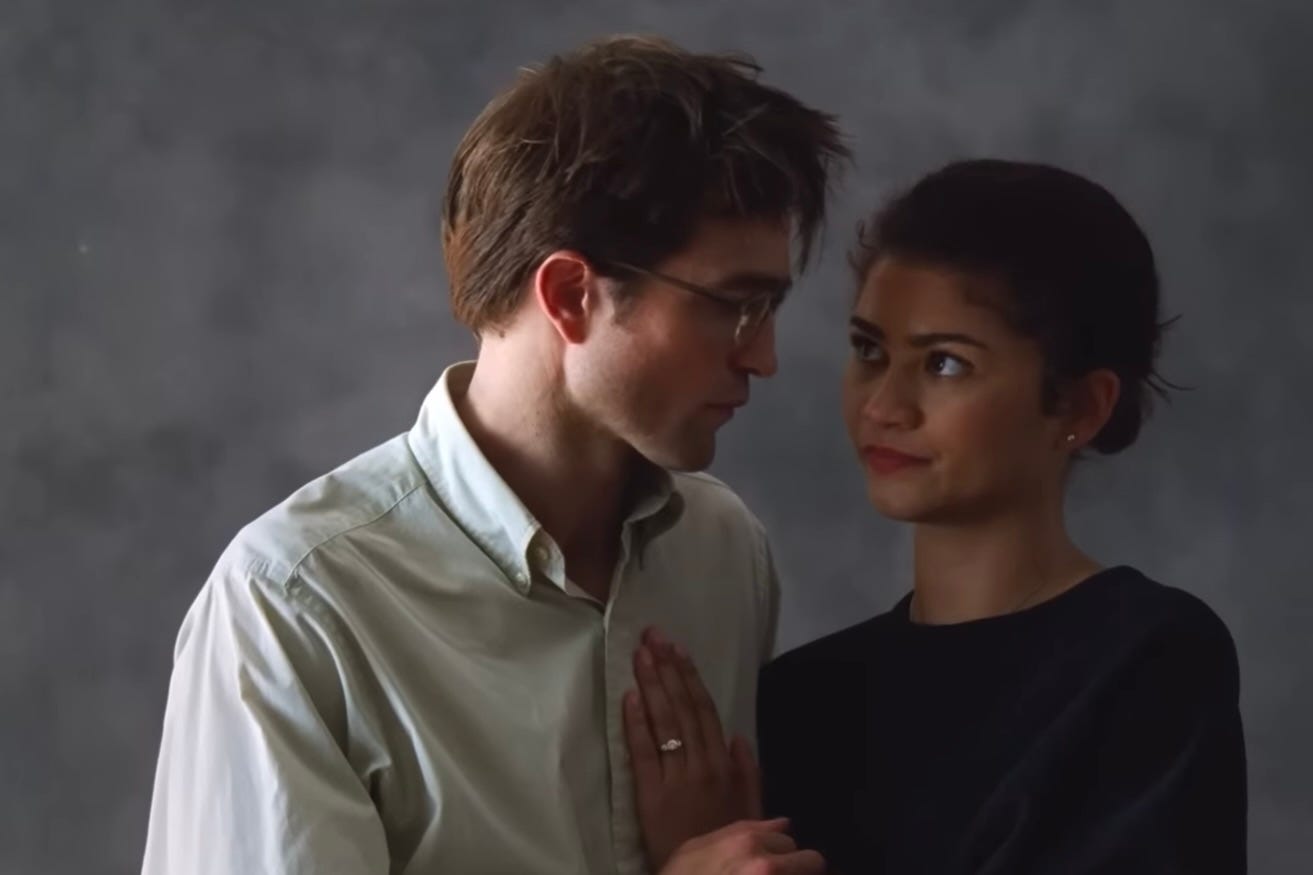
The soft, warmly-lit look of the film slots easily alongside Celine Song’s Past Lives and Materialists, as well as Joachim Trier’s Sentimental Value, The Worst Person in the World, and Oslo, August 31st. But Borgli’s film wants to provoke in ways those kinder films never could. What Borgli really wants to get at is the narcissism and neuroticism of upper-middle-class Americans — he wants to play the trollish Scandinavian, breaking out of his pristine Norwegian bubble to worm his way into the taboos and unspoken worries of America’s most enlightened, liberal striving class. Hence the way he throws us immediately into the awkward meet-cute of Charlie (Pattinson) and Emma (Zendaya), a disaster that has no reason to work, followed by a date so painful it has no reason to progress, followed by a series of intercut conversations with friends Rachel (Alan Haim) and Mike (the great Mamoudou Athie). From the start, we understand that these two beautiful people are not normal characters — in fact they’re barely characters at all, but ciphers who know next to nothing about each other, and who seem to possess few actual qualities beyond stammering, wincing, or laughing awkwardly.
Pattinson and Zendaya play their characters as doggedly and plausibly as possible, yet that’s exactly what interferes with the film. You get the sense watching it that there’s a strange, funny script running along on one level, trying to develop its central conceit into an exploration of empty, anxious modern people; while on another level, the actors have committed themselves to really selling the psychology and fragility of the characters — but all they can do is contort inwards, looking exasperated, or catatonically depressed. The film is missing that hyperbolic, even cartoonish, comical dimension, which a few more heightened performances could have brought to it. It tosses back and forth between brief moments of realist panic, followed by droll comedy, which works about half the time. There’s none of the swagger or charm Zendaya has shown before: she’s forced to play the bewilderingly naive gamine with supposed dark depths, while Pattinson plays a basic, exasperated neurotic as if begging to be unleashed into the weirdo he really is. Only Alana Haim gets to play her role as if she’s really in her own skin — mostly in the same bitchy register as her role in Licorice Pizza, which was such a great performance you can hardly mind the partial reprise.
The conceit is deadly simple and profoundly Millennial — the same sort of brief, nightmarish moment of oversharing that something like Tim Robinson’s I Think You Should Leave is built on. As they approve the catering and wine for their wedding ceremony, Charlie and Emma sit at night with Mike and Rachel, and their tipsy conversation leads each of them to reveal the worst thing they’ve ever done. The mistake is Emma’s: she confesses that, at the age of 15, she nearly carried out a school shooting, something she’d actively planned and only abandoned at the last minute. The rest of the film spools out in a panic over this revelation, which Charlie and Mike treat as simply unbelievable — and to which Rachel, whose cousin was paralyzed in a shooting, reacts with disgust and horror. From the moment this happens, the rest of the film is simultaneously decided (because its satire wouldn’t exist without it) and cursed by it (because no person in the film, above all Charlie, seems capable of reacting to it like a normal human being).
To a degree this is Borgli’s doing. He wants us to see the jerky, terrified motions of these fragile people as a pathetic, neurotic response to something that should really be entirely understandable. He wants Emma’s revelation to be a kind of challenge to that neuroticism — the terror, the essentially elitist fear of being contaminated by another person’s filth and darkness. The worry that anyone you know might at any time be harboring fantasies of violence (or any other taboo, or criminal vision). The finest part of the film is the long, chopped-up conversation the morning after, in which Emma tells Charlie the full story of her violent adolescent fantasy. Briefly, the film takes real flight, as Charlie imagines the young Emma, moving to Louisiana with her military father, being teased, developing her fascination with guns, and, as she says it, with the whole “aesthetic” of shootings themselves.
The sequence is funny, frank, illuminated with genuine pathos. Everything about Emma’s situation is in fact quite normal. She wasn’t some warped psychopath — only a sad, isolated kid, at an age when every kid feels sad and isolated. She developed a fascination with revenge, and the cult of shootings, because (as Charlie halfheartedly tries to say to his friends later) that’s exactly what American kids do. Teenagers have always been doomy and fatalistic, have always felt like the central victims of the world. In America they are simply provided with a morbid way out, and this particular way is sensational, cultic, and the subject of a secret, shameful fascination to all Americans. This sequence of the film has nothing but sympathy for the trite, pathetic normality of the young Emma, and for the older Emma, now facing the possible dissolution of her marriage only because her fragile fiancé, so disturbed by the possible latent violence in his future wife, can barely stop for a moment and consider how completely basic the girl’s anger and dissociation were.
The real masterstroke of the film — a high point it never quite recovers from — is the further revelation of how Emma’s plan was interrupted. Before she could carry it out, another shooting happened nearby, claiming the life of a kid from her school. Soon she was swept up in a student crusade and in fact became a strident activist against gun violence. All it took was that one sudden shift, and a newfound sense of belonging, and young Emma was freed from her ideas of violence, “like waking up from a dream.” Charlie mordantly compares this to Louis Malle’s Lacombe Lucien, about a French boy who is rejected from the resistance and joins the Nazis instead, “Only in reverse.” He’s nearly right, though he cannot finally intellectualize it. Of course, Emma’s story reveals how life actually works, which is what’s apparently intolerable about it. We’re not all running on simple, reducible scripts of violence or non-violence; sometimes completely normal people get into very dark, violent obsessions without being total psychopaths; then, just as quickly, they snap out of it.
What really haunts Charlie (and Mike, and Rachel) is the boring universal contingency of all human life, the capacity of every person for committing terrible acts. In this, Borgli gets the mundane absurdity of 21st-century American professional class morality dead right — since their world is more or less predicated on denying that they could ever be capable of doing or thinking the wrong thing. Had Emma gone through with her plan, she would have been irrevocably marked as evil, and remembered as a tragic psychopath. But she didn’t. So is the person standing in front of Charlie, about to marry him, really a normal, trustworthy person? When Charlie asks his coworker what she would do if she found out something similar about her partner, she blithely responds, “I don’t know, call the police?” It’s a good line. It hammers home just how hopeless we are before the unknown dimensions of those we claim to know. At some point in the past, someone thought about doing something horrible — but what authority now could punish them for that? Do people deserve punishment for things they’ve only thought about? Well, somebody deserves punishment. Otherwise, how do we know it was wrong?
We can see where Borgli is going with this: look at these yuppies, look at this tortured, crumpling man, unable to recognize the abject humanity of his lover. Borgli certainly gleans the hypocrisy of a certain class of young-ish Americans: stridently moralist in temper, while aspiring towards complete inoffensiveness; but secretly very afraid of being associated with the wrong people, deeply concerned with making sure those people get punished. The trouble with all of this is that it feels secondary to the general unbearable, personal anxiousness that grips Charlie, which also renders Emma an equally confused, stammering mess. By the time we get to the finale, and the wedding, the film has long since passed the point at which a normal person would have either abandoned the ceremony, or accepted the tormented past of their partner. It has spun its wheels furiously to get where it was going, while generally losing the threads of deeper questions set off by those early revelations. The ending, after the disaster of the wedding, feels perfunctory and unearned, as if beamed in from a simpler movie. Perhaps this is the point, given the abortive rom-com we were presented with at the film’s start.
With more viewings, it’s possible The Drama will stand up a little better. At first sight, it’s a film that wants to provoke far more than it actually does. On the other hand, anyone troubled by its attempt to make satire out of school shootings should keep far away from movies for a while. One thing the film certainly gets right is that narcissism and moral hypocrisy, though universal and perennial, have a specific flavor in the 21st century. So many people are so neurotic about art, sex, and emotion, they can barely enjoy them. They wish to be libertines, but worry whether the people around them are secretly thinking bad thoughts, or harboring the wrong desires. This is especially true in literature and film: all many people seem to see in a work of art is their own convictions (which are never as deeply held as they’d like to think), reflected or rebuked in it. Because of this, cinematic discourse these days rarely gets past a childish kind of pseudo-morality. Art is never given any real freedom — never allowed to risk being wrong.
The Drama at least gestures towards the kind of challenging and even offensive work we so desperately need. If I got anything from the film, it’s this: the urgency, the necessity for someone to come along and make a film that actively shocks, angers, and disturbs our miserable moral complacency. We’re starving for it. After the disappointment of Emerald Fennell’s Wuthering Heights, I felt especially despondent. What’s missing in Fennell’s movies is missing everywhere else. There’s no true vulgarity or excess. There’s no abandon. She wants everything prim and controlled, glossy, wrapped in lurid colors; a candy-colored confectionary feast on a too-green lawn. She apparently believes that kink, vomit, blood, and eggy fluids all add up to some sort of feverish sexual transgression, when in truth it’s as dull and frigid as a dollhouse. After Wuthering Heights, I found myself returning almost reflexively to my beloved Ken Russell, that great maverick of British cinema — particularly The Devils, a masterpiece of true Dionysian excess, so orgiastic and blasphemous it was banned and redacted in countless places. It’s a beautiful, absurd film, filled with medieval violence and pagan riot, genuinely dangerous, genuinely erotic, and cruel. But totally free to offend anyone, throwing itself without reserve at every historical hypocrisy it can sink its teeth into. Russell paid the cost for it. Yet the result makes whatever passes for transgression in art today seem so tame it hurts. How long do we have to wait before cinema gets that brave again?

Sam Jennings, The Metropolitan Review’s film critic, is an American writer living in London. He is the Poetry Editor at The Hinternet, and he runs his own Substack, Vita Contemplativa. For those interested, his Letterboxd account can be found here.
 | A guest post by
|
I saw The Cook, the Thief, His Wife & Her Lover in a theater near me recently. You want "vulgarity and excess," goddamn. The crowd loved it too, but I don't live in an over-educated, emotionally stunted metropolis.
I think we're going through an artistic period of very blunt truth-telling, call it 'epater la woke-oisie.' My favorite movie in this vein so far is The Brutalist. I'm not sure this period is producing great art, but maybe it will make room for great art again in the future.
I really enjoyed The Drama, but I take your points here. I remember seeing The Devils with a friend on Halloween once and as we walked out, he said, "Now there's some real medicine for the soul." Truer words never spoken.