


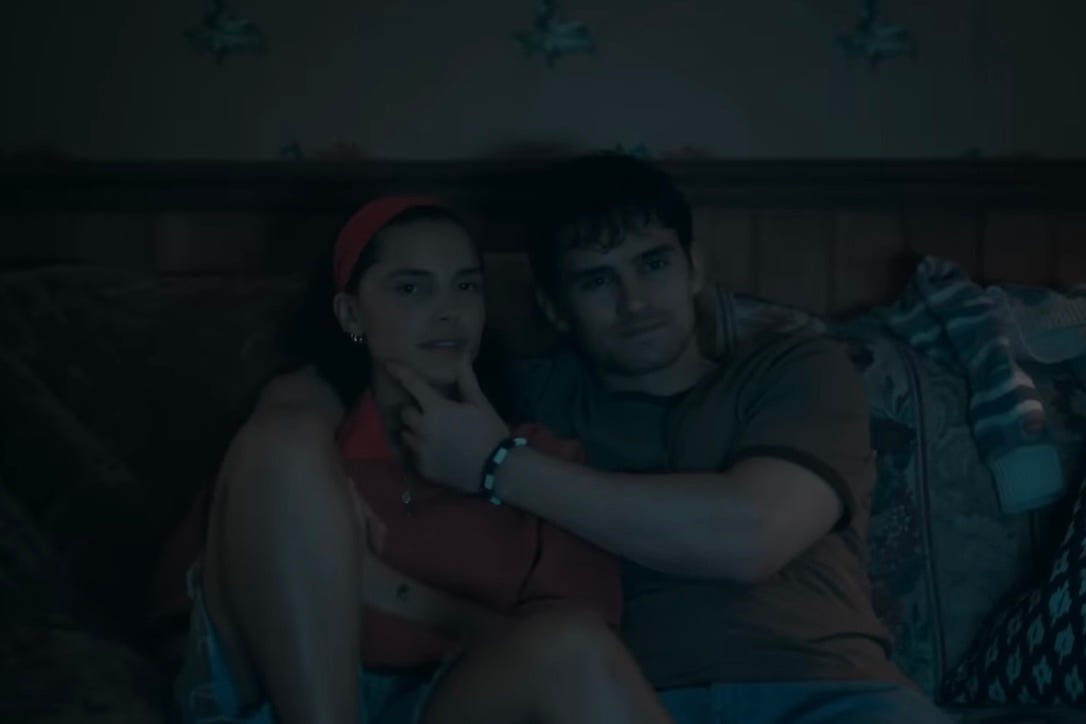
Obsession is a nifty little horror movie. Genuinely disturbing, and exhausting, it seems destined to become a midnight movie classic, if we still have that kind of thing anymore. That the film was made for a pittance (less than $1 million) and has just become the least expensive movie since 2009’s Paranormal Activity to top the box office is an obvious victory for buzzy little movies, and a hopeful sign that audience interest can still accrue somewhat naturally around a tiny film like this. Of course, it’s still 2026, so said film must almost inevitably be a horror film and some kind of conversation piece. But even as a conversation piece, and a distillation of a specific contemporary mood, Obsession makes good despite its limitations. For a few brief stretches of the film, I found myself frankly exhilarated, as I realized I was watching the rare horror film that could — for those moments — leap past the usual pressurized, claustrophobic world of contemporary horror into something unpredictable and (almost) out of control.
Which is not to say that Obsession is necessarily a great film. At its least interesting, it tends to lapse into the Ari Aster school of smoothly roving and rotating camera, alternated with an overly-controlled stasis — while director Curry Barker’s script occasionally teeters too far away from mystery into the realm of rules and explanations. It’s one of the peculiarities of contemporary “elevated horror” that so much of it has been so compactly logical at bottom, many of its key directors and writers seemingly obsessed with making the pieces of their film fit together in coherent allegories — a tendency nowhere more apparent than in Zach Cregger’s Weapons, which essentially reverse-engineered the schematicism of the usual art-horror fare until the mystery of its first half could be meticulously unveiled in its second (a strategy that worked only because Cregger managed such a giddy catharsis with his ending). We’re still not out of the woods as far as the overproduction of that vague genre goes: many horror films still struggle to balance their basic need for universal ambiguities to exploit and anxieties to plumb, with the burden of social seriousness, the expectation that the films will serve as allegories for our current cultural fixations. Yet we may just be on the way out.
What keeps Obsession from growing tiresome, as it flits around obvious buzzy contemporary themes — themes like female bodily autonomy, nice-guy cowardice, the terror of appearing cringe, general male neediness, our period’s ambient heterosexual resentment — is that it locates something universal (the nightmare of getting exactly what we desire most), while the rest emerges naturally from that central conceit. When Bear Bailey (Michael Johnston) breaks that little One-Wish Willow novelty item, wishing his friend and crush Nikki (Inde Navarrette) would love him “more than anyone in the entire world,” it happens as an offhand tag to a cringe-inducing moment that’s still essentially innocent. The way the movie manages the lurch from this innocence into immediate queasiness is skillful. It’s cut well, directed and written so the switch seems clear, while the exact effects of the switch can still remain ambiguous. The scene in which Nikki first changes — lying about her dying father, teasing, suddenly crying, acting in completely unreal ways — is a difficult scene, and a lesser film might not have managed it. Its sudden off-kilter tone sets up the best of the later scenes between Bear and Nikki, in Bear’s house, which are so thrillingly unpredictable.
To be sure, a lesser film would also not have contained a performance like Inde Navarrette’s. Plenty of critics have been rolling out Oscar-lauding superlatives — yet it’s hard to disagree with any of them. It’s clearly one of the breakthrough performances of this decade. She’s certainly aided by a script that’s intriguingly circumspect about just what’s going on with the apparently wish-possessed Nikki, allowing her to cycle through fits, overreactions, and moments of real terror with the kind of pin-drop accuracy actors love, since it gives them such a buffet of ranges to show off. Meanwhile the rest of the performances are adequate, even banal (which usually ends up working well, as a contrast), and Michael Johnston goes to some heroic lengths to convey his nice-guy everyman’s essential spinelessness. But Obsession is obviously The Inde Navarrette Show: the whole film exists as a canvas for her to run riot, and the rotating scenarios of escalating mania in Bear’s apartment — which are so galvanizing and difficult to forget — are exactly primed for the kind of heightened performance she gives.
And yet her performance elevates the film even beyond that, from the moment Nikki appears again at Bear’s door a second time, after their first bizarre night together, her shiny eyes beaming out of the darkness at him. It’s an unforgettable image, and Navarrette knows exactly how to play with and against her own uncanny beauty — there are moments where her face is itself a special effect. Occasionally the film does too much to suggest some submerged conflict between the original Nikki and her wish-made double. But the sequence on their second night together — as Nikki watches Bear sleep from the corner, moaning and crying about disliking her dreams, and moving in ways completely inhuman — is one of the eeriest and most memorable scenes I’ve ever encountered in a horror film. From there, Barker handles the escalation of the possessed Nikki’s unpredictability in ways that feel organic and dreamlike, not overly thought-through. And Navarrette lets her performance flow into the same essentially ambiguous space, which is why it works so well. There’s a real sense of control giving way to loss of control, of moments spiraling out of the normal range of human sounds or actions — frequently recalling Isabelle Adjani’s infamous performance in Andrzej Żuławski’s Possession, the bar for this kind of unhinged maximalism. There is also perhaps some debt to Lynch’s Fire Walk With Me, though more likely to the ghosts of Kiyoshi Kurosawa’s Pulse, considering the way Barker stages Navarrette in near-darkness, and tasks her with such unreal choreography. Still, for the most part, her performance (and its presentation on screen) feels authentically original.
It’s hard to criticize the look of the film. Yes, it’s made out of a familiar kind of bland digital bleariness, which makes its daytimes unreal and gray (though the nighttime camerawork makes for a richer contrast); yet a film with this small a budget is more or less bound to minimal exteriors and low-lit interiors. These days, it almost has to be cheaply digital, and that means the ubiquitous ARRI ALEXA 35 camera, which Barker and his cinematographer Taylor Clemons push to some interesting extremes. The ensuing pale, numbed-out look actually works here, tempered by the spectacular effects they get from shadow — which only complements the movie’s ambient nausea and strip-mall drabness. That it’s frequently ugly as hell actually ends up making sense of the film’s visual universe, unremittingly bleak as it is, stripped of brightness or sharp color. This is a film that undulates with an electrical and digital hum (again, a probable influence from Kurosawa, transmuted through the ubiquitous impact of David Fincher’s hyper-composed digital style): its themes of possession and heterosexual repression, and the general muted emptiness of contemporary personality, all proceed holistically out of the atmosphere and palette of the film. It’s profoundly numbing and unpleasant — and such is the point.
Many literal-minded critics are sure to insist that Obsession is “about” things like inceldom, or the male loneliness epidemic. Yet the film is really powerful insofar as it isn’t directly about these things, or even subtextually about these things: instead the film is at its most beguiling when it’s about a very basic (if pathetic) wish, and its nightmarish fulfillment, and the way this subsequently reveals the pettiness and opportunism of a certain kind of timid, self-hating young man. You could take that initial conceit — part folktale, part mid-century morality fable à la The Twilight Zone — and apply it to any time you like, and it would still serve as a solid archetypal beginning for the nightmare. Our particular time just so happens to be that of the Greater Gender Relations Upheaval — the vast antisocial mess we’re all constantly being convinced by the internet to subject each other to. So this naturally becomes one of the film’s most obvious keys (and, to be clear, the film is deliberately playing in that key — among others).
Only look at the name of the film. Not “The Obsession” or “The Obsession of Nikki” or “Bear and Nikki’s Bad Night Out” — just Obsession. The concept itself, a giant idea behind a simple word, is what the film has on its mind. And for a period like ours, abounding in categories and classifications, running amok with pseudo-therapeutic terminologies for every minute romantic anxiety — it’s certainly interesting, and timely, that one of the most memorable genre films of our moment is able to reduce all of that back down to a single essence, one universal and abstract idea, which still haunts us. It’s a great title.

Sam Jennings, The Metropolitan Review’s film critic, is an American writer living in London. He is an Associate Editor at The Hinternet, and he runs his own Substack, Vita Contemplativa. For those interested, his Letterboxd account can be found here.
 | A guest post by
|
Oh, Sam - I don’t do horror films. Why are you making me want to watch this? This is deeply unfair to us scaredy-cats.
Hah, JUST published a piece about how this movie is subtextually about the male loneliness epidemic and inceldom ;)
I like your take on this movie looking bleak and drab, and while that could be due to a lack of budget, it's also possible that it is completely intentional as it conveys the story better.