


A good New York City summer is filled with music. I sit backstage in the green room, supporting my closest friend as they prepare to go onstage. Another act, a popular young DJ, is being interviewed by the venue’s social media team. He pauses to seek assurance from the crew looking on that there will be plenty of zero-proof Heinekens available during his set. Someone confirms, and I’m instantly curious.
“Those beers are pretty good.” I interrupt his interview to begin my own.
“Totally. We’ve been sober for six months now. It’s the most connected we’ve ever felt.” He gestures toward his beautiful girlfriend, who nods enthusiastically. No one in the room seems remotely surprised.
I offer a laudatory word and tell them that I don’t drink either.
“Well, that’s much cooler.”
The memory of Sinatra’s jazzy New York and its smoke-filled hideaways was once tantalizingly accompanied by the burn of Jack Daniel’s, ice cube clinking in the cup; bringing a Vesper martini to beautiful lips summoned the charged sexual energy of a rogue spy. A bit of damage, to survive some soft self-destruction, was sexy, even spiritual. But New Yorkers are drinking less and less. Sobriety has become a new status symbol, a badge of adaptogen-infused “cool.”
Most popular restaurants and bars in the city now have major menu real estate dedicated to cutesy “mocktails” — the Phony Negroni, the Not-So-Mule, the Faux-Jito — the kind of names one prefers to order under their breath. At the Odeon, I ask for the Virgin Mary with three green olives like I’m whispering a prayer. Owing in large part to a decline in alcohol sales, establishments in the city are shuttering, and new alcohol-free venues, like Carl Radke’s Soft Bar + Cafe, are popping up. The New York Times’ Alex Vadukul writes that city dwellers “seem to grouse about the closing of old restaurants and bars more than ever.”
Even young celebrities — whose glamorous lifestyle one could be forgiven for associating with indulgence — have dropped the chalice. Tom Holland’s Bero and Bella Hadid’s Kin are part of the new wave of zero-proof drinks meant to be enjoyed during a guilt-free night on the town. At $39 per eight-pack of Kin, one can buy into the elevated, fashion-model-filled world of this health-conscious alternative. It’s a “sparkling, herbaceous blend of bright ginger, orange bitters, hibiscus, and citrus” that will “ease you into a higher state.”
Disillusioned by the morning after one too many G&Ts when my brain serves as both judge and condemned — replaying my own perceived shortcomings and sins for a jury existing only in the mind — I too have stopped drinking. “First you take a drink,” F. Scott Fitzgerald has been quoted as saying, “then the drink takes a drink, then the drink takes you.” But the trend cannot simply be chalked up to a reckoning with one’s depressive hangovers. And if economic expense were the sole barrier, sales of celebrity-backed non-alcoholic cans wouldn’t be soaring.
In a viral Apple Music interview with Zane Lowe, Miley Cyrus said that sobriety “is like my God.” Each day sober becomes a small win as the tally increases, a victory on the liturgical calendar, borne of a similar impulse driving the popularity of bio-tracking jewelry and running clubs. We seek a sort of purifying organizing principle, and so we call the drink “virgin.” But it’s a theology without grace. One drink, and the devotee must begin the count anew. Those stakes are part of the point — we fight to draw closer to something divine. We’re a spiritually hungry culture that now prefers David Lowery’s Mother Mary and Rosalía’s saintly album Lux to Britney and Tarantino. “I hunger and thirst after true righteousness,” Amanda Seyfried’s character, a Shaker, sings in Mona Fastvold’s latest film, The Testament of Ann Lee.
There was once a sort of curious shame around professing one’s sobriety, because addiction was not a disease, but a character defect. An image of the down-on-their-luck miscreant in the street was called to mind, or a cruel 2000s tabloid image depicting Lindsay or Paris as badly behaved and “back to rehab!” An inability to handle one’s liquor and enjoy the “good life” was their own moral failure — alcohol has long been a symbol where sex appeal meets celebration and reprieve, a coming-of-age birthright. Our cultural inheritance is awash in these images: George Clooney riding his motorcycle down a rogue dirt road in an ad for Casamigos; model Milla Jovovich as the face of Johnnie Walker. There’s a renegade masculinity that comes with bellying up to the Polo Bar and ordering an Old Fashioned, a deep romanticism to dining in Il Buco’s cellar and uncorking the first vintage bottle.
Yet there’s an emerging sense that it’s not the late night out that holds the appeal, but the phoning it in early after a $14 can of Bero in order to make the 6 a.m. hot yoga class. Holding a conspicuously expensive, non-alcoholic drink at the party signals an aesthetic of elevation, the posh renunciation of the secular sin of toxins. The cleanliness of the inner landscape remains, perhaps, the last domain within one’s control. If one cannot govern the world, they still may govern themself — for a price.
After two glasses of wine this spring, his first drink in over a year, a famous lifestyle podcaster tells an audience of millions that his sleep score was ruined. His life was shot to hell “for three days.” This lapse was, to him, catastrophic, and only through public self-flagellation could order be restored. (The podcaster is not in recovery; he is sober for reasons related to health and productivity.) The increasingly large crop of sobriety influencers was quick to repost the clip of the tangent — “[sobriety] was the greatest gift of my career,” one messaged me. I empathize, but the podcaster’s reaction feels disproportionate to the act itself. A rise in health consciousness, a newfangled obsession with quantifying one’s biological metrics married to the capitalistic instinct to optimize, cannot really be the sole culprit of this attitudinal shift and its unforgiving intensity.
Our movies, music videos, and magazines taught us that to be desirable was to emerge from the taxi at dawn with mascara under the eyes. Beautiful unraveling — cigarettes and booze, Kate Moss’ 4 a.m. chaos, Ke$ha’s music video bathtub blackouts — was the culture’s aesthetic of cool. While at Gucci, Tom Ford preferred his models looking hungover. There was a freedom to this way of being in the world, a sexy, anti-establishment irreverence. Even the tortured writers who drowned themselves in alcohol — Hemingway, Edgar Allan Poe, Dorothy Parker — were alluring because of their vices, not in spite of them, as if the Muses could only be expected to bang on the doors of the sick and suffering.
What we decide is cool is so often a countercultural kick in the guise of innovative thinking. The idolized addict can’t be cool when everyone is addicted — to a drink, to a feed, to a fantasy, to a feeling. In self-mastery, one paradoxically becomes the rebel. Every sip, each excess, spells failure.
For months, I would roll over each morning and check my sleep stats, right before the torrent of baffling news alerts on the screen impinged upon consciousness. I’d vow to be a better woman with better numbers, and I’d contour my life around this promise. A high Oura score and green detox juice, glassy, glowing skin, the Pure Barre body, the minimalist gym temple, the Kin, speak the coveted language of self-possession. Sobriety is a chic shorthand for composure and spiritual maturity. There is a seduction in the discipline of refusing excess, a sacred weight to this proclamation of abstinence as ritual that cannot be reduced to the latest instantiation in the quest to better commodify the self.
I will not be the first to tell you the world is ravaged by crisis, war after war, threat after uncontrollable threat, all unfolding against the backdrop of the slow torture that is an awareness of the impending climate collapse. Tending to one’s emotional life is suddenly a feat of endurance, and one must monitor their inner sanctity vigilantly. There is nowhere else to turn.
Putting our human appetites on display — imbibing the anesthetics of drink, of sex, of food — feels like exposure, and sobriety is the one refusal still on offer (if you have the force of will). And that refusal, even for a young DJ playing a drugged-out Brooklyn festival deep into the summer night, feels like the coolest thing to do. Neither the Saint nor the singer betrays their hunger, though they’re the hungriest of all.
Several “quit lit” books are now populating the space, tracing a path even for those not in recovery and driving home the thesis that we will be better, more forward-looking artists in sobriety. If we’re strong enough to stay clean, we will be armed with a new vision with which to tap into the Spirit, to rigidly distinguish the sacred from the profane, and it begins with what we imbibe. When I sip my first Elton John Zero sparkling wine (launching in the U.S. very soon), I hope to feel divinely inspired — even if Elton may simply be capitalizing on the feeling in the air tonight, as it were.
America doesn’t appreciate moderation in any form, so it ricochets between Prohibition and the fraternity basement, glut and excess. Perhaps this moment will allow room for a reconsideration of our relationship with the substance — our inability to treat it as rite rather than anesthesia, or else shun it outright — as a symptom of something deeper.
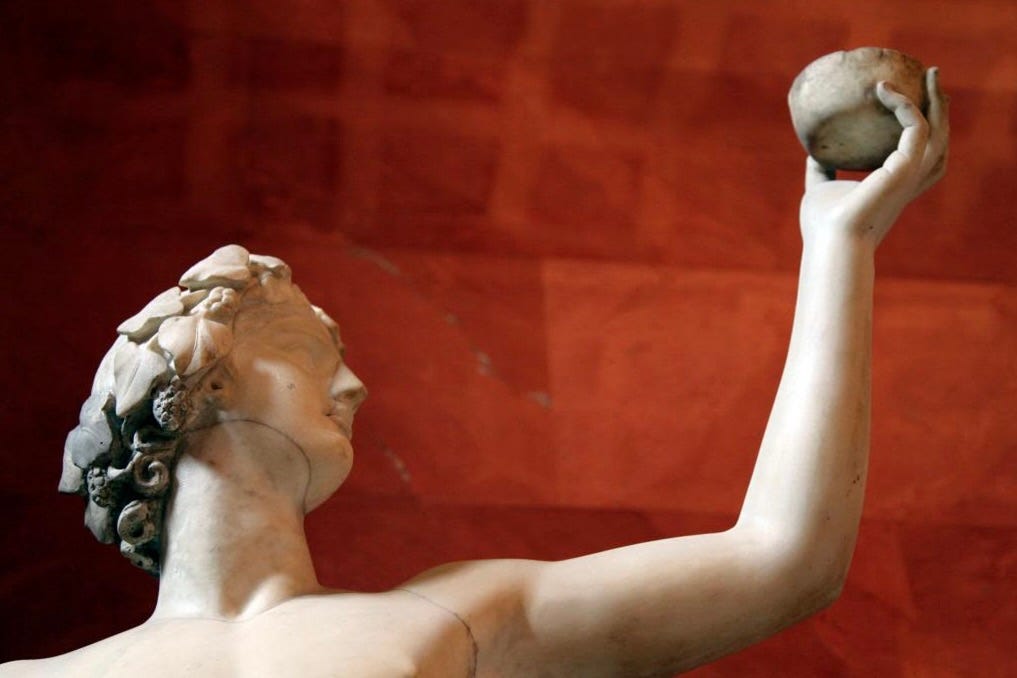
In our haste to surrender ourselves completely to the regimented Apollonian, we forget that Dionysus was never merely the god of wine. He was the god of ecstasy, theater, transformation, and sacred disorder. The god of music.
The ancients understood that sometimes we needed to go mad to ensure we kept our sanity. To fall down once did not mean to shatter, but to be reborn. Somewhere along the way, we kept the chaos and lost the ritual.

Savannah (“Sav”) Huitema is a New York City-based writer, attorney, and fashion model. She serves as Style Critic at The Metropolitan Review.
 | A guest post by
|
“America doesn’t appreciate moderation in any form, so it ricochets between Prohibition and the fraternity basement, glut and excess. Perhaps this moment will allow room for a reconsideration of our relationship with the substance — our inability to treat it as rite rather than anesthesia, or else shun it outright — as a symptom of something deeper.”
My fav quote. You’re an inspiration and rockstar, Sav
Is there a name for the excess of moral virtue? Perhaps it too will be discovered to be addictive, a disease.