


I came to Aymann Ismail’s memoir Becoming Baba eagerly, not only because I’ve been writing about fatherhood for many years, but also because one of the great surprises of my 2025 was a personal exploration of Islam. It’s a courageous book, and it satisfies on both counts. But its enduring influence, if it has one, will lie more in its discussion of faith.
It’s hard to know where the story of fatherhood begins. Is it at the moment a pregnancy test comes back positive? The moment of birth? Or further back, when the foundational layers of masculine identity are laid?
Ismail wisely begins with his parents’ formative influences as guides that he resists as a child and then struggles to emulate as an adult. Raised in Newark by Egyptian immigrants, Ismail code-switches between the Islamic school he attends and the gritty urban culture beyond his family’s protective shield. It isn’t just that he wants to fit in as an American, he also questions rules that seem arbitrary or overly punitive.
In one case, a harmless game of MASH (Mansion, Apartment, Shack, House), in which children predict which celebrities they’ll marry, lands the young Aymann in the principal’s office under the false charge of playing boyfriend/girlfriend (dating is forbidden in Islam). The principal brandishes a pair of sharp scissors, threatening to cut out his tongue if he doesn’t use it more responsibly. In another case, he is punished for speaking to a girl who forgot her lunchbox in a classroom. When he swears in frustration, Ismail’s teacher throws him against the door and later expels him from class.
“The people in charge had revealed themselves to be even more childish than the students,” he writes. “I saw no point in following rules that only led to more punishment.”
Examples like these serve as important benchmarks for how he later approaches discipline as a father.
While Ismail respects his parents’ traditional practice of Islam, it often seems puppet-like to him. As a young person, he wants authenticity more than anything, and he chases it in art, illegally photographing graffiti in the NYC subway and once even climbing the beams on the Williamsburg Bridge for a few risky shots of the city. He is proud to be Arab, proud to be Egyptian, even proud to be Muslim, but he carries a deep-seated guilt for not loving his faith the way his parents wish he would.
This inner tension remains unresolved when he meets Mira, another child of Egyptian immigrants. Mira knows the Quran inside and out, but she does not wear the hijab, and Ismail is shocked when she takes a hit of his roommate’s joint. Their relationship quickly moves from friendship to courtship, including a formal engagement with her family in Kentucky, when Mira’s father asks Aymann to lead the Maghrib prayer. It’s been so long since he’s prayed that Aymann stumbles his way through, forgetting how to close the ritual. Despite his embarrassment, he finds Mira’s family forgiving and he feels a rekindled desire to embrace faith genuinely.
Ismail’s own Baba reminds him that children follow the example they are given: if he is lazy with his faith, his kids will be, too. But America isn’t friendly to families. The steady demands of work, coparenting, and schedules indifferent to the salah (the five daily prayers) constantly get in the way. Mira keeps up with her prayers, but Aymann does not, and he carries guilt and defiance within him.
Becoming Baba captures the paradox of American identity. Part of Ismail is unshakably Egyptian and his earliest memories include playing with other boys at the mosque after the Friday prayer. Yet he is also a tough Newark kid, comfortable on the streets and ready to rebel at the slightest provocation. He doesn’t follow orders just because someone in authority has said so. And he is not going to pray, even though he knows all the words, if his heart isn’t in it.
That conflict resolves in one of the most touching scenes of the book. Aymann and Mira take the edge off a stressful day with the kids by sharing a cannabis gummy. The effects last a few hours and Aymann still feels high when Mira invites him to join her for the Maghrib prayer. The Quran forbids praying while under the influence, but Aymann decides to join Mira anyway. Surprisingly, he feels more present than he ever has.
“For so long,” he writes, “I had carried a sense of disconnect from Islam, as though it were a tradition I’d inherited but never fully internalized. That night, the act of prayer wasn’t about circumstances or perfection — it was about showing up, imperfections and all, and finding a way to connect.”
This was a brave book to write. I’ve browsed the reviews and several readers take Ismail to task for his haram choices and the shade he casts on his parents. They seem to miss the fact that it was judgment that pushed the young Aymann away from his faith.
Becoming Baba does not suggest that “anything goes” or that precision doesn’t matter in practicing Islam. The book is a bridge between cultures and generations, an invitation to anyone (including me, a newcomer to faith) to come as they are, questions and flaws intact, to emphasize mercy over judgment even in your view of yourself. In that sense the book is a balm for our time. It resists tribalism, refuses to be shoved into a cultural or political box, and opens a space for other fathers to wrestle openly with what parenthood means.
It is also a young man’s book. Some of Ismail’s jokes about smashing patriarchy fall flat. In one case, he makes far too much of teaching himself how to make mashed potatoes. But there are many touching moments, such as the feeling that his infant son Musa protects him while he pushes his stroller through the rough Newark streets. A good memoir resolves its opening tensions, and Ismail shows how his children soften him, coaxing love and gentleness from his wild urban heart.
Perhaps the most moving scene is when Ismail invites his father to join him and Musa for the Friday Jummah prayer. In place of his characteristic brusqueness and disapproval, the elder Baba says, simply, “Good idea.” It becomes a weekly ritual for the three of them and an image that brings the book’s title home.
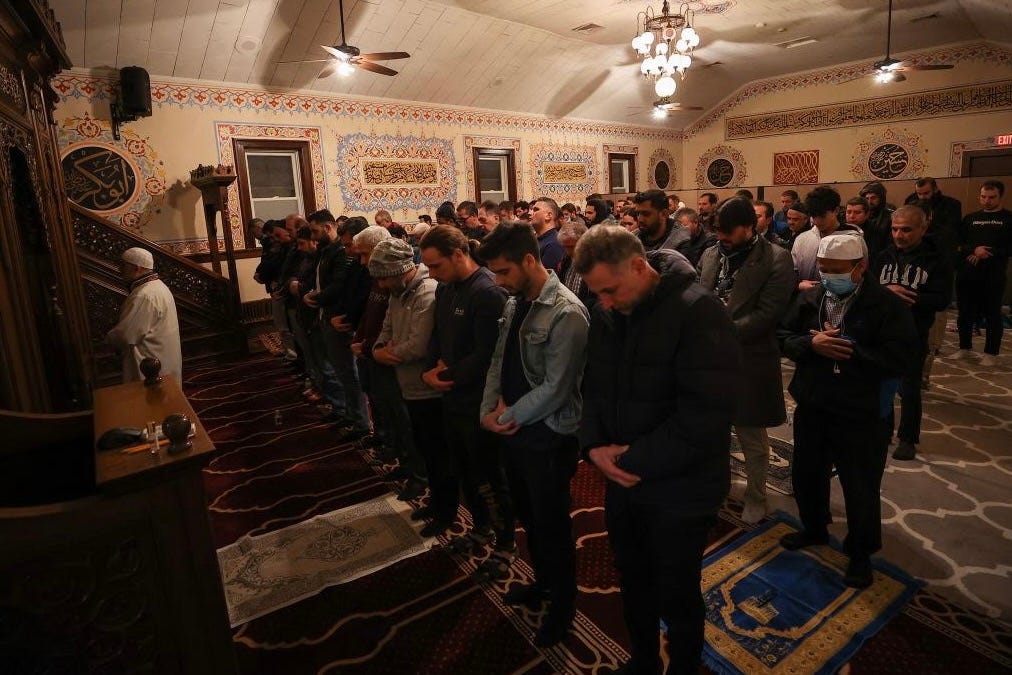
They attend the same mosque where the young Aymann played. Only now it’s his son climbing on him while he bows, his own mini-me chasing the other boys around the room after the prayer. He isn’t the man his own father was, but who is? Their weekly reunion is an act of mercy on both sides, one that allows Ismail to fully inhabit his role, to become a baba himself.
It’s a story that every father and son, and every sister and mother, should read.

Joshua Doležal is a book coach and editor. He is the author of a memoir, “Down from the Mountaintop: From Belief to Belonging,” and a poetry collection, “Someday Johnson Creek.” He also writes “The Recovering Academic.”
 | A guest post by
|
I bought the book after our chat about it a few months ago but just haven't had a chance to read it yet.
The over the top strictness that crosses the line into harshness really saddens me. Throwing a kid against the door for swearing? I think that we have a problem culturally where we misunderstand our faith, and we overexaggerate the focus on certain rules vs. the actual biggest principles within it (worship of one God, justice, dignity, etc). It's sad because the people who do this are the most "committed" to the faith and therefore the loudest voices, but are certainly not the best representatives of it, and, as you described so well in the piece, have the negative impact of pushing other people away.
I am glad he managed to reconcile his own personal position, and it's so sweet that the ending of the book has him come back to the same mosque his Baba used to take him, but with both his dad and his son. I hope he's able to pass along a softer, kinder impression of the faith to his kid than what was passed down to him, although I know that no matter what, our kids will always have some scarring from us. It's basically impossible to avoid.
So many more thoughts on this one: the story of the Bedouin man who came into the Prophet's mosque and urinated and the companions wanted to beat him up or drag him out and the Prophet told them to calm down, the story of the Prophet telling his wife Aisha that God is gentle and loves gentleness... I just... I wonder where all the harshness came from when he only preached gentleness? I mean, I know part of the answer: decades and centuries under colonialism and subjugation have an enormous impact.